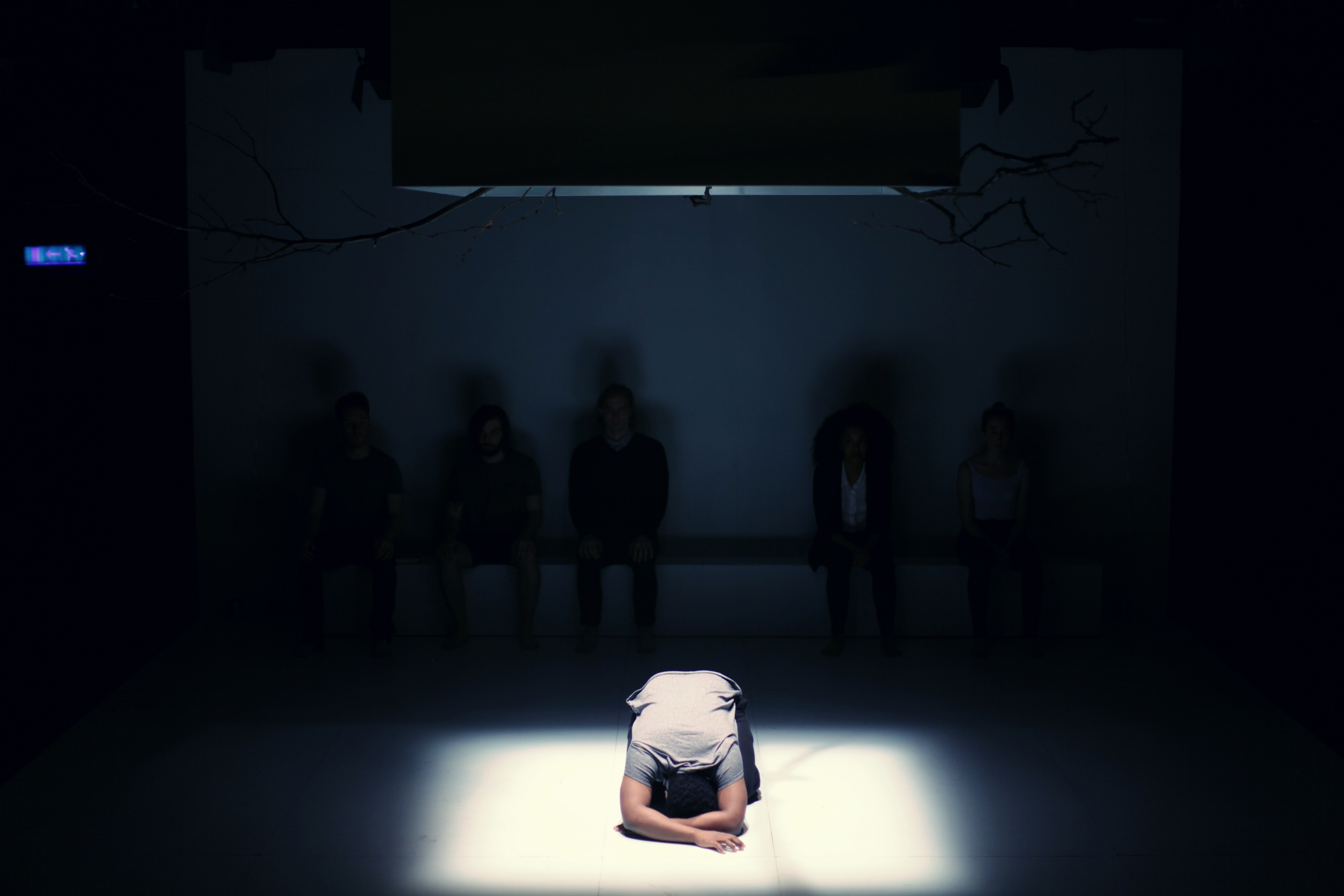
Review: HerStory 4 at Theatre N16

Guest review by Jemima Frankel

What might you expect from a feminist theatre festival at a small fringe theatre in Balham, in June 2017? What issues, events, people, stereotypes – laws, even – might compel feminist theatre makers to, well, make theatre right now? The more cynical amongst us might expect a hipster-infused horde of angry, “snowflake” millenials shouting loudly about the “pale stale male”.  What they would find, however, is a potent and welcome remedy to such limiting cynicism. HerStory, founded by Nastazja Somers, was born out of frustration at the repetitive, singular storyline of female characters in theatre and wider society. She invites feminists to perform work that platforms the untold stories – the real faces of intersectionality – that are so routinely trampled over in the charge for more palatable voices. HerStory does not just demand our attention; it grabs it, with consent, by the pussy.

The second of two nights at HerStory 4 (the big sister of the HerStorys 1, 2 and 3 in preceding years) was a showcase of eight richly varied solo performances. We heard the female voice on topical issues such as abortion, domestic abuse, child rape, LGBTQ issues, sexual harassment, social media, war and… Iranian mothers. What shot through the hurt, the anger, the raw and gutting sadness of several of these stories was the resounding support buzzing from the audience. Huge cheers, belly laughs and tenterhooked-gasps filled the air – testament, of course, to the quality of the performers who took to the stage.

As expected, some of the work made emotional viewing. Dannie-Lu Carr’s Just Another C*nt told the incredibly moving story of a toxic relationship with an alcoholic man who encouraged an abortion. The Twilight Zone by Suzy Gill tackles cultural discrimination and homophobia, as a young woman’s Muslim girlfriend is called away again to fight for the American army in Iraq. In one of Tolu Agbelusi’s powerful spoken word performances she spoke of the rape of a seven-year-old girl at the grabbing, angry hands of two young boys. In Mission Abort, directed by Claire Stone and performed by Therese Ramstedt, the Pro-Life words of Donald Trump – “there must be some form of punishment” – seared through the graphic re-enactment of a painful and intrusive abortion. The audience was left open-mouthed and wide-eyed, shocked into reflective silence before roaring applause acknowledged the bravery and resilience of these women.

Humour rippled in welcome and powerful moments through the evening. Amanda Holiday’s The Art Poems took artworks by diverse female painters as the inspiration for witty words, and the ridicule at the price of a handbag (that she will use as a hat, thank you very much). Social Media Suicide by Clare McCall showed us the behind-the-scenes of a very special, perfectly set up, live streamed 27th birthday party, at which she – for the benefit of you lucky viewers – was going to kill herself after much cam-girl style foreplay. The show goes out, quite literally, with a bang as the likes come rolling in. Shahbanu brilliantly performed by Lydia Bakelmun (and written, directed and produced by Melina Namdar, Anna Jeary and Penny Babakhani) revisits the childhood of a girl raised in London to an overbearing Iranian mother and English father. In the nostalgic tales of Iranian princes and (always – eye roll) beautiful princesses, we unravel the feeling of loss, displacement and desperate need to reconnect to heritage and culture. Roxanne Carney’s I’m the Hero of This Story tickled the audience with Tinder one-liners and the jaw-dropping realisation that these were lifted from real conversations with real men, probably within about five miles of you.

The Museum of Women, the poignant closing poem of Tolu Agbulesi’s set, speaks of the great women “quietly shaping” her. “This body is a monument of many women; I was not built alone,” she speaks; a perfect beacon of support and solidarity that resonated with the diverse mix of men and women in the audience. As the audience left chattering and tweeting, I was reminded once again of the power of performance – if not as a way to change the world, then as a way to get the conversation well and truly started.

Follow @HerstoryFTF for details of upcoming events and performances, as they move to a more central London location.


Can’t see the map on iPhone? Try turning your phone to landscape and that should sort it. I don’t know why but I’m working on it… 😉

Review: Kiss Me at Trafalgar Studios

Most single women have at some point bemoaned the lack of decent men. That throwaway line is put into sobering perspective in Richard Bean’s Kiss Me, where it’s quite literally true. It’s 1929, and Stephanie (not her real name) is a 32-year-old widow who wants a baby. Faced with a male population that’s been tragically depleted by World War 1, she finds herself forced to take an unconventional path. Enter Dennis (not his real name), a father-for-hire employed by the mysterious Dr Trollop, who by all accounts is extremely good at his job – as long as he stays within the parameters. That means no kissing on the lips, no real names, no sharing of any personal information, and definitely no second meetings.

Photo credit: Robert Day

Within minutes, we find ourselves drawn into a scenario that has the potential to be both very funny and horribly sad – and Kiss Me delivers on both fronts. This intense two-hander unfolds in Stephanie’s bedroom, with a mirrored back wall that brings the audience right into the heart of the action and makes us privy to every intimate detail of her life and loves. She’s a modern woman who smokes and drives a munitions lorry, and has no qualms about speaking her mind or standing up for her rights. In fact she seems incapable of holding anything back, even when she tries; in a powerful performance, Claire Lams reveals just as much in Stephanie’s pensive, silent moments as she does with all her character’s nervous chatter.

In contrast, Ben Lloyd-Hughes’ Dennis is a stickler for propriety, yet not without passion; he’s a soldier on his own personal mission, driven by an intense guilt over having survived the war when so many others didn’t. We never see him enter the room; the lights go up on each scene and there he is (director Anna Ledwich describes him gleefully in her programme notes as “seemingly summoned like a sex genie”). His speech, unlike Stephanie’s, is slow and considered, and where she resorts often to humour as a means of self-defence, he seems to hardly know what a joke is. They’re total opposites, yet somehow fit together perfectly (in a nice touch, he often finishes her sentences when the right word escapes her), and it’s no surprise when their initial encounter leads to something more, however doomed their relationship may feel from the start.

Photo credit: Robert Day

The chemistry between the two characters is as believable as it is surprising, and the desperate, relatable human desires that drive each of them toward the other make them easy to invest in emotionally; the play’s final revelation drew shocked gasps from more than one audience member. This does come with a side effect, though: because we can so easily relate to the characters, some of the more intimate scenes become quite awkward to watch – Stephanie’s own discomfort during her first meeting with Dennis is infectious, and her later willingness to chat at length about her clitoris equally disconcerting. (For different reasons, it’s also hard not to be taken aback by the use of the term “minger” to describe an unattractive woman – despite the hasty explanation that it’s an old Scottish word.)

The play’s conclusion is unexpectedly intriguing; we’re left with a good deal of unanswered questions about the future and the past for both characters, and still without a complete understanding of their motivations. This hint that the story may not be quite over is rather comforting, despite the frustrating knowledge that we’ll never know for sure what lies ahead.

Funny, poignant and offering a fresh perspective on the horrors of war, Kiss Me features two excellent performances and has an emotional and, to a certain degree, political heart that’s as relevant today as it would have been in 1929 – perhaps even more so.


Can’t see the map on iPhone? Try turning your phone to landscape and that should sort it. I don’t know why but I’m working on it… 😉

Interview: Alice McCarthy, Rotterdam

The two years since Rotterdam‘s critically acclaimed debut run at Theatre 503 have been eventful, to say the least. Jon Brittain’s bittersweet comedy about gender and sexuality, directed by Donnacadh O’Briain, not only transferred to Trafalgar Studios and enjoyed a sell-out run in New York; it also won the 2017 Olivier Award for Outstanding Achievement in an Affiliate Theatre. And this month the fairy tale continues with a further London transfer, this time to the Arts Theatre, where the play will run from 21st June to 15th July.

Rotterdam is a warm, hilarious, appalling and devastating firecracker of a story, with a simple human love story at its heart,” explains Alice McCarthy, an original cast member returning once again to the role of Alice – who’s about to finally come out as a lesbian when her girlfriend announces she wants to start living as a man. As Fiona begins the transition to life as Adrian, Alice is left wondering if this means she’s now straight…

Photo credit: Piers Foley Photography

Alice is joined by Anna Martine Freeman and Ed Eales-White, who also reprise their roles in the play, along with newcomer Ellie Morris, taking over from Jessica Clark as Alice’s free-spirited colleague Lelani. “It’s very exciting, of course, to be able to sit with a character for two years,” says Alice. “Relationships change and deepen, and I am discovering new sides to Alice all the time. Reuniting with the team is always fantastic and means that these long relationships between our characters now make more sense, as we do actually know each other better! Also, Lelani is now played by the lovely Ellie Morris, which has meant new colours and an exciting opportunity to look at all those scenes in a fresh light.”

Jon Brittain wrote Rotterdam after a couple of his friends transitioned in the late 2000s, and he decided to address the absence of transgender stories in pop culture. Despite this, Alice believes what makes the play interesting is that it avoids didacticism: “It in no way seeks to comment on the whole trans-experience but simply tells the story of a group of specific individuals dealing with a unique set of problems. It’s certainly a queer love story, which is of course important, but it is still essentially just a love story. In this way it’s accessible to all and invites the audience to view Alice and Adrian as no different from themselves. I hope that audiences will leave moved, laughed out and feeling like they have got to know four individuals intimately. The best responses are also when we change people a bit!”

And what does she feel is the secret to the play’s success? “I think it’s because Jon has written such specifically human and well-rounded people. There’s an element of the play that allows the audience to become voyeurs, and so they leave feeling close to the characters and wanting to know what happens to them next. A few audience members have come straight up to me and said, ‘What happens to Alice?! We want to know- make a series!'”

Photo credit: Piers Foley Photography

Alice and the team are just back from their sell-out run at 59E59 Theaters in New York as part of the Brits Off-Broadway Festival, where the play’s reception was different but no less enthusiastic. “I think New York audiences are certainly more earnest,” says Alice. “There is an element of taking everything seriously. I think maybe UK audiences are more comfortable with a mix of irreverence and comedy in the tragic, whereas our U.S. audiences have seemed to enjoy the drama side of Rotterdam more. It’s certainly been fascinating to see how plays are so changeable dependent on the temperature of the audience and their expectations. We are lucky though, as our audience’s responses have been just as warm and ecstatic as back home.”

It’s not just audiences who can learn something from this play; Alice has also benefited personally from being a part of the Rotterdam story. “I’ve gained so, so much,” she reveals. “It’s my first lead role after drama school and so on a professional level it’s been my training ground and a huge learning curve. Also, it’s been such a privilege to learn about trans-issues, and for me more specifically, about the partners of transitioning people. I now feel equipped to enter the world as a well-informed trans-ally!”

Book now for Rotterdam at the Arts Theatre from 21st June-15th July.

Review: The Last Ones at Jermyn Street Theatre

Guest review by Lucrezia Pollice

The wonders of human behaviour will never fail to inspire. Politics, domestics and history are all intertwined. In The Last Ones the Russian playwright Gorky, knowingly admired by Chekov, creates an honest tableau of life, power, conflict, love and devastation.

The play is set in the bloody aftermath of the 1905 revolution but focuses on the struggles of a corrupt tsarist police chief named Ivan Kolomiitsev and his family. After a failed assassination and unjust accusation, the family is left in utter confusion, not knowing who to trust nor what to believe. The father’s gambling, drinking and affairs waste away all their money, and the family is forced to take refuge at wealthy Uncle Yakov’s house.

Photo credit: Scott Rylander

The play asks us: do we really know each other? How can one come to terms with their father, husband, brother, lover being wrong? Looking into the life of a despised and hated man – we grow affectionate to his family and begin to unpeel the layers and grey areas present in the human body. Conveying these grey areas – evil is not absolute, it is not binary nor concrete.

It is not an easy play; character journeys are very weaved together and are slightly difficult to follow. Ivan, played by Daragh O’Malley and Sonia, played by Louise Gold, have five children: Alexander, Peter, Nadia, Vera, Lyubov. Some of the children follow the father’s footsteps into corruption, greed, alcoholism and gambling, whilst the younger ones are faced with many questions. The latter, Lyubov, is damned for being “crippled” by Ivan, who she discovers in the play is actually not her biological father. This is not news to the family as Ivan’s brother Yakov, played by Tim Woodward, and Sonia’s old love affair is not as secret as they would hope.

Ivan is attempting to bribe his way back into the police force and regain his power. However, power has a price. Peter and Vera begin to learn the truth about their father when a young man, a revolutionary, explains to him the facts. Then the mother of the innocent child incarcerated for Ivan’s assassination comes to the house to speak to Sonia, and things begin to unravel. Conflict increases throughout to finally culminate in a desolate open-ended finale, in which corruption and evil triumph over the rest.

Photo credit: Scott Rylander

Anthony Biggs’ production is intense and moving at times. The set, designed by Cecilia Trono, is simple, but appropriate to the atmosphere created. The performances fluctuate between moments of truthfulness and other slightly weaker moments, although the show kept my attention throughout and moved me with its passionate honesty. It is a play about people, the human body and mind. We too often forget the importance of focusing on the reasons and objectives behind our actions. The Last Ones brings them to the forefront, putting us face to face with difficult questions. What would you have done in their position?


Can’t see the map on iPhone? Try turning your phone to landscape and that should sort it. I don’t know why but I’m working on it… 😉

Review: The Enchanted at The Bunker

If you had to think of a word to describe death row, what would it be? Dark, perhaps. Hopeless. Desperate. Whatever word first comes to mind, probably one of the last would be enchanted. Yet this is how Pharmacy Theatre’s haunting play begins, as a death row inmate describes his surroundings in language so poetic and beautiful it seems impossible he could be talking about a prison where men and women who are despised and forgotten by society go to die.

Photo credit: Dina T

This is just one example from the play of how hope and redemption can be found in even the darkest of places… or people. The Enchanted – both the play and Rene Denfeld’s novel on which it’s based – tackles head on the assumptions we in the free world make daily about death row: everyone there is evil; they feel no love or remorse; they deserve to be where they are, and can have nothing to offer the world but more pain. It does this without making excuses or painting an unrealistically rosy picture: the two prisoners in the play are guilty men who’ve done terrible things, the full details of which – thankfully – we never learn. What’s more important is not what they’ve done, but why; at the play’s heart is a desperate need to understand, and as the actors scrawl words and images on the walls and floor in chalk, the set begins to resemble a big mind map trying to make sense of a huge and complex problem.

Condensing the multiple complex strands of the novel into 90 minutes, Joanna and Connie Treves’ skilful adaptation is narrated by Arden, a prisoner whose crimes are so terrible that nobody – not even other killers – ever speaks of them. In a spellbinding performance, Corey Montague-Sholay plays this character with an intense vulnerability that’s at odds with his role as murderer; every movement, gesture and facial expression, his childlike love of books and his poetic use of language to escape the confines of his world cry out to us that this is not an evil man, but rather one who’s been broken by life.

Perhaps more in keeping with our imagined idea of a death row inmate is York (Hunter Bishop), the man in the cell next door. Unpredictable, unstable and unkempt, all restless energy and crazy eyes, he’s done the unthinkable: given up on his appeals and decided he wants to die. The only person now standing between him and execution is The Lady (Jade Ogugua), an investigator who’s become a symbol of hope for everyone on the row. As she delves into York’s past, she uncovers a horrific tale of abuse and neglect – hauntingly portrayed by puppets, as if in a therapist’s office – that explains how he ended up a killer. But can she convince him to live – and is that even her ultimate goal, or does she have some other motivation for her tireless efforts to get inside the mind of a murderer?

Photo credit: Dina T

What comes across so well in the performance, movement (directed by Emily Orme) and language of all the actors is a deep sadness and sense of collective responsibility – not just from those who’ve committed crimes, but also from those around them, who failed to hear or react to their cries for help as they set off down the dark path that ends on death row. While in no way diminishing the responsibility of the individual for their own actions, the play makes it clear that society must take some of the blame; otherwise how can we ever hope to stop such crimes from happening?

Just as in life, there are no easy answers or neat endings in this dark and gripping tale – to suggest there are would be overly simplistic. The Enchanted isn’t a political drama but an urgent human one, shining a light on a world most of us can’t even imagine, and forcing us to confront and accept the flawed and forgotten humanity of those within it, before they run out of time.


Can’t see the map on iPhone? Try turning your phone to landscape and that should sort it. I don’t know why but I’m working on it… 😉