Review: Mumburger at Old Red Lion Theatre

First, a word of warning: don’t go and see Mumburger on an empty stomach. It’s all kinds of confusing.

Now that we’ve got that out the way, let’s discuss Sarah Kosar’s play. Andrea just died in a horrific car accident on the M25, leaving behind her devastated daughter Tiffany (Rosie Wyatt, reprising her Offie-nominated role) and husband Hugh (Andrew Frame). What begins as a seemingly straightforward story of two people struggling to process their grief in very different ways (she’s made a Google spreadsheet and is looking at urns on Amazon; he just wants to read the messages of condolence on Facebook and watch his wife’s favourite movie) takes a surreal and grisly turn when a mysterious delivery arrives. Inside the greasy bag are burgers – an odd enough sight in a house of committed vegans, even before we learn that they’re in fact a “Digestive Memorial” arranged by Andrea as a way to sustain her family after she’s gone.

Photo credit: Lidia Crisafulli

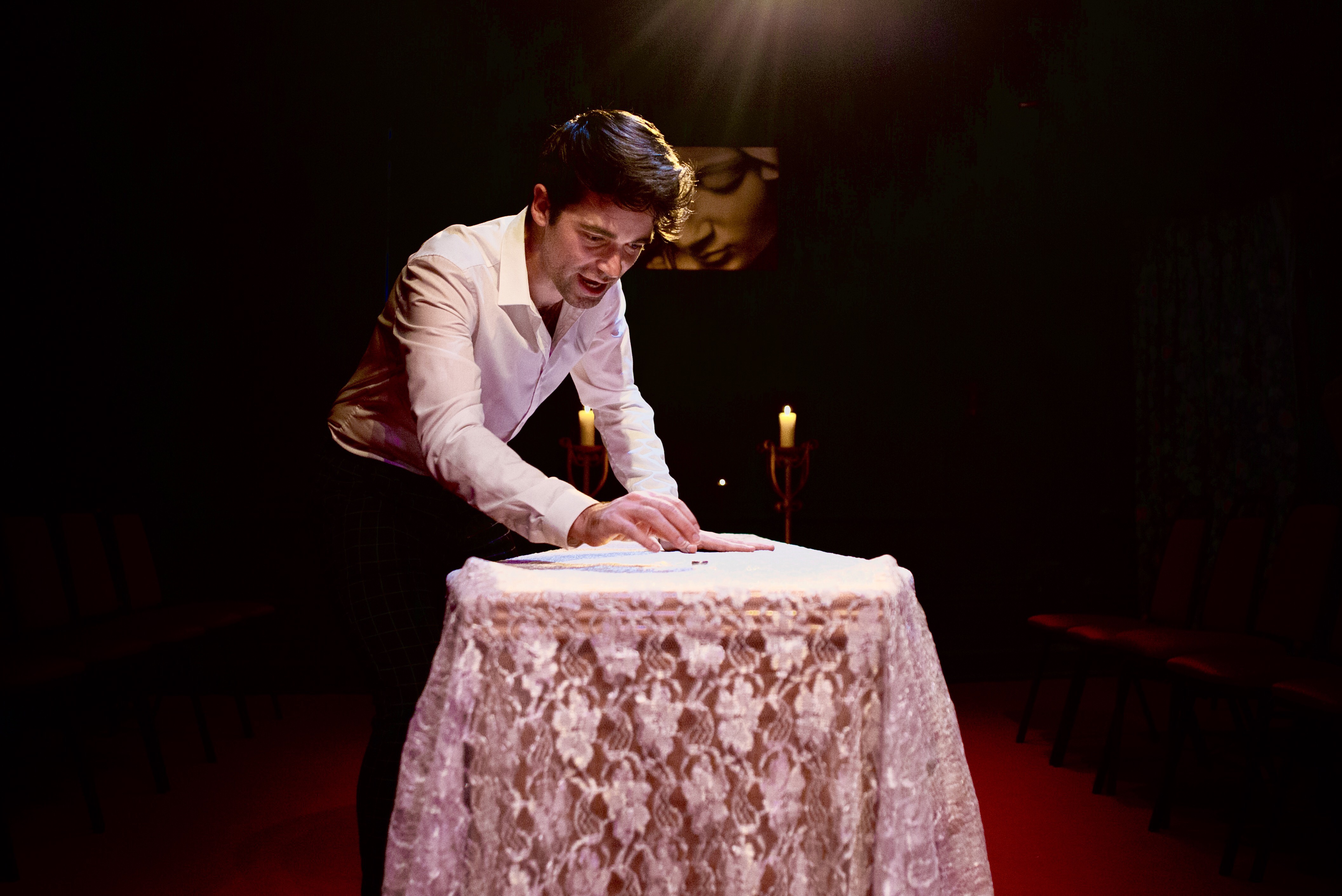
If it’s visceral theatre you’re after, you’ve come to the right place; it’s impossible to watch Mumburger – which follows Tiffany and Hugh’s horrified attempts to abide by Andrea’s final wish – without feeling some kind of physical reaction. Director Tommo Fowler has obeyed to the letter the writer’s instruction that “the actors should consume food when it says they eat”, so there’s no getting away from either the consumption or the various bodily functions that accompany it. (Or indeed the smell of cooking burgers, which explains the confusion I mentioned earlier.) It’s disgusting and messy and uncomfortable to watch, particularly when you add into the mix a series of video projections against the curtain at the back of the set, which verge at times on motion sickness inducing.

But let’s put the meat to one side for a second. At its heart, Mumburger is a story about a family coping with the loss of the person that held them together. Though we never meet Andrea, Kosar’s script paints a detailed picture of her; it’s clear from listening to Tiffany and Hugh argue and reminisce that she was the common link between them, and that without her they’re almost strangers who have no idea how to communicate. Both are also pretty annoying in their own ways; Tiffany, played by Rosie Wyatt, is shrill, domineering and self-involved, while Andrew Frame’s Hugh would rather play Candy Crush on his iPad than deal with anything even remotely difficult. Each believes that they knew Andrea better and therefore has more right to grieve, and the mumburgers become a physical manifestation of that competition. All of which begs the question: was Andrea’s intention really a noble wish to help her bereaved daughter and husband go on, or was it prompted by her own selfish need to maintain her position at the centre of the family for as long as possible?

Photo credit: Lidia Crisafulli

Many plays about bereavement go for the emotional jugular, encouraging us to feel sympathy for the characters and move us to tears as we watch them bond over memories of their loved one. Mumburger is not one of these plays. You’re more likely to come out feeling slightly sick than overwhelmed with emotion (though the play certainly has its moments) but that doesn’t make it any less real, and in this regard it’s actually oddly refreshing. Death – particularly of the sudden, violent kind – is not romantic or glamorous, but messy and painful. Not everyone who dies is perfect; nor are the people they leave behind. Grief can drive us apart just as much as it brings us together. These may not be truths we want to hear – or see, or smell – but they’re truths all the same. Not one for the faint-hearted (or vegetarians), maybe, but Mumburger certainly makes a lasting and powerful impression.


Can’t see the map on iPhone? Try turning your phone to landscape and that should sort it. I don’t know why but I’m working on it… 😉

Review: Tremors at the King’s Head Theatre

You do have to wonder sometimes what makes people go into politics. Despite certain obvious benefits, it seems often a very thankless career, exposing you to public scorn, ridicule and disdain the minute you mess up or show the slightest sign of weakness. Because of the nature of the job, politicians become public property – and the public has the power to make or break them on a whim.

This is the very predicament in which Tom Crowe, the Labour MP at the centre of Tim Cook’s new play Tremors, finds himself. After a private encounter in a hotel room with a senior party member goes viral, he takes the advice of his PR advisor Lisa and flees to Eastbourne. But his hometown is in chaos, with riots and vandalism led by anti-austerity activists threatening to tear the town apart – and a dark secret from Tom’s past that could derail the attempt to salvage his future.

Though written a few years ago, by chance the staging of Tremors by Broken Silence Theatre has fallen during one of the most extraordinary eras that many of us can remember in British politics. It’s an indication of how disillusioned and suspicious we’ve become – not really a surprise after watching our politicians routinely turn on each other over recent months – that a character like Tom, who genuinely just wants to help people, seems entirely too good to be true. Even so, William Vasey gives a believable performance, managing to convey both the wide-eyed idealist, who followed his heart into politics, and the ambitious social climber, whose accent these days is more Oxford than Eastbourne.

Tom’s one of four characters who never get fully developed, despite good performances from the cast. Much like in politics, each of them comes to represent a particular ideology, which overrides their individual personalities, and consequently we never really get to know them as the 60-minute play unfolds. At the opposite end of the scale from Tom is his old friend Chris (Tim Cook), who has the same passion to make the world better, but very different ideas on how to achieve it. And then there are the women: Lisa (Vicky Winning), a hard-nosed ice queen who doesn’t do feelings, remorse or indeed anything that might get in the way of her own career interests. Her opposite number is Marie (Cerys Knighton), Chris’ sister; her activism days are firmly behind her, and now all she cares about is finding her brother before he does something stupid.

There’s a lot going on for such a short piece, and some of the plot threads at times become a little tangled – Tom’s career crisis and concealed homosexuality, the decline of his coastal hometown, Chris’ struggles to come to terms with his past or the country’s future, and the revelation of the secret that binds the three old friends together. And despite some helpful BBC News announcements, the timeline of the play isn’t always entirely clear; some early flashback scenes only really make sense in the closing minutes.

Though not without some issues, Tremors is an interesting premise and definitely has potential for development into a longer play examining the issues in greater detail. What connects all the various plot threads is a simmering anger over the growing distance between we the people and those who put themselves forward to represent us – which is something I think most of us can identify with. Judging by recent events, that’s not an issue that seems likely to go away any time soon, so here’s hoping Tremors will return to shake things up in the future.


Can’t see the map on iPhone? Try turning your phone to landscape and that should sort it. I don’t know why but I’m working on it… 😉

Review: The Quentin Dentin Show at Tristan Bates Theatre

It’s the golden rule of capitalism: to convince a customer that your product will make them happy, you have to first make them realise how very unhappy they are without it. Science fiction musical The Quentin Dentin Show by Henry Carpenter takes this concept to infinity and beyond; now directed by Adam Lenson, the show introduces us to bored (and boring) couple Nat and Keith, who become the unwitting subjects of the universe’s most bonkers marketing scheme when they find a mysterious golden microphone in their living room. At the helm is Quentin Dentin – or at least the synth currently in possession of that name – whose only job is to sign them up to The Programme and make them both happy forever (although what that actually means is removing their souls, but you know, same difference). Naturally, Quentin isn’t doing this for nothing; he’s in line for an upgrade if he can seal the deal, so is willing to do just about anything to sign his subjects up.

Photo credit: Lidia Crisafulli

In case you were wondering, this is all absolutely as bizarre as it sounds. Luke Lane steals the show with a gloriously over-the-top portrayal of TV host/preacher/mentor Quentin, backed by his two robotic “friends”, creatively named Friend 1 and Friend 2 (Freya Tilly and Lottie-Daisy Francis). Behind their beaming smiles, cheery singalongs and energetic choreography, there’s a decidedly sinister undertone about this trio as they skilfully manipulate Keith and Nat into signing their lives – and more – away.

Shauna Riley and Max Panks do a good job with necessarily flimsy characters, whose bemusement quickly gives way to acceptance of their own unhappiness and rejection of the dreams they thought they had. It’s a bit hard to believe Nat and Keith would so readily succumb to a strange man who appeared out of their radio, and nor do we ever find out why they’ve been chosen as Quentin’s latest subjects – but by this point we’re so far through the looking glass anyway that it’s best to just go with it.

That said, there is still a nugget of harsh truth about humanity’s constant search for happiness to be found amidst the manic grins, talking microphones and inflatable fish (don’t ask) – and the show’s unexpectedly bleak ending leaves us to wonder rather despondently if finding the meaning of life through artificial means really is the best future we have to look forward to.

Though there are only a couple of songs that are particularly catchy – among them a Hey Jude-esque final chorus that I still can’t get out of my head – all the musical numbers are enthusiastically performed by band and singers, with sharp, synchronised choreography from Caldonia Walton. In fact, movement in general throughout the show is crisp, polished and perfectly timed, down to the simplest turn of a head at just the right moment.

Photo credit: Lidia Crisafulli

The production does suffer from a few sound issues; with the band on stage throughout, there are a couple of numbers where it’s hard to make out all of the lyrics, and there’s also an odd disconnect between the intimacy of Nat and Keith’s living room and the fact that they’re talking to each other in it through radio mikes. The show would perhaps work better in a slightly larger space – it certainly has the larger than life personality required to fill a bigger stage.

The show’s been described as “The Rocky Horror Picture Show for the new millennium”, and the influence of Richard O’Brien’s show is obvious (ordinary couple stumble into the path of a charismatic but unhinged stranger, who makes them question everything they thought they knew about themselves). Whether Quentin will ever reach the same levels of cult fandom I couldn’t say, but there’s no denying the show makes for an entertaining – and slightly bewildering – evening out.


Can’t see the map on iPhone? Try turning your phone to landscape and that should sort it. I don’t know why but I’m working on it… 😉

Review: Il Matrimonio Segreto at Mill Hill Music Festival

Guest review by Lucrezia Pollice

Pop-up Opera attempts to engage and give agency to audiences who would not normally attend the opera. To do this, Cimarosa’s 1792 comedy Il Matrimonio Segreto (The Secret Marriage) has been modernised to a 21st century setting, acting is exaggerated and the concept is at times ridiculous, playing on the comedic side of the narrative.

It is a comedy to be taken with a laugh and an open mind, it pushes many boundaries and manages to reach many people in meaningful ways. Most importantly the music and quality of the performers is of really high quality, and that is the strength of the company. If anyone thought the opera was boring, go and see this performance and you will not be disappointed – this one is definitely not boring!

Photo credit: Richard Lakos, The Other Richard

The show was quick, did not bore the spectators and did receive laughs from the public. Although in Italian, large screens project short colloquially translated captions and satirical images accompany the story in a very easy to follow manner. The story commences with the secret marriage of Carolina (Chiara Vinci) to Paolino (Mark Bonney). However, Carolina’s father Geronimo (Joseph Kennedy), a rich and mean merchant, is Paolino’s master and would never approve their marriage. Around them is the classical comedic scene of that time – Elisetta (Emily Blanch), her sister, the English Count Robinson (Tom Asher) who wants to take Carolina’s hand and the rich widow, auntie Fidalma (Vivien Conacher), who also has a burning desire for Paolino. Conflict and tension are obviously present. Carolina’s father is determined to have his daughters married to respectable people and with the excitement of knowing that English Royalty is planning to take one of his daughters as a wife, stakes are raised high.

The performance is full of comedic over the top tableaux. Auntie Fidalma’s passion is exaggerated into a blazing sexual need – as she presents the audience with her book Sex and Joy and reproduces orgasms on stage – it is so ridiculous that it cannot be found funny! The sisters fight with boxing gloves and the English count is disturbingly but realistically extremely sexual.

Photo credit: Richard Lakos, The Other Richard

However, as an opera native and lover it was very difficult to watch the performance the entire way through. The musicality of the performance was lovely to listen to, but unfortunately modern satirical references, costumes and acting would override the music and in my opinion destroyed the magical poetics of the opera. Having said this, for non-opera goers this might be a very interesting beginning to engage in the art form.

Review: I Know You Of Old at The Hope Theatre

I recently reviewed a production of Shakespeare’s Much Ado About Nothing, and while the play was excellent, I was reminded, not for the first time, of how much its conclusion bothers me. Hero, who’s just been publicly shamed on her wedding day, cheerfully takes back her fiancé and forgives everyone for doubting her, despite not a word of apology ever being offered. The audience’s attention returns to the more colourful characters of Benedick and Beatrice, and Hero – having served her purpose – is instantly forgotten.

David Fairs of GOLEM! is having none of that. His dark rearrangement of the text of Much Ado places Hero at the centre of the story – in more ways than one. Using only Shakespeare’s text, he’s created an entirely new story in which Hero’s dead and Beatrice (Sarah Lambie), Benedick (David Fairs) and Claudio (Conor O’Kane) meet in the chapel on the night before her funeral. In an attempt to ease his guilt over his treatment of her, Claudio decides to bring the warring Beatrice and Benedick together, with predictably amusing results. But there’s no escaping Hero this time, because her coffin dominates the room – many of the conversations take place quite literally over her dead body, and the shocking circumstances of her untimely death must eventually be dealt with.

Whether you know Much Ado or not doesn’t really matter. I Know You Of Old stands confidently on its own two feet as an original plot that in many ways is even more compelling – and certainly more intriguing – than its source material. Placing these three pivotal characters in Hero’s story into a pressure-cooker situation, where there’s nowhere to hide (though Benedick gives it a try), allows us to examine the dysfunctional relationships between them in a whole new light. And one thing’s for sure; while the play’s conclusion is rather open-ended, it’s far from unsatisfying.

Shakespeare lovers need not fear, though – by taking apart the text, GOLEM! aren’t being disrespectful, but instead demonstrating the astonishing versatility and enduring relevance of the words written so many centuries ago. In keeping with this, director Anna Marsland brings the story bang up to date; this is Shakespeare with iPads, motorcycle helmets, teddy bears and even Cher – suffice to say it isn’t your standard pre-funeral vigil. And yet somehow the 400-year-old text describes perfectly everything we can see, a reminder that while the world around us may change, human behaviour and emotions remain as messed up as they’ve ever been.

The play’s casting could hardly be more perfect. Conor O’Kane is every inch the heartbroken bridegroom, but with an appealing childlike quality that makes it easy to see how he could have been tricked into believing Hero’s guilt. All three actors are skilled comedians, and succeed in getting a laugh out of a single word or the simplest look or gesture; the verbal sparring between Sarah Lambie and David Fairs – who also starred together in Golem!’s previous production, the excellent Macbeths – is a comic delight (the layout of the theatre is such that watching their exchanges begins to feel like being on Centre Court at Wimbledon). But with Beatrice grieving for her cousin, their flirting takes on a darker edge that eventually spills over into something altogether more disturbing.

One of the most enjoyable aspects of Anna Marsland’s production is its extraordinary attention to detail. There are real candles burning, a smell of incense in the air, and sombre music playing as we enter the dark chapel, and the stiflingly hot weather – however uncomfortable – conveniently helps to complete the claustrophobic effect. The use of modern technology isn’t just for show, either; the letter that Benedick reads out can be clearly seen on the iPad screen, as can the incriminating video he later views on his phone.

I Know You Of Old is an astonishing achievement, and a brave choice to take apart a play so many people know so well. David Fairs has succeeded because he’s used the opportunity to tackle some of the unfinished business in Shakespeare’s work – like the appalling, unpunished treatment of Hero, and what makes Beatrice and Benedick behave the way they do. Consequently it’s clear that this is not a gratuitous ripping up of a classic, but rather a fitting and respectful complement to the original, a gripping new tale which can be enjoyed by Shakespeare fans and newbies alike.


Can’t see the map on iPhone? Try turning your phone to landscape and that should sort it. I don’t know why but I’m working on it… 😉