Review: LOOP at Theatre N16

Few things prompt more heated debate than our taste in music (it’s definitely the source of most tension in my office). We all think our own favourites are the best, and anyone who disagrees with us is automatically wrong. Yet our passion for music – any music – can also bring us together like little else, whether it’s casual banter with a stranger at a gig or a huge one-off event like last weekend’s One Love Manchester concert.

BoxLess Theatre’s LOOP takes us through three generations of one family, set to a soundtrack of the music that both unites and divides them. In the 1960s, a young woman leaves behind her home in London and sets off for a new life in Manchester. In the 80s, her teenage daughter comes home from a gig with a new boyfriend in tow – and in 2017, that same couple struggle to find common ground with their own 19-year-old son, who ultimately finds himself returning to his grandmother’s hometown in search of answers.

Though music is the common thread that links all three stories, it doesn’t dominate or overwhelm Alexander Knott’s script, which is very much character-driven. In a fast-moving introductory monologue delivered by Emily Thornton, we experience all the hopes and fears of The Woman as she leaves home for the first time and ventures out into a scary new world. Later, she returns as both mother and grandmother, perfectly capturing not only the physical changes but also the lifelong emotional fragility of a woman whose life hasn’t gone the way she hoped it would. James Demaine closes the show as the Young Man, with an equally powerful story of teenage angst and artistic ambition, but perhaps the most enjoyable – and humorous – scenes are those between the Boy and the Girl, played by Aaron Price and Rubie Ozanne, whose fledgling teenage romance is adorably awkward and very believable.

Completing the show’s finely tuned balance of words and music is the movement, directed by Zöe Grain. Working with a set that consists of just a few boxes that are rearranged for each new setting, the cast travel on trains, dance in clubs, and walk the busy city streets in this highly physical piece of theatre. In one effective scene, an act of violence becomes strangely beautiful as it unfolds in exquisite slow motion. Each of the four-strong ensemble performs these moves with precision, energy and perfect timing to bring their characters and the world around them to life.

LOOP has a little bit of everything; it’s funny and heartwarming yet not without moments of poignancy, and nostalgic but also very current – and by combining storytelling with movement and music, directors Alexander Knott and Zöe Grain have given the company an opportunity to demonstrate their broad range of talents. This is an exciting debut from BoxLess Theatre, and definitely worth a visit for music lovers of any generation.


Can’t see the map on iPhone? Try turning your phone to landscape and that should sort it. I don’t know why but I’m working on it… 😉
Review: Tom Molineaux at the Brockley Jack Studio Theatre

Guest review by Lucrezia Pollice

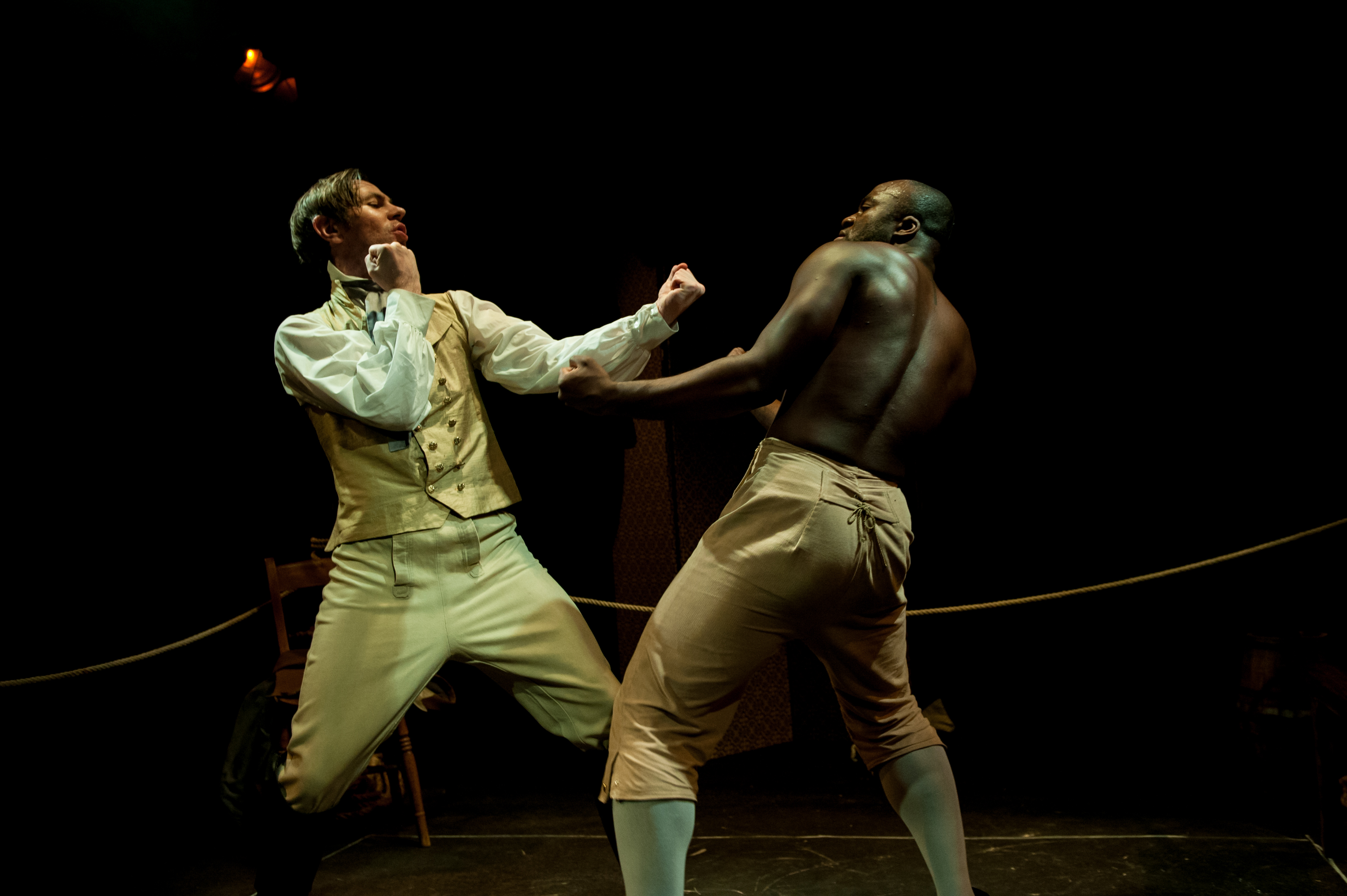
Tom Molineaux is an extraordinary true story about boxing, gambling and friendship. About a man who fights his way to freedom, but remains trapped in the injustices of society. A boxing ring, two men and some period costumes; nothing more is needed to bring this narrative to life. Tom Green’s compelling writing flows fluidly in an extremely believable manner, bringing us back to London in the nineteenth century whilst never losing the audience’s attention. Directing with simplicity and beauty, Kate Bannister constructs an extremely pleasurable evening.

Photo credit: Timothy Stubbs-Hughes

Nathan Medina skilfully plays the part of an African American boxer, born on the plantation in Virginia, with incredible force, leaving spectators astounded. Tom Molineaux is strong, powerful and will not stop until he beats everyone. Before the play begins, Tom is cherished in America for winning his master a great deal of money, which releases him from slavery and wins him freedom. It seems like nothing will bring him down, his determination and ambition to become world champion is too strong. He manages to convince the English champion Tom Cribb, who is retired, to fight him.

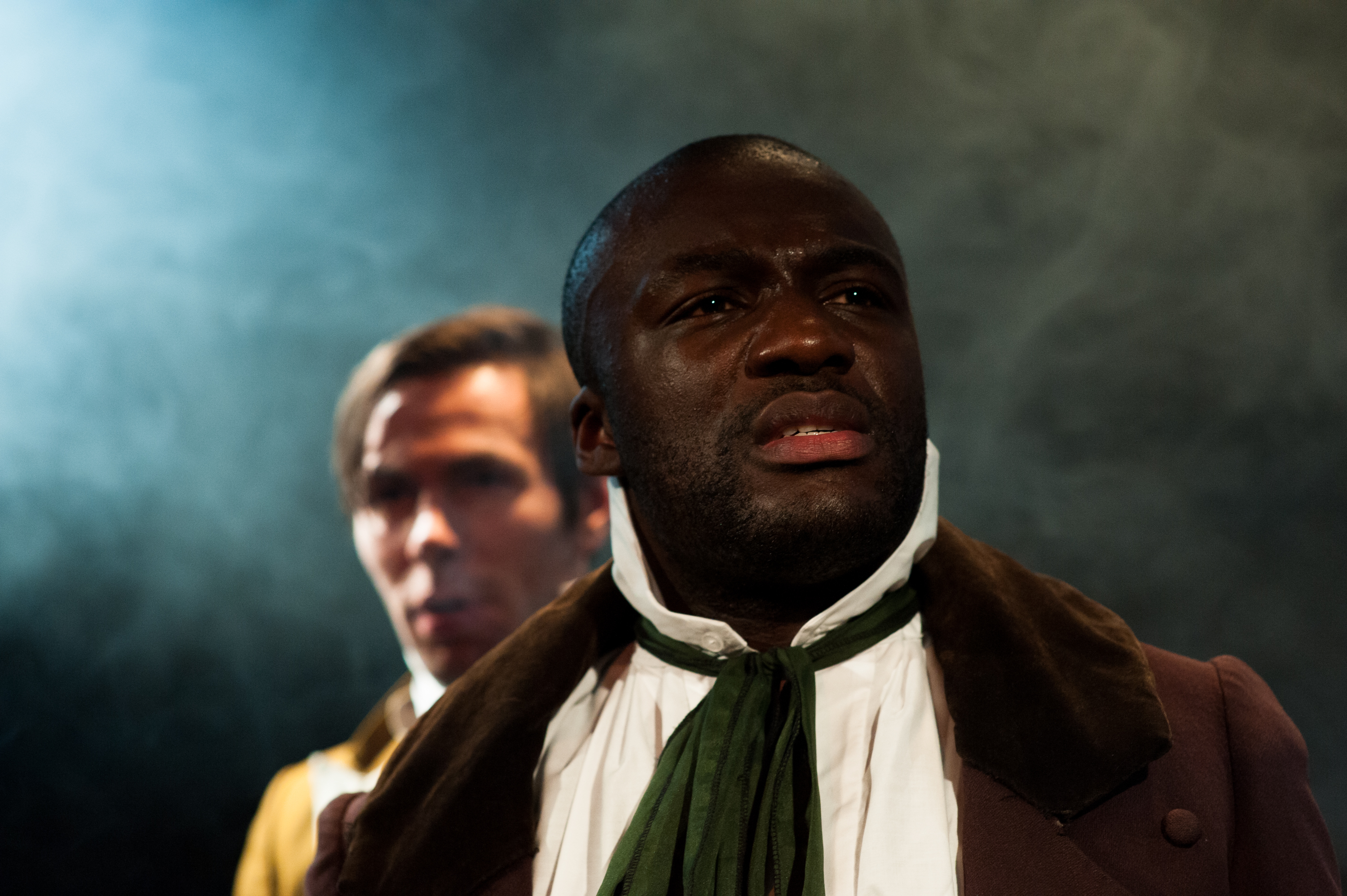
However, the play is not only about boxing, it is about so much more. About injustice, prejudice, loyalty and addictions. The story is narrated by another incredibly talented actor, Brandon O’Rourke, who plays Pierce Egan, a sports journalist who befriends Tom when he arrives to London. Pierce allows us to see the honest emotional turmoil which is present under Tom’s muscles and strength. Unfortunately, this is not a happy story. It is a true story. Will the former slave manage to gain his victory and make millions, or will he be crushed to the bottom by society’s injustice and greed?

Photo credit: Timothy Stubbs-Hughes

The performance is highly physical. The set is dark and misty. A seriousness in tone is most commonly present, but lighthearted moments are present too. One of my favourite moments is when Tom and Pierce come back drunk from a night out in 19th century London. The atmosphere transports you and allows one to imagine the streets of London back then, thanks to the accurate descriptions. Unfortunately, Tom and Pierce’s friendship is put to the test. Molineaux fights Cribb but the match is flawed, and Pierce knows. Will Pierce decide to lose the money he has bet on Cribb; or will he convey the truth and tell the world that Molineaux is the world’s biggest champion? Will Pierce fight the system or will Molineaux be representative of our unjust post-colonial society?

Courageous, powerful and human, this brilliant play packs a punch in more ways than one.


Can’t see the map on iPhone? Try turning your phone to landscape and that should sort it. I don’t know why but I’m working on it… 😉

Review: Persuasion at the Royal Exchange Theatre

Guest review by Aleks Anders

Persuasion is Jane Austen’s last complete novel, and is set most definitely in the counties of Avon and Somerset in the early part of the 19th century. It is a tragi-romance, and although there is some humour to be found in the novel, it is essentially written in earnestness. In the main, the story concerns the 27-year-old daughter of an impoverished noble wanting, nay needing, to marry; and the travails this entails as she watches in horror and amusement her relatives’ follies and dalliances. Her life changes forever though, when she encounters the man she had been engaged to more than seven years ago, and has not seen in as many years.

“Other people will try to persuade you. You must listen to your heart.”

A classic British novel which tells of a time passed; when morals, ideologies, customs, behaviours and habits were all so very different from the present. Perhaps the appeal here is that this evokes a kind of nostalgia, or a wish for change; or perhaps we just like to look at and laugh at the folly of our ancestors knowing that our lives are infinitely changed. Whatever the case, we expect to see a production that mirrors and compliments the author’s intent… and thereby lies the rub.

Photo credit: Johan Persson

On walking into Manchester’s celebrated in-the-round theatre we are greeted with a huge, looming cream-coloured rectangle, taking up most of the stage area. Around this are positioned multifarious sound and lighting paraphernalia, and the whole is lit with a cold blueish wash. A body is lying face down on top of this oblong. It’s female, she has dreadlocks, in modern dress, and seems dead. The cast are seated on the front row of the audience, in costume, and even change their costumes in full view of us all. It’s all a little strange.

First, it was obvious where the budget for this show went. On this rectangle. The omnipresent block is on two levels and the top half is a turntable which moves round at various points in the play. There is no set, no props, and nothing else is ever brought on for a scene. The scenes change fast and furiously, completely seamlessly, and we are expected to keep up with this without being given any visual stimulae to aid us. There is even a point where one character finishes speaking in one scene, stays exactly where she is and continues speaking for the start of the second scene as a different character, without so much as voice or body language change. The costumes are modern, but really rather strange. None of the costumes really seem to signify the character in any way, and are obviously not meant to be completely realistic.

“The problem is it is impossible to know what will happen in the future.”

The only thing to change this monotony is towards the end of the first act, when the action moves to the seaside town of Lyme Regis. The cast strip off revealing sexy swimsuits underneath, and a seemingly never-ending flow of foam cascades from above onto this rectangular block. The cast slip and slide in it and across it much to the laughter and approbation of the audience. This is followed immediately by Louisa, who slips once too often and has ketchup poured over her by Anne, again to much laughter since this is funny. It is only afterwards that we learn that it was in fact tragic, and she fell over the edge of a cliff!

Photo credit: Johan Persson

The language of the play is also at odds with this highly modern vision from director Jeff James. It’s very similar to watching a Shakespeare play in modern costumes whereby the language and business (such as sending letters etc) simply do not befit the updating. And yet – out of nowhere – Anne suddenly half-way through the second act screams the line, “Shut the f&$! up!” It jars and is out of place with the rest of the dialogue. However, if all the dialogue had been modernised in this way, I may well have enjoyed the play more.

Basically, I think what I am trying to say is that I do not believe that this adaptation is true to the author, nor is it at all clear. A mixed production at best. It is at one and the same time ultra-contemporary in concept and execution, and yet firmly fixed in the early 1800s with the language and references.

Fortunately the saving grace of this play is that the acting is really very good. All the cast invested a huge amount into their roles and this paid its dividends. Lara Rossi is a rather moody and sullen Anne, whilst her more frivolous female peers are played excellently by Cassie Layton (Elizabeth and Louise) and Caroline Moroney (Mrs. Clay/Henrietta). In fact, there has been – and still is – much bemoaning that there are so few plays with strong female leads. This play is quite the opposite; there are many strong female characters here.

The male roles do seem less defined than the female ones, but Samuel Edward-Cook’s Captain Wentworth is true and grounded throughout and very believable.

“Love can save your life. But love is the problem.”

Persuasion is at the Royal Exchange Theatre, Manchester until 24th June.

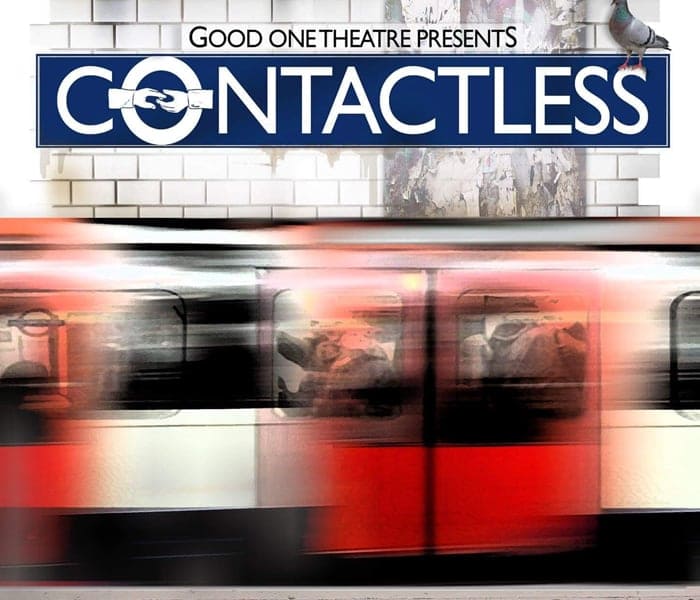
Review: Contactless at The Hen and Chickens

Nothing sums up the British quite like our relationship with public transport. It’s a world full of unspoken rules, which we like, and we reserve the right to be furious – silently, because we’re British – when those rules are not observed. Because there’s no chance of escape, the most insignificant moment becomes a massive deal, whether it’s the person next to us having a loud phone conversation, the cute stranger opposite catching our eye for the briefest of seconds, or the agony of trying to figure out if someone’s pregnant or not.

These are all moments anyone who spends any time on the London Underground can relate to, and they make up the backdrop to Tom Hartwell’s new comedy, Contactless, which takes us inside the world of the Tube to meet annoying passengers, overenthusiastic station announcers and even the original voice of “Mind the Gap”, Peter Lodge. These characters appear in a series of sketches that take recognisable situations and stereotypes to comical extremes (one of my favourites was the night tube, where passengers are tucked in with a blanket and hot chocolate while the driver reluctantly reads them a bedtime story).

While these characters are familiar to us, they’re all fictional – but Contactless also draws on historical fact and current affairs in the development of its main plot threads. Besides Peter Lodge, the sound engineer who inadvertently became the voice of the Underground, we also meet Emma Clarke, the voiceover artist who eventually replaced him, only to be sacked for comments that appeared to criticise the Underground. Meanwhile, a hapless union rep tries to reach an agreement in the tube strikes over ticket office closures and night working, and Peter’s widow Susan – who still works at Embankment 30 years later – struggles to keep up in a constantly changing world of progress and technology.

Directed by Phil Croft and performed by a versatile cast of six (Adam Elliot, Rosie Edwards, Hannah Jay, Jeryl Burgess, Stanton Cambridge and Will Hartley), the show’s style is reminiscent of spoof documentaries like Twenty Twelve, affectionately poking fun at a British institution that we love to complain about, but also wouldn’t want any other way (I kept half expecting David Tennant’s voiceover to start). The scenes referencing the strikes, while undoubtedly some of the funniest, also make a sharp political point; as union rep Rachel faces off against an army of incompetent and – in one case – sleazy civil servants, there’s never any doubt whose side we’re meant to be on, even before the hilarious first date scene in which a striking tube driver hammers home the main points of their argument.

There’s a further case against progress for the sake of it in the story of Susan, an unexpectedly poignant diversion inspired in part by Margaret McCollum, the widow whose pleas saw her late husband’s voiceover reinstated at Embankment. Ultimately, Hartwell’s message seems to be that the Tube is about people far more than processes. Drivers, passengers, station staff and yes, even the voiceover guys and girls come together to form a tapestry that’s rich with comic potential, and makes this cherished British institution what it is, in a way iPads and driverless trains never will.


Can’t see the map on iPhone? Try turning your phone to landscape and that should sort it. I don’t know why but I’m working on it… 😉
Review: Evita at the Orchard Theatre

Sometimes it’s a bit of a shock to realise how long the shows I grew up with have been around (which in turn makes me feel old… but let’s not go there). While Evita – written by Andrew Lloyd Webber and Tim Rice in 1976 and first performed in the West End two years later – isn’t one I saw on stage until my 20s, I do remember watching the movie version starring Madonna and Antonio Banderas all the way back in 1996. Back then I didn’t necessarily follow all the political context of the story, but I loved the music and was fascinated by the rags to riches tale of a teenage girl from a rural town, who rose to become First Lady of Argentina and “Spiritual Leader of the Nation” – only to die from cancer at the age of just 33.

Photo credit: Pamela Raith Photography

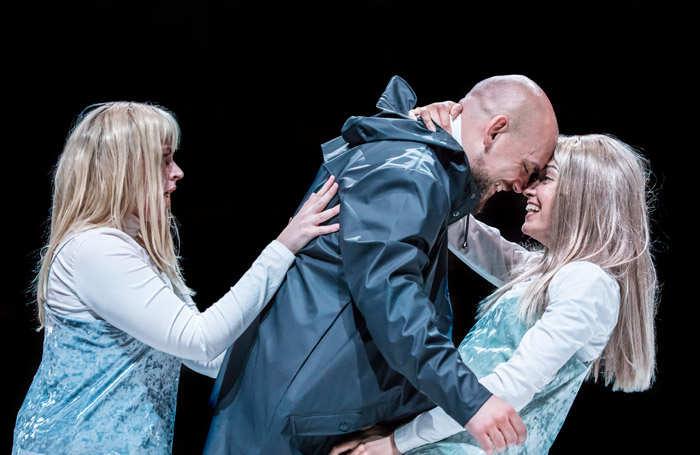
Now Evita is back on tour, and bringing the story of Eva Perón, second wife of Argentine dictator Juan Perón, to a new generation. Starring Wicked‘s Emma Hatton and Italian actor Gian Marco Schiaretti – who recently played Tarzan in Stuttgart – this lavish production from Bill Kenwright is both entertaining and educational, a love story with added politics, and a great deal of style. And whether or not you follow all the ins and outs of Argentine history, it’s a fascinating insight into how a celebrity with no knowledge of politics can power their way to the top by sheer determination. Which makes you wonder if we’ll all be watching an equally tragic – for different reasons – show about Trump in 40 years’ time (if so may I suggest a working title of Covfefe: The Musical).

Not entirely surprisingly, West End star Emma Hatton gives a commanding and vocally flawless performance, just as much when Eva’s crumpled on the ground in the last days of her life as when she’s at the height of her power, performing the show-stopping Don’t Cry For Me Argentina to an adoring crowd. Alongside her, relative newcomer Gian Marco Schiaretti more than holds his own as the omnipresent Che, hitting just the right mix of Latin charm, arrogance and helplessness – and some impressive, not to mention unexpected, high notes. The two have excellent support from Kevin Stephen-Jones as Perón, Oscar Balmaseda as Eva’s first lover (and ticket to the big city) Magaldi, and Sarah O’Connor as the unnamed Mistress, a seemingly minor character who nonetheless wows the crowd with one of the show’s best-known numbers, Another Suitcase in Another Hall.

Photo credit: Pamela Raith Photography

With Bill Deamer’s lively choreography that takes inspiration both from the Latin American setting and the oppressive atmosphere of a military dictatorship, and an imposing set designed by Matthew Wright, Evita transports us to 1940s Argentina in a dazzling and fast-moving spectacle that only begins to slow down when its protagonist does. 40 years old the show may be, but the passion and energy of this production prove there’s plenty of life in Evita yet.

Evita is at the Orchard Theatre until 3rd June then continuing on tour.