Review: Three Unrelated Short Plays at Theatre N16

Three Unrelated Short Plays is the debut production from Blank Tin Productions, and does exactly what it says on the… er, tin: three 20-minute plays, none of which bears any relation to the others – or indeed to reality as we know it. The press release promises weird and unexpected, and that’s exactly what we get.

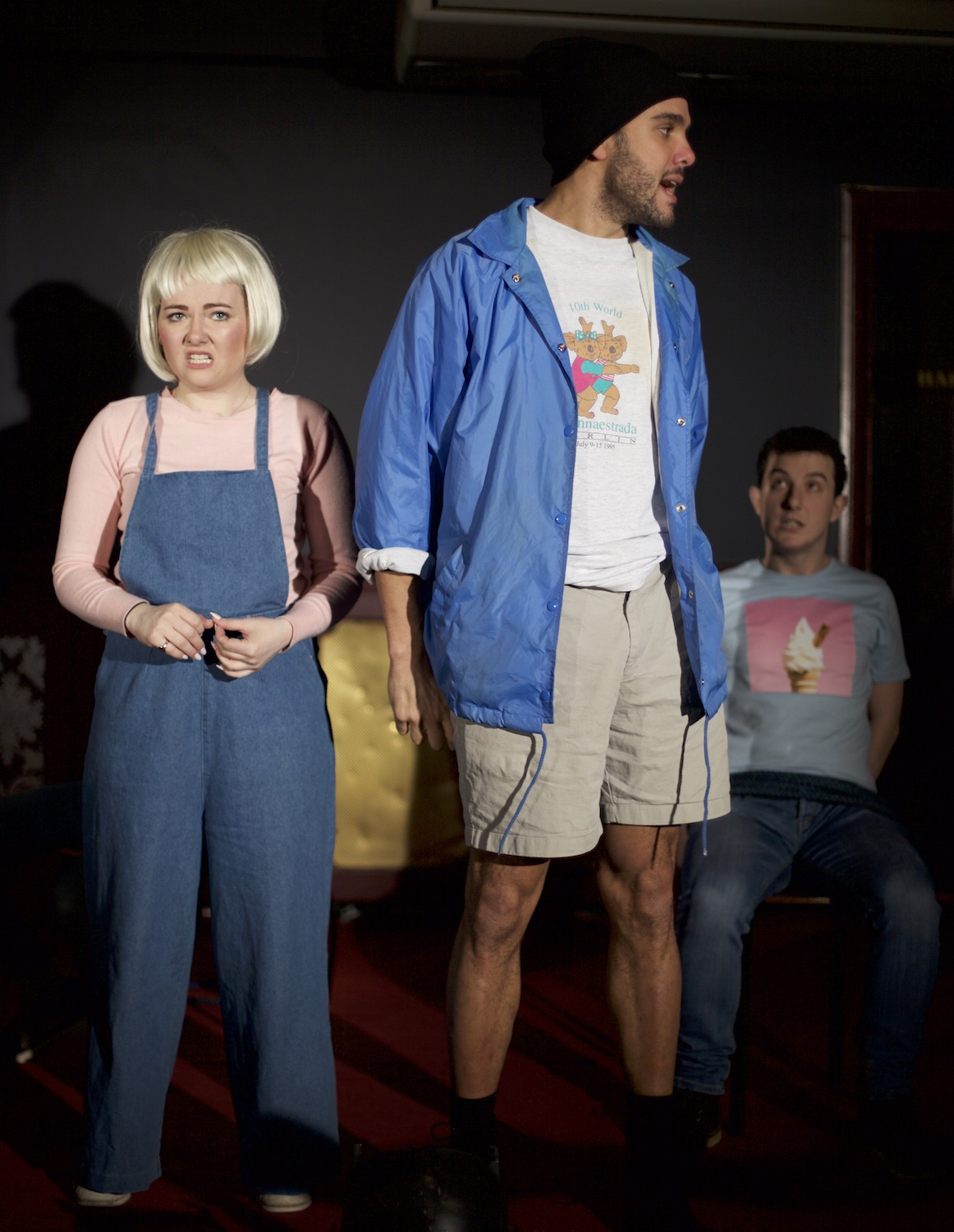
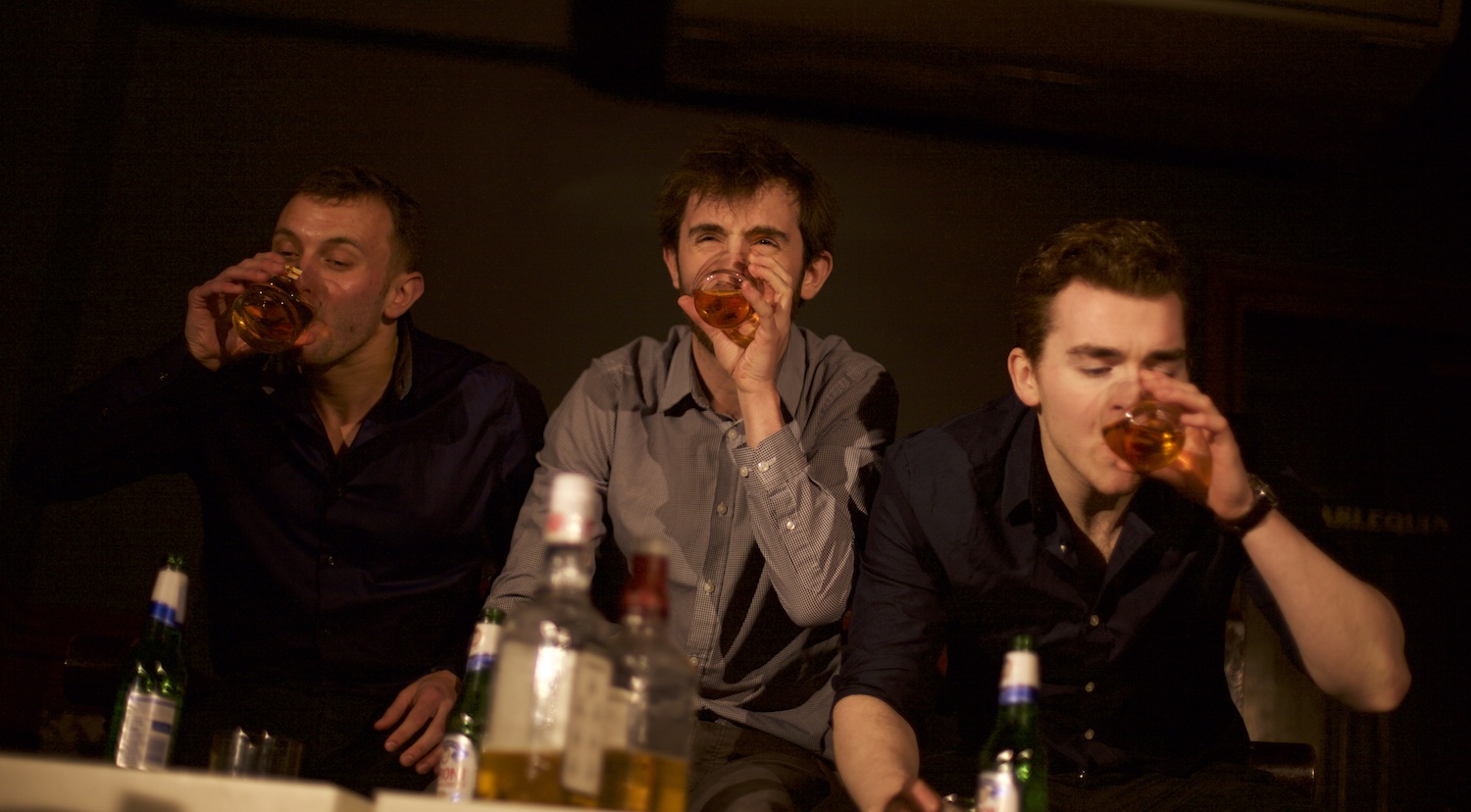
In The Stuttgart Syndrome, John (James Messer) wakes up tied to a chair in a basement, next to Mickey (Dan Thorn), who seems worryingly chilled about the whole situation – possibly because his grandfather was an escapologist, or maybe just because he doesn’t actually know what kidnapping means. One Scotch sees friends Tony, Danny and Jack (James McClelland, Abe Buckoke and Will Jeffs) play a drinking game that will supposedly allow them to meet God, but it turns out (s)he isn’t quite what they were expecting… and that’s not the only surprise of the night. And in Who the Fuck is Dr Deathzo? mild-mannered Kevin (Jimmy Roye Dunne) learns that he’s got an evil alter-ego who only comes out on Saturday nights – and as if that’s not bad enough, now superhero Assorted Props Girl (Elle Banstead-Salim) and her sidekick Tape Boy are out to vanquish him.
three-unrelated-short-plays-5
Photo credit: Oliver Malam
So. You get the idea. Nothing here makes any sense, but then it’s not really supposed to. Writer James Messer has let his imagination run off pretty much wherever it wants to go, resulting in a show that’s entirely bonkers and very very silly – but hey, who doesn’t enjoy a bit of silliness every now and then?

Each play has a different director (Will Jeffs, Oliver Malam and James Messer each taking a turn) and cast to keep things fresh, and as promised in the title each is a completely separate, self-contained story. Personally, I found the middle piece, One Scotch, to be the strongest, possibly because despite being quite as mad as the others, the plot felt just a touch more coherent, and I loved the twist in the tale. But there’s something here for everyone (unless you’re not a fan of random), and it’s likely everyone will have their own favourite, for different reasons.

The show has a charming, homemade feel, with frequent references to the limitations imposed by a fringe theatre budget. And far from making excuses, it revels in its own chaos; the transitions between plays are part of the fun, with cardboard signs imploring us to look at the guy juggling, or dancing, rather than the frantic scene changing going on behind him.
three-unrelated-short-plays-4
Photo credit: Oliver Malam
The cast display a similar exuberance, throwing themselves into their assorted roles with an enthusiasm that borders at times on the hyperactive. Most appear in more than one play, with Blank Tin co-founder Elle Banstead-Salim popping up in all three as a selection of increasingly feisty women; as the only female cast member it’s down to her to bring all the girl power, and she doesn’t hesitate to accept the challenge.

As a reviewer, I often feel I have to find the meaning in every play I see, so it’s a rare pleasure to see a show that isn’t trying to tell us anything. Blank Tin just want to have a good time, and to make sure the audience have fun too. And in that they definitely succeed. It’s a surreal night out, don’t get me wrong – but it’s also a thoroughly entertaining escape from reality, and that’s something we could all do with these days.


Can’t see the map on iPhone? Try turning your phone to landscape and that should sort it. I don’t know why but I’m working on it… 😉

Review: Crime and Punishment at Jack Studio Theatre

In the centenary year of the Russian Revolution, Arrows & Traps have got in early with their production of Dostoyevsky’s Crime and Punishment. But put aside any off-putting thoughts of epic 600-page novels; this short, sharp adaptation by Marilyn Campbell and Curt Columbus cuts straight to the heart of the story and is all over in a gripping hour and a half.

Focusing less on either the crime or the punishment, instead this adaptation gives us a disturbing insight into the mind of a murderer during the days between the two. By the time the play begins, the murder – of an elderly pawnbroker and her sister – has already been committed, and Raskolnikov (Christopher Tester) finds himself drawn into a cat and mouse game of psychological warfare with police inspector Porfiry (Stephen MacNeice), who’s convinced of his guilt. In desperation Raskolnikov turns to Sonia (Christina Baston), a virtuous young woman forced into prostitution to save her family, who offers his only chance of redemption.

Photo credit: Davor Tovarlaza @ The Ocular Creative

Flashbacks give the audience an opportunity to piece together the events that preceded the murder, as well as the crime itself – but also demonstrate the fractured state of mind of the killer, who himself looks back in an attempt to justify his actions. In the present, Raskolnikov explains to Porfiry that he believes some crimes – including this one – are necessary for the greater good. This is the debate at the heart of Dostoyevsky’s novel, and Campbell and Columbus’ adaptation gets straight down to it, mercilessly axeing several additional characters and plotlines, without losing any of the essence of what the story’s all about.

Director Ross McGregor has assembled a brilliant new cast for this production. Stephen MacNeice is an affable Porfiry, a self-confessed “freeform” investigator whose complex relationship with the suspected murderer begins to feel more like that of father and son than detective and criminal. As Sonia, Christina Baston has a physical fragility that contrasts with the spiritual and moral strength that sustain her – before transforming in flashbacks into the hunched, sneering old pawnbroker who’s about to meet a messy end. But this is ultimately Raskolnikov’s story, and Christopher Tester is captivating as the tormented killer. Despite being a violent criminal driven by his own arrogance, he’s also charming, articulate and capable of great kindness… and so like the biblical Lazarus who’s referenced throughout the play, we desperately want to believe he has the potential for salvation.

Anyone who’s seen Arrows & Traps in action before knows that they have a signature style – but they’re also not afraid to take a risk and step into new territory. Crime and Punishment is the company’s 10th production, and in a lot of ways is quite different to anything they’ve done before, with a cast of just three actors and a running time of only 90 minutes. Yet this is also recognisably an Arrows production, not just in its strong acting performances, but in the use of contemporary music, atmospheric lighting (courtesy of Karl Swinyard) and a dreamlike quality, particularly in movement director Will Pinchin’s exquisite slow-motion murder scene. (I never thought I’d be able to describe watching two old ladies get bludgeoned with an axe as beautiful, but there we go.)

Photo credit: Davor Tovarlaza @ The Ocular Creative

So what we really get with this production is a super-concentrated Arrows experience, stripped back to basics but bearing all the hallmarks of a company and director who know exactly what they’re doing. An intense psychological drama, the play has the entire audience holding our breath throughout, and asks some very real, and relevant, questions about the nature of crime and whether there’s actually any such thing as good and evil.

Think you know Crime and Punishment? Think again.


Can’t see the map on iPhone? Try turning your phone to landscape and that should sort it. I don’t know why but I’m working on it… 😉

Review: Doctor Faustus at Theatro Technis

London’s most active amateur theatre company, The Tower Theatre, has been in business for more than 80 years – but shows no sign of getting tired. Their new production of Doctor Faustus at Theatro Technis is dramatic, intense and gripping, and while it may not have Kit Harington in his pants, at least in this version we can all keep track of what’s going on.

Doctor Faustus, or to give Christopher Marlowe’s play its full title, The Tragical History of the Life and Death of Doctor Faustus, is the story of a bored German intellectual, who sells his soul to Lucifer in exchange for 24 years on Earth, the ability to use magic, and the devoted service of the demon Mephistopheles. The years pass, and Faustus becomes famous all over the world – but it’s only when his time begins to run out that he realises what a huge mistake he’s made.

Photo credit: David Sprecher
Tower Theatre’s production, directed by Lucy Bloxham, is a relatively traditional interpretation of Marlowe’s text, featuring two central performances that wouldn’t look out of place on a professional stage. Jonathon Cooper is charmingly eccentric as Faustus, skilfully embodying every side of the character: the frustrated genius, the cocky celebrity and the terrified dead man walking. It’s hard to feel sympathy for a man who’s entirely responsible for his own downfall, but Cooper’s Faustus is just likeable enough that we can’t help hoping he’ll find a loophole as his final minutes tick away.

He’s joined by Tower Theatre veteran Robert Reeve as Mephistopheles, the demon charged with sweet-talking Faustus into giving up his soul, and then being his constant companion for 24 years until it’s time to collect on the debt. Dressed all in black, Reeve radiates a quiet authority, and it’s clear from his sly grin whenever Faustus isn’t looking who’s really in control of the situation.

The rest of the cast take on multiple roles, most memorably having a bit of fun with the seven deadly sins (in the case of Lust, played by Matt Cranfield, perhaps a bit too much fun). This and a couple of later scenes provide welcome moments of light relief in what is, let’s face it, not exactly the happiest of stories.

Photo credit: David Sprecher
First-time director Lucy Bloxham makes effective use of the large stage area at Theatro Technis, with multiple entrances (including the one to hell, which is positioned alarmingly close to the audience) and a curtained off area behind which Lucifer himself appears to Faustus. There’s one slightly clunky set change in Act 2, which could benefit from something for the audience to look at while the furniture’s cleared away, but on the whole transitions between scenes are clean and efficient. And the clock that regularly appears to tick down the minutes until Faustus’ downfall is a nice dramatic touch, as is Adam Taylor’s lighting design, which creates a suitably hellish atmosphere throughout.

Once again, The Tower Theatre Company have made it clear that amateur doesn’t have to mean unprofessional or poor quality. Every member of the company volunteers their time and talent for the sheer love of theatre, and that passion shines through in this and every production I’ve seen. Who needs Kit Harington?


Can’t see the map on iPhone? Try turning your phone to landscape and that should sort it. I don’t know why but I’m working on it… 😉
Review: Necessity at the Bread and Roses Theatre

Brighton-based Broken Silence Theatre bring their latest production, Necessity, to Clapham’s Bread and Roses following a sell-out run at last year’s Brighton Fringe. Inspired by a real event, Paul Macauley’s play tells the story of Patrick and Mish, a young couple faced with an impossible decision when a letter intended for their next door neighbour is delivered to their flat in error. Their ensuing struggle to decide what to do with its potentially explosive contents, whilst carefully observing – and judging – their neighbours’ troubled marriage, reveals hidden tensions in their own relationship that they might have preferred to keep buried.

This suburban drama is quietly intense, with a few surprises along the way and a twist ending that simultaneously brings the story back to where it started and leaves us dangling off a cliff. It’s a story about appearance versus reality – both couples are doing what they think society expects of them: buy a house; get a job; have a family. But it turns out doing what’s expected isn’t always the secret to happiness, and both relationships bear cracks hidden only just beneath the surface, waiting to be uncovered by something as seemingly innocuous as a letter.

necessity-alternative-image-sq

The characters are complex and surprising; there’s nothing predictable about this play. Alex Reynolds makes a brief but memorable appearance as the letter-writer, a vital role that lights the touch paper and leaves it to burn. Will Anderson, a new addition to the established cast as Stephen, captures the weary resignation of the henpecked husband – but our sympathetic view of him is marred by the early revelation of his secret past. And Vicky Winning is easy to hate as the stuck-up Veronika, although she too catches us off guard early on with a moment of kindness that doesn’t quite gel with the thoroughly nasty piece of work she ultimately turns out to be.

Mish and Patrick seem like a happy enough couple as they share relaxed, light-hearted banter after a long day – but it doesn’t take long for old tensions to resurface. Aspiring jewellery maker Mish wears her heart on her sleeve, and is easily the most likeable of the four main characters because of that; Cerys Knighton slips from joking around to anger to total heartbreak without hesitation. But perhaps the most intriguing performance comes from Tim Cook as Patrick, simply because it’s impossible to tell from one moment to the next if he’s a loving husband or a bit of a psycho. Or maybe both.

One little niggle: it was sometimes hard to keep track of the story’s timeframe. There’s a suggestion that the action’s taking place over a matter of weeks, but that’s hard to process when one minute the neighbours are enjoying a summer barbecue, wearing shades and complaining about the heat, and the next they’re wrapped up in jumpers and winter coats. It’s a small detail, but noticeable enough to be distracting (to me, anyway; these are the sorts of things I worry about).

Simply staged and sensitively written, Necessity is a play that touches several pressure points about modern life (career, family, class, the awkwardness of socialising with your neighbours) while still keeping us entertained and in suspense until the end. And while most of us will never find ourselves facing this particular scenario, the play nonetheless leaves its audience with plenty to think about.


Can’t see the map on iPhone? Try turning your phone to landscape and that should sort it. I don’t know why but I’m working on it… 😉
Review: Dirty Great Love Story at the Arts Theatre

In a world that feels increasingly dark and depressing, a little light relief goes a long way. Dirty Great Love Story by Katie Bonna and Richard Marsh is a sweet, heart-warming romantic comedy about a perfectly imperfect couple, a much-needed bit of escapism for fans of Bridget Jones, Notting Hill, Friends, even Harry Potter – and if you also happen to be single and in your 30s, I recommend getting yourself down to the Arts Theatre for a good old giggle.

Recently heartbroken hen Katie and lonely, geeky stag Rich wake up together in a Travelodge after a boozy one night stand. She can’t get out of there fast enough, despite his awkward attempts to make her stay – but when two of their friends unexpectedly get together, it seems they’re doomed to keep bumping into each other. Will they overcome their differences and realise they’re meant to be together? (Obviously, we all know the answer – but let’s pretend we don’t.)

Photo credit: Richard Davenport for The Other Richard

The show was originally performed by its writers, but now stars Ayesha Antoine and Felix Scott, who in taking Katie and Rich’s names still leave us wondering whether the story we’re hearing, with all its toe-curlingly embarrassing details, is actually autobiographical. Like all the best romantic comedies, Dirty Great Love Story brings together two flawed but ultimately likeable characters – the cheers of support from the audience as Rich prepares to declare his love are heartfelt and genuine. The pair also play an assortment of the couple’s annoying friends, switching with ease between accents and personalities, but it’s in their scenes as the two main characters that sparks really fly.

Dirty Great Love Story began life as a 10-minute “poetry duet”, and the full-length show maintains this rhyming verse – but don’t be fooled into thinking it’s all that roses are red nonsense; it turns out you can make poetry out of anything, including boob bothering, gluten-free croissants and even an unfortunate vomiting incident at the worst possible time. The use of language combined with the actors’ skilful comedy performances result in some full-on belly laughs – even if a few of them are prompted more by surprise (of the “did they really just say that?!” variety) than anything else.

Photo credit: Richard Davenport for The Other Richard

Director Pia Furtado and designer Camilla Clarke wisely keep the staging simple, allowing the actors and the writing to take centre stage, armed only with a couple of stools and a fabulous pair of sparkly heels. This means we don’t have to waste time with costume or set changes, and the show can keep flowing at an enjoyable pace. That said, there is one nice touch at the end from lighting designer Mark Howland that offers a final cheeky wink to the cheesy sentimental rom com format we all know and love (to affectionately mock).

Dirty Great Love Story is the perfect night out for girls and guys – unlike most romantic comedies, which focus on just one side of the story, this takes on both. The result is a show that celebrates love in all its clumsy, embarrassing, screwed up glory, and brings our favourite romantic cliche – “opposites attract” – firmly back where it belongs. Highly recommended.


Can’t see the map on iPhone? Try turning your phone to landscape and that should sort it. I don’t know why but I’m working on it… 😉