Review: Olympilads at Theatre N16

It came as a shock to me a few weeks ago when I realised it was already the fifth anniversary of the London 2012 opening ceremony. It’s a night most of us will remember as one of patriotic pride and huge anticipation of what this prestigious event would mean, for our country in general and the people of London in particular.

Five years later, Andrew Maddock’s new play Olympilads – set during London 2012 – questions whether that promised legacy was ever really going to bring much benefit to the people on the doorstep. The story focuses on three siblings, Abigail (Michelle Barwood), Simeon (Rhys Yates) and Darren (Nebiu Samuel), as they try to rebuild their fraught relationship following the death of their father.

Photo credit: Kathy Trevelyan

The main sticking point is Darren, the youngest, whose deluded belief that he can win a gold medal in the 100m has become an obsession. Darren’s demanding and manipulative, but it seems the best anyone outside the family has been able to come up with is to suggest that he channel his aggression into a sport; after all, the Olympics are coming up. Taking care of him has become a full-time job – one that may well have contributed to their father’s death, and which Simeon was forced to take on when Abigail left.

Needless to say, the short one-act play packs quite a punch; there’s a lot of bitterness, anger and regret coming from all three characters, revealing itself in different ways. As Simeon, Rhys Yates has the shell-shocked expression of a young man forced to grow up and shoulder a massive responsibility overnight. He’s caught in the middle between the fiery temperaments of his brother and sister, but reserves his own anger for the lack of support he and Darren have received from external agencies.

Michelle Barwood’s Abigail appears at first to be the toughest of the three – but she struggles with her complicated feelings towards her brothers, and Darren in particular; while her affection for Simeon is obvious, it’s not clear how much she really wants to connect with their younger brother. Completing the cast is Nebiu Samuel, who perfectly captures the complexity of Darren’s character – on the one hand he’s a victim who’s been convinced by others that he has what it takes to be a champion; on the other he’s a bully, who’s grown used to throwing tantrums in order to get what he wants. Because of this, the play’s conclusion is a perfect balance of satisfying and devastating.

Photo credit: Kathy Trevelyan

Niall Phillips’ production is set in the round, in a room directed with British flag bunting, and with a raised stage area running through the middle that doubles as both a track and a podium. There are some other, more subtle nods to the Olympics too; Abigail’s posture as she prepares for her encounter with Darren, for example, is that of an athlete on the start line, and Simeon unknowingly echoes his brother’s line – “I ran and I ran and I ran until I couldn’t run anymore” – when remembering his old life as a petty criminal. The audience is involved throughout, with the actors more than once speaking directly to us, making us a sounding board for their views on family and society.

With the World Athletics Championships drawing to a close at the Olympic Stadium, it couldn’t be a more appropriate time to look back at the Games and reflect on their impact. Andrew Maddock has pitched this perfectly – there’s never any attempt to detract from the excitement or patriotism that London 2012 inspired, but just enough simmering anger to make us take another look. And even if you take the Olympics out of the equation altogether, Olympilads is a powerful family drama that successfully explores the complex relationships between its characters. The brevity of the play is such that we don’t get into this perhaps as much as we could, and the ending comes very suddenly; it would be great to see the piece further developed, as the story and characters are certainly interesting enough to go the distance.


Can’t see the map on iPhone? Try turning your phone to landscape and that should sort it. I don’t know why but I’m working on it… 😉


Review: Little Shop of Horrors (Summer Youth Project) at the Orchard Theatre

For a second year running, the Dartford Summer Youth Project has selected a show that’s new to me. Following last year’s brilliant Bugsy Malone, this summer they’re back with Little Shop of Horrors, the classic horror comedy about a man-eating plant by Howard Ashman and Alan Menken, in a production that brings together a community cast of young Dartfordians aged between 9 and 19. The story follows shop boy Seymour, who finds himself in possession of a “strange and interesting” plant that makes him rich and famous – but at what cost…?

The show might be considered a bit gory for kids (it does, after all, involve an abusive relationship, murder, dismemberment and a psychotic dentist) and it had to be sanitised a little for this production. But the horror is all very tongue-in-cheek, and the jokes are pitched so that a lot of the humour can be appreciated by adults whilst sailing over younger heads. There’s also a valuable lesson for all ages to be taken from this cautionary tale about the dangers of putting personal gain ahead of moral values.

I have two main conclusions from this evening’s opening night performance. First, I’ll be keeping a much closer eye on my plants from now on. Second, director Sean Hollands and the rest of the SYP team have pulled off another triumph. After just two weeks of rehearsal, Little Shop of Horrors is slick, professional and features several young performers who could easily give seasoned stars a serious run for their money.

This is particularly true of the principal leads – Ethan Oswald, Olivia Hallett, Luke Walden and Mikey Stevens – who all look and sound like they’ve been on stage for years. Each of them has at least one big musical number, and absolutely nails it, with my personal highlights Mikey Stevens’ hilariously deranged Dentist! and Olivia Hallett and Ethan Oswald’s gorgeous duet, Suddenly Seymour. There’s also some brilliant voice acting from Thomas Bassett, the voice of Audrey II, who succeeds in giving us the shivers without once appearing on stage, and impressive vocals from the chorus of glamorous Ronettes.

The principals lead a huge company of over 100 children, all of whom get to be involved throughout the show as they pop up frequently in aisles and on balconies performing dance routines choreographed by Mel Simpson. This sometimes messes with the audience’s view of the stage a bit – but it’s hard to mind that too much when the children are obviously having such an amazing time.

And that’s the genius of the Summer Youth Project. Yes, this is a fantastic production that showcases some outstanding young talent, but more importantly it’s giving each and every one of the children on stage an experience they’ll never forget – the chance to be part of a production led by a professional creative team, performing for a huge audience of friends, family and strangers in a proper theatre. But it’s not just a treat for the kids; their enthusiasm and delight is infectious, and you don’t have to be a parent or even know anyone involved to feel proud of what they’ve all achieved, or to appreciate the hard work they’ve put in. This is something that’s easy to take for granted when watching a professional company for whom it’s just another day at work, and sometimes we need a reminder of why we go to the theatre in the first place: to be entertained. And on that score, Little Shop of Horrors more than delivers.

Little Shop of Horrors continues at the Orchard Theatre until Saturday 12th August.

Review: Beautiful Little Fools at the Cockpit Theatre

Beautiful Little Fools is the debut production from all-female company Optic Theatre – and it’s clear they mean business. Intense, brutal and with a conclusion that’s genuinely quite traumatic, the show takes an everyday situation to the ultimate horrifying extreme, showing what human beings are capable of when exposed to a relentless stream of hatred and lies.

Three young women wake up in a room, with no idea of how they got there or even who they are. There’s no way of leaving, and each of them is wearing an electric ankle bracelet that delivers a painful shock every time they step out of line. Every day they’re forced to listen to disembodied voices – which we recognise as those of public figures including Margaret Thatcher and Donald Trump – discussing the danger posed by immigrants. And then a new girl arrives…

I’d love to say this story is far-fetched – and of course it is, in the sense that the British government doesn’t really have bunkers full of terrified prisoners who are being slowly radicalised (or at least let’s hope not). But the way in which the girls are manipulated in their torture chamber/Big Brother house is unnervingly familiar, and with people like Katie Hopkins advocating “final solutions” in the mainstream media, the play’s shocking climax doesn’t seem like such a wild stretch of the imagination.

Anna Marshall’s production successfully depicts the passing of time (though exactly how much is hard to tell), with movement sequences between scenes that demonstrate the captives’ mind-numbing routine. Each time we come back to them, they’ve lost a little more of their humanity, as they play mind games, form alliances and turn on each other in their desperation to survive the ordeal. In 60 gripping minutes, Jemma Burgess (who also wrote the play), Sophia Hannides, Isabel Goldby-Briggs and Jessica Collins take us on a rollercoaster ride through shock, fear, anger, hysteria and hatred – but also some deeply moving moments of vulnerability that remind us these young women are human beings just like us, whatever they may find themselves driven to do.

The play unflinchingly exposes its audience to the same treatment as its characters. We listen to the same abhorrent recordings at least three or four times, and endure flashing lights, high-pitched tones and crackling electricity (courtesy of sound designers Dan Bottomley and Davide Vox). It’s deeply unsettling, even for just an hour, and makes it easy to believe that after days, weeks or even months of this treatment, the girls might be willing to do just about anything to gain their freedom.

Beautiful Little Fools is an exciting debut from Optic Theatre, a thrilling and disquieting reminder of the power of words to change hearts and minds, for better and for worse. It would perhaps have been easy to dismiss as impossible a couple of years ago – but with hate crimes on the rise, Brexit going ahead and Trump in the White House, the play is not only timely; it’s terrifying.


Can’t see the map on iPhone? Try turning your phone to landscape and that should sort it. I don’t know why but I’m working on it… 😉
Review: Boom at Theatre503

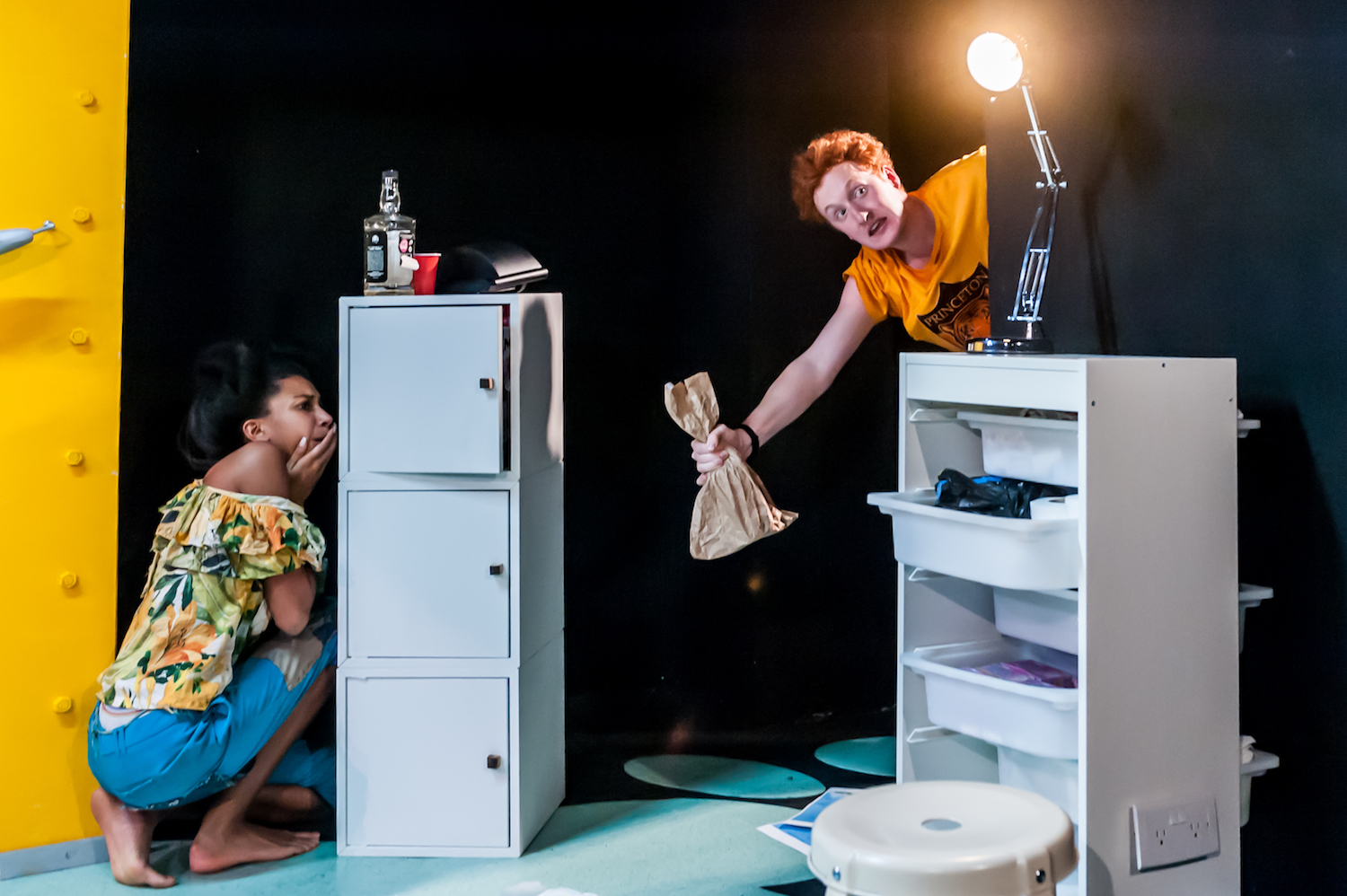
What would you do if you knew the world was about to end? Call your loved ones, spend all your money, ditch the diet…? All good answers – unless you’re marine biologist Jules, who has a different approach. He’s predicted the imminent apocalypse by observing the behaviour of his fish, but having failed to convince anyone to take him seriously about the threat, he’s made his own arrangements: luring unsuspecting student Jo to his lab/bunker for what she thinks is a fun night of no strings sex. It’s only when she discovers a drawer full of diapers that it dawns on her Jules’ promise of “intensely significant coupling” might have been more than just good marketing…

Photo credit: Lidia Crisafulli
Boom by Peter Sinn Nachtrieb is a play of two halves. It begins as an enjoyably off the wall romantic comedy about two people thrown together in the most extreme circumstances. Will Merrick and Nicole Sawyerr are great as the unlikely couple – he’s an earnest nerd who genuinely can’t understand her reluctance to be Eve to his Adam; she’s a wannabe journalist with a sharp tongue, dismayed by her latest disastrous life choice. They’re so terrible together that it actually works… at least to begin with.

Then the world ends, and things take a bizarre and mildly baffling turn with the sudden intervention of Barbara. Up to this point, Barbara’s been sitting in the corner, pulling levers and providing enthusiastic percussive sound effects for what we now learn is a museum exhibit several millennia from today, educating future generations about “the Boom”. Barbara’s not supposed to talk, she informs us, before going on to do exactly that – frequently, and at great length.

It’s here that the play seems to lose its way a bit, as Barbara, played with joyous abandon by Mandi Symonds, goes pretty quickly from amusing and lovable to verbose and more than a little irritating as she constantly interrupts proceedings to talk about her own issues. Some of her monologues are utterly surreal (in particular the bit where – a propos of absolutely nothing – she decides she must tell us how she was conceived; and no, it’s not in the way you might think) and her behaviour increasingly erratic, which is entertaining but gets in the way of the play actually making a point. As a fan of dystopian fiction who’s fascinated by the psychology of survival, I was looking forward to a juicy exploration of Jules and Jo’s evolving relationship, but we spend less and less time with them as Boom slowly but surely becomes Barbara’s story instead. Having enjoyed the randomness because I assumed it would all make sense in the end, I left 90 minutes later with very little idea what I was meant to be taking away other than a feeling of slight bewilderment, and a new respect for fish.

Photo credit: Lidia Crisafulli
All this doesn’t mean the play isn’t funny; it is, and all three members of the cast give great performances. But the humour lies mainly in the awkward relationship between Jules and Jo, and in Barbara’s lively personality, rather than in the end of the world story itself. There are fewer laughs in the second half of the play – partly because, well, the world’s ended and our characters find themselves in dire straits; and partly because by this point things have got so bizarre it’s difficult to know how to respond to anything that happens.

For this reason, it’s difficult to give a conclusive opinion on Boom. It may be that in a few days’ time, something clicks into place and I suddenly get it. Right now, though, I’m still trying to figure out what hit me.


Can’t see the map on iPhone? Try turning your phone to landscape and that should sort it. I don’t know why but I’m working on it… 😉

Review: Mrs Orwell at the Old Red Lion Theatre

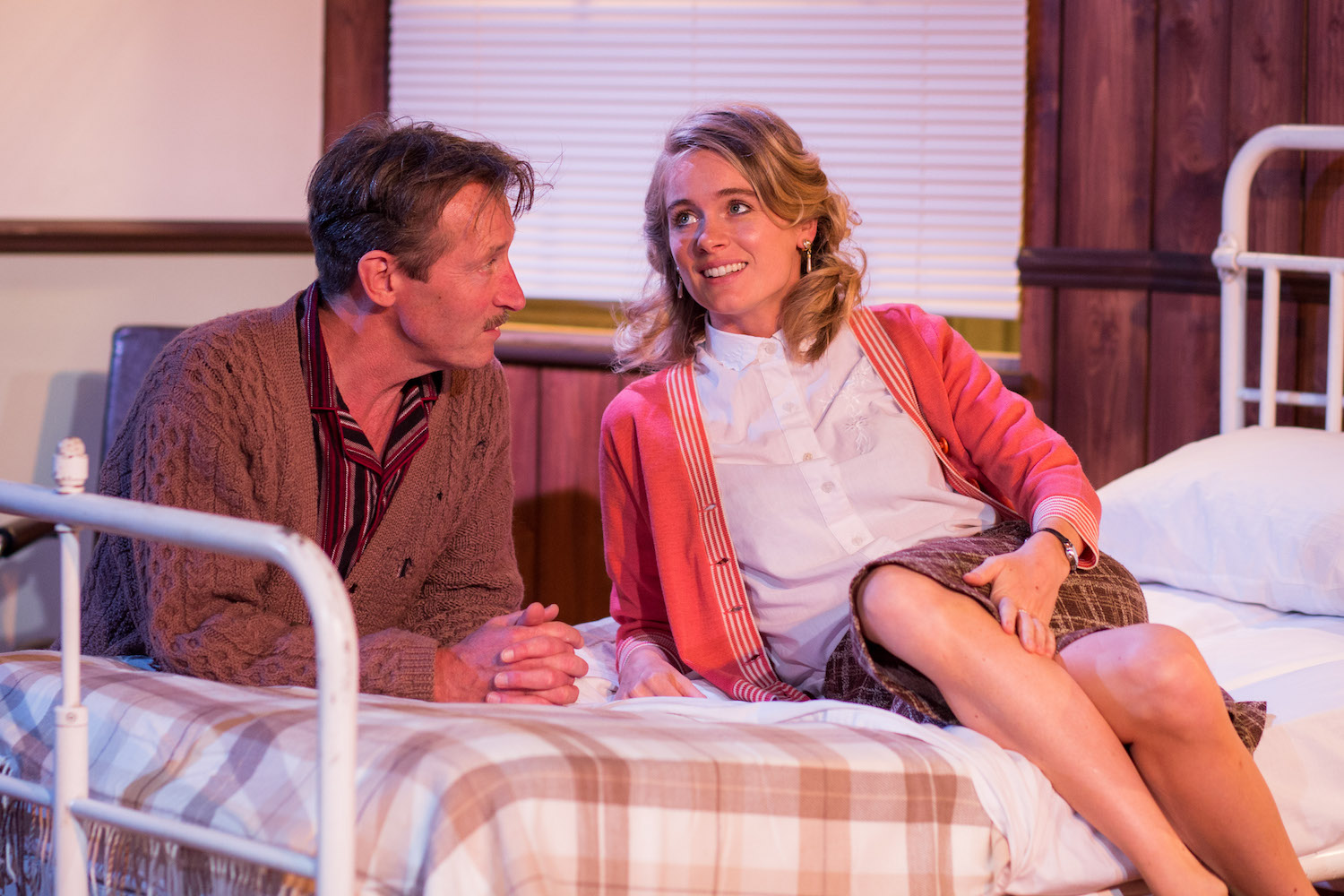
Fun fact to remember for future pub quizzes: George Orwell’s real name was Eric Blair. This is just one of the things to be learnt about the author of Animal Farm and 1984 in Tony Cox’s Mrs Orwell at the Old Red Lion. The play, directed by Jimmy Walters, charts the final months of Orwell’s life following the publication of 1984. Admitted to University College Hospital suffering from tuberculosis, a fragile George proposes to young, glamorous magazine editor Sonia Brownell, who goes on to become the second Mrs Orwell. Cox examines their relationship and the motivations of each party in this fascinating and moving new play, which also touches on Orwell’s politics, his guilt over the death of his first wife Eileen, and the universal need to be remembered after we’re gone.

Photo credit: Samuel Taylor
Despite its title, the play is just as much the story of Mr Orwell as that of his wife, and Peter Hamilton Dyer absolutely commands the stage for almost the entirety of the evening. A hunched, pathetic figure in clothes that are far too big for him, racked by ill health and desperately lonely and afraid, it’s tragically clear that his wits are still as sharp as ever, and he longs to believe he has at least three more novels in him. George loves Sonia without hope or agenda, knowing full well her heart belongs to the French philosopher Maurice Merleau-Ponty, and his simple joy in just being around her is devastatingly well played by Hamilton Dyer.

As his new wife, Cressida Bonas is equally compelling. Clipped, efficient and often impatient, she also demonstrates an obvious affection for George that makes it difficult to work out Sonia’s true motivation. While she certainly seems swayed by the suggestion that she could benefit financially from the marriage, her grief when she learns of his death and her desire to honour his final wishes appear genuine and heartfelt. She’s not a particularly likeable character in the story – all our sympathy is spent on the vulnerable figure of Orwell himself – but at the same time, she’s not a villain of the piece either, and we find ourselves admiring her sacrifice whilst still questioning her motives.

A brilliant cast is completed by Rosie Ede as Orwell’s no-nonsense nurse, Robert Stocks as his fiercely loyal publisher Fred Warburg, and Edmund Digby Jones in a particularly intriguing performance as Lucian Freud. His scenes with Bonas are marked by a simmering sexual tension, while with her husband he’s relaxed and humorously frank about his own and others’ shortcomings. (In fact the play in general is surprisingly funny, considering it’s a story about a dying man.)

Photo credit: Samuel Taylor
The majority of the action takes place in George’s hospital room, though some conversations are held in the corridor behind, amplified for our benefit and with the actors visible through the bedroom windows. This presents a slight confusion, because it isn’t made clear if these discussions can also be heard inside the room – perhaps this isn’t hugely significant given that George is always fully aware of Sonia’s romantic indifference to him, but it’s a minor frustration in an otherwise excellent production.

Cox delights in name-dropping famous writers and artists throughout as a way of reminding us that the play’s based on true events: Picasso, Dalí, Thomas Mann, Norman Mailer all get a mention. Even so, you don’t need to know much – or anything at all, really – about Orwell or his work to enjoy this very human story of love, fear and hope. Beautifully performed with warmth and humour, Mrs Orwell is a fascinating and entertaining insight into the life and death of a legend.


Can’t see the map on iPhone? Try turning your phone to landscape and that should sort it. I don’t know why but I’m working on it… 😉