Review: Dust at Soho Theatre

It’s said the beginning is a very good place to start – but Milly Thomas’ award-winning Dust does things a little differently, and starts at the end. Well, sort of.

After years of living with depression, Alice has just committed suicide – and wakes to find herself looking down at her own corpse on a morgue table. Initially, she’s fascinated by her new perspective and the freedom being dead gives her to go anywhere, see anything. But as she watches her loved ones grieve, and makes a few unwanted discoveries, it begins to dawn on her what she’s done – to them and to herself.
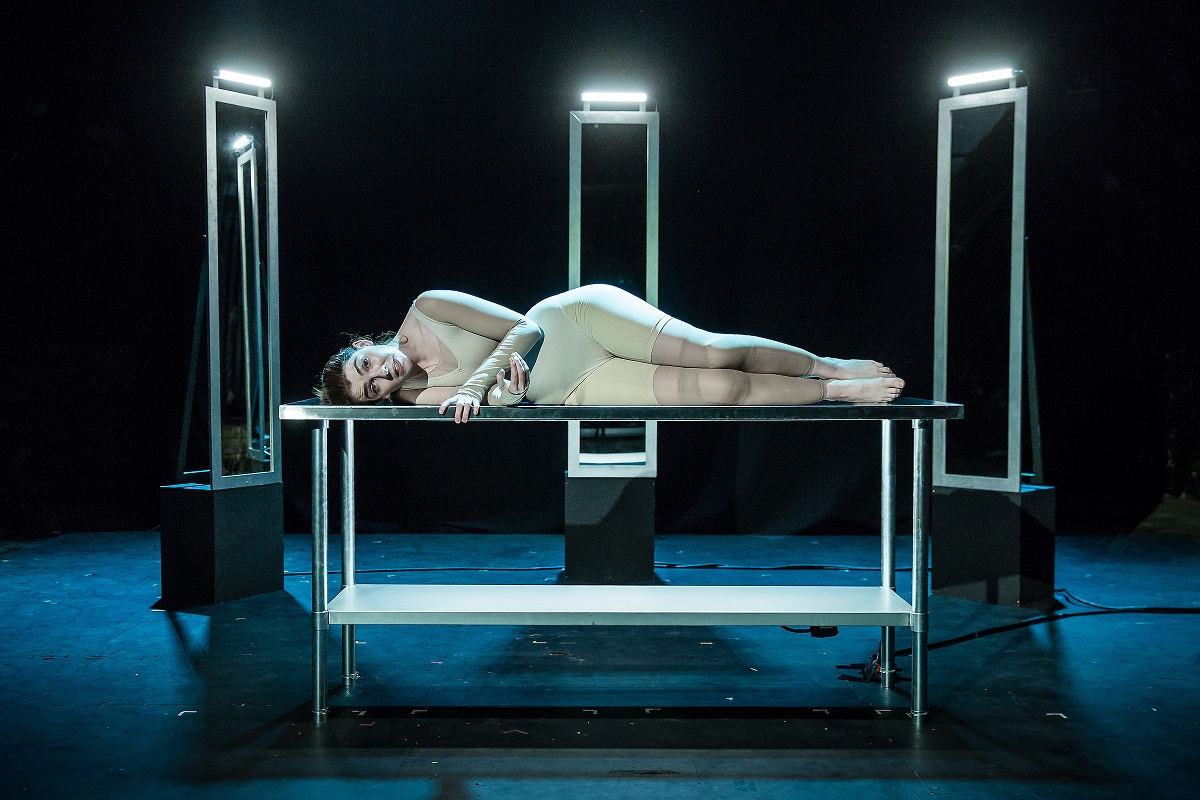
Photo credit: The Other Richard

It rather goes without saying that Dust is not an easy show to watch, but almost immediately it’s obvious that it is a vitally important one. Alice’s death was supposed to be an escape, but instead it becomes a perfect metaphor for the depression that drove her to kill herself: trapped in a world where she can’t talk to anyone, she’s forced to watch the people she loves go on with their lives, while she remains stuck.

Dust also makes the important point that depression doesn’t necessarily mean being miserable all the time. The show itself is surprisingly funny for a story about suicide, thanks largely to Alice’s own frank, unapologetic sense of humour, though much of the comedy comes with a sting in the tail. Alice’s posh aunt, for instance, who bursts into the house uninvited and takes over everything, is hilarious to watch, but also expresses some unforgivable – but sadly not as shocking as they should be – views about her niece’s life and death.

There’s also a great scene that takes us rapidly through a year in the life of Alice – a year in which she went to parties, gave her best friend makeup advice, had sex with her boyfriend – which serves as a powerful reminder that just because someone seems to be having a good time, that doesn’t necessarily mean they’re not privately suffering. I don’t think it’s an exaggeration to say that this is probably one of the best and most enlightening portrayals of depression I’ve ever seen on stage.

Photo credit: The Other Richard

It’s not just the writing, either; Milly Thomas’ performance, directed by Sara Joyce, is equally outstanding. Her Alice is witty and loyal and attractive, so that even without knowing her, we’re sad she’s dead – but she’s also selfish and bitchy and foul-mouthed and real enough to ensure that her story never feels overly simplistic (despite a passing reference to it, this is not Ghost). Her bewilderment and anguish as she looks back on her decision is almost physically painful to watch. At the same time, Thomas brings each of the characters and settings around her to life so vividly that it’s easy to forget you’re watching a solo show, on a set populated only by a few mirrors and a morgue table. It’s an inspired and inspiring performance, which leaves you shaken and moved, but also entertained and educated about this huge and complex issue.

Dust‘s run at Soho Theatre is sold out – and for good reason – but if you can beg, borrow or steal* a ticket I’d absolutely recommend it. Don’t expect an easy hour; this is a show about suicide and depression, after all, and one that doesn’t hold back on the details, either. But it also makes an eloquent contribution to the conversation about mental health, and that alone makes it a must-see piece of theatre.

*Don’t really steal, obviously.

Can’t see the map on iPhone? Try turning your phone to landscape and that should sort it. I don’t know why but I’m working on it… 😉

Review: Conquest at The Vaults

One of the interesting things about the #metoo movement that’s been sweeping social media since the Harvey Weinstein revelations is how it’s been just as much of a wake up call for women as it has for men. And not only in terms of realising the scale of the issue; many women will have spent time over the last few months re-evaluating incidents from our own lives that we might have previously played down, tried to justify to ourselves, or never even thought of as unwanted physical contact.

Alice’s #metoo moment happens in Boots, as she’s buying the morning after pill following a one night stand that on reflection, she’s not at all sure she wanted to happen but was basically too polite to put a stop to. As fate would have it, she bumps into Jo, a perfect stranger and committed feminist, who’s irritated by what she sees as Alice’s weakness (she cries a lot, apparently) but also spies an opportunity to recruit a new member for her feminist revenge group, Conquest.

Conquest’s mission is simple: to take revenge on men who’ve shown they don’t understand that no means no. They do this via the inventive medium of cupcakes – with one very unique ingredient. (I won’t go into detail, but let’s just say I went in half hoping we might get cupcakes as part of the show, and left very glad that we didn’t.) Whether this approach actually achieves anything is unclear, however, and when Alice freaks out on her first cupcake delivery run, it all begins to unravel.

Written by Katie Caden and directed by Jess Daniels, this funny and thought-provoking debut from PearShaped Theatre is brought to life by Lucy Walker-Evans and Colette Eaton, in a fast-paced performance that never flags in energy (their breaking and entering exploits are particularly fun to watch). Along the way, they take on a variety of characters, among them Jo’s chain-smoking mum Angela – also a feminist, but of the old-school variety – and Alice’s nonplussed, boxers-clad revenge target, Dave. This multi-roling approach is acknowledged early on in one of many direct addresses to the audience, but a warning that we might get confused proves unfounded; the characterisation of each is distinct, and smoothly handled by both performers as they scurry from chair to chair, adopting different postures and accents as they go.

In the end, though, this is Alice and Jo’s story; a story of two very different women drawn together by their need for solutions to a problem so massive that it’s impossible to even fully get your head around, let alone know where to start in fixing it. (Which raises the question: why should it be the responsibility of women to fix it anyway?) What makes the two unlikely friends so appealing to watch, besides their constant amicable bickering, is that there’s far more to both of them than their initial stereotyping would suggest. And while all their plans seem to end in disaster, at least they’re doing something.

At a time when sexual consent is high on many agendas, Conquest is a timely and important piece of work, which exposes the complexity of the issue in a way that speaks to both male and female audiences. And if it makes you think twice the next time someone offers you a cupcake – well, that’s probably a small price to pay.

Conquest‘s run at Vault Festival 2018 is now over – but keep an eye on @pearshapedplays for future news.

Can’t see the map on iPhone? Try turning your phone to landscape and that should sort it. I don’t know why but I’m working on it… 😉
Review: The Quantum Physics of My Heart at The Vaults

Writer and performer Amy Tobias introduces The Quantum Physics of My Heart as a lecture about science, which will combine anecdotes from her life, audience participation and experiments. I won’t lie – as someone who didn’t particularly love science at school, and who’s definitely not a fan of audience participation, this formula presented me with mild cause for concern – particularly having innocently taken a seat in the front row (seriously, when will I learn?). But then something unexpected happened: in a pleasantly surprising chemical reaction, everything came together to produce a show that’s funny, endearing and even a bit educational.

Photo credit: Mann Bros Media

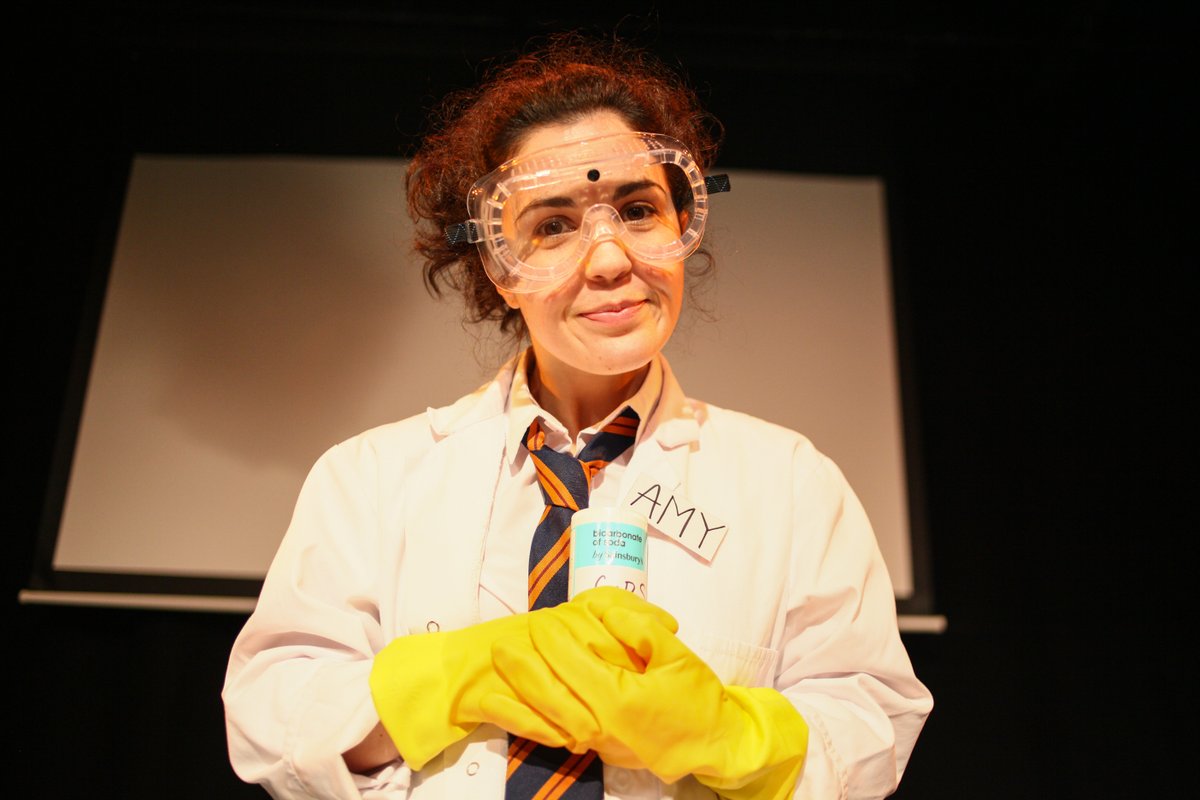
The magic ingredient, I suspect, is Amy Tobias herself. Taking full advantage of the fact that – as she herself admits – a lot of people think she’s still a child (even though she’s not), she plays her teenage self with twinkly enthusiasm, unflinching honesty and a self-deprecating humour that proves very difficult to resist. Over the course of an hour, to a soundtrack of 90s hits and video clips from classics like Clueless and Jurassic Park, she reflects on her life between the ages of 13 and 16, including teenage crushes, her first house party, and an inappropriately placed hand on her 16-year-old knee.

The aim of all this is to try and prove the hypothesis that science can be used to explain everything. Following in her scientist dad’s footsteps, Amy loves the subject, and throughout the show manages to successfully bend various theories to make sense of life’s Big Questions – or at least what pass for Big Questions when you’re a teenager: things like why your BFF doesn’t want to be friends any more, or why last week you fancied your science teacher, and now you’re more interested in the ICT technician. But eventually she encounters a problem that can’t be explained away so easily – the aforementioned inappropriate hand – and is forced to look elsewhere for answers.

Photo credit: Mann Bros Media

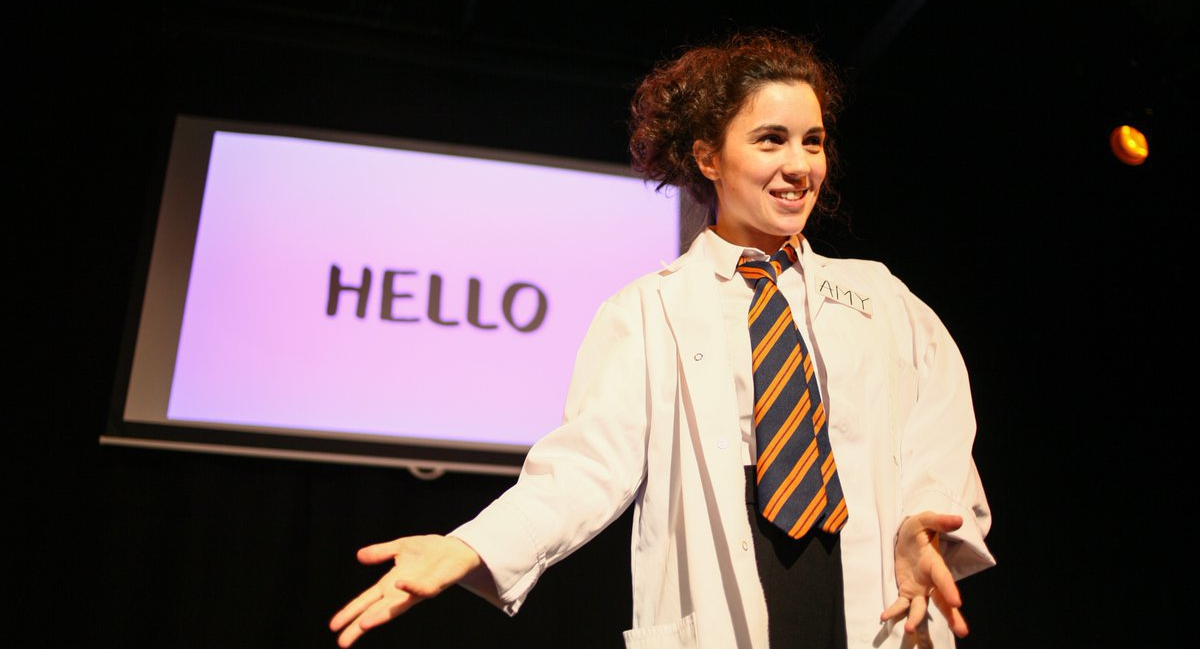
Directed by Roxy Cook, the action is indeed framed very much as a (slightly unconventional) lecture, with audio and visual aids on a projector screen to help illustrate the show’s anecdotes and theories. Meanwhile down on the ground, Amy bounces around the stage in her school uniform and a lab coat, vividly recreating events so that we’re totally drawn into her story and come to really care about what happens to her.

As for the audience participation, it’s all very harmless, mostly consisting of us all delving frequently into our “experiment bags” and producing 90s-themed props (some of the edible kind). The role each of these plays in Amy’s experiments is tenuous at best, but their inclusion brings the show to life in a fun, nostalgic way. And for those of us who also grew up in the 90s or 00s, it’s a great opportunity to reflect on our own teenage years and the important moments – and music – that made us who we are today. I only wish all my science lessons at school had been this much fun.

Can’t see the map on iPhone? Try turning your phone to landscape and that should sort it. I don’t know why but I’m working on it… 😉
Review: Foul Pages at The Hope Theatre

To quote the timeless classic Shakespeare in Love (not sarcasm, I love that movie): “Love, and a bit with a dog – that’s what they want.” Robin Hooper clearly subscribes to the same belief; his play Foul Pages has both – and Shakespeare too, though in this case it’s not him who’s in love but pretty much everyone else. Will, meanwhile, is more interested in refining his latest work, As You Like It, whilst fending off interference from the Countess of Pembroke, a fellow writer full of helpful suggestions, and from King James I, who’s become infatuated with one of the actors and insists that he be given the lead role. The purpose of the production is to charm the monarch into pardoning Sir Walter Raleigh, who’s days from execution for treason – but pleasing the king comes at a cost for more than one member of the company.

Oh, and there’s also a talking dog.

Photo credit: LHPhotoshots

Ian Hallard appears as Shakespeare, but such are the scandalous goings on that for once the legendary playwright isn’t the centre of attention. As his all-male company is torn apart by jealousy, ambition and more than a little sexual tension, all Will can do is watch in bemusement and do his best to hold everything together, along with straight-talking maid Peg (Olivia Onyehara) and the king’s devoted Scottish bodyguard Mears (Jack Harding).

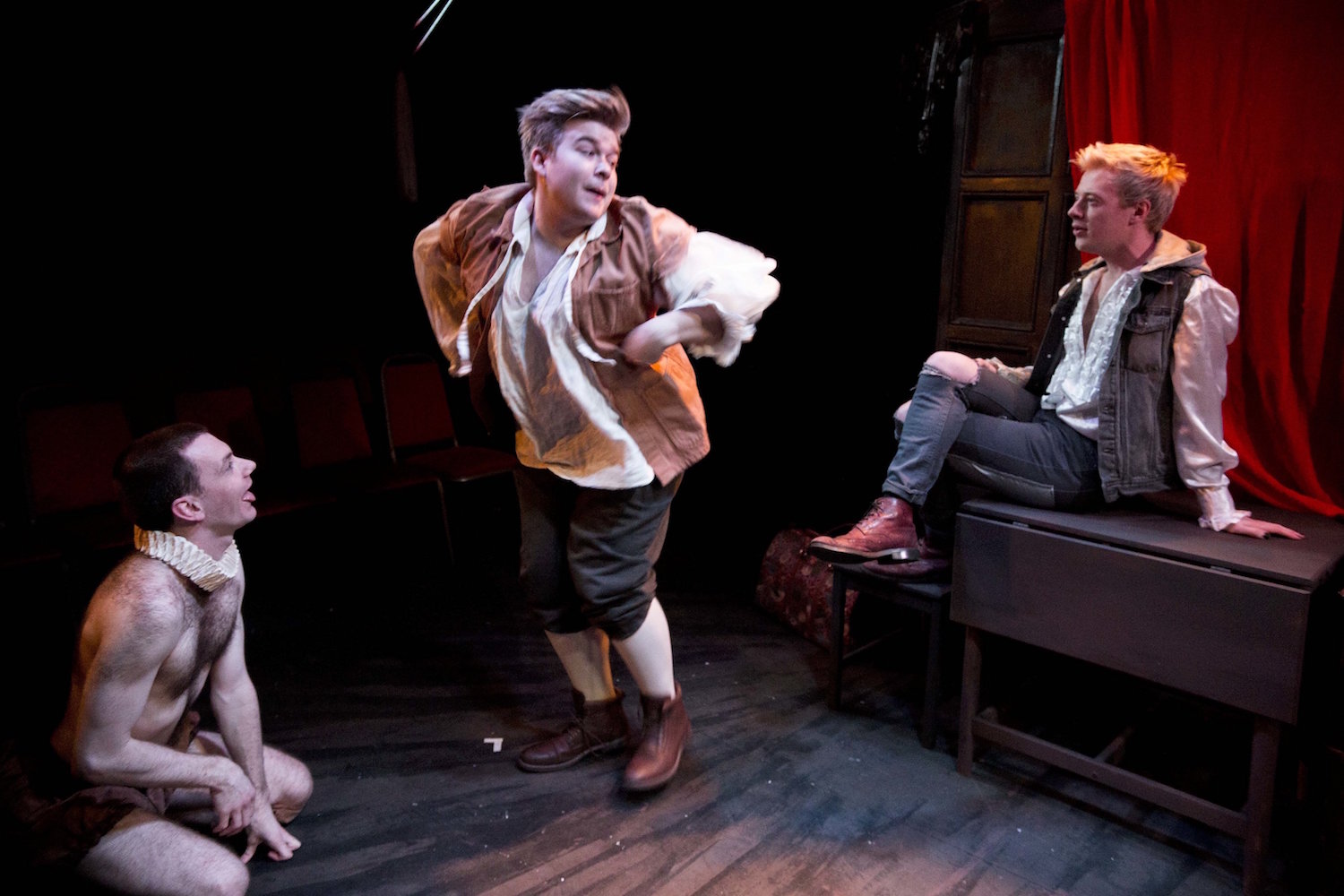
Meanwhile it’s the more flamboyant characters – Lewis Chandler’s shunned actor Alex, Clare Bloomer’s eccentric Mary, Countess of Pembroke, and Tom Vanson’s lovelorn King James – who take centre stage, each driven by their own desires to take potentially catastrophic actions. There’s poignant work from Thomas Bird and Greg Baxter as actors Rob and Ed (also Shakespeare’s brother), whose fledgling relationship is threatened by the king’s interference. And then there’s Chop the dog, played to scene-stealing perfection by James King, who’s not only got all the animal behaviours down but also gets the most laughs, with wry observations on the bizarre human behaviour going on around him.

Photo credit: LHPhotoshots

Though the action is set in 1603, director Matthew Parker gives the production a modern twist; the costumes are an intriguing mix of 17th and 21st century, and rapid scene changes are punctuated by loud music and flashing lights, creating a sense of urgency as the stakes become ever higher and events take an unexpectedly tragic turn. Rachael Ryan’s economical set allows us a glimpse of goings on both upstairs and downstairs at Wilton, while still somehow allowing enough room on the tiny Hope stage for nine people to come out and treat us to an energetic jig at the end of the show.

There’s a political detour in the plot that doesn’t quite fit – it arrives out of nowhere and is just as quickly dealt with and forgotten – but that aside, Foul Pages is a compelling and irresistibly entertaining tale of love, lust and theatrical ambition that may just make you see As You Like It, and Shakespeare himself, in a whole new light.

Can’t see the map on iPhone? Try turning your phone to landscape and that should sort it. I don’t know why but I’m working on it… 😉
Review: Moments That Changed Our World at the Royal Exchange Theatre

Guest review by Aleks Anders

The Royal Exchange Elders, a group of keen theatre-going amateurs over the age of 60 who attend weekly sessions at The Royal Exchange, have put together this quite extraordinary and quirky piece of theatre which celebrates age. With some pathos each of the 11 strong cast – including a couple of recorded stories from other members – tells us the moments in their lives which shaped them, changed them and made them the person they are today.

The stories intertwine, and the chronology is lost after the first sentence, but somehow this doesn’t matter. There is humour, bonhomie, and a sense of fellowship amongst the cast that one seldom sees, or at least is aware of, amongst professional actors.

Though entitled rather grandiosely as Moments That Changed Our World, the large global political or geographical events which can and do shape many peoples’ lives are in short supply in this one hour long celebration of the third age of mankind. Instead it focuses on the smaller and more personal instances which affect the individuals in their own special ways. Becoming an actress and receiving her first applause; being homosexual at a time when it was illegal and offensive; turning 60; the joys and dangers of computer technology; a divorce.

The stage is set with audience on two opposing sides whilst the other sides of the rectangle are used as a screen to project film, photos and other footage to exemplify and augment the narrative. The space is intimate, and when not acting, the cast sit on the front row; but the staging is far from optimal. End on would have worked much better.

There are darker and more serious moments aplenty too. A young black lady coming over to work for the NHS, and finding our island cold, unwelcoming, insular and above all, intolerant and racist (so, nothing has changed then??!!); another lady in her youth fighting for Women’s Lib and equality (and still nothing has changed!); whilst an ardent CND campaigner tells of his moments in rallies, and asks if in reality, his campaigning has actually amounted to anything changing on a global scale.

With group hugs and plenty of friendly encouragement, these tales are spoken about with a hint of nostalgia, but with a huge zeal and zest for life. And hooray to that!

As the final lines of the play ring out… “Time is not on our side, so let’s live for today; and tomorrow I will… tomorrow I will wake with a smile and be grateful. I WILL!”

Directed by The Elders’ Company leader Andrew Barry, and created by him and the company through workshops and devising, the 11 members telling their moments on stage are Sheila Colman, Christine Connor, Gordon Emerson, Graham Gillis, Brenda Hickey, Christopher Littler, Jacquie Lang, Estelle Longmore, Don McGregor, Glyn Treharne, and Kenneth Walker. Well done to all of you, it’s a wonderful idea, bravely and sensitively told, and since “it’s easy to stop playing as you get older” – please, don’t stop!