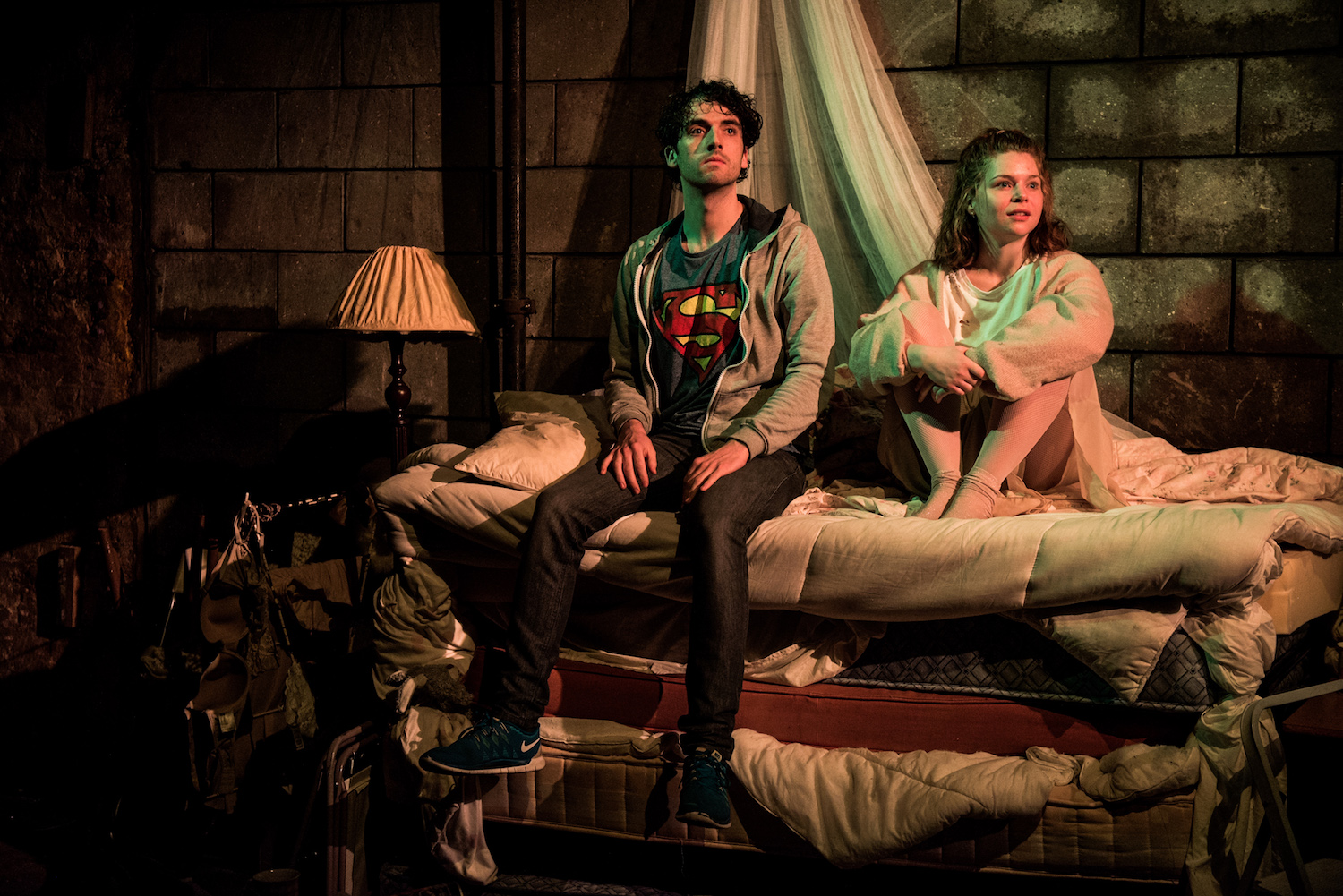
Review: The Dog Beneath The Skin at Jermyn Street Theatre

On the face of it, W.H. Auden and Christopher Isherwood’s eccentric fairy tale The Dog Beneath The Skin bears little resemblance to the world we live in today – but scratch beneath the surface and there’s a strong note of political satire that can be read as a cautionary tale for the 21st century.

The play’s central character, unassuming English gent Alan Norman (Pete Ashmore), is picked at random for a quest: if he can track down his village’s missing heir Francis Crewe, he gets a share in the Crewe fortune and the hand of Francis’ beautiful sister in marriage. Which is all well and good, except Francis has been gone ten years, and Alan is far from the first to undertake this perilous search.
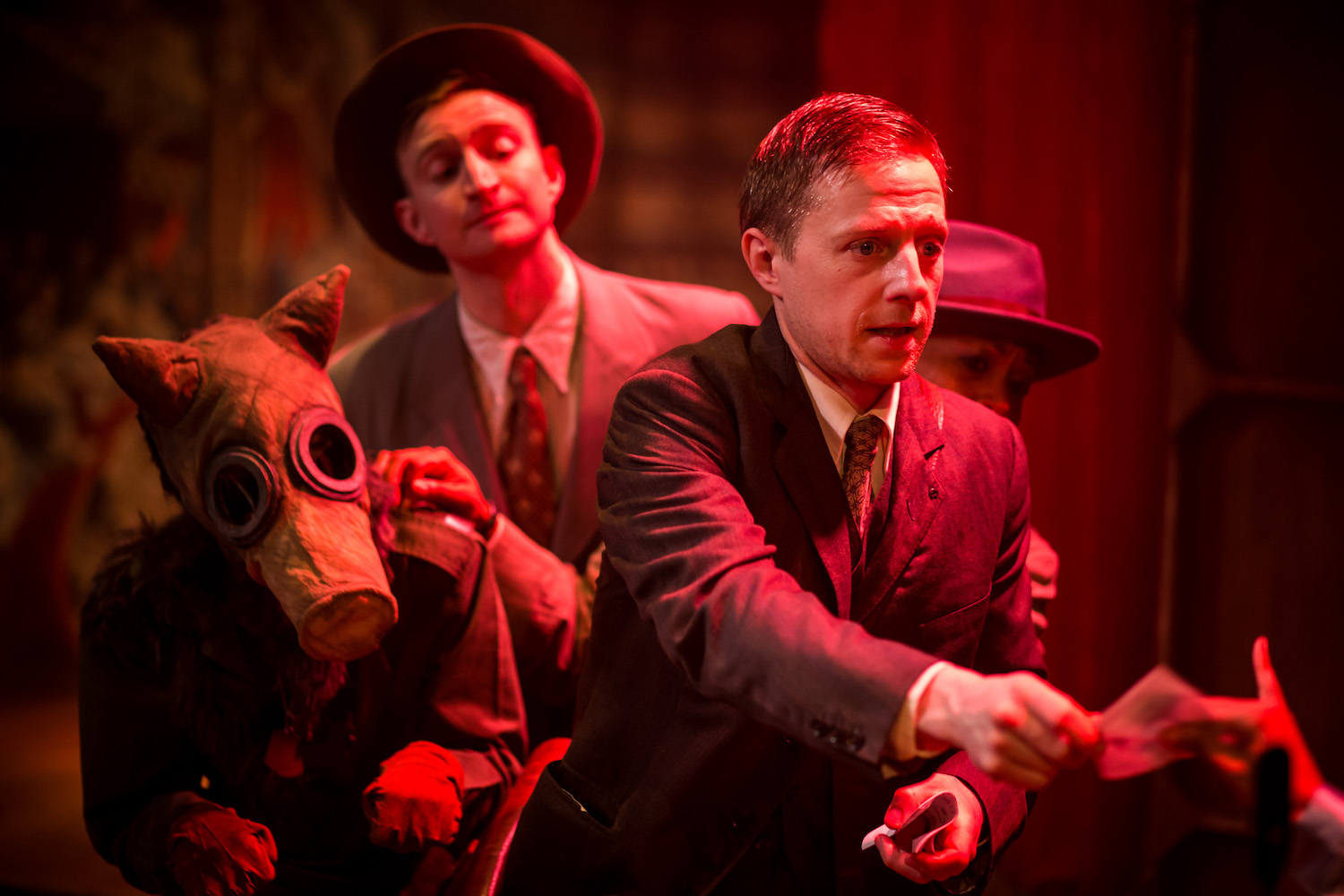
Photo credit: Sam Taylor (S R Taylor Photography)

Undeterred, our hero sets boldly off across pre-war Europe, accompanied by a dog from the village (Cressida Bonas) whose oddly human behaviour doesn’t seem to surprise or concern anyone. As they journey through fictional European nations that feel a million miles from the charm of rural England, they meet monarchs and prostitutes, lunatics and lovers, but find no trace of the missing Francis. Despondent, the pair return home to the village of Pressan Ambo – except it’s not quite how they remember it. (Side note: I was interested to discover, while researching the play, that Auden and Isherwood each wrote a different ending. This particular production uses Isherwood’s marginally more upbeat conclusion.)

To say that the play has a bit of everything feels like an understatement; I couldn’t pin it down to one particular style or genre if I tried. At times it’s laugh out loud funny, at others darkly ominous, and occasionally entirely baffling. In other hands it could have been a bit of a mess, but under Jimmy Walters’ direction, a competent and incredibly hard-working cast – some of whom play no fewer than ten characters each – ensure we remain entertained and interested throughout, even when we have little or no idea what’s actually going on.

As the only two actors to play just one role each, Pete Ashmore and Cressida Bonas give enjoyable performances as Alan and The Dog, but it’s the ensemble who really bring the play to life. I particularly enjoyed Edmund Digby Jones’ smarmy vicar turned dictator and Eva Feiler’s obsequious master of ceremonies, while Suzann McLean is compelling in brief appearances as a grieving mother, whose words of warning are dismissed by the villagers.

Photo credit: Sam Taylor (S R Taylor Photography)

The production makes maximum use of the limited space available, with one end of Rebecca Brower’s set devoted to a stage area that suggests a lot of what we’re seeing is merely a performance (it’s not what you say, it’s the way that you say it, etc). Scene changes are incorporated seamlessly into the action, while a recorded voiceover provides poetic narration to keep things moving along.

The Dog Beneath The Skin was first performed in 1936, as Europe faced head on the rise of fascism and the threat of World War 2. That dark period may now be the stuff of history books, but the disquieting reminder as the play begins and ends that “this might happen any day” forces us to consider if where we’re headed right now is really that different. It is without doubt a bizarre play and consequently might not be everyone’s cup of tea, but the cast’s enthusiasm and the script’s underlying relevance make this a very worthy and welcome revival.

Can’t see the map on iPhone? Try turning your phone to landscape and that should sort it. I don’t know why but I’m working on it… 😉

Review: Stuffed at the Brockley Jack Studio Theatre

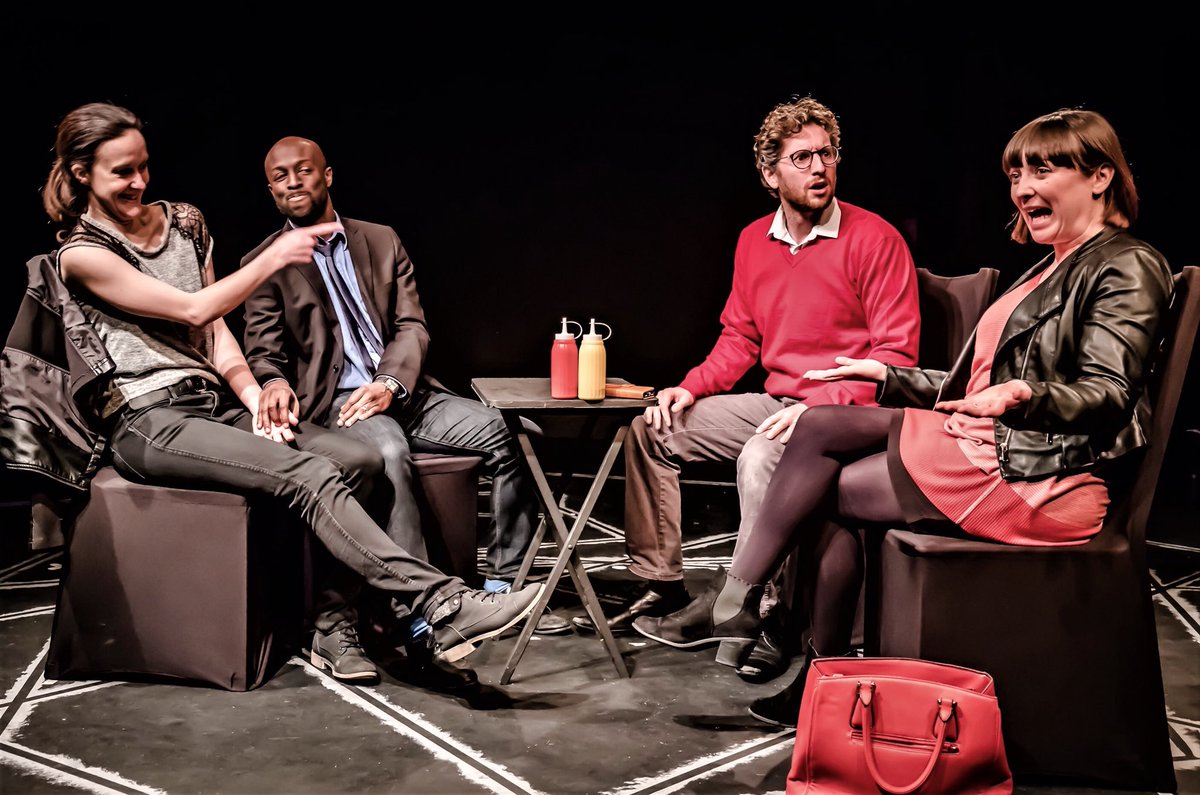
I can’t pretend to know what Kim and Jack, the couple undergoing IVF in Lucy Joy Russell and Holly McFarlane’s play Stuffed, are going through. Having said that, as a childless woman in my 30s (who recently had a heated discussion with a male friend after he made the mistake of saying, in genuine bewilderment, “But don’t all women want kids?”) there are moments in the play that I can relate to a little bit too well.

Red Squash Theatre were most recently seen at the Hen and Chickens in their extremely daft Shakespearean comedy, Macbeeth. Stuffed is quite a different project and given the topic it unsurprisingly feels much more grounded in reality, but it retains a little of Macbeeth‘s delightfully surreal humour – largely in its portrayal of healthcare professionals, for some reason.

Photo credit: Robbie Ewing

These moments aside, it’s actually quite a sad story, about a couple whose desperate need for a baby has taken over their lives to the obliteration of everything and everyone else, and to the point where even they can’t remember why they wanted to be parents in the first place. Every time the IVF fails, they have to deal not only with their own disappointment but also that of friends and acquaintances, whose well-meaning attempts to be helpful and comforting just end up making things ten times worse.

Faye Maughan and Ben Scheck are likeable and convincing as Kim and Jack, but it’s the scenes where their facade of brittle optimism slips and we glimpse the turmoil beneath that they really come into their own. Maughan in particular has a lost, fragile and exhausted look; this is most evident during scene changes, when she lingers aimlessly on stage while the other cast members rearrange the furniture around her.

Also excellent are Dorothy Cotter, as Kim and Jack’s old uni friend Grace, now a mother of three, and Alexander Tol as her husband Colin, a lovable geek with a heart of gold. It’s interesting and refreshing to see that it’s Grace, not Kim, who’s most excited about reigniting their friendship, and a welcome reminder that having children – no matter how much you love them – doesn’t make your life magically complete. Co-writer Holly McFarlane plays a number of roles but particularly stands out as Kim’s mum Frances, the one character who always seems to know exactly the right thing to say. Finally, director Rory Fairbairn completes the cast with a brief, humorous appearance as another friend’s teenage son.

Photo credit: Robbie Ewing

From my own experience I can confirm that this heartwarming and poignant comedy – based on co-writer Lucy Joy Russell’s own experience of IVF – will have women of a certain age nodding in agreement (while also enjoying an excellent soundtrack of 90s tunes from Oasis, Alanis Morissette, Meredith Brooks and more). But as the play shows us only too well, the pressure and desire to have a baby isn’t something that only affects women; Jack’s pain is just as real as Kim’s, yet he often goes unnoticed as everyone falls over themselves to offer his wife sympathy and encouragement. And through Grace and Colin we see the story from the other side – the discomfort of never knowing the right thing to say, but also the sadness of seeing a friend so consumed by the idea of parenthood that they begin to slip away from us. Well acted and a bit of a tearjerker, this little gem of a play is definitely worth a visit.


Can’t see the map on iPhone? Try turning your phone to landscape and that should sort it. I don’t know why but I’m working on it… 😉

Review: Abducting Diana at the Hen and Chickens Theatre

The media has long had the power to influence (some might say manipulate) our hearts and minds – but 2018 seems a particularly relevant moment for a revival of Dario Fo’s Abducting Diana, if only to prove that we’ve learnt nothing since the play was first written in 1986.

Media tycoon Diana Forbes McKaye is in the middle of a romantic liaison with a guy called Kevin when she’s kidnapped by three masked figures. However, she quickly turns the tables on her incompetent abductors and concocts a plan to cut out the middleman, make them all rich, and save her own skin. Quite straightforward, you might think. Except that Diana isn’t really Diana, Kevin isn’t really Kevin, there’s a man in the fridge with electrodes attached to his halluxes (that’s his big toes to you and me)… and where did that priest with the big nose come from?

As you might imagine, everything gets rather chaotic, rather quickly, with existing characters switching allegiances, and new ones popping up just when you thought the story couldn’t get any more complicated. Such is the air of general mayhem that the play almost forgets to make its point, and the characters have to return to the stage in the final moments to remind us why we’re all there – namely, corruption in high places and the exploitation of the working classes (in this scenario the hapless kidnappers, who seem to come out of every allegiance a bit worse off).

The company are enthusiastic and deliver some strong comedy performances, although in all but two cases, Fo’s characters don’t give them a huge amount of material to work with. As the only one of the three kidnappers we really get to know, Marius Clements has the thankless task of delivering most of his lines from inside a fridge, but rises to the occasion with spot-on comic timing. And Elena Clements plays Diana with cool sophistication and withering sarcasm, keeping her head when all around her are losing theirs – which has the unfortunate side effect of leaving us a bit confused over whether we’re supposed to cheer or boo her resourcefulness.

There are a few issues with Michael Ward’s production; not all the chaos feels entirely deliberate, and there are times – particularly when everyone’s on stage at once – when pace and volume could both come down a notch to ensure the audience is able to keep up with the plot’s more complex twists and turns. It’s also not very clear when the play is set; some of the biggest laughs are inspired by the kidnappers donning masks that feature the faces of Trump, Farage, Boris and the like – but while these topical references to the ruling elite make perfect sense in light of the play’s message, they feel confusingly out of place in a room where people still use typewriters, tape recorders and cheque books.

If you’re after sharp political commentary, Abducting Diana is possibly not the play you’re looking for. What it does offer, however, is high-energy, absurdist fun, performed by a committed cast who are obviously enjoying themselves immensely. Though at times a little unpolished, the play promises an hour of farcical mayhem, and on that score it certainly delivers.

<em>Can’t see the map on iPhone? Try turning your phone to landscape and that should sort it. I don’t know why but I’m working on it… ;)</em>

Review: Ballistic at the King’s Head Theatre

Following the recent tragic events at Marjory Stoneman Douglas High School in Florida, global attention has been focused very much on the issue of gun control. As well it should; it’s very obvious to anyone willing to see it that when it comes to guns, America has a serious problem and needs to take action.

There is a downside, though, to the intense focus on guns in the wake of Nikolas Cruz’s deadly rampage, because it means nobody’s looking at the tragedy’s other contributing factors. And if anybody does, they’re likely to be accused (often with good reason) of trying to deflect our attention from the main issue. “Guns don’t kill people; people kill people,” are words we’ve heard a lot over the past few weeks (and months, and years), and while we may not agree with how they’re used, that unfortunately doesn’t make them any less true.

Photo credit: Tom Packer

All of which is a very longwinded way to introduce Alex Packer’s Ballistic, a play that is decidedly not about guns. In fact, guns have been taken out of the equation almost entirely by setting the story in the UK, where our common sense laws – enacted after the Dunblane massacre in 1996 – mean if you want to shoot someone you have to put a bit more work into getting your hands on the means to do it. As a result, the play allows us, for once, to focus undistracted on some of the other issues in play when someone plots or commits this kind of crime.

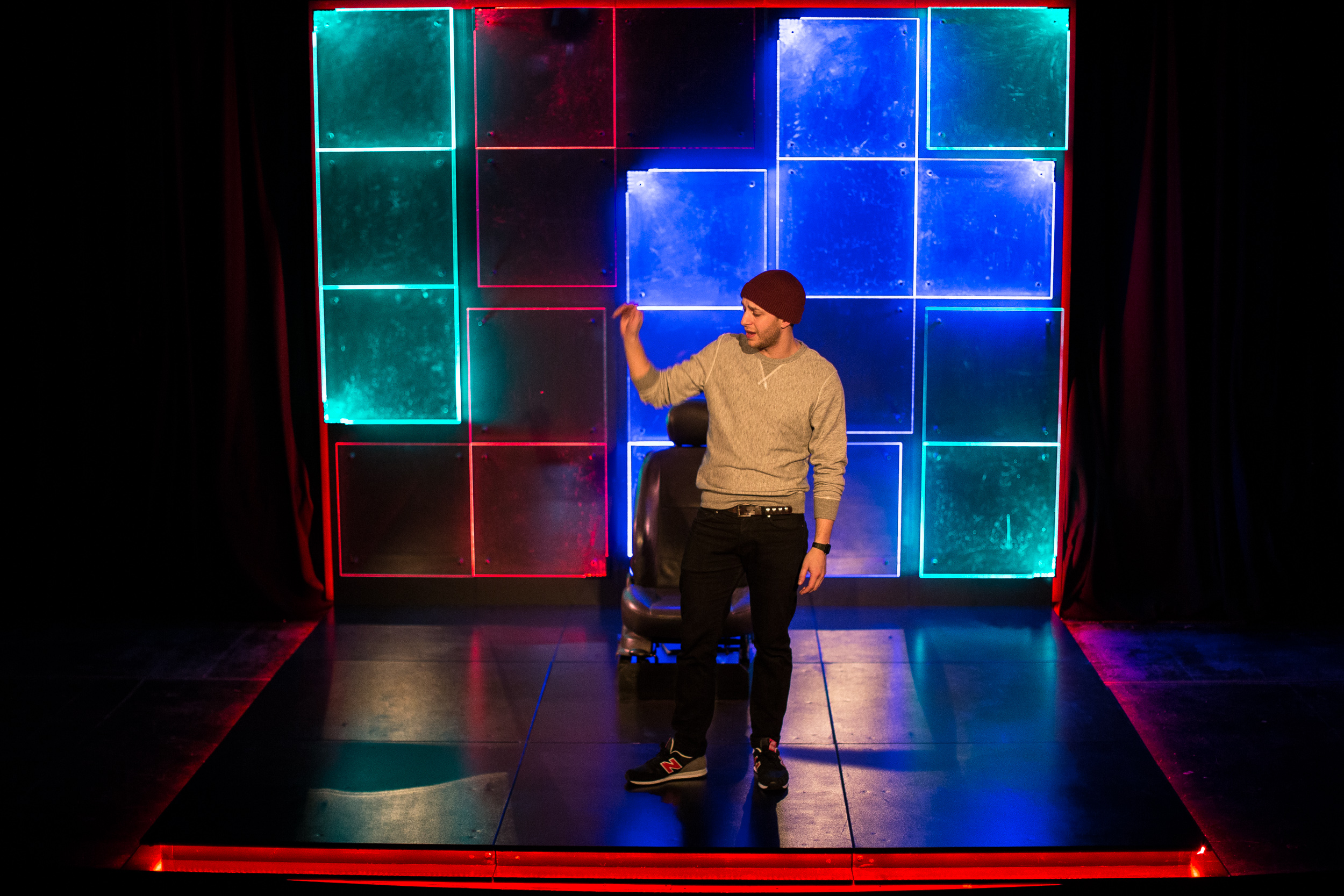
Ballistic is the story – fictional, but based on true events – of a nameless teenager, who’s driven by various factors to commit an act of terrible violence. Using the rather perfect image of a game of Tetris (reflected brilliantly in Frances Roughton’s simple but effective set), where all it takes is a couple of pieces out of place to destroy everything, Mark Conway tells us his character’s story of betrayal, bullying and rejection, all set in a world where the internet and social media have the power to destroy our lives or make us famous with just the click of a button.

The point isn’t to make excuses for him; the experiences he describes happen every single day to countless other teens, 99.99% of whom don’t go on to claim them as a motive for murder. What the play wants us to examine is our own reactions to what we hear, and to consider where the story could have gone a different way if just one person had responded differently at any point. Conway and director Anna Marsland prove themselves masters of misdirection; we’re so busy laughing at the funny stories he’s telling that we don’t notice the subtle, bitter shift in Conway’s tone, or that he stopped seeing the funny side long ago, until he suddenly explodes. Another way of looking at the Tetris metaphor: if you take your eye off the game for even a second, things can go bad really quickly.

Photo credit: Tom Packer

Mark Conway gives an exceptional performance as the troubled teenager, starting out with an air of naive innocence and enthusiasm that gradually slips away, until finally we’re left with the dead-eyed killer we know all too well from the news. He addresses the audience directly throughout – but eye contact that initially comes across as cheeky and flirtatious is, just an hour later, thoroughly chilling.

We tend to think of mass killings like the one in Florida as something far away, a drama that we can watch unfold from the comfort of our own safe shores. Ballistic brings the topic right on to our doorstep and urgently asks us to confront a few harsh realities. Here in the UK, such attacks are mercifully a rarity thanks to the aforementioned common sense gun laws, but that doesn’t mean they can’t happen, or that we don’t have a role to play in preventing them – if not directly, then by addressing the culture that keeps allowing them to happen. That might not seem like much, but it could turn out to be the Tetris piece that stops everything from crashing down around us.

Can’t see the map on iPhone? Try turning your phone to landscape and that should sort it. I don’t know why but I’m working on it… 😉
Review: nest at The Vaults

I think most of us would agree the idea of building a nest – a place to retire to and shut out the outside world – has been pretty tempting this week. The difference is that Jade and Liam, the couple in Katy Warner’s off-beat love story nest, aren’t sheltering from a temporary weather crisis but from a society in a state of ever-worsening decline, where shopping trolleys being pushed from the roof of their tower block is a daily occurrence, and all the windows have been removed from their stairwell to discourage people from trying to live there.

Jade (Charlotte Jane Higgins) hasn’t left their messy, run-down flat in a long time; she’s comfortable where she is, and sees no reason to risk a trip into the dangerous city streets. We stay there with her, so our knowledge of what’s going on outside mostly comes from Liam (Arthur McBain), who still maintains some social and family relationships beyond their limited circle, and is trying desperately against all odds to find a job. Everything comes to a crisis point when Jade gets pregnant, and the two have to weigh their excitement about being a family against the prospect of bringing a baby into such a messed-up world.

Photo credit: Alex Harvey-Brown

Directed by Yasmeen Arden, the story’s not told in chronological order, so takes a little bit of piecing together – but in a way it doesn’t matter. Jade and Liam’s life together is claustrophobic and repetitive; they have the same conversations over and over, sometimes word for word, and if not for the baby you can’t help feeling that they’d just have stayed this way forever. Their devotion to each other is touching – in a world that’s falling apart, these two vulnerable souls have been left holding tightly to the one thing they know they can rely on – but theirs is also a very dysfunctional relationship, where control and jealousy are a common feature of every conversation.

Arthur McBain’s Liam is the more obviously likeable of the two; wracked by guilt and frustration over what he sees as his own uselessness, he tries to keep Jade happy by bringing her thoughtful gifts and constantly backing down in arguments. But his kind nature leaves him open to manipulation – and not only by her; their first encounter only happens because his friend Pete played a practical joke on him. Meanwhile Jade, played by Charlotte Jane Higgins, is a tougher character to get along with, at least at first. She knows she can get her own way with Liam by sulking and threatening – but it’s only later we begin to understand the intense fear that motivates her behaviour: fear of what’s outside, of being alone, and of what the future holds.

Photo credit: Alex Harvey-Brown

The Vaults’ Cavern space works well as a venue, drawing our eye immediately to the shabby cosiness of Holly Pigott’s set. It’s a total mess, with discarded clothing, furniture and rubbish everywhere and a general sense of not having been cleaned in some time, and yet when compared with its damp, echoey surroundings it does feel like a haven of sorts.

The play, which marks Australian writer Katy Warner’s English debut, was inspired by a true story, and paints an uncomfortable picture of two people left behind by society and looking for a way out. We may not yet quite be at the point of raining shopping trolleys, but that doesn’t mean these characters don’t already exist – and maybe they’re closer than we think.