Interview: Clementine Lovell, Pop-up Opera

Pop-up Opera was established in 2011 with the goal of encouraging more people to see and enjoy opera. After recently performing their first ever tragedy, I Capuleti e i Montecchi, the company return to comedy for their new production of Rossini’s Il Barbiere di Siviglia, which will – as always – take them to some unique and unforgettable venues around the UK.

Director Clementine Lovell founded Pop-up Opera on her return from living in Italy. “When I began training as an opera singer I had mixed reactions from my friends. Opera wasn’t really their thing – one even claimed to be ‘allergic’ to it. That stayed with me, and I wanted to prove them wrong, to show them that opera could be magical, hilarious, devastating or moving.

“Opera is so much a part of Italian culture, so broadly appreciated, and is performed everywhere, not just in the big houses. I grew up in a small village in the UK miles from an opera house. We never went to see it, it wasn’t an option. My uncle has a barn where he hosts folk and blues events and we put on an opera there for a largely non opera going audience. They loved it. It made me think about how the setting can have a bearing on people’s enjoyment, or their willingness to give it a go.”

Photo credit: Richard Lakos

Each new space presents a unique challenge: “The production grows and evolves as it pops up in different places. We stage it in the rehearsal room and then adapt it to embrace each venue, so every night is different. The performance spaces vary wildly in size, shape, acoustic, feeling. We get in to the space on the day and start working out the entrances, exits, how to involve the audience… The performers have to think on their feet and be willing to allow some freedom and spontaneity. I think this keeps it fresh and creates a very special atmosphere.”

Clementine has countless happy memories of the unusual venues in which the company have performed. “One of our first venues was a boat made of scrap metal in Shoreham. The stairs were made out of an old car and the room we performed in had previously been part of a bus. We once performed 100ft underground in Clearwell Caves – to make some of the entrances the singers had to grope their way down a very dark tunnel with only headlamps to light the way, and one of them was terrified of bats!

“Another venue was the ruins of Raglan castle, where our backstage area was a crumbled down tower… We’ve also done shows in the Brunel Museum Thames Tunnel Shaft several times. It used to be more challenging to get in there – you had to crawl through a tiny entranceway and then down a scaffold stairway. It was always a nightmare getting props down there. We love going to the Garlic Farm on the Isle of Wight, the audience always go crazy for it. But my favourite venue will always be our original, the cider barn in Herefordshire. You can have a glass of cider from the Ross-on-Wye Cider & Perry Co, and the atmosphere is always fantastic.”

Photo credit: Richard Lakos

Il Barbiere di Siviglia is one of the world’s best-loved operas, but for those of us who may not know what it’s all about: “It’s the story of Count Almaviva, who wants Rosina to fall in love with him for who he is, not for his money or fame, so he conceals his true identity. In order to win her he must also get past her guardian, so many ridiculous obstacles and disguises ensue before he can get the girl.

“Our version is unique because it’s truly ‘pop-up’ in the way it can adapt to each space. We want to embrace the fact that we have an electric piano, and that we don’t have the budget of the Royal Opera House. We’ve stripped the costume and set right back so it allows the music and the story to shine through. We want to allow those things to take front stage, to show people that you don’t need all this extra stuff to make a comedy: with brilliant singing and acting and by involving the audience you can still create an amazing show.”

The opera will be sung in its original Italian with English captions, presented in Pop-up Opera’s signature style: “We believe that you can still make opera accessible when performed in the original language. The music, the intentions of the actors, the interaction between the characters and the power of the drama get the story across. The captions are there to complement, not to detract. They keep the audience broadly abreast of the story but don’t demand their attention all the time. With a comedy the captions can add another layer of humour, and we can play around with the modern context. In our last production, which was a drama, we kept the translation more ‘straight’ but still with the same approach of captions rather than a full text translated into continuous surtitles.”

As a company, Pop-up Opera aim to broaden opera’s appeal and challenge the perception that it’s stuffy and elitist. “We want to make our productions engaging, exciting, hilarious, dramatic, moving… We hope audiences go away having laughed until their cheeks ache or having been moved to tears, that they will have been drawn into the story and connected with its characters. We hope they take away with them a thirst for more opera, whether it’s by fringe companies or at the Royal Opera House, and a different attitude towards what they thought opera was about or represented. Never been to the opera? Come to one of our shows! You won’t regret it.”

Il Barbiere di Siviglia can be seen around the UK until 1st September 2016 – check the website for full dates and venues.
 

Review: Titanic at Charing Cross Theatre

There are a few events in history that we all just sort of know about, without necessarily remembering how or why. Henry VIII and his wives would be one; the World Wars, obviously… and the sinking of the Titanic is another. It’s an event so legendary, and so much a part of our national history, that sometimes we forget the sheer scale of the tragedy that claimed 1,517 lives in the early hours of April 15th, 1912.

This probably wasn’t helped by James Cameron’s blockbuster movie – which happened to coincide with my teenage years, so I make no apology for the fact I saw it five times at the cinema. As much as we all cried when she let go (admit it), the film went so overboard – sorry – on the special effects that as Celine Dion sang us out, the story of the Titanic still felt like just that: a story.

Photo credit: Scott Rylander

Maury Yeston and Peter Stone’s Tony award-winning musical, which was first performed on Broadway in 1997, approaches telling the story in a similar way to the movie it preceded. Act 1 (pre-iceberg) is considerably longer than Act 2, setting the scene and introducing us to the lives, loves, hopes and fears of a cross-section of the people aboard the ship: passengers – from first, second and third class, and all based on real people – and crew, from Barrett the stoker all the way up to Captain Smith. But with no Jack and Rose to hog the limelight, and despite the need to keep over twenty characters straight in our heads, we care about the fate of every single one. There’s also a lovely touch at the end of the show, which ensures we leave thinking not just about the people on stage, but about everyone who perished in those icy Atlantic waters.

Of course no portrayal of the Titanic would be complete without an element of social commentary; the theme of class runs throughout the show, without ever lecturing (because, let’s be honest, it doesn’t really need to). Heartbreakingly, it’s the third class passengers who are most likeable, and have the most to look forward to, yet we know from the start it’ll be they who are more likely to perish, simply because of where they come from.

Photo credit: Scott Rylander

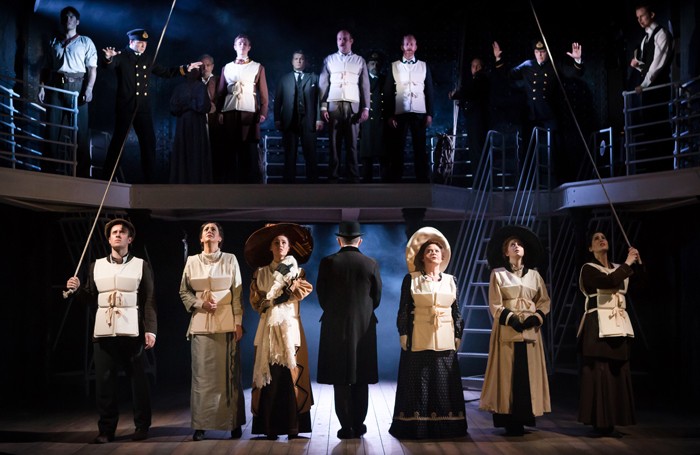
It’s quite a feat to not only recreate on stage a ship with over 2,000 people on board, but then to sink it too. And yet somehow, despite the relatively intimate setting and with surprisingly little in the way of special effects, Thom Southerland’s production feels like an epic. Partly this is down to the incredible cast, who rotate through a multitude of roles, costumes and accents, giving the sensation there are hundreds of them instead of a couple of dozen. And it’s partly a result of David Woodhead’s multi-level and constantly moving set, which brings us right on board the Titanic, so that we feel the same awe as the passengers and crew on their first sighting.

But it’s mostly due to Maury Yeston’s music, with new arrangements by Ian Weinberger and directed by Joanna Cichonska, which is nothing short of exquisite. The show is a true ensemble piece, and while the solo numbers are fantastic, it’s when the cast and orchestra all come together – whether in hope as the ship sets sail, panic as it begins to sink, or grief as loved ones are separated – that the music quite literally soars, filling every inch of the space with its stunning harmonies.

Unlike its ill-fated subject, Titanic looks set to repeat the resounding triumph of its 2013 run at Southwark Playhouse. It’s a show that deserves a larger stage and a much wider audience. I know I’m gushing, but that’s how much I loved it – and I’m a grown-up now (or so they tell me), so I can’t even put my reaction down to a teenage crush on Leonardo DiCaprio.

Thank you so much to boxoffice.co.uk for the opportunity to review this show.

Review: Richard O’Brien’s Rocky Horror Show at the Orchard Theatre

I have to confess something… until last night, I was a Rocky Horror virgin. Richard O’Brien’s classic musical is not so much a stage show as a phenomenon with a life of its own, and seeing it for the first time feels a bit like stumbling into a club of which you’re not a member. There are weird outfits, private jokes and choreographed dance moves – and that’s just the audience.

Fortunately, initiation into the Rocky Horror club is not only painless, but a lot of fun. And one thing becomes abundantly clear from the first moment: if you love this show, you will love this show. It’s a classic of such epic proportions, with such a devoted following, that it doesn’t really matter who’s in it, or where you see it; unless something goes horribly wrong, a Rocky Horror fan – old or new – is pretty much guaranteed a good time.

ROCKY_PRODUCTION_11

For the record, though, the touring production of Rocky Horror currently making a stop at the Orchard Theatre is of the highest quality, whether you’ve seen the show hundreds of times or you’re a slightly bewildered newbie. Slick, sexy and spectacular, it has a wicked sense of humour matched only by the increasingly cheeky responses being shouted by the Dartford audience, which the cast – particularly Norman Pace as the Narrator – handle with great aplomb.

Richard Meek and Lauren Ingram are perky and loveable as newly engaged Brad and Janet, who find themselves drawn into the bizarre world of Dr Frank-N-Furter when they get a flat tyre on a stormy night. Kristian Lavercombe is irresistibly creepy as Riff Raff, Dominic Andersen sets everyone’s pulses racing as Rocky and Sophie Linder-Lee’s Columbia is a brilliantly unhinged groupie. But the stage really belongs to Liam Tamne as Frank-N-Furter, the Sweet Transvestite from Transsexual, Transylvania; hilarious, seductive and quite, quite mad (not to mention a bit chainsaw-happy), he has both his guests and the audience in the palm of his hand from the start.

ROCKY_PRODUCTION_240

Oh, and the songs. Well, we all know the songs, right? Dammit Janet, Sweet Transvestite, Hot Patootie… Even for a first-timer, they’re pretty hard to resist – and come on, who never did the Time Warp at their school disco? There were a couple of occasions when the band drowned out the vocals a bit, but by that point things had got so bonkers I’d long since given up on keeping track of what was happening anyway.

Don’t think of Rocky Horror as a musical. It’s an experience: one I’m glad to have had – and that I won’t soon forget…

Richard O’Brien’s Rocky Horror Show is at the Orchard Theatre until 11th June 2016.

Review: A Subject of Scandal and Concern at Finborough Theatre

John Osborne’s A Subject of Scandal and Concern was written in 1960 as a TV drama starring Richard Burton. Now adapted by Jimmy Walters of Proud Haddock, the play gets its long-awaited London debut in the intimate setting of the Finborough Theatre.

Based on true events, A Subject of Scandal and Concern tells the story of George Jacob Holyoake, the last man to stand trial for blasphemy in England. On his way from Birmingham to Bristol in 1842, the young teacher stops in Cheltenham to give a lecture, where his determination to speak his mind will prove to be his downfall. Despite the efforts of a parade of lawyers, journalists and churchmen to break him, however, Holyoake maintains a steadfast resistance, even when it ends up costing him everything.

Photo credit: Samuel Taylor

Jamie Muscato gives a riveting performance as the unfortunate Holyoake, an unassuming figure who overcomes a severe stammer to make his case with passion and conviction. It’s a testament to Muscato’s presence and performance that even during his lengthy courtroom speech, we still hang on his every word. He’s joined by a versatile cast of five, who take on a multitude of roles; Edmund Digby-Jones impresses with an astonishingly fast and fluent delivery of the indictment against Holyoake, while Doron Davidson plays no less than five characters, each with a different accent and personality.

In addition to playing multiple roles within the story, the cast also constantly rearrange the simple wooden frames that make up Philip Lindley’s set, to become a jail cell, a courtroom, a kitchen and, most memorably, the ever-changing road from Birmingham to Bristol. There’s something almost mesmerising about the graceful movement of the actors as they move the pieces around, and it gives the play a dynamic feel, as if it’s taking place on a much larger stage.

Photo credit: Samuel Taylor
 Much like its title, A Subject of Scandal and Concern is a very wordy play; it’s worth getting hold of a copy of the play text to read through afterwards if you can. But what could have been a pretty heavy hour is broken up by moments of humour, and a vein of quiet sarcasm runs throughout the play. The authority figures ranged against Holyoake are all faintly ridiculous, but there’s a note of censure against the protagonist too, particularly towards the end of the play. As explained by the narrator in his closing lines, the play doesn’t seek to provide answers; this is not a story with a moral, and we must draw our own conclusions. Nonetheless, this is a fascinating tale, which still resonates today in its references to freedom of speech and the influence of religion in everyday life. This buried treasure has finally seen the light of day, and it was well worth the wait.


Can’t see the map on iPhone? Try turning your phone to landscape and that should sort it. I don’t know why but I’m working on it… 😉

Review: Off the Kings Road at Jermyn Street Theatre

Off The Kings Road is the first full-length play from former Hollywood publicist Neil Koenigsberg. A touching reflection on grief, companionship and getting older, the play sees American widower Matt Browne check into a small hotel in London, where he intends to spend some quiet time rebuilding his life following the death of his adored wife, Betty, from cancer. But London has other plans for Matt, and the resulting journey of self-discovery is at once laugh out loud funny and powerfully moving.

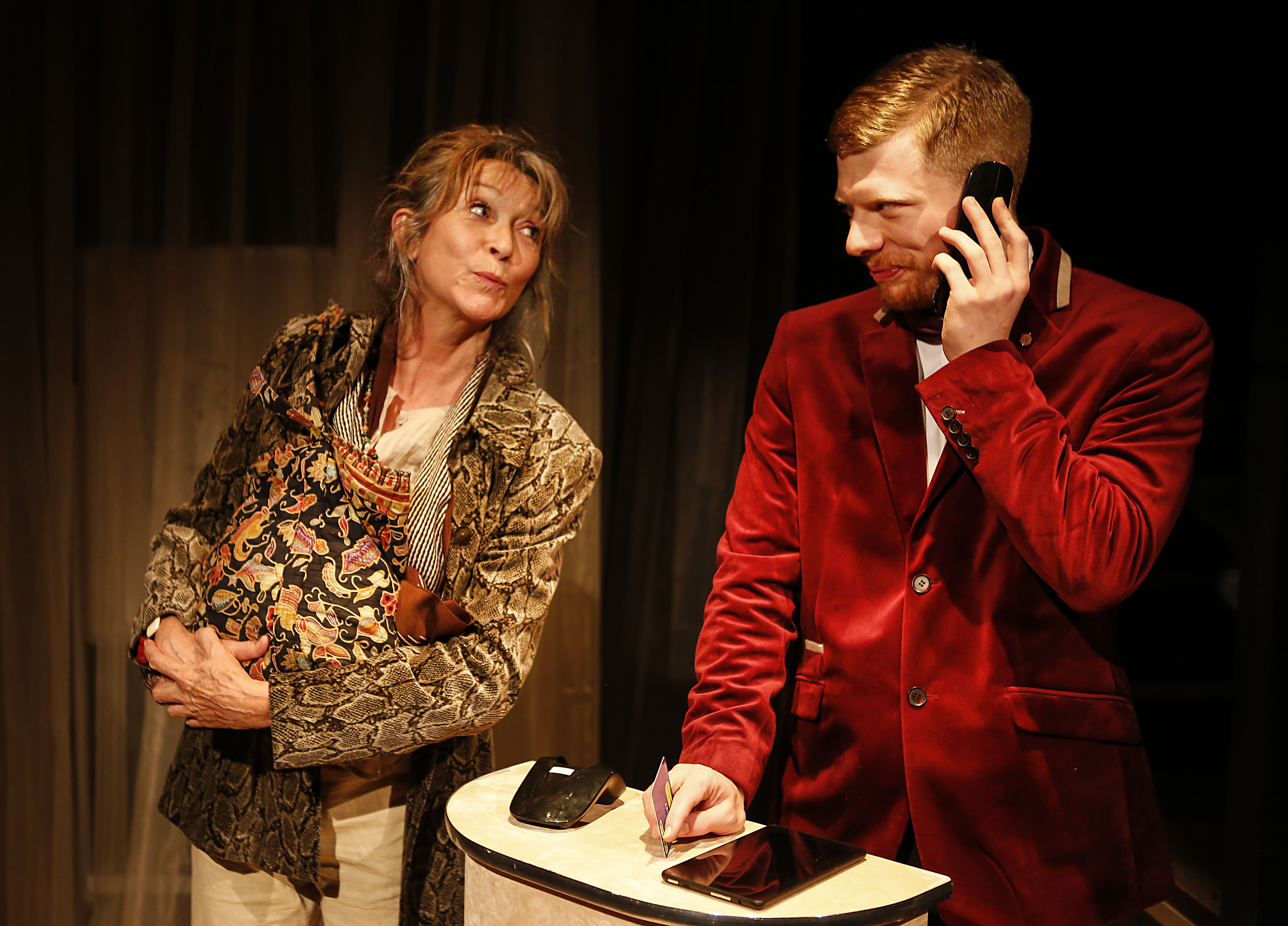
Michael Brandon leads the cast as Matt with a performance that perfectly captures his character’s fragility, but also his humour and compassion; we can’t help but like this genuinely good guy who’s just trying to make his way in a new, unfamiliar world. Along the way he meets some interesting characters, among them Freddie, the hotel concierge, and Ellen, a crazy cat lady from down the hall. Luke Pitman and Cherie Lunghi shine in these roles; as a long-term resident, Ellen has a close friendship with Freddie, and the affectionate scenes they share on stage are wonderful to watch. Though the two roles are predominantly humorous ones, with both actors revelling in their characters’ eccentricities, there are hidden depths here too: Freddie, while often a touch over-enthusiastic, is very good at his job and genuinely cares about his guests’ welfare, while Ellen turns out to have a lot more in common with Matt than he realises.

Photo credit: Pamela Raith

Diana Dimitrovici also appears as a Russian prostitute, the intriguingly named Sheena McDougal. Following their first encounter in her flat, the relationship between Matt and Sheena moves in a direction that’s not wholly unexpected, but no less touching for its predictability, and Dimitrovici gives a strong performance as a young woman disguising her own vulnerability with a veneer of toughness.

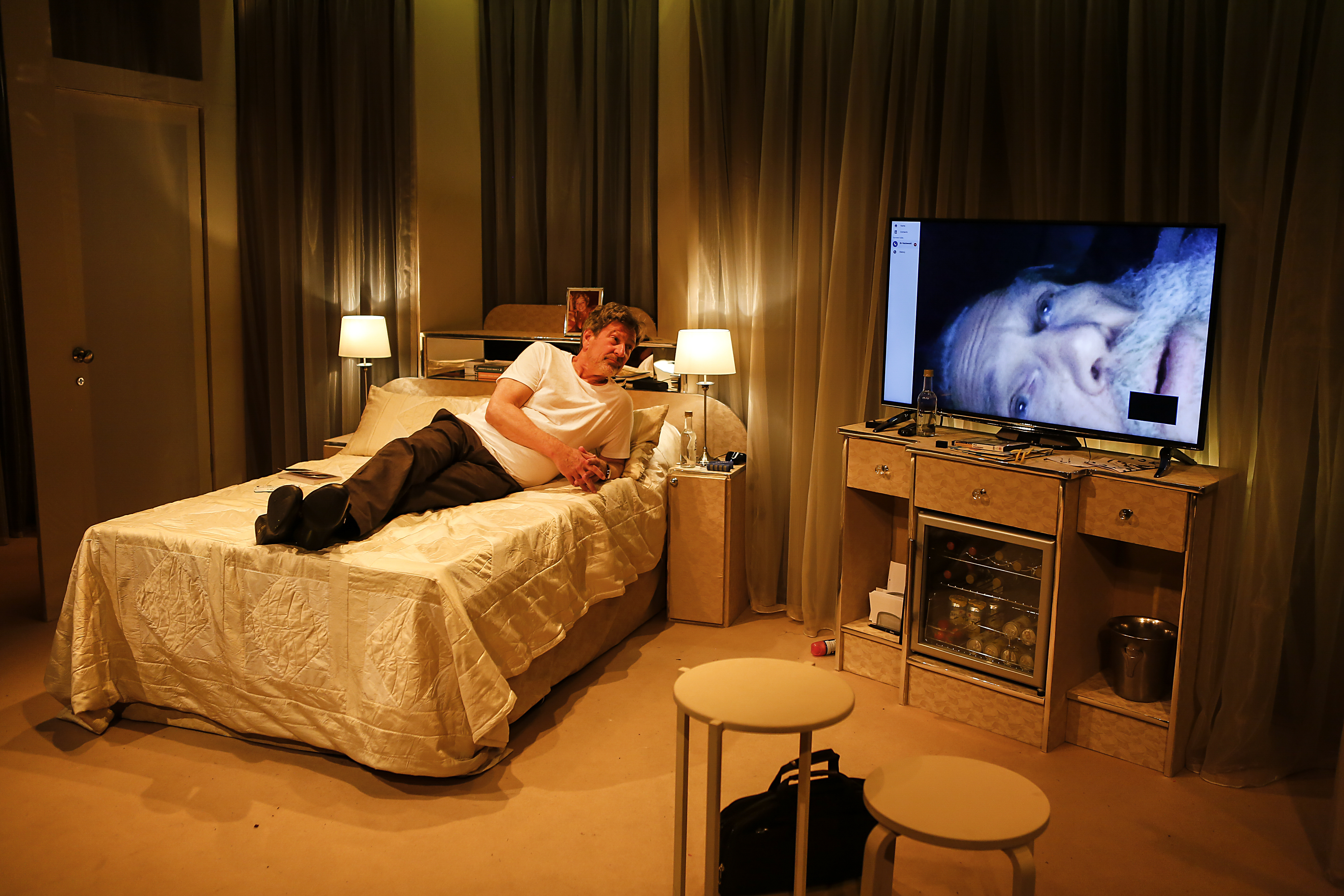
In a unique and thoroughly modern twist, the cast of Alan Cohen’s production includes a fifth member, one who never sets foot on the stage; Oscar winner Jeff Bridges ‘e-appears’ as psychiatrist Dr Kozlowski, with whom Matt has several Skype calls throughout the play. There’s comedy gold in these scenes, partly in watching the two men attempt to use the technology, but mostly because Kozlowski is a spectacularly bad psychiatrist, who’s going through his own marital difficulties, and seems permanently a bit stoned. But where he fails as a doctor, he succeeds as a friend – proof that we don’t always need someone with all the answers; sometimes we just need somebody who’ll listen when things go wrong. These scenes fit so naturally within the live action, and Brandon interacts with the screen so well, that it’s almost possible to forget Bridges’ appearance is pre-recorded.

Photo credit: Pamela Raith

At its heart, Koenigsberg’s play is a celebration of human relationships, in all their wonderful weirdness. Matt starts out as a lonely figure, but as soon as he allows other people in, his life begins to change (mostly) for the better. Like the Ingmar Bergman movie referenced throughout the play, this bittersweet comedy is the story of a man on a journey, both physical and emotional – and like its characters, it’s very hard not to love.


Can’t see the map on iPhone? Try turning your phone to landscape and that should sort it. I don’t know why but I’m working on it… 😉