Review: Day Job at the Bread and Roses Theatre

Guest review by Ross McGregor

Written and directed by Evi Stamatiou, this is the first production from Fanny Pack Theatre, an all-female collective founded by Rachel Scurlock and Maria Alexe. Their company seeks to produce “contemporary stories about contemporary women”, and has been set up to tackle theatrical gender inequality. In a recent interview with The Stage, the co-founders said they wished to focus on working with women who are “outside the industry norm”, and although this is perhaps a lofty way of saying “give character actors a chance”, Day Job proves that the actresses in this project should be anything but overlooked.
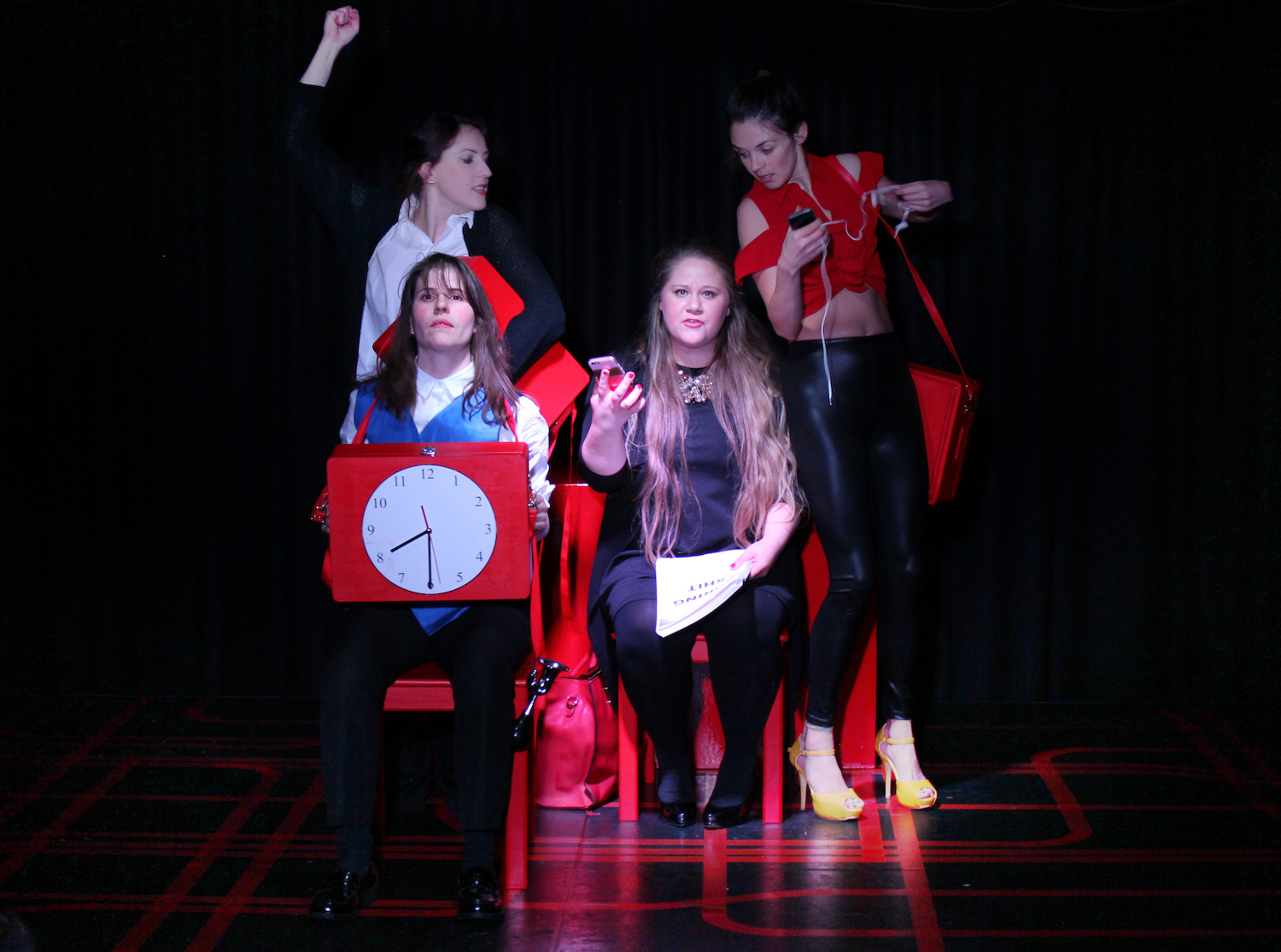
Photo credit: Minglu Wang

Constructed as a series of interlocking tales about the lives of four female artists struggling to make ends meet in modern day London, Fanny Pack Theatre have created an energised, vibrant, engaging and at times hilarious piece of new writing. The device that links the narratives is the fact that all four women share the same bus journey to work, and scenes switch and intersect with ease thanks to Minglu Wang’s simple yet effective (and entirely blood-red) set. There is a degree of physical theatre and symbolised movement that is incorporated more or less well into the piece and melds fluidly with the more script-based moments.

Of the three stories, Maria Alexe’s songstress French teacher stands out as the highlight. The tale of a woman needing to get to a potentially life-changing audition whilst being stuck between a gaggle of remedial students and an overbearing teaching supervisor was played to perfection by Maria Alexe, and the fact that it involved a degree of comfortable audience participation made it all the more enjoyable. As Alexe’s frustration and desperation with her predicament grew, so in turn did the hilarity of the scene, and for me it was the highlight of the production. 

Because unfortunately the other tales, one of baby-stealing escort service and a receptionist-murdering Devil Wears Prada rip-off were far too absurd and long-winded to maintain the laughter. With the French Class tale, it seemed obvious what we were in for: an hour of semi-autobiographical tales of the plight of being a part-time actress/full-time barmaid, but then shortly afterwards the subsequent stories descend into surreal tales from the underworld, with an infernal and demonic escort agency (with their contact phone number even ending in 666 we wave goodbye to subtlety) owning the rights to every baby their escorts produce, and a team of receptionists for “Dirty Business Inc.” (a company along the lines of Enron one assumes) being slaughtered by their line manager as the police break down the doors. The jokes started to flag here, and the characters, whilst ably held up by the talented cast, are just too two-dimensional and grotesque to warrant concern.  It’s also a shame that the writer/director/devisers picked sex worker as a generic female job – surely this experience is not as widespread and relatable as teaching, bus driving or receptionist? This decision is so clichéd that it feels like Fanny Pack are actually promoting the theatrical views their company attests to strive against. A misstep here, to my mind.

8-copy
Photo credit: Minglu Wang

These script qualms aside, it is the cast that deserve the highest praises. Switching from role to role in a matter of seconds, handling pathos and comedy with a clear aptitude, this quartet of actress prove that they’re a force to be reckoned with. Rachel Scurlock chews the scenery in every role she assumes, and is a complete delight to watch – she steals every scene and comes complete with an electricity in her eyes that makes her almost impossible to stop watching. Maria Alexe has a sultry, captivating and vivacious presence on stage, as well as a truly beautiful singing voice. Clare Langford is perhaps the most introverted and demure of the group, though this may be due to the selection of roles she’s given, and thrives when she is given the opportunity. Out of the four, Langford is the most underused, and this is a shame as she seems capable of tackling so much more than the material she was given. Stephanie Merulla as the enigmatic bus driver is the heart of the piece and holds the shows thematically together with a wry and knowing delivery, knowing how to hold back when needed and sharply point every punchline she’s given. 

Day Job is an entertaining night out held together by four very talented young women. The script needs work in terms of its focus, but the performers deal with this ably, allowing their natural talent and creativity shine through.

Find out more about Fanny Pack Theatre on their website.


Can’t see the map on iPhone? Try turning your phone to landscape and that should sort it. I don’t know why but I’m working on it… 😉

Review: Hamlet Part II at the Hen and Chickens

If you’ve ever wondered what happened next after the tragic conclusion of Shakespeare’s Hamlet (and let’s face it, who hasn’t?) an answer can be found in the snappily titled Hamlet Part II from the Theatre of Heaven & Hell, returning to the Hen and Chickens after an acclaimed run at this year’s Camden Fringe. Whether it’s the answer Shakespeare had in mind I’m not totally sure, but one thing is certain: it’s a lot of fun.

Fun? I hear you ask, and not without good reason. After all, most of us know how Hamlet (Part I) ends – bodies all over the stage and Denmark’s entire royal family wiped out in one bloody encounter. Making a comedy out of that scenario would take some doing, you could suggest. And yet when you stop and think about it, there actually is something slightly comical about a play in which every character gets wiped out; it’s so extreme that it almost crosses the line from tragedy to comedy.

image1

Writer Perry Pontac seizes upon this blurring of genres and runs with it, picking up not only on the excessive quantity of corpses but also the many other slightly ridiculous elements of Shakespeare that we all put up with because – well, it’s Shakespeare. The flowery language; the drawn-out death bed speeches; the Fool who talks complete nonsense; the soliloquies that none of the other characters ever hear, even though they’re standing two feet away… all make an appearance. The story’s also packed with references to Shakespeare’s other plays – some subtle, some not so much; you don’t have to be a major literature buff to find the humour in this very accessible show.

Part of Pontac’s ‘Codpieces’ trilogy, the story sees Seltazar (Darren Ruston) return home to Denmark, met by court librarian Fornia (Elena Clements) who reluctantly unfolds the recent tragic events; her list of the dead is so extensive she has to check them all off on a clipboard. Together, with a bit of ‘help’ from a passing Fool (Nicholas Bright), the two attempt to figure out who’s left to take over the throne – but just as they hit upon a solution, the rightful king (Brian Eastty) appears… and it’s not who you might expect.

All four cast members give it their all, though it’s Darren Ruston and Elena Clements who take centre stage as Seltazar and Fornia; their evolving love-hate relationship really is a hilarious joy to watch from beginning to end. And director Michael Ward finds opportunities for humour even when nobody’s saying a word; the opening moments are particularly enjoyable, and so totally unexpected it’s almost impossible not to laugh.

A common complaint about Hamlet is that it’s too long; there’s a lot of talking and not a lot of doing, and – let’s be honest – it’s not exactly the cheeriest of tales. No such problems with the sequel; at just 45 minutes, any hanging around is very much part of the joke, and unlike its predecessor, Pontac’s parody is genuinely a laugh a minute, whether you’re a Shakespeare fan or not. Though I can’t promise nobody dies in this one – it is still Hamlet, after all.


Can’t see the map on iPhone? Try turning your phone to landscape and that should sort it. I don’t know why but I’m working on it… 😉

Review: Her Aching Heart at the Hope Theatre

Her Aching Heart is the Hope Theatre’s third and final in-house production of 2016, billed as “a bodice-ripping musical full of gothic silliness and sapphic tomfoolery!” Who could say no to that?

Well not me, as it turns out, because I loved it. Bryony Lavery’s lively comedy, in the expert hands of the Hope’s Artistic Director Matthew Parker, transports us into the pages of a gothic romance novel – with all the flowery language, heaving bosoms and melodramatic sighs you might expect.

Photo credit: Roy Tan

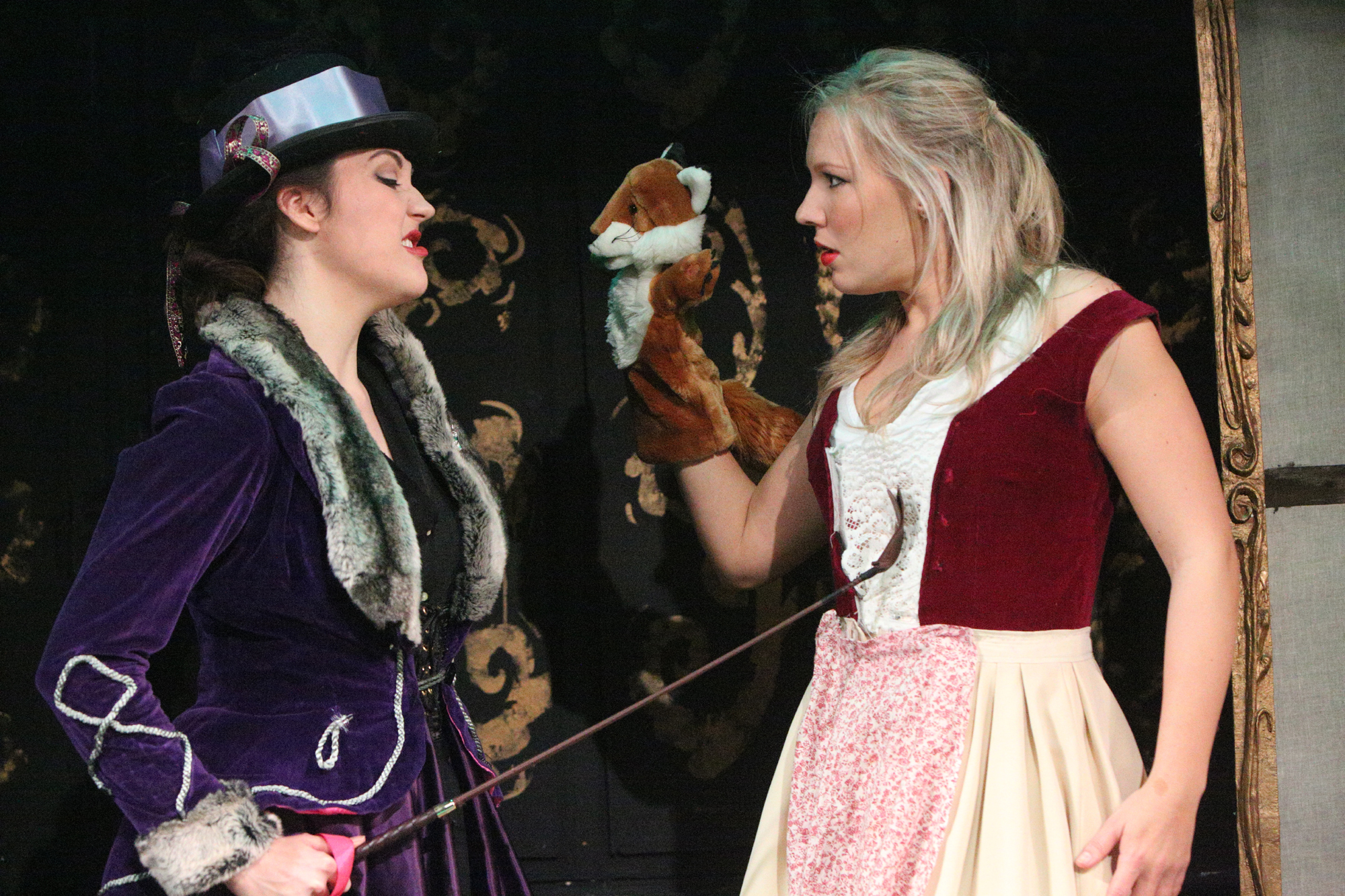
In modern day London, Harriet and Molly are taking their first tentative, awkward steps into a relationship, while simultaneously in 18th century Cornwall, the fictional Lady Harriet Helstone, an aristocrat with an unfortunate habit of killing innocent wildlife, meets Molly Penhallow, a kind-hearted country girl who wouldn’t look out of place in a Disney movie. Despite having nothing in common, not to mention clashing on their first encounter over the grisly fate of one of Molly’s fox friends, the two women find themselves unexpectedly drawn together, in an irresistible love story guaranteed to warm the cockles of your heart.

From the moment the first chapter, “A Nun has a Nightmare”, is introduced, we know we’re in for a fun evening. Collette Eaton and Naomi Todd throw themselves into their roles with infectious enthusiasm, not only playing both versions of Harriet and Molly but an assortment of other characters too, and doing it all to perfection. Making creative use of a cramped space that offers barely enough room to swing a – er – fox, the two performers manage to wring every last drop of comic potential out of the most unlikely scenes – who would have thought a roe deer being trampled by a horse could result in such howls of laughter?

That said, there’s also a genuine chemistry between the two that makes the fledgling relationship of their modern counterparts both moving and believable. The present day story of Harriet and Molly, to which we return at various points throughout the evening, marks a clear and occasionally jarring change in tone that takes a bit of getting used to. Each time the red velvet curtain swishes closed and the actors break into one of Ian Brandon’s musical numbers, we’re thrown into an altogether more contemplative mood, and reminded that love is far more complex than cheesy romance novels would have us believe. These scenes, though they may seem like an afterthought to the comedy action, we ultimately realise are the true emotional heart of the show. Real life can be painful and difficult – but it can also at times be infinitely more rewarding than fiction.

Photo credit: Roy Tan

Her Aching Heart is a laugh out loud comedy and touching romance, which simultaneously pays tribute to and affectionately pokes fun at the Mills and Boon genre by which it’s inspired. An unexpected delight, in which all the elements – great writing, fantastic performances and quality production – come together to produce a magnificent whole, it’s impossible not to fall in love with this show.


Can’t see the map on iPhone? Try turning your phone to landscape and that should sort it. I don’t know why but I’m working on it… 😉

Review: Scratch the Surface: The World Today at the Hen and Chickens

Instinct Theatre’s first new writing night at the Hen and Chickens brought together four pieces of work around the theme “The World Today”. It’s a broad topic, and the plays being showcased were, unsurprisingly, pretty diverse. From the personal to the political, it was an evening of high quality new writing, with uniformly strong performances. Interestingly, regardless of their subject matter each of the four captured an element of both comedy and tragedy – which I suppose is very much like the world today. And more importantly, they all left me wanting to see more.

First up was Besides The C by Francesca Mepham, in which a young woman recently diagnosed with cancer struggles to cope in the face of her boyfriend’s cold indifference. The strength of this play, directed by Michelle Payne, lies in its balanced view; there’s no doubt whose side we’re supposed to be on, and James (John Dayton) freely admits his primary concern is how Natalie’s news affects him. But his honesty, and the fact he’s allowed to have a say at all, is actually quite refreshing – and at the same time, Natalie (Leanne Petitt) isn’t perfect either; terrified of being alone through her cancer treatment, she stays with James despite knowing they don’t have a future. So who’s using who?

cxnq4dbxuaanog3

This was followed by another equally insightful perspective on a flawed relationship, in Jonathan Skinner’s Suck, Squeeze, Bang, Blow. Directed by Hilary Burns, the play introduces us to a nameless couple (Felicity Huxley-Miners and Harrison Trott) forced to confront the fact they’re officially on the rocks. It’s much lighter in tone than the previous play – and provided arguably my favourite quote of the evening: “This is like walking through mud in flip flops” – but there’s a feeling of sadness too as the couple teeter on the edge, taking progressively more savage swipes at each other. Whether they hang on or go over… we’ll have to wait to find out.

The evening then took a turn towards the political in Guerrilla Kingdom by Saria Steyl, in which two young women carry out a terrorist attack. Or at least they would, if they could stop bickering and remember which button to press. Under the direction of Thomas Attwood, Laura Lawrence and Marina Tapakoudes give two brilliant comic performances as the incompetent rebels, but behind the laughter there’s sincere passion. We don’t know exactly who or what the women are fighting against, but an emotional recital of their mission statement shows how deeply their cause matters. And as with any play involving an explosive device, there’s also a certain degree of suspense involved…

cxnrsgdwiaayygy

Finally, we enjoyed an excerpt from Tea and Good Intentions by Felicity Huxley-Miners, directed by Dominique Gerrard. Student Elizabeth (Lily Driver) arrives home from uni to discover her mum’s taken in a Syrian refugee, much to the scandalised delight of the neighbours. While the play pokes good-natured fun at the misguided intentions of the middle-aged Margaret (Catharine Humphrys) and Mary (Erin Geraghty), it also makes a serious political point about what makes someone leave everything and become a refugee (hint: it’s not our benefit system). Yusuf Bhaimia gives a particularly powerful performance as the nonplussed Adar, who seems at first sight to have swapped one kind of trauma for another.

Each of the four plays featured in Scratch the Surface is complex and sensitively written, exploring different aspects of the world we live in. With enjoyable hosting from actor and presenter Paul Lavers and lively discussion in the bar afterwards, the scratch night was undoubtedly a big success; hopefully it’s the first of many.


Can’t see the map on iPhone? Try turning your phone to landscape and that should sort it. I don’t know why but I’m working on it… 😉

Review: An Inspector Calls at Playhouse Theatre

Stephen Daldry’s groundbreaking production of An Inspector Calls acquired legendary status when it was first performed at the National Theatre in 1992. Having completed yet another national tour, it’s now back in the West End, and as powerful and relevant as ever. In fact if anything, given the current sorry state of the world, the play’s message of social responsibility speaks to us now even more than it did 24 years ago.

Photo credit: Mark Douet

Though J.B. Priestley’s story is set in the early 20th century, the brilliance of Daldry’s production and Ian MacNeil’s astonishing set is that the events unfolding before us could be taking place anywhere, at any time. In 1912, the well-to-do Birling family are enjoying a dinner party in their elegant home, which resembles a large dolls’ house perched precariously above a dark, rainy street from the 1940s, when the play was written. But the family’s celebration of daughter Sheila’s engagement is interrupted by the arrival of a police inspector, bearing the tragic news of a young woman’s suicide… One by one, the mysterious Inspector Goole forces each member of the family to confess his or her part in the woman’s downfall, and draws them away from their luxurious surroundings to face judgment from a silent audience of “supernumeraries” – men, women and children to whom the Birlings would never usually give a moment’s thought.

The pouring rain, creeping mist and Stephen Warbeck’s ominous music help to build the tension towards an explosive climax and a final direct plea from the Inspector, delivered with genuine emotion by Liam Brennan as he begs us all to remember the responsibility we have to each other. But the story doesn’t end there, and a glimmer of hope can be found in the despair of the Birling children as they stand alongside the family maid Edna (played with quiet dignity by Diana Payne-Myers) and watch the others climb, cackling like pantomime villains, back into their wrecked house.

Photo credit: Mark Douet

As the Inspector, Liam Brennan embodies the very heart of the play, a gruff Scotsman who both ridicules and rages at these people who seem so stubbornly unaware of the damage they’ve caused. Clive Francis cuts a frail but defiant figure as the patriarch Arthur, and there are strong performances from Barbara Marten and Carmela Corbett as mother and daughter – one refusing to acknowledge her guilt, the other readily embracing it with appalled horror.

J.B. Priestley’s political stance as a socialist is well-known, and not at all glossed over in this production. But the story is not just about politics; it’s about humanity. This is the third time I’ve seen the play, but without a doubt it’s the most powerful. Priestley might perhaps have hoped that by 2016 his play would be redundant, but the events of this week show it’s anything but. We live in a world where intolerance and self-interest are increasingly the norm – and as long as that’s the case, this play will continue to resonate.


Can’t see the map on iPhone? Try turning your phone to landscape and that should sort it. I don’t know why but I’m working on it… 😉