Review: Rounds at the Blue Elephant Theatre

It’s been a long old week. A couple of work trips and several late nights meant that by the time Friday rolled around, I was feeling pretty shattered and wanted nothing more than to go home and collapse into bed.

Why am I telling you this? Because fortunately, I have an office job where being tired might mean I’m a bit less productive than usual, but isn’t a matter of life or death. Now imagine being that tired and having to carry out complex medical procedures, or administer drugs that could, in the wrong dosage, prove lethal. And then imagine it’s your very first day as a junior doctor, you don’t know where anything is and suddenly you’re responsible for real patients in real pain, who expect you to know exactly what to do to help them.

In Resuscitate Theatre’s Rounds, six junior doctors are about to learn that just wanting to help people – which seems the most fundamental requirement for a medical professional – may not be enough. The show touches on several of the issues facing the people we rely on to keep us healthy… and it’s terrifying. Long shifts, abuse – racist and sexist – from patients, indifferent management and the fear of knowing one wrong move could cost someone their life are all piled on top of the usual problems faced by 20-somethings just out of uni, like romance, fitting in with colleagues and finding a work/life balance (and someone to feed the cat).

Directed by Anna Marshall, an internationally diverse cast (Christina Carty, Alex Hinson, Nicolas Pimpare, Penelope Rodie, Iain Gibbons and Adam Deane) bring to life the six young doctors, each of them coping in their own way – and some better than others – with the pressures and insecurities of their job. At just an hour in length, the show gives some of the characters a little more air-time than others, with one in particular ultimately taking centre stage in a conclusion that’s simultaneously shocking and somehow inevitable. This is both a blessing and a curse: on the one hand, it means we don’t really get to know the characters that well; on the other, by spreading the focus quite thinly the show is able to demonstrate the vast number of problems that need to be addressed.

The set, designed by Naomi Kuyck-Cohen, is deceptively simple, made up of six medical screens which form a vital part of the show’s choreography. The movement sequences within Rounds tell us just as much as any of the dialogue scenes; choreographed by Lexi Clare and directed by Davide Vox, they effectively convey the frantic nature of an average day through the repetition of routine tasks like checking x-rays or scrubbing up for surgery, while curtains are whisked aside again and again as the doctors treat a seemingly endless stream of patients.

Penny Rodie, Rounds

The characters on stage are fictional, but based on real stories (in fact the show was devised with input from junior doctors) and it’s sobering to realise that they represent the doctors treating us and our loved ones every day, in increasingly difficult circumstances. When the show was first performed at last year’s Illuminate Festival, the junior doctors’ dispute with the government was making headlines. Though it may no longer be the top story, that doesn’t mean the problem’s gone away, and if anything, shows like Rounds are more important than ever, to keep the problems faced by junior doctors – and the NHS in general – in the spotlight. And on a more personal level, it may make the rest of us think twice before complaining about a bad day at work.


Can’t see the map on iPhone? Try turning your phone to landscape and that should sort it. I don’t know why but I’m working on it… 😉
Review: One Last Thing (For Now) at the Old Red Lion Theatre

In one of the stories that make up Althea Theatre’s One Last Thing (For Now), a British soldier serving in Afghanistan asks his friend: if he didn’t come back, what would be the last words his fiancée at home had heard from him? And would they be enough?

Photo credit: Headshot Toby

The power of words – both shared and withheld – is a theme running through the show, which was devised with the company by director Lilac Yosiphon, and brings together stories of lives and loves touched by conflict across the world and across history. An American husband can’t tell his wife the truth about the war and its effect on him. A woman from Colombia struggles to master the English language so she can plead for help for her husband, who’s been kidnapped by FARC guerrillas. A French wife and mother can’t escape the words written to her by a German soldier years before, and a teacher from Israel sets one of her students an assignment that proves to have a surprising significance for them both.

These are just a few of the many plotlines skilfully interwoven throughout the show, each introduced by a different company member and returned to later as each story unfolds and develops. The international nature of the stories requires a range of accents and even languages from the cast of eight (Josephine Arden, Sam Elwin, Carolina Herran, Cole Michaels, Katerina Ntroudi, Tom Shah, Elizabeth Stretton and Thomas Wingfield), and both they and dialect coach Laura Keele deserve a lot of credit for their almost flawless delivery, and easy transitions from one to the next.

And it’s not just accents that change; each cast member takes on more than one significant role in the show, juggling comedy and tragedy with equal skill, but even with no introduction there’d be no problem telling the very different characters apart. It’s hard to choose favourites amongst such a universally talented cast, so I won’t try… and to be honest, several of my personal highlights were the moments the actors formed an ensemble – moving, listening, reacting, even breathing as one. Each of these moments is carefully choreographed and staged for maximum visual impact, with the images that conclude both Acts 1 and 2 most striking.

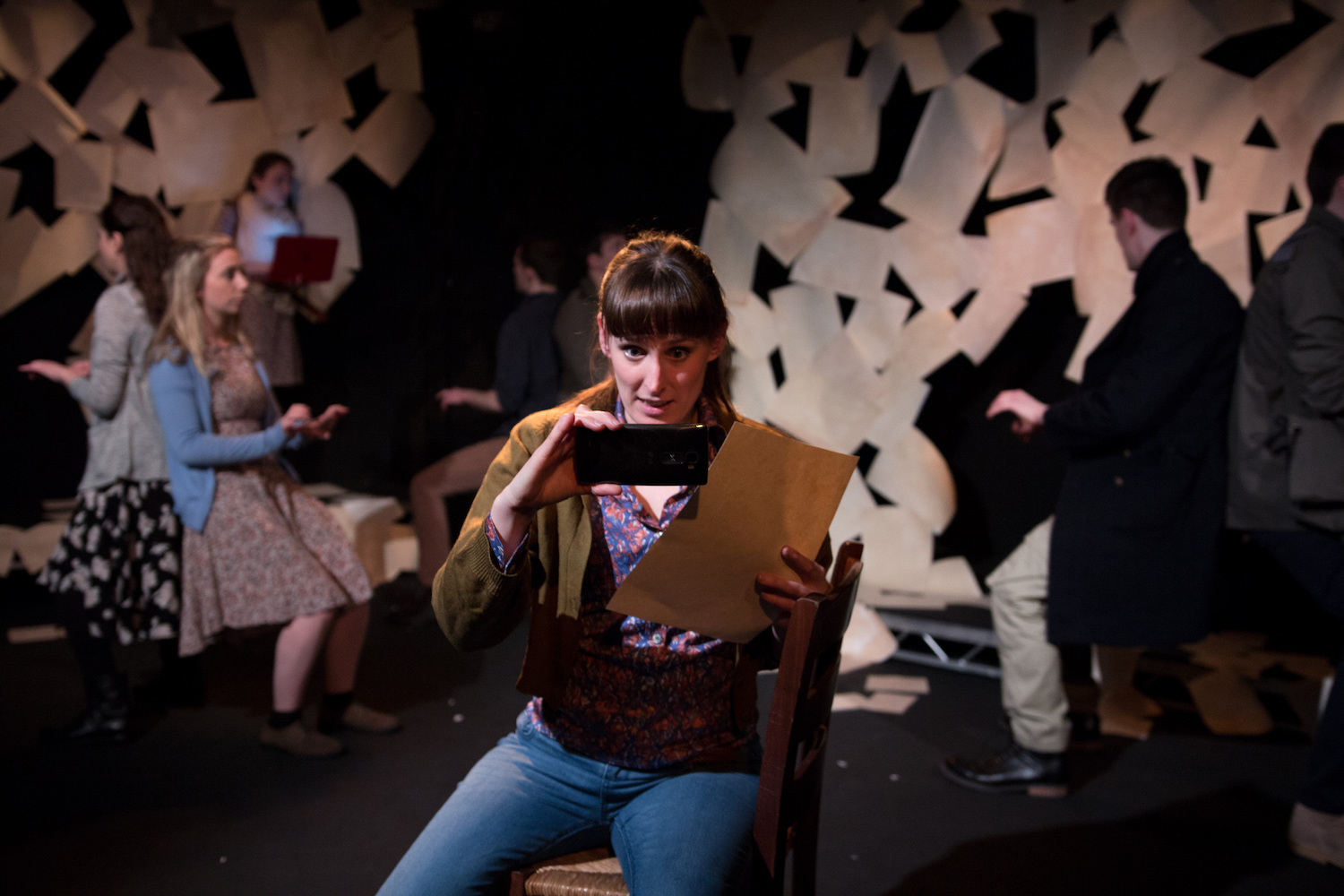
There’s no set to speak of, though designer Elliott Squire has created a simple yet very effective backdrop made up of blank pages cascading to the floor, and the actors make creative use of a selection of items (a chair, a wooden chest, a trombone…) not to mention their own bodies, to fill in the gaps in each picture to the point where you don’t even notice what’s missing.

Photo credit: Headshot Toby

Though the play isn’t overtly political, it does have a few pointed comments to make about the impact of war on the individuals involved (both directly and indirectly), and on whether war is ever the answer. But there are moments that hit a little closer to home, too, like the seemingly lighthearted story of a carefree woman whose life has never been touched by conflict, or the harsh, insensitive treatment of an asylum seeker by a British journalist, who hears only what makes a good story and is deaf to her desperate pleas for help.

As in life, some of the stories in One Last Thing (For Now) end happily, others in tragedy. One has a shocking twist; some never conclude at all. There are a lot of distinct threads to this show, but combined they create a memorable and undeniably powerful portrayal of the universal human emotions that hold us all together, even in the worst of times and circumstances. Though not always an easy watch, it’s certainly an important – and recommended – one.


Can’t see the map on iPhone? Try turning your phone to landscape and that should sort it. I don’t know why but I’m working on it… 😉
Interview: Heather Fairbairn, The Mutant Man

How much have we really progressed over the last century in our understanding and treatment of gender? This is the question posed by Christopher Bryant’s The Mutant Man, which has its world premiere at The Space on 28th March.

The Mutant Man is about challenging the stereotypes of gender,” says director Heather Fairbairn. “The play follows the true story of Harry Crawford, who lived in the early 20th century. In this psychological thriller, Harry grapples with his gender identity, faces an arranged marriage, attempts to disappear at sea, and, when charged with the alleged murder of his wife, is subjected to an unfair trial focussed more on questions of gender than on guilt or innocence.

“That said, the play is not naturalistic, let alone linear. If you could imagine the Norwegian playwright Jon Fosse adapting Netflix’s Making a Murderer for stage, you would be well on the way to forming a picture of The Mutant Man.”

Heather was drawn to the play, first and foremost, by the quality of the writing. “Christopher Bryant’s multi-award-nominated script is a testament to excellence in new playwriting. I was already a fan of Bryant’s work, and when he sent The Mutant Man to me, I could see it would be an excellent foundation to build a production from. When the writing is this good, one can take more risks with the staging.

The Mutant Man was written around four years ago and has received numerous semi-staged readings since. We recently presented an excerpt at Theatre N16’s HerStory: Feminist Theatre Festival, and further afield in Melbourne, where Bryant is based, an excerpt of the play was included in Gasworks Arts Park’s Midsumma Festival as part of their ‘Playtime Staged Readings’ of new queer theatre. Even so, our production is the world premiere of the full work. To find such a strong, politically relevant, new play, that hasn’t been staged yet, is a rare and exciting treat for a director.”

Though the events described take place in the early 20th century, the story has just as much to say 100 years later. “Given the current political climate, arguably any story that aims to smash a societal framework of prejudice is an important one to hear,” says Heather. “The Mutant Man in particular exposes historical and continuing injustices facing members of the LGBTQIA community, yet ends with hope for the future.

“It explores the beginnings of Western society’s understanding of gender diversity; suggesting that, though the events in the play took place about a hundred years ago, our comprehension hasn’t grown much in the intervening years. Through the portrayal of historical events, the play highlights some unfortunate but necessary parallels between the intolerance of the early 1900s and the intolerance we’re consistently seeing now towards anyone, regardless of gender, who does not fit accepted stereotypes. The play is almost Brechtian in that regard: using a setting of another time and place to afford the audience with objectivity about what is happening here and now.

“I hope The Mutant Man contributes to the larger current discourse about the non-binary nature of gender and encourages audiences to disregard archaic gender stereotypes. At its heart, this inherently feminist play promotes the positive values of compassion, acceptance, and equality.”

The production is supported by the Arch and Bruce Brown Foundation, who champion LGBT positive arts projects inspired by history. “Their support has been invaluable to the development of The Mutant Man,” says Heather. “In 2015, Christopher Bryant was the first Australian to be shortlisted for the AABB Foundation’s playwriting award when The Mutant Man won an Honourable Mention in the competition. For the upcoming premiere season, I’m collaborating with a great team, including designer Charlotte Henery and lighting designer Sean Gleason. We’ve been fortunate to receive continued support from the Foundation in the form of a production grant, which will enable us to realise the design elements of the production.”

As a theatre and opera director, Heather’s worked all over the world, in a career that’s already full of highlights. “The one that jumped straight to mind was working as Assistant Director to Katie Mitchell on Ophelias Zimmer. I had worked with Katie Mitchell previously, but to do so at the Schaubühne – an institution I have long admired, with Simon McBurney creating Beware of Pity in the neighboring studio, and productions directed by Ostermeier and Castellucci showing at night, it was an exhilarating experience for me as an early career director.

“Another highlight has been collaborating with composer Ana Seara and librettist Sophie van der Stegen. We met in Munich last year whilst participating in a workshop about new music theatre for young audiences. During that weeklong workshop, we created a short opera, and we haven’t stopped creating work together since. We currently have an immersive adaptation of Mozart’s The Magic Flute in repertory at the Music Chapel in Belgium, and three other projects at various stages of development.”

The Mutant Man is Heather’s UK directorial debut: “So, this project marks a homecoming of sorts for me. I grew up in Nottinghamshire before moving to London by myself when I was 17 to attend The BRIT School. After The BRIT School, I continued my studies in Australia, but since graduating from NIDA in Sydney, most of my practice has been Europe-based. The Mutant Man, a project I am so passionate about, felt like the right work to return home with.”

The Mutant Man is at The Space from 28th March-8th April.

Review: One Was Nude and One Wore Tails at the Hen and Chickens

Guest review by Ross McGregor

Dario Fo’s lesser known one act play One Was Nude and One Wore Tails bears all the trademark satirical prods and nods that you would expect from the mind that wrote Accidental Death of An Anarchist.  There’s some plot, some characterisation, and a few set pieces but it thankfully never really attempts naturalism or a cohesive narrative, and you can take what you want from it. Do you fancy a cutting social commentary on how the wealthy (personified here by a nude man in a bin) rely on the assistance of the working class (personified here by a roadsweeper and also caretaker of aforementioned bin) to get them out of messes of their own making (being stuck naked in this same bin)? This play has that for you. Fancy some Brechtian working class singalongs with comedy horns and innuendo? Job done. Do you desire Beckettian dialogues on the nature of existence? Yup, got that too. Dissection of religion’s intrinsic value and man’s relationship with the deity itself in reference to our own nothingness? Job’s a good’un. Copious nob gags and funny carrot-based prop moments? Consider it done. Find people being hit over the head repeatedly with bin lids absolutely hilarious? This play has you covered.

I don’t think it’s necessary to understand every moment of the play, and to be honest it goes at such a lick that it would be almost impossible to do so without studying it heavily first. But it’s not really important. Fo is throwaway, he’s anarchic, he revels in breaking fourth walls and sending up authority. He doesn’t so much care about making coherent and empathetic narratives as giving you a laugh and a social message. It’s fun, its clever and it’s filled with invention and absurdity. Is this production well-made with love and energy? Yes, clearly – the actors are having a wonderful time up there onstage and their enthusiasm is infectious. Am I glad it was only an hour long? Yes indeed.

This production was made by Theatre of Heaven & Hell, so let’s deal with their “heavenly” points first. Their Programme Notes state the company “began in a living room in Southend-on-Sea”, and the production honours this humble origin with a charming and roughshod design. Newspapers and other street detritus litter the floor with such prolific abandon that it doesn’t so much feel like a normal city street at night but the morning after a newspaper-based apocalypse. The rest of the set is simple and does the job. The acting is enthusiastic with special mention going to Darren Ruston as the Naked Man in the bin, as he completely stole the show and chewed the scenery, sometimes literally. He had a slightly unfair advantage over his cast-mates as his role was a country mile better than the others, to the extent that when he wasn’t visible onstage the action noticeably dipped in interest, but considering he was static (in a bin) and often only a talking head (in a bin), he worked moments of utter stage magic.

Nicholas Bright and Jake Francis do well as the Roadsweeper and Man in Evening Dress respectively, and their grasp of Commedia acting style is clearly apparent and deserving of praise. Bright leads the piece as an ingénue of sorts, or an idiot savant, and somehow that comes across as the clown-like love-child of Goofy and Rodney Trotter, but it’s endearing and those type of parts are always very hard to pitch right, so Bright deserves much praise for aiming his little roadsweeper dunce with such innocence and sparkle that I only wanted to kill him a little bit. Elena Clements plays Woman with a vice-like command of punchlines and timing, and Brian Eastty multi-roles as a philosophical lascivious roadsweeper and a nosy patrolman. The cast are good on the whole, their energy is always at the apex of what is needed for the piece, and they clearly relished playing archetypes of sex workers, and policemen and ambassadors – this is not Pinter, or Shakespeare, or Chekhov – there are no three-dimensional characters here, and you can see the cast are loving living life large.

Now to deal with the “hellish” elements, as unfortunately this production could do with some honing.  The set-pieces and clowning elements were a little off in their timing and are in need of some more practice. There were multiple line fluffs which would be fixed by the actors taking a breath and some time during the performance to just “sit” in their roles and get comfortable. Only Ruston allowed the scenes to truly breathe, and it is something the rest of the cast could benefit from.

Second, the actors were all over-dressed in terms of their heat management. Many of the actors were sweating so much that it became a distraction for me, as I couldn’t get past how uncomfortable they looked. Turn the lights down, and turn the air conditioning up higher. Let them lose the hats and gloves. Make them comfortable, and they’ll be more at ease onstage. And if you’re going to have a naked man run across the stage at the end, then, let him be actually naked. Don’t fudge it with white loincloths. If he doesn’t want to, or if you don’t want to, then cut it. It’s one of those things you either do properly or don’t do at all, and to have it as the last image of the play meant that the whole production ended on a whimper as opposed to the explosion that presumably was intended.

One Was Nude and One Wore Tails is a quintessential London Fringe story. It’s a forgotten gem brought back to life, with a talented and energised cast that produce some moments of utter brilliance, but is let down slightly by a lack of precision in rehearsal in terms of movement direction. With some time and work – it could be divine.

One Was Nude and One Wore Tails is at the Hen and Chickens until 18th March.


Can’t see the map on iPhone? Try turning your phone to landscape and that should sort it. I don’t know why but I’m working on it… 😉
Review: Four Thieves Vinegar at Barons Court Theatre

Guest review by Ross McGregor

Four Thieves Vinegar is a new play by Christine Foster, directed by Adam Bambrough for The 42nd Theatre Company at Barons Court Theatre. At times with the Fringe Theatre industry, grand ideas take place in tiny cramped arenas, but here we have a perfect unison of play and venue in that the subterranean vault-like gloom of the Baron’s Court Theatre is transformed into a 17th century prison cell and this genius venue choice complements the aesthetic of the tale perfectly. The most striking element of this production is its design. Sally Hardcastle and Will Alder deserve the highest of praise for their work on this production, as they have elevated it to something worthy of the West End. The lighting, props, costume and set decoration are simply flawless, creating a perfect, captivating world in which the actors can play in. From tiny details of amber window effects, to the dirt underneath the actors’ fingernails, it’s all done with an attention to detail that is staggering.

The plot revolves around three inmates of Newgate prison and their kindly jailer, in the time of the Black Death. The possibility of a cure is understandably on everyone’s minds, and fearful superstition of God’s wrath is heavy in the air, thicker than vinegar fumes and hot brick ash. Matthias Richards, played with grace and sincerity by Nick Howard-Brown, is an impoverished alchemist trying to cure the plague before time runs out. Kate Huntsman is a fiery ball of energy and pathos as Jennet Flyte, Richards’ romantic interest, an innocent young maid who is awaiting the noose once her baby is delivered. Hannah Jeakes is the third prisoner – a world-weary nurse, played with gravel-voiced anarchic glee by Pip Henderson. Simon Holt is their keeper, with Bruce Kitchener as the slow plodding but well-meaning jailer, the lesser of the four roles but one he absolutely nails the timing for, and gets the most laughs out of an understandably grim subject matter.

The plot is packed full of different strands, but without spoiling anything too badly, no one is quite who they say they are, and as the play goes on, and the Black Death closes in around them, each character must make their peace with their own personal inconvenient truth.

This production has the makings of something truly outstanding, but unfortunately the ratio of gold to liquid in the alchemy of the show’s different elements is off, and as it stands, they are failing to fully dissolve together. The biggest culprit is unfortunately the writing. There are simply too many storylines for a 90-minute play, and it’s down to the director and writer to now work out which to keep and which to cut, if the show is to have a future revival. The plague plot is present throughout but it’s often side-lined by bickering and innuendo that tire after a while. Huntsman and Howard-Brown have the most to do in terms of characterisation and arcs, and they’re the glue that hold the production together. Huntsman is perhaps the most watchable and fully-formed in terms of her performance, claiming the stage like a little tear-stained imp, whilst giving a clear intention with every single line she’s given, whilst Howard-Brown gives his best Hamlet The Science Nerd, injecting much-needed wide-eyed mania bordering deliciously on obsession. You’re never quite sure if Richards is telling the truth about claiming to have discovered a cure, and Howard-Brown plays this with mastery and a delicate toying with the text. Kitchener has a paternal heaviness that is kindly, genial and reassuring – a lighter moment in amongst the darkness, and much needed.

Four Thieves Vinegar is an interesting idea, that could do with being longer, slower, and more precise in its plotting and pacing. The director needs to be clearer about the placing of the different narrative elements, and the cast need a script that matches their abilities, and one that isn’t so overwritten. And somebody at the Almeida needs to hire the show’s designers immediately.


Can’t see the map on iPhone? Try turning your phone to landscape and that should sort it. I don’t know why but I’m working on it… 😉