Review: Homecomings: The Monkey at Theatre503

John Stanley’s gritty debut play The Monkey, one of the winners of Synergy Theatre Project’s national prison scriptwriting competition, is a fast-moving, plain-talking black comedy that somehow manages to be very funny and incredibly grim all at once. Directed by Russell Bolam, it’s an honest portrayal of a world that’s often violent and unforgiving, but drawn with the sympathetic pen of a writer who knows his subject matter well, and tackles head-on the stereotype that says just because people find themselves in a bad situation, it doesn’t necessarily mean they’re bad people.

The action begins in the stairwell of a run-down block of flats in Bermondsey. This is the home of petty criminals Dal (Daniel Kendrick) and Becks (Danielle Flett), and their nice but dim local drug dealer Thick-Al (George Whitehead). Life’s not exactly easy for the trio, but it’s also fairly uneventful… until Dal’s childhood friend Tel (Morgan Watkins) comes back into town to retrieve £500 he lent Thick-Al in an unlikely moment of generosity. Realising he’s been taken for a mug, the unpredictable Tel, who’s never been quite the same since falling on his head during a robbery a few years ago, sets out to take his bloody revenge – and woe betide anyone who gets in his way.
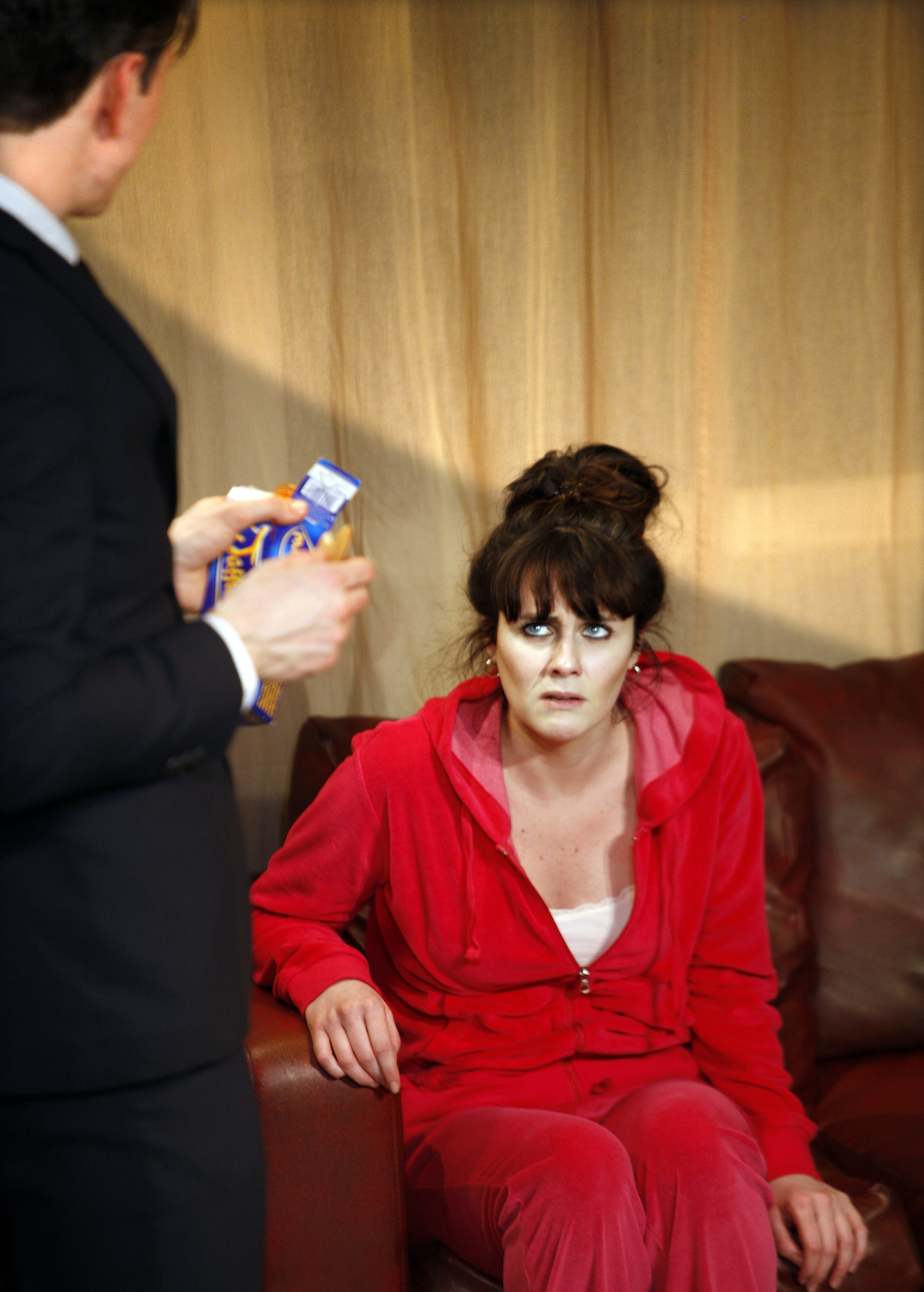
Photo credit: Simon Annand

What’s so appealing about The Monkey is that despite everything that goes on (and between the language and the violence, it does get pretty graphic at times), all the characters – even the psychotic Tel – have redeeming features and are even quite likeable. There’s genuine friendship on display here, for instance, even if it is expressed through liberal use of the c-word, and in many ways the characters’ idiosyncrasies make them easier to get along with: Tel and Thick-Al’s shared love of Jaffa Cakes is oddly endearing, as is Tel’s unexpected obsession with cleanliness.

This flawed humanity is captured in four brilliant performances from the cast. Morgan Watkins is particularly enjoyable as Tel, a ticking time bomb of twitchy, pent-up energy that occasionally explodes in bursts of violent rage towards anyone who happens to be nearby. Impeccably dressed in suit and tie, Tel stands out from the Bermondsey crowd, and his air of superiority shows that he’s well aware of the fact, while his admiration for Tarantino’s Reservoir Dogs exposes him as a frustrated gangster wannabe.

Photo credit: Simon Annand

At the opposite end of the scale, George Whitehead’s affable and appropriately named Thick-Al has no such pretensions, and is so laid-back he’s practically horizontal; content to lounge about on the sofa all day, all he cares about is his next fix, and he’s blissfully unaware of the trouble he’s in until it’s too late. Daniel Kendrick and Danielle Flett fall somewhere in between the two as Dal and Becks – while they’re quite content to get on with life in the only way they know, they are at least alert to the danger posed by Tel’s return and its potential ramifications, not just for Al but for themselves as well.

Not for the fainthearted, The Monkey is nonetheless a thoroughly enjoyable 90 minutes (and educational: not only did I learn some new rhyming slang, I now know that Tim Roth’s from Dulwich, not Deptford – yes, I did go away and look it up) with larger than life, complex characters who feel like real people, not clichés. It’s an impressive debut from John Stanley and well worth checking out during its short run at Theatre503.


Can’t see the map on iPhone? Try turning your phone to landscape and that should sort it. I don’t know why but I’m working on it… 😉


Interview: Debra Baker, Big Guns

Interview: Haste Theatre, Oyster Boy

After award-winning performances all over the world, Haste Theatre’s Oyster Boy is back for a new UK tour. Kicking off last week at London’s Blue Elephant Theatre, the revamped show will travel to venues around the country between now and May, finishing up with four dates at the Brighton Fringe.

Oyster Boy is a dark comedy told in a light-hearted and quirky way, about the struggles of a boy living with an oyster shell for a head,” says Jesse Dupré, co-founder of Haste. “We use puppetry, clowning, dance and music to tell this strange story.”

Oyster Boy is based on a 1997 poetry book written and illustrated by Tim Burton: “Initially, we were drawn to the stories in his book The Melancholy Death of Oyster Boy because they were so strange, and although short in length, seemed to say a lot and evoke much reflection and thought. We saw potential in the material and in the small number of characters he created, knowing we could inject comedy and humour into this rather sad tale.”

The show has been enjoyed on previous tours by audiences of all ages. “There is something in it for everyone!” says Jesse. “Because we are a physical theatre company, the story is told with a whole range of different performance styles, such as live music with ukulele and a cappella harmonies and choreographed movement and dance sequences. It is high energy and will leave you feeling revived, but also will provoke questions to do with the subject content.

“Primarily, we’d like audiences to have a good time watching the show, as it’s an action-packed performance full of colour, vibrancy and music. We want them to be engaged and to laugh, even though the story has dark undertones. 

“We’d also like to encourage a sense of questioning amongst the audience, especially in terms of morality and judgement of others. The character of Oyster Boy is subject to a lot of harsh criticism from society because of the way he looks, and this acts as a mirror to show the reality of some people’s lives today. We hope that audiences will sympathise and become attached to the puppet of Oyster Boy, and therefore be more inclined to empathise with people who are different without pre-judging them.”

Those who’ve seen the show before will notice some changes this time around. “We’ve performed our original version of Oyster Boy since 2013, and have toured it all over the world including America and Italy where it’s won numerous awards,” Jesse explains. “We know that it worked well how we first made it, but we wanted to challenge ourselves to tweak and change parts that we knew could be better and more developed. We also wanted it to represent our work now as a company rather than 3 years ago when we were just starting out. 

“Many things have changed this time around – in fact with the help of our Associate Director, Kasia Zaremba-Byrne, we’ve done a full overhaul of the story, the characters, the props and the set. Kasia helped us breathe new life into the show and expand on what we had before, bringing out new elements in us as actors as well as in the narrative itself.”

One stop on the tour is the Marlowe Studio in Canterbury, where Haste will be performing for one night only on March 30th. “The Marlowe Studio is a wonderful place to perform,” says Jesse. “We toured another show there in 2015 and had a great experience. The team who programme shows in the studio are very on the ball in terms of new theatre and emerging companies, and so it’s an exciting space to perform in.

“Local audiences should come along to check out smaller productions as well as large touring productions, in order to experience other types of shows. The studio is a great modern space with a decent sized stage and raked seating, and so audiences are guaranteed to have a good experience, especially if they come to watch Oyster Boy!

“Last time we performed in Kent, we had supportive and receptive audiences who made us feel encouraged and appreciated, and so we are really looking forward to bringing a different show to the same theatre. We felt we attracted a wide cross section of the community around the Marlowe and judging by the feedback we had, they thoroughly enjoyed our previous show. We are hoping that the same magic will work again this time!”

Catch Oyster Boy on tour – visit Haste Theatre’s website for dates and venues.

Review: The Machine Stops at Jacksons Lane

Dystopian fiction is starting to feel a little too close to reality lately – and although E.M. Forster’s 1909 short story The Machine Stops is set in a future version of our world, some of the themes – the politics of fear and mankind’s increasing dependence on technology among them – feel disturbingly current more than a century later.

Juliet Forster directs Neil Duffield’s faithful adaptation of the story, in which humanity has retreated underground, unable to continue living on the Earth’s surface. Direct contact between individuals has all but died out; everyone keeps to their own room, exchanging recycled ideas and knowledge with others via video chat and avoiding sunlight, travel or anything that might bring them into physical proximity with other people.

Photo credit: Ben Bentley

Life underground is supported by the Machine, a system invented by humans to supply all their wants and needs. But as time passes, it becomes less obvious who – or what – is really in charge… Only the rebellious Kuno (Rohan Nedd) can see what’s happening, but can he convince his mother Vashti (Ricky Butt) of the danger before the Machine stops?

Pilot Theatre’s chilling production takes place within designer Rhys Jarman’s futuristic metal cage, which develops a life of its own as Maria Gray and Adam Slynn crouch, climb and swing among its cables and wires. Movement director Philippa Vafadari has the two interacting with a mesmerising synchronicity and fluidity, which only falters when the Machine begins to fall into disrepair, its failing condition reflected perfectly – and rather poignantly – in the physical tics and stammering speech of the performers.

Ricky Butt is grim-faced and stubborn as Vashti, refusing to accept the truth about the Machine or the outside world, but also cutting a vulnerable figure as she shambles halfway across the world to visit the son she claims to have no time for (parental responsibilities – and presumably affection – are supposed to cease immediately after a child’s birth). In contrast, Rohan Nedd’s Kuno is full of youthful energy and passion, painting a picture through words and movement so that we can see and feel every second of his illicit trip to the Earth’s surface – and encouraging us, perhaps, to take another look at the surroundings we take for granted. Music by John Foxx and Benge helps complete this picture; the tense, repetitive strains underground contrasting with a crescendo of joyful choral melodies as Kuno explores the outside world.

Photo credit: Ben Bentley

Whether Forster really suspected his story would come true we’ll never know, but there’s no denying the play strikes a chord. In a world where we increasingly choose to communicate through technology instead of face to face, where do we draw the line between convenience and the risk of losing all human contact?

Worse, there’s no suggestion that any of this is the Machine’s doing; humans created the Machine and its rules, not the other way around, and then simply sat back (quite literally) and allowed it to take control and tell them what to believe – and what to fear. In this scenario, which hits a little too close to home, humankind brings about its own destruction… and that, perhaps, is the most terrifying idea of all.


Can’t see the map on iPhone? Try turning your phone to landscape and that should sort it. I don’t know why but I’m working on it… 😉

Interview: Ffion Jones, Merely Theatre

Merely Theatre has just embarked on a new national tour with productions of Romeo and Juliet and Twelfth Night in repertory. But there’s a twist in these tales, as company member Ffion Jones explains:

“Each character, or set of characters, is played by both a male and female actor from the full company of ten. Each male-female pairing will play the same parts as each other across both shows.

“All of the actors are off-script before we begin and we rehearse very quickly but precisely, applying what we call our ‘Merely Principles’ from the get-go. The principles are a set of rules we all abide by in rehearsal to create exciting and audience focussed work. They include things like striving to tell the story at all costs and never looking out into the middle distance when we speak. Each actor within the male-female pairings gets tagged in and out whilst rehearsing scenes; this rotation process means that we get used to listening and responding to whichever actor happens to be in front of us, because we can perform with any combination of actors from the other four pairs.”

This unique approach to rehearsal and performance presents a number of challenges. “For example, I am playing only male characters in both plays, purely by chance,” says Ffion. “I can’t help but think about how an audience might receive or judge my performance in comparison to men in other productions. However, because I’ve been with the company for three years now, I have learned to embrace the freedom this can give me as a performer. I don’t really feel inhibited at all and I enjoy bringing the essential humanity to each part that I play and representing the character regardless of gender.”

Merely Theatre was founded in 2010 by Artistic Director Scott Ellis to perform stripped back productions of Shakespeare’s work, and evolved over time to become the first fully gender blind Shakespeare company. “I think that Scott and Merely Theatre are leading the way with gender-blind casting in such a humble, experimental and joyous way that I am so proud to be a part of,” says Ffion. “I was inspired by Scott and Simon’s vision to strip away the unnecessary in Shakespeare and present the heart of the matter. During 2014, Merely produced a season of Shakespeare with no props, no set and no costume. I think our company’s gender-blind ethos goes hand-in-hand so simply with this attitude and it also means that I don’t have to think twice about my gender limitations, which is so liberating and enriching for an actor.”

Following the success of last year’s rep productions of A Midsummer Night’s Dream and Henry V, Merely Theatre’s 2017 tour brings us another double bill of classic Shakespeare. “Romeo & Juliet is arguably the most famous Shakespeare play,” says Ffion. “It’s renowned for its love story, but with our simplistic style and raw energy we also hope that we can depict the friendship, familial love and ultimate tragedy found within its poetry. It pairs itself beautifully with Twelfth Night, which showcases Merely’s humour and mischievous nature. It’s a raucous comedy of errors that allows us to really show our silly side as well as remaining true to the compassion of the characters.”

As a repertory company, Ffion explains,  the team have been growing and progressing together as performers for a number of years. “Scott Ellis and Tatty Hennessey, who have co-directed on both tours, have developed their ideas on how to create great Shakespeare and we have all been working on our craft as actors from vocal technique to text work. All of this groundwork serves as the foundation for these shows which, hopefully, will be felt by our audiences in even slicker, more accessible shows. Interestingly enough last year was also the first time in quite a while that Merely weren’t working in-the-round. It may seem rather backward to any other theatre company that we had to work hard to adjust our style to end-on and proscenium arch spaces. Our aim is to create the audience feeling of involvement that in-the-round or outdoor theatre gives and bring that magic to the theatre royals.”

There’s been much debate in recent years about the decline of repertory theatre, but Ffion believes it still has much to offer, for both actors and audience. “Rep theatre allows a company of actors to expand their skills. It has allowed us to take risks, which has led to some great discoveries. Because we continue to make work with the same company of actors it means that we know each other really well and it creates short cuts in the rehearsal room. There’s no awkward ‘getting to know each other’, we know each other’s skills and talents and we know how to encourage each other to make the best work possible. If audiences like our work then they know that they are guaranteed a good show every time they come to see us, and they too can see us grow and continually surprise.”

The 2017 tour is giving Merely the chance to return to some familiar venues: “The joy of the tour is that we can travel the length and breadth of the UK, hopefully entertaining fellow Shakespeare-fans, inspiring the next generation of theatre-goers and introducing Shakespeare to people that may not have engaged with it thus far. I am particularly looking forward to a week touring Northern Ireland at the end of March; we are returning to a number of venues where the company had an incredibly warm welcome and an overwhelming and kind response to the shows. My male acting ‘twin’, Robert, was lucky enough to take that leg of the tour last year, so I can’t wait to see what all the fuss was about!”

So what can we expect from the tour? “You can expect to see a fresh and rarely seen approach to Shakespeare,” concludes Ffion. “Merely Theatre provides simple, energetic and accessible performances of the bard’s best works, affirming that he is indeed a writer that transcends the ages.”

Merely Theatre perform Romeo and Juliet and Twelfth Night on tour until 25th May. Visit their website for dates and venues.