Interview: Alex Campbell, DAODS Made in Dagenham

The Dartford Amateur Operatic & Dramatic Society was founded in 1906, when three residents decided to form a local operatic society to offset “the perceived lack of facilities for entertainment” in Dartford. Though we no longer have that problem, with a thriving local theatre that attracts some of the UK’s top touring shows, DAODS are still going strong – and proving with each production that they’re more than capable of holding their own alongside the visiting talent.

And later this month DAODS will be back at the Orchard Theatre with their production of Made in Dagenham. They’re one of the first amateur groups in the South East to perform the show, and director Alex Campbell is looking forward to bringing a little bit of Essex to our Dartford shores.

“It’s very exciting to be one of the first groups to do the show in this area,” she says. “It feels so close to home – just across the bridge! – so we know that the people of Dartford will really enjoy it. Within our company, there are many who remember and were directly affected by the events that inspired Made in Dagenham, and we hope it will bring back memories for lots of people.”


The show’s based on the true story of the women who worked in the Ford factory at Dagenham during the late 60s. “After their jobs as machinists were deemed ‘unskilled’ and upon the realisation that they were paid 87% of the wage of their male counterparts, the women went on strike,” explains Alex. “They gained the backing of the Trade Unions, which forced Ford to adopt an equal pay policy. As a direct result, the Equal Pay Act was signed into legislation in 1970 and formed the basis of much of our equal rights policy in this country.”

This particular strike may have ended in victory, but Alex believes women’s rights still have a long way to go: “Although we have come very far, gender inequality is still not resolved in this country and the show really highlights all the work we have left to do. Feminism is certainly having a resurgence at the moment and I think Made in Dagenham is an excellent reminder of how recently things have actually begun to change for women, and in some ways, how much they have yet to change at all.”

The show brings together a cast of over 40 talented local performers. “I am so thrilled by our fantastic cast,” says Alex. “Our leading lady Rita O’Grady is played by Stephanie Trott, who’s previously worked professionally in the West End, and she’s joined by Alex Freeman, who’s played many fantastic roles for DAODS, as her husband Eddie. The two were last seen as Sweeney and Mrs Lovett in our production of Sweeney Todd last year. We also have two brilliant local young people, Joseph and Elouise, who join us to play their children. There is a fantastic mixture of old and new members in the show, with many DAODS leading actors returning to take up principal roles.”

Alex has been a member of DAODS for over 15 years, having joined the society as a member of the youth group at age 9. “Since then it’s been a huge part of my life and has helped me gain skills and experience that have allowed me to pursue a professional career in the theatre world,” she says. “It may sound cliché, but DAODS is really like a huge family and I am so grateful for their encouragement and support over the past few months.

“I’m thrilled to be directing my first Orchard production, having previously directed Hair for the society which was performed at our hall. I’ve always wanted to direct an Orchard show and one of the most exciting things is the huge scale of the production and the potential to create amazing things with a large cast. We are so lucky to have the support of the Orchard staff, who are so incredible at their jobs and have been a great support to the process.”

For anyone inspired to join DAODS, there are some great opportunities ahead over the coming months. “We have many exciting things coming up next, including our Disney revue Dream which will be at Heathfields Hall in July, and then our next Orchard production will be the iconic Singin’ In The Rain in October. As always, we are looking for new members for our group and our next society auditions will be after Dagenham – so do get in touch and join us. You will not regret it!”

Don’t miss DAODS’ Made in Dagenham at the Orchard Theatre from 26th-29th April. And to find out more about DAODS, visit the website.

Review: Oyster Boy at the Marlowe Studio

Haste Theatre’s award-winning Oyster Boy was inspired by Tim Burton’s short poem, The Melancholy Death of Oyster Boy. The original title leaves little to the imagination in terms of the story’s gloomy conclusion, though Haste have given their unfortunate hero a slightly less horrific end, and the show has an altogether more light-hearted tone than Burton’s typically dark tale.

Set in 1950s Coney Island, this is the story of ice cream seller Jim (Valeria Compagnoni) who falls in love with Alice (Lexie McDougall) when he saves her from a shark. After overindulging in a French restaurant on their wedding night, nine months later the couple are taken aback when their son Sam is born with a large oyster shell-shaped head. Despite the support of his friends Molly and Polly, all the adults in the local community are horrified by the otherwise utterly inoffensive Sam, and when his parents’ attempts to find a medical solution end in failure, they’re faced with a tragic decision about his future.

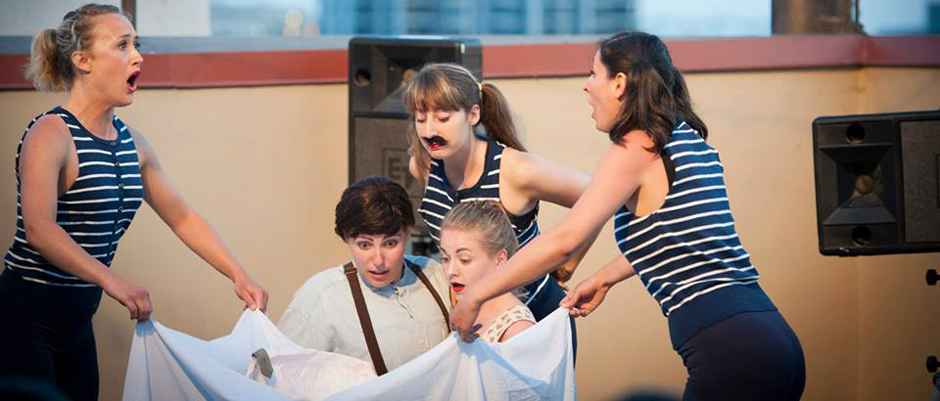
The show is a perfect showcase for Haste’s creativity and versatility (not to mention multilingualism), blending music, dance, puppetry and physical theatre to bring Sam’s story to life. An empty stage is transformed into the seaside setting through knowingly simple touches: a large piece of blue cloth becomes the sea, complete with cardboard dolphins and sharks, while the cast don stick-on fake moustaches and adopt over-the-top accents, conjuring up tables and counters with nothing more than a tablecloth held by the corners. The overall effect is bright, colourful and with a charming, slightly homemade feel that proves sometimes a lot can be said with very little.

This theme continues with Sam himself, who appears only in puppet form… but don’t be fooled into thinking that means he’s not real. Skilfully manipulated by the cast, Sam very much comes to life before our eyes – even indulging in a spot of kite-surfing at one point – and demonstrates all the emotions and qualities of any other little boy. He laughs, cries, feels fear and shows courage, and this really helps to drive home the show’s message about looking past physical appearance to get to know the person underneath.

Musical interludes fill in the details of the story as time passes, with a barbershop quartet chorus (Jesse Dupré, Elly-Beaman Brinklow, Tamara Saffir and Sophie Taylor, who also each take on a multitude of roles) determinedly trying to keep things upbeat even when the story’s taking one of its darker turns. Music is also used, rather differently but no less effectively, as the show comes to its melancholy yet strangely beautiful conclusion.

The cast are clearly thoroughly enjoying themselves, hamming it up as their various larger than life characters and throwing themselves enthusiastically into the dance numbers. Occasionally it all gets a little bit manic – I must admit I slightly lost track of what was going on during the doctor scene, perhaps due to a bit of unscripted banter with an audience member – but on the whole the company’s obvious joy in what they’re doing is infectious and gives us just as many laughs as the jokes within the script.

Oyster Boy is a story about acceptance and friendship, which gets its message across even without the neat, happy ending we might expect from a family show (though it’s still not as gory as the opening lines suggest). It’s all very surreal but a lot of fun, and a great hour’s entertainment for audiences of all ages.

Oyster Boy is at Edinburgh’s Assembly George Square from 2nd-28th August.

Review: The Mutant Man at The Space

On the surface, Christopher’s Bryant’s The Mutant Man is a crime drama; we open in a courtroom, as two identically dressed actors – one male, one female – unpack an assortment of items in evidence bags. But it doesn’t take long to understand there’s a lot more going on here than a straightforward murder trial. The defendant, Harry Leo Crawford, was born Eugenia Falleni and has been living as a man for years, and when his gender identity is made public, it becomes the key piece of evidence leading to his conviction.

Photo credit: Greg Veit

The timeline of the play jumps back and forward in time, sometimes quite rapidly, piecing together Harry’s life story as he struggles to live in a body that doesn’t represent who he really is. Bryant’s language is often poetic, but holds nothing back – we get a detailed description of how Harry was able to convince not one but two wives of his anatomical masculinity, and there’s a brutally explicit account of his rape and subsequent pregnancy by a sea captain who discovered his secret. Simultaneously the court case unfolds, with characters from Harry’s past reappearing to speak against him, and both gripping stories build to a climax as we learn what really happened to Annie, and the inevitable conclusion of the trial.

The central character is played beautifully by two actors – Clementine Mills as Harry and Matthew Coulton as Eugenia – a simple yet highly effective way of separating the two personas. Eugenia is submissive, anxious and seems constantly uncomfortable in her own skin, while Harry, though played by an actor who’s physically shorter, seems far larger in stature and confidence. At one point they deliver overlapping monologues that sum up the distinction: “I’m terribly afraid,” says Eugenia, while Harry states defiantly, “I’m not afraid.” The one phrase they have in common: “I did not kill this woman.”

The two actors also play all the other characters, and herein lies one of my few gripes about the production: though some attempt is made to physically differentiate, with the actors adopting different postures and ways of speaking, it’s not always easy to tell who we’re looking at – often we’re halfway through a character’s testimony in court before we realise who they are and what relevance they have to the case.

Photo credit: Greg Veit

Though the set appears simple, the production is actually incredibly complex and rich in detail. Director Heather Fairbairn equips her actors with a range of props, which gradually emerge from those evidence bags we saw earlier and show how every detail of Harry’s past has come to be used against him. In addition, the production makes highly effective use of lamps, microphones and cameras, often projecting close-ups of evidence on to the large video screen at the back of the stage, and culminating in a powerful image that represents Harry’s confusion and disdain for his own body. There are occasional sound issues; the actors have so much to do with props to unpack and countless small costume changes as they slip from one character to the next, that at times the acoustics work against them and their words are lost – but the most important moments are delivered direct to the audience with clarity and passion.

The play doesn’t try to tell us everything, but instead gives us just enough to send us away disturbed and sufficiently intrigued to read up on Harry’s story for ourselves. Though we may comfort ourselves with the knowledge that such a travesty of justice couldn’t happen today, The Mutant Man does force us to confront the question of how gender diversity is still viewed and (mis)understood a century on from the events depicted. A gripping and thought-provoking 70 minutes, and well worth a visit.


Can’t see the map on iPhone? Try turning your phone to landscape and that should sort it. I don’t know why but I’m working on it… 😉

Review: Big Guns at the Yard Theatre

Guest review by Ross McGregor

Big Guns at The Yard is a new play by Nina Segal, after her debut at the Gate Theatre in 2016, with In The Night Time (Before The Sun Rises). Featuring a cast of two, Debra Baker and Jessye Romeo, and skilfully directed by Dan Hutton, Big Guns is a nerve-shreddingly uncomfortable watch about the anxiety of living in our modern western world where everyone is emotionally isolated but obsessively cyber-connecting.

Photo credit: Mark Douet

The plot of the piece is somewhat difficult to pin down without writing a thesis on the script, but it is perhaps best described as a dramatic poem, in a modern style, split between two voices, dealing with the growing fear of terrorism or attack, from the perspective of a forum board commenter, or serial tweeter. This ever-present sense of foreboding and threat is symbolised verbally by the oft-repeated phrase “The man with the gun…” This means that there is a third presence in the room with these women, invisible to us, unknown beyond his gender and the fact that he is armed, but still demanding that they validate, investigate and justify their own existences.

The style of the show is perhaps a visual radio play. The beauty and power of the production is in the smooth and meticulously paced patter between the two unnamed speakers, and a gorgeous horror soundscape designed by Kieran Lucas. At multiple points the stage is plunged into darkness and all we experience is either the amplified and sometimes distorted voices of the actresses, playing over a series of ominous chord progressions or precise and stilted sound effects. There is very little blocking to speak of, and the production makes no apologies for that. The performers are static and seated on the floor of the sloped stage for almost all of the production, but the whirling stream of consciousness style of the poetic text cares neither for naturalism nor visual pieces as we’re thrown somewhat chaotically through a series of interlocking vignettes, and provides all the movement that we could wish for – we just hear it instead of seeing it.

“Big Guns,” the back of the programme states, “is the prickling at the back of your neck, the faint taste of blood on your teeth, the could-be sounds of a strange figure in the semi-darkness. The YouTube clip you hope doesn’t load but can’t help watching.” And yes, Big Guns is all those things, however due to the jarring and whirling speed at which the script is delivered, as well as how the writing leaps over and through narratives with complications, contradictions and repetitions, you emerge from the play’s conclusion with not a lot more understanding of the play’s subject than when you went in.

Segal’s script is packed full of details and imagery, whipped through by Romeo and Baker with a delicious enjoyment of diction and a verve of delivery. It is confusing, mesmerising and captivating. You may not understand every second – hell, there was a good ten minutes where I possessed not a clue what was happening – but it’s done well and with enough grace that you go with it in the hope that the message might permeate your eardrums via some kind of verbal osmosis. Perhaps to some people’s tastes this might be too abstract and pretentious in terms of the script’s ambivalence for conventional narrative or character – the actors are deliberately non-characterised and are in essence interchangeable in terms of their delivery and viewpoints, but what matters is the poetry and meter of Segal’s verse, and here Baker and Romeo shine as pure masters/mistresses of their craft. Baker is in equal parts gleeful and nonchalant, but possesses moments of unbridled pathos in the face of Romeo’s antagonism and provocation. The stunningly beautiful Romeo allows Segal’s words to trip and fly from her mouth, her eyes glittering in the red darkness, drawing us in and devastating us with emotion in the final fourth-wall breaking moments of the production.

Photo credit: Mark Douet

There is an element of the production that speaks about our over-reliance on technology and social media, and our inability to restrain ourselves from online obsessions, and though I didn’t quite get how that ties into the afore/ever-mentioned “Man With The Gun”, in general the atmosphere and tension created by the piece is phenomenal. It plays to our own paranoia and fears, of violence, of disruption and chaos, and it does this wonderfully well.

Obviously the topical timing with the recent attack in London pushes the subject matter’s concerns right to the front of our minds, but the writer is skilful enough to not languish on gratuity. The similarities between us and the speakers may be narrowing with every passing crisis that we face, as unfathomable violence keeps breaking into our consciousness, but ultimately the play’s message is one of positivity and togetherness. There is a way to beat the Man With The Gun. Lose the fear. Embrace acceptance, and – ironically considering the play’s lack of visual elements – open your eyes to who exactly the Man With The Gun is.

Big Guns is a powerful piece of writing that makes a good play – but potentially an even better podcast.


Can’t see the map on iPhone? Try turning your phone to landscape and that should sort it. I don’t know why but I’m working on it… 😉

Review: Barred Freedom at the Cockpit Theatre

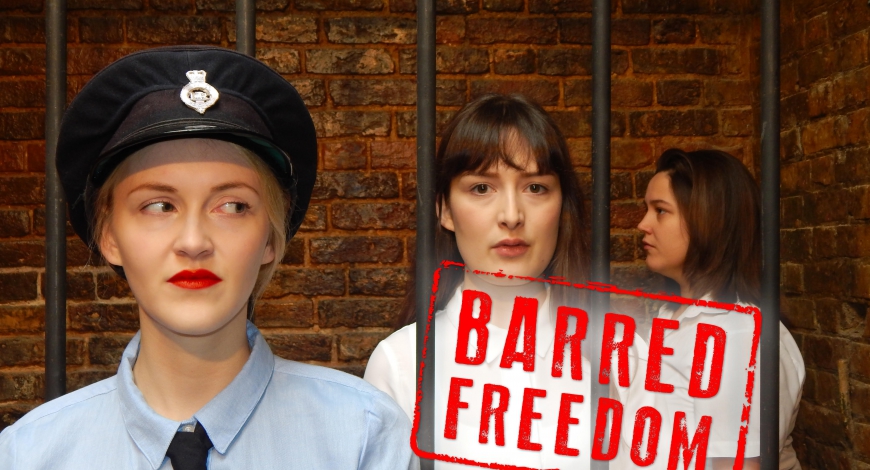
Barred Freedom is the ambitious first project from producer and actor Matthew Hawes. Written by Eugene Ambrose, the play has two casts, one male and one female, who’ll take to the stage on alternating nights throughout this week’s run at the Cockpit Theatre. It’s an interesting idea – the play examines not only the experience of being in prison for each set of characters, but also the developing friendship between them, both of which I imagine could play out quite differently for men and women – and it’s a pity that limited time allows only one viewing.

Anyway, for the purposes of this review, let’s discuss the boys, who are directed by Asia Osborne (while writer Eugene Ambrose directs the female cast). Set in a prison in the 1970s, the story introduces us to well-spoken, educated and – let’s be honest – insufferable know-it-all Wentworth (Adam Sabatti), who’s a new arrival in prison having murdered his spouse (one downfall of the gender neutral approach is that this unlikely word keeps coming up in conversation). His cellmate Dawson (Matthew Hawes) is the polar opposite – he’s been in and out of prison for years, can’t read or write, and spends most of the time having to decipher his Cockney rhyming slang for Wentworth, who unsurprisingly prefers Latin. The two men have been locked in their cell for an indefinite amount of time because of a riot in another wing, and try to alleviate the boredom by talking and playing games, before turning their attention to plotting an escape.

Both Matthew Hawes and Adam Sabatti – along with Mark Loveday, who plays thuggish prison guard Deacon – make their professional theatre debuts with enthusiastic and reasonably polished performances; Hawes is particularly engaging as Dawson, a cheeky chappy with hidden depths and a kind heart. Even so, there are times when the play could use a bit of action. The conversation between the two prisoners takes some interesting twists and turns, but confined as they are to one place (with only their bunks, a table and chairs, and a bucket – which fortunately never gets used – to work with), the story doesn’t really go anywhere and meanders along from one subject to the next, ending on a sweet but rather subdued note instead of the explosive twist ending I’d hoped for.

There’s definitely potential here, though; there are a few almost-incidents that could be developed, and with a bit of pruning (we probably only needed one alphabet game, for instance) the play could be a really interesting one-act piece exploring the true nature of freedom, which ultimately emerges as the story’s central theme. More could also be made of Deacon’s character; his appearances are few and far between, and seem to serve primarily as bonding opportunities for the two cellmates. He’s a bit of a stereotype – bullying prison guard who thinks the prisoners’ lives belong to him – but right at the end, Mark Loveday’s performance reveals a hint of uncertainty that could be explored further. Maybe the prisoners aren’t the only ones looking for a way to escape their grim reality? 

For a debut production, Barred Freedom is off to a promising start, with solid performances and some thought-provoking questions to take away and mull over. It needs a bit of honing, but I’ll be interested to see how the play develops from here.


Can’t see the map on iPhone? Try turning your phone to landscape and that should sort it. I don’t know why but I’m working on it… 😉