Review: Insignificance at the Arcola Theatre

Imagine for a moment what would happen if Albert Einstein met Marilyn Monroe. And then imagine their spirited discussion about the theory of relativity being interrupted by first Joe DiMaggio, who hasn’t seen his wife for two weeks and wants her to come home, and then Senator Joseph McCarthy, who’s trying to drag Einstein to an un-American Activities Committee hearing.

Having trouble? Well then get yourself along to the Arcola, where Terry Johnson’s Insignificance imagines it for you. Directed by David Mercatali, the result is an enjoyably (and perhaps predictably) bizarre encounter that begins as a comedy but ends up in significantly darker territory. Written in 1982, it’s a play that seems to be about a lot of things, much of which a 21st century audience can still relate to – among them the downsides of fame, the threat of nuclear war and the stereotyping of women.
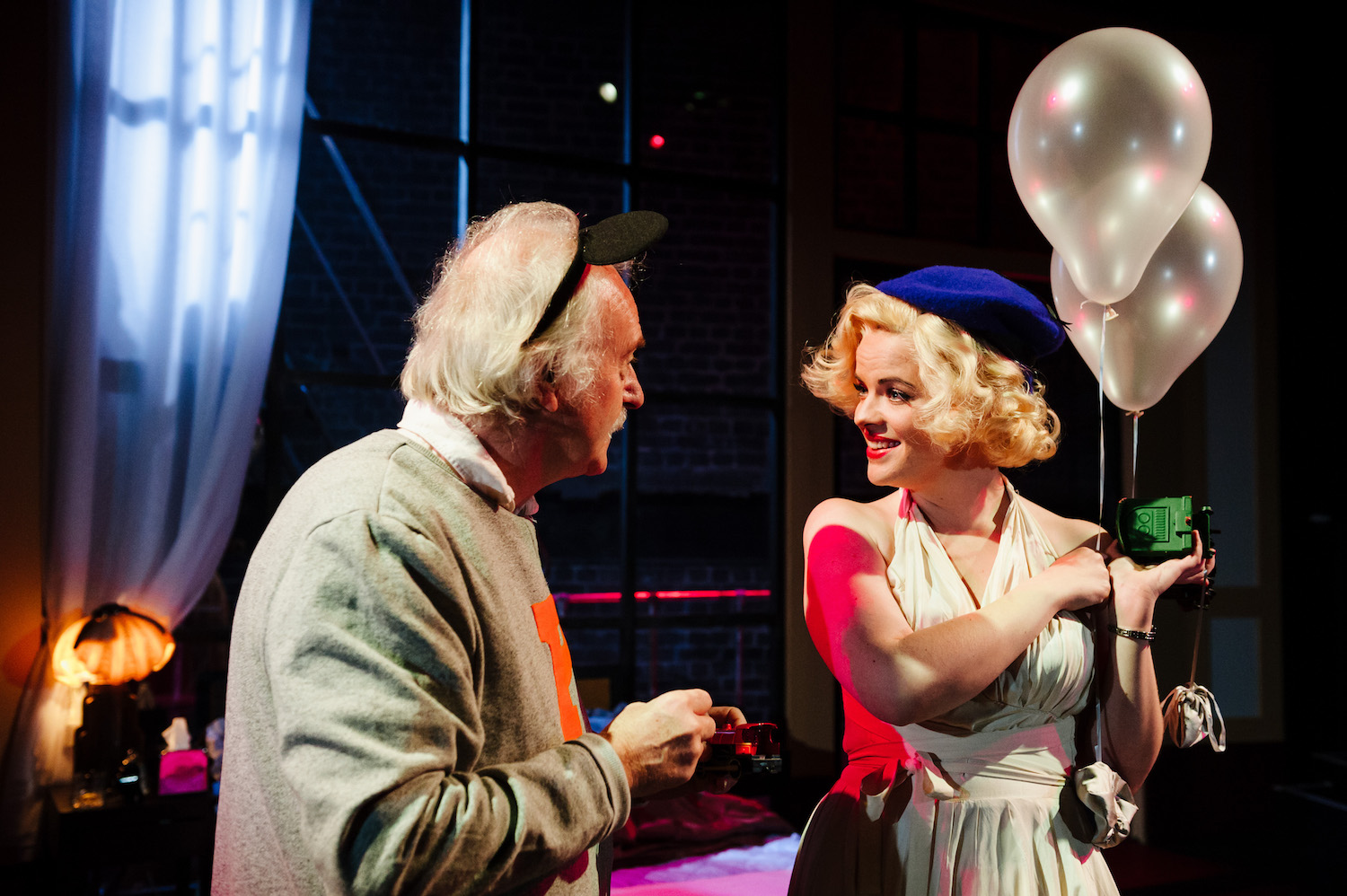
Photo credit: Alex Brenner

Simon Rouse’s Professor and Alice Bailey Johnson’s Actress (none of the characters are referred to by their names, although the script, costumes and performances leave us in no doubt who we’re looking at) find a surprising connection when she bursts into his Manhattan hotel room eager to meet him and prove she understands the theory of relativity. As someone whose scientific knowledge is limited to say the least, I don’t mind admitting I got totally lost during her increasingly enthusiastic recital – not helped by the fact it’s delivered at the speed of light – but that doesn’t prevent it being the defining moment of the play. You can’t help but cheer a little bit to see Marilyn shrug off her dumb blonde persona and take on one of the brainiest men on the planet… and then again when she takes down the infinitely easier target that is her abrasive, gum-popping husband with a series of withering retorts.

At the root of this triumphant moment, though, is a deep sadness that only grows as the play goes on. The Actress desperately wants to be taken seriously, but is constantly thwarted by the image she’s created for herself. Similarly, the mild-mannered Professor just wants to sit and quietly work out the shape of space, but is pursued by the expectations of others, and the use to which his name and work could be put, should he allow them to be. Each has grown used to the world knowing them only by their public persona, which is why this odd pair make a strange kind of sense – certainly more so than the Actress and the Ball Player, who don’t seem to get each other at all. Joe DiMaggio, played with swagger and just a hint of appealing vulnerability by Oliver Hembrough, is fine with people seeing him exactly as he is, just as long as they still see him… which is probably why the suggestion that he’s merely a creation dreamed up by Tom Mannion’s malicious Senator riles him so badly.
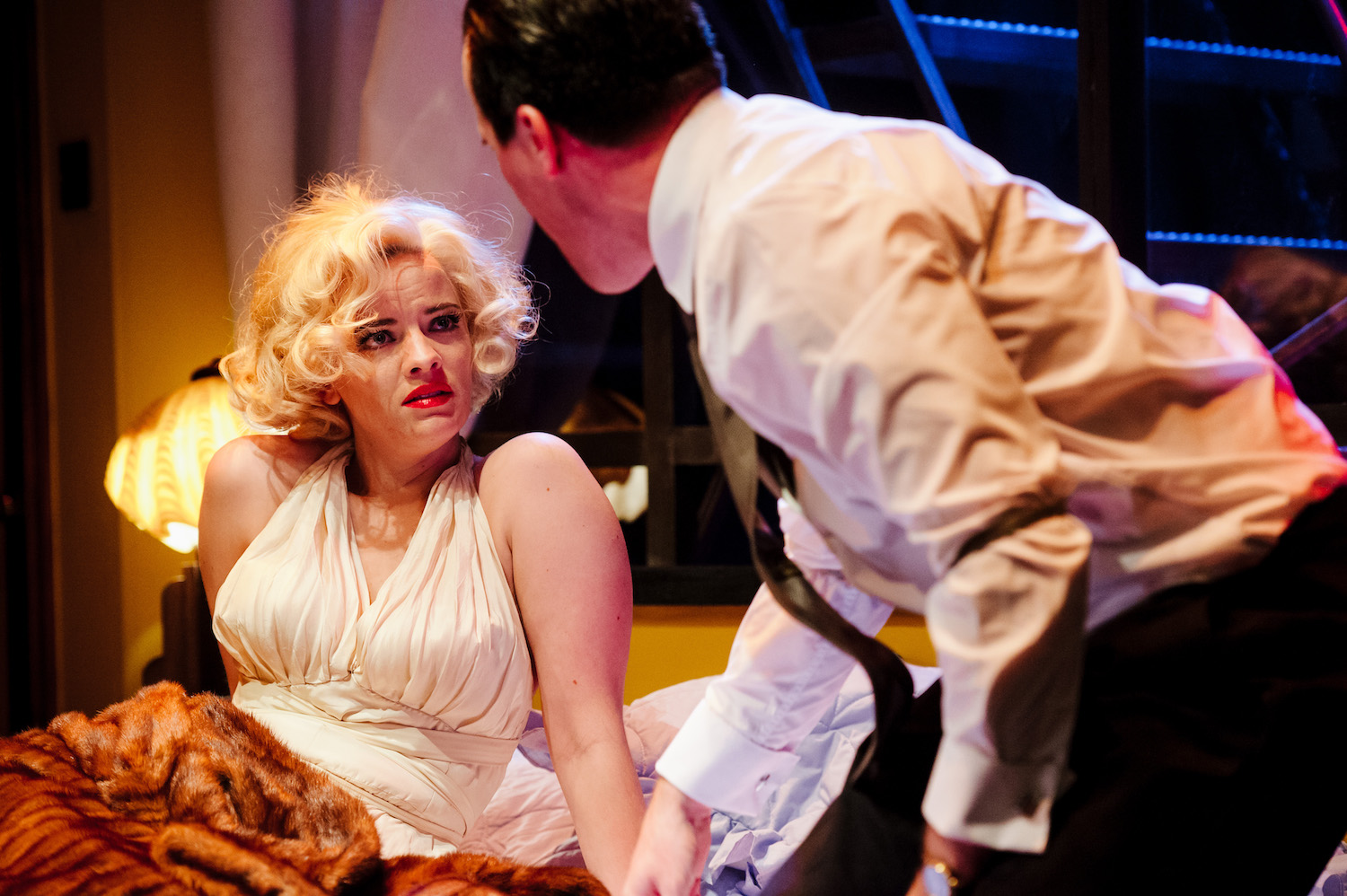
Photo credit: Alex Brenner

Though rooted in troubling subject matter, Johnson’s script is full of witty one-liners, from inside jokes about Schrödinger’s cat and Arthur Miller to more universal gags, most at the expense of the less intellectually blessed characters. In between the four of them talk at length about various topics, from the scientific to the political to the domestic, in a production that tails off to a vaguely unsatisfactory conclusion – so much so that we end up wondering if the bizarre events of the night happened at all.

There’s a lot to enjoy in Insignificance, not least the strong performances from four actors seemingly unfazed by the pressure of playing real – and in at least two cases, iconic – historical figures. The Professor and the Actress might not succeed in teaching us much science, but their imagined encounter does pose some interesting questions about the self-defeating nature of celebrity. It’s a bit of a slow burner on the night, but this is the kind of play that stays in your mind, throwing up more ideas and discussions the longer you think about it. Well worth a visit, if only for the thrill of witnessing such an unlikely meeting of minds.


Can’t see the map on iPhone? Try turning your phone to landscape and that should sort it. I don’t know why but I’m working on it… 😉

Review: Anything That Flies at Jermyn Street Theatre

When we hear the word “refugee”, there’s a certain picture that comes to mind – and it’s fair to say Otto Huberman, the elderly man in Judith Burnley’s new play Anything That Flies, is as far from that picture as you can get. 50 years after the Holocaust killed his family, he’s living in a nice flat in Belsize Park, having made his name and a comfortable living from inventing – among other things – a popular brand of speaker. After he suffers a mild stroke, his concerned daughter engages her friend Lottie to come and take care of him, much to his disgust. Not only is he fiercely independent, he also objects to Lottie’s heritage as a member of an aristocratic German family – but it turns out she has a tragic history of her own, and the two may have more in common than Otto thinks.

Photo credit: Robert Workman

Otto’s cantankerousness allows for plenty of humorous moments, and the developing understanding and affection between the two characters is certainly heartwarming. More than anything, though, the play is a quietly devastating portrayal of traumatic loss – of family, friends and country – and its lasting impact over five decades. What the play does particularly well is to challenge assumptions: the idea, for instance, that anyone who wasn’t Jewish in 1940s Germany couldn’t possibly have suffered, or that a refugee who makes it to a safe (or, to use Otto’s word, sane) haven, their problems are somehow immediately at an end.

The production, directed by Alice Hamilton, also succeeds on a personal level, with two beautiful performances from Clive Merrison and Issy van Randwyck. Otto is an old man, increasingly frail and confused after his stroke, and Clive Merrison captures his volatility to perfection. He’s simultaneously proud and intellectual, rude and wildly inappropriate, frightened and haunted by loss – and any one of these personality traits can come out at any given moment.

As Lottie, Issy van Randwyck bears it all stoically, refusing to rise to her patient’s bait, though clearly troubled by both his repeated labelling of her as a Nazi and his growing physical and mental vulnerability. She’s a classy, intelligent woman, and like her we find ourselves wondering how she ended up on her hands and knees cleaning up an old man’s latest bathroom emergency; it’s only later that we come to understand she’s repaying a debt for an imagined crime committed in her childhood.

Photo credit: Robert Workman

Emily Adamson and Neil Irish’s living room set fits perfectly in the intimacy of the Jermyn Street Theatre, with realistic light and sound from Elliot Griggs and Max Pappenheim. In fact, the production is relentlessly spot on in its attention to detail; the above mentioned bathroom emergency, for instance, leaves little to the imagination, and even before Otto seemingly breaks the fourth wall to relive the night his family was taken (a horrifying story that finally explains the play’s title), we feel included and completely at home in his flat.

Anything That Flies is on the surface a touching story about two very different people finding some common ground. But beneath that surface is something far darker, an exploration of the nature of loss on multiple levels – and it’s here that the play really makes an impact. This well-crafted production of a powerful new play is definitely worth a visit.


Can’t see the map on iPhone? Try turning your phone to landscape and that should sort it. I don’t know why but I’m working on it… 😉

Review: No One Wants A Pretty Girl at the Bread and Roses Theatre

At a time when the theatre is crying out for more female representation, Francesca Mepham and Femm Theatre are doing their best to oblige. No One Wants A Pretty Girl – written, directed and performed by women – is a collection of six monologues, which take us on a short but powerful rollercoaster ride through different aspects of female life, touching along the way on heartbreak, humour and even horror.

Though each one of the six can and does stand alone as an independent story, under Laura Clifford’s direction they also fit cohesively together as a collection, overlapping just enough to allow a brief moment of interaction between performers as they enter or exit the stage. This is a nice touch that gives the piece a feeling of collaboration, even though the individual stories are very different.

In the first, Should, Tayo Elesin has just watched the man she loves get married to someone else. A short but captivating piece, it’s full of pain and futile rage – not against the man in question, but against herself for having lost him in the first place. Things then take a decidedly more upbeat turn in Jade Jacket and Trousers, a story of success against the odds that almost feels like a motivational TED talk. Antonia Kleopa is funny and likeable, and not afraid to directly address members of the audience in order to get her point across. The same goes for Charlotte Hunt’s vain blonde in Side B*tch – except her intention is to make her chosen audience members uncomfortable, and she definitely doesn’t care if we like her. She’s pretty, after all…

Arguably the most powerful of the pieces is My Daddy is Mexican, heartbreakingly performed by Felicity Huxley-Miners. She plays a young blind American whose family has been devastated as a result of racism against her father. As horrific as the story is, particularly in light of recent events in the USA, the end is oddly touching, because despite everything she’s gone through, this young woman refuses to be beaten.

In No Shame, Naina Kohli reminisces about falling for her boyfriend’s sister – but somehow it’s the boyfriend who ends up dominating the narrative, by complaining that he feels ashamed of her new relationship – though she herself knows she’s done nothing wrong. Similarly, in Saturday Night, Farran Mitchell finds herself sitting at home alone watching Doctor Who, waiting for the boyfriend she just dumped to call and beg her to come back. She knows he will, because he’s done it before – and she’s too lonely to resist, even though she knows being with him won’t make her happy.

All six pieces are beautifully written, and resonate with warmth, humour and above all, authenticity; each of the women feels like someone you might actually meet – or maybe even already know. Some you’d want to go for a drink with; others not so much. Some have been defeated by their stories, while others refuse to give in. It’s not always pretty, but that’s exactly the point – women are more than just ornaments, and this enjoyable showcase of female talent does a great job of going beneath the surface to find the individuals underneath.

Follow @FemmTheatre on Twitter for news about future performances.


Can’t see the map on iPhone? Try turning your phone to landscape and that should sort it. I don’t know why but I’m working on it… 😉
Review: The Castle at The Space

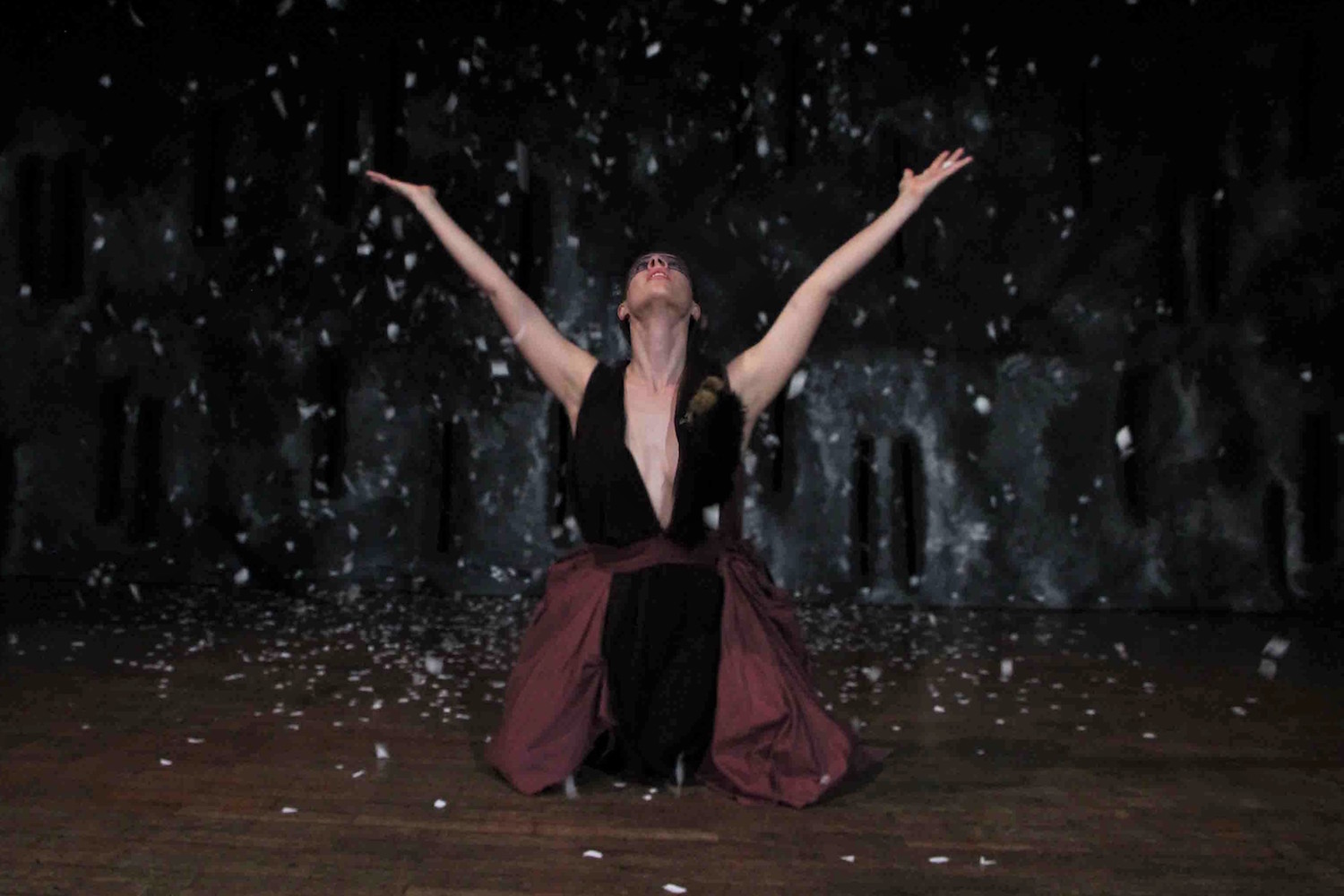
In Howard Barker’s rarely performed 1985 play The Castle, Stucley and his men return home from the Crusades to find the women have taken over and established their own tribal regime. Far from the hero’s welcome he was expecting, Stucley is horrified to discover his own wife in a relationship with a witch, and with no interest to returning to his bed – or giving him a child, despite having become famous in his absence for her abundant fertility.

Rather than try and work things out, Stucley decides to build a castle designed by Arab “genius” architect Krak, who’s returned home with him from the Holy Land. As construction gets underway, Stucley grows increasingly obsessed with making his castle bigger and more impressive than anybody else’s – but his plan to win back control ultimately only creates more chaos.

Photo credit: Ellamae Cieslik

It’s quite a strange play in many ways: a lot happens, not all of it very easy to understand and much of it entirely unexpected; it delves into everything from religion to gender politics; and though overwhelmingly dark in tone, there are several moments of surreal humour (at one point Stucley attempts to found a new church, anointing his chosen priest by putting a toolbag on his head in lieu of a hat; at another the witch Skinner, having confessed to murdering the castle’s chief builder, is sentenced to carry his corpse around wherever she goes, only to end up getting rather too attached). The language is also an odd blend of semi-classical and modern, which takes a good few minutes to get used to, particularly as the dialogue is very fast-moving from the start.

Having said all that, Adam Hemming’s new production at The Space is excellent and incredibly atmospheric, with a set from Jo Jones that makes great use of the converted church building to create a show that feels epic in scale. Andy Straw’s lighting design recreates the gloom of rainy middle England, giving us at times only just enough light to see what’s going on, while sound effects from Keri Chesser fill in – on one occasion in rather distressing detail – events unfolding off stage.

The cast of ten give passionate performances, particularly Anthony Cozens as Stucley and Kate Tulloch as Skinner, each driven to the brink of madness by their desire to win. Chris Kyriacou’s Krak looks quietly – and comically – dismayed at first by the chaos he’s stumbled into, but ultimately reveals his own hidden demons, and the same goes for Shelley Davenport’s Ann, whose firm resolve as the play opens soon begins to fall away.

Photo credit: Ellamae Cieslik

With all these strong personalities fighting for supremacy, the play does get a bit shouty (not to mention sweary) at times – but there’s welcome light relief from the likes of Holiday (Matthew Lyon), who’s spent so much time constructing tall buildings he can’t stop looking up and who, ironically, is petrified of heights, and Hush (John Sears), an old man who’s been making himself useful over the last seven years by obligingly getting all the women pregnant.

Despite the quality of the production, I’m not sure enjoyable is the right word for The Castle – which would probably quite please its writer, who in 2012 was quoted as saying, “A good play puts the audience through a certain ordeal. I’m not interested in entertainment.” All in all, this is the kind of play that leaves you feeling a bit bewildered and more than a little uncomfortable. Those who like to come away from the theatre understanding everything that just happened might want to steer clear; Barker doesn’t give us any easy answers, instead leaving it to the individual to interpret what we’ve seen in our own way. On the other hand, if you enjoy watching committed, compelling performances in a play that’s dramatic and darkly humorous, and which provides more than enough food for thought to keep you going for a good long while, this might just be the show for you.


Can’t see the map on iPhone? Try turning your phone to landscape and that should sort it. I don’t know why but I’m working on it… 😉

Review: Reunion and Dark Pony at the John Harvard Library

Baseless Fabric are known for bringing theatre to unique settings; their last production was a pop-up opera that took place across the high streets of Merton. For their latest project, they’ve turned their attention to libraries – and in keeping with the venue bring us two quietly moving portrayals of the relationship between father and daughter, both written by David Mamet and performed by David Schaal and Siu-see Hung.

In the first, Reunion, ex-alcoholic Bernie meets his estranged daughter Carol for the first time in years. She’s gone to considerable effort to track him down, but now they’re back together the tension is palpable, and the play frequently feels more like a monologue as David Schaal’s Bernie rambles on, telling meticulously detailed stories about his life during their missing years. He repeats himself often, seemingly desperate to fill the silence and keep Carol close by. She, on the other hand, seems constantly ready to flee, perched on the edge of her chair and with her handbag always within easy reach.

Photo credit: Baseless Fabric

Their relationship is tentative and sometimes misjudged, and it would be difficult to understand why Carol’s even come, but for quick flashes of insight – like the moment she suddenly blurts out a revelation about her sex life (watching Bernie fumble for an appropriate response is both amusing and poignant) – and the play ends on a cautiously uplifting note as the two finally begin to find some common ground.

The two actors slip unseen into the space before the play begins, then move among the audience, increasing the intimacy as they draw us into their story. We then follow them along a path of feathers, to the children’s section for the second part of the show: Dark Pony, a much shorter but distinctly more upbeat piece in which a father tells his young daughter a story to pass the time on a long journey home. Siu-see Hung is particularly great to watch here as she transforms from a tense, unhappy young woman to a carefree and energetic little girl. Her enthusiasm is infectious; she obviously knows the story well and can join in with many of the words, yet constantly reacts – with fear, sadness, joy – like it’s the very first time.

Photo credit: Baseless Fabric

Dark Pony is a lovely testament to the power of stories (and particularly appropriate in the library setting), but it also serves as a perfect counterpoint to Reunion by offering a glimpse of what Bernie and Carol missed out on. Having seen the after effects of their estrangement, we’re better able to appreciate the value of the close father-daughter relationship that follows.

This is a rare opportunity to see two early works from David Mamet in a very special venue. It’s no secret that libraries have been struggling to hold their position in a world of Amazon and Kindle books; this Libraries Week it’s lovely to see them getting the appreciation they deserve.


Can’t see the map on iPhone? Try turning your phone to landscape and that should sort it. I don’t know why but I’m working on it… 😉