Interview: The Lampoons, House on Haunted Hill

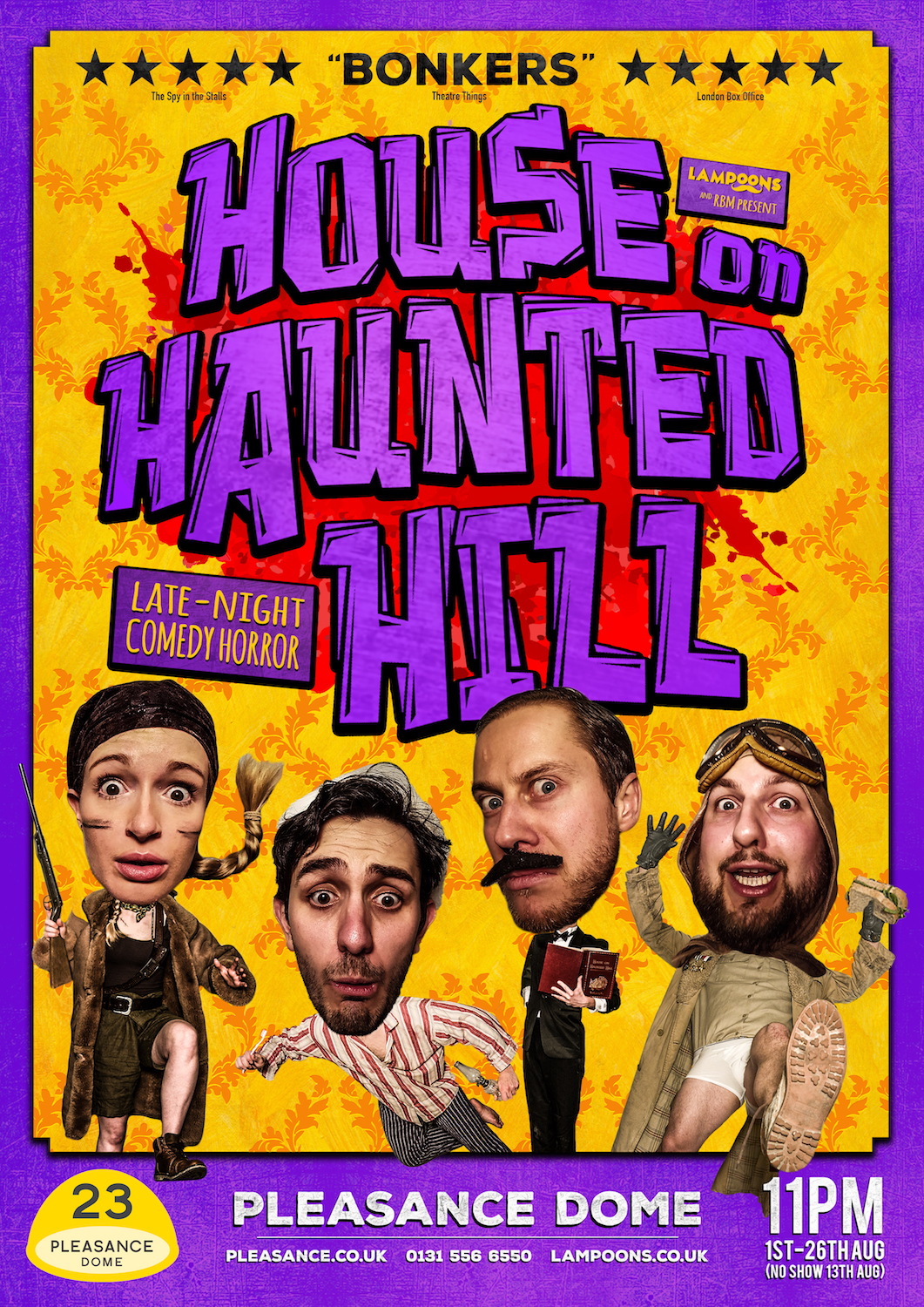
If you think that four “professional idiots” (their words, not mine), a haunted house, lots of ping pong balls and a jar of pickles sounds like a recipe for chaos… well, you’d be right, actually.

Meet The Lampoons – also known as Tina Baston, Adam Elliott, Josh Harvey and Oliver Malam – who’ve spent the last two years sharing their own unique brand of B-movie mayhem with London audiences. Now they’re preparing to unleash the madness on Edinburgh for the very first time with House on Haunted Hill, a hilarious and utterly bonkers remake of the 1959 horror starring Vincent Price.

“We’ve only gone and brought you a debut!” says Josh. “We have lots of friends in London from our Halloween shows each year, but this will be a newborn baby idiot for us to all deliver. It could well be the most ridiculously bizarre late-night show on the fringe – a thumpingly hilarious non-stop comedy-horror the likes of which have never been seen.

Everything you see in that very sweaty hour is completely devised from Rob White and William Castle’s original black and white 1959 screenplay. Then imagine we threw that classic screenplay into a large blender with some Mighty Boosh, Monty Python, Garth Marenghi and a heavy seasoning of surreal clowning!

House on Haunted Hill is The Lampoons’ second full-length show, following the success in 2016 of their debut – another B-movie remake, Attack of the Giant Leeches, at Camden’s Etcetera Theatre. Adam explains, “We’d been friends for a long time, and big admirers of each other’s work, but had been looking for the right project to come along. At the outset of The Lampoons we really didn’t know what we were going to end up with, but we knew we wanted to explore something beyond the more commonplace comedy styles. Turns out we like the irreverent and the ridiculous!

“As for the horror spoofs: well for one, you have to love the titles! Attack of the Giant Leeches, House on Haunted Hill, who doesn’t want to see those! But also, the simple plots of that genre really allow us to pull the stories and characters every which ridiculous way whilst still maintaining some semblance of story structure. Really, we make the most faithful unfaithful adaptations you’ll ever see.”

Faithful they may be, but The Lampoons’ shows could never be accused of being predictable – a lot can, and does, happen in those 60 minutes, from dodgy fake moustaches to the weirdest ballet recital you’ll ever see. “It’s always most fun to be at the start,” says Ollie. “Coming up with the ridiculous ideas list then going through the process of learning how to implement them. One day maybe we will see Josh as a grandfather clock.”

Now they’re looking forward to bringing the show to Edinburgh, where it’ll run from 1st to 26th August at the Pleasance Dome. “I think I’m most excited about being at the centre of a wonderful casserole of creativity,” says Tina. “I think seeing other shows and meeting other creatives every day will give us so much inspiration and motivation to make people chuckle every night. Also, I’ve heard Edinburgh has great beer…”

They’re also hoping to check out a few other shows while they’re in town: “3 Years, 1 Week and a Lemon Drizzle, Will Seaward’s Ghost Stories and Stevenson Experience – they’re twins AND comedians!”

And with plenty of classics still out there waiting to be reimagined, what does the future hold for The Lampoons? “After this debut fringe festival we will likely want to reach more regional areas with our clowns,” says Josh. “And also to continue re-imagining a wonderfully awful B-movie every Halloween in London.”

Interview: Milly Thomas, Dust

Milly Thomas is a London-based actor and writer, whose solo show Dust is about to transfer to the West End, following critically acclaimed runs at last year’s Edinburgh Fringe and London’s Soho Theatre. The solo show, directed by Sara Joyce, tackles the difficult topic of mental health from a unique viewpoint – that of a young woman who’s just committed suicide.

“This is Alice’s story,” explains Milly. “Alice has depression and decides to take her own life. However, what she isn’t counting on is remaining there, stuck. And in this stuck place she can see the effects of her decision on her family and friends and, ultimately, on her.

“It’s something I feel very passionately about, having had depression and anxiety myself for a while. I think it’s so easy to lose sight of what it means to be high functioning and the real impact of depression on our lives. I hope that it will get people not just to open up about their issues with mental health but also to do more and realise that suicide isn’t the answer. Mental health is spectrum. Suicide is binary: once you’ve died, you are no longer in that conversation and there is no room for hope. This play takes that concept and turns it on its head.”

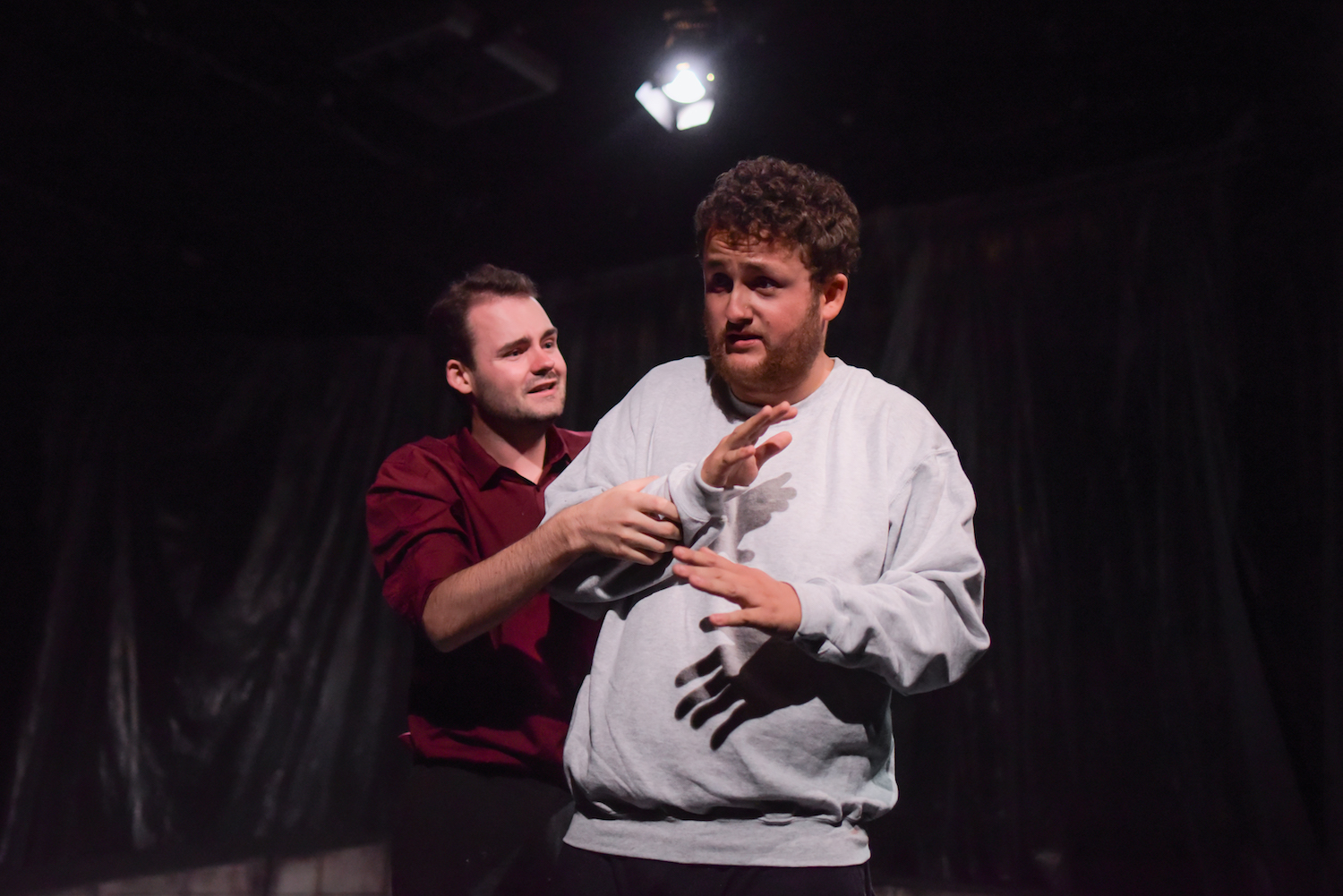
Dust by Milly Thomas
Photo Credit: The Other Richard

Dust has been greeted with widespread acclaim since its debut at last year’s Fringe, for which Milly won an Edinburgh Stage Award. “It’s been incredible,” she says. “I think the biggest surprise is it actually happening at all! And the fact that people have responded to it quite the way they have. I’m very overwhelmed by it and thrilled that it’s helping dent the stigma a bit. With the West End transfer, I think I’m most looking forward to the new audiences. Each time the show has been on the audience has evolved, and I’m so excited to meet the people I’ll be playing with.”

The 75-minute solo show sees Milly playing not only the central character of Alice, but all the people in her life as well. It’s a challenging task, but one she relishes: “Ooh, I love it. I love doing it. I miss it when I’m not doing it! It’s like being on the treadmill in a good way. What I love is that you can’t end game it. When it starts, Alice is in a place of complete denial and almost amusement. Almost giggly. You can’t think about where it’s going or what’s going to happen. It’s only halfway through that you suddenly realise how hard it is and by the end you’re totally out of breath.”

Milly began her career as an actor, and started writing when she graduated from drama school in 2014. Her first full-length play, A First World Problem, opened at Theatre503 in July of that year, followed in 2015 by Piggies and in 2016 by Clickbait, which played to sold-out audiences and an extended run. Last year, she took two shows to Edinburgh – Brutal Cessation and Dust. Her top tip to other aspiring writers is to write as much as possible: “As much and as often as you can. Throw nothing away. Absolutely nothing. Might be gold in five years. Be patient. This is a long game and your age and experience are only going to make your work richer.

“Talk to people. Talk to strangers. Writing is a relationship. Try to make it a loving and fair one where you are kind to each other. Talk to other writers. Talk to directors. Actors, producers, designers, stage managers – talk to people. Find out how it works outside your sphere. Keep interested and open and never be precious. There are different hills to die on and choose them carefully. You’ve only got limited hills! You can’t die on all of them!”

Review: The White Rose at the Brockley Jack Studio Theatre

Best known for their adaptations of literary classics, Arrows & Traps have taken a different approach in their latest production, The White Rose. An original piece written and directed by Ross McGregor, based on Richard Hanser’s A Noble Treason, the play tells the powerful true story of Sophie Scholl who, along with her brother Hans, was the leader of a resistance group – known as the White Rose – and was arrested and executed in 1943 for distributing leaflets denouncing Hitler’s regime. The structure of the play interposes scenes of Sophie’s interrogation with the story of the White Rose, telling an extraordinary tale of courage in the face of tyranny, and posing some important questions that resonate now more than ever with a modern day audience.

First of all, to anyone who fears that the company moving away from its roots was a bad idea, let me put your mind at rest: I think it’s very possible that The White Rose is the Arrows’ best show yet. It’s certainly the one that’s had the biggest impact on me personally – although leaving the theatre I couldn’t quite decide if I was sad, inspired, furious or terrified at the state of the world (both past and present).

The White Rose at Brockley Jack Studio Theatre
Photo credit: Davor Tovarlaza @ The Ocular Creative

The outstanding ensemble cast don’t put a foot wrong – both metaphorically and literally; like all Arrows productions, this is a play where every movement has meaning – and make us feel every emotion: there’s desperation and anger in abundance, but in lighter moments we’re also given the chance to appreciate the optimism and camaraderie of young people who want to make the world a better place. And through it all runs fear: the fear of being caught, of speaking out, of losing friends – but on the other side of the scales sits the fear of keeping quiet and what that could potentially lead to.

From Christopher Tester’s conflicted Gestapo officer Robert Mohr to Pearce Sampson’s quietly courageous Christoph Probst; Conor Moss’ witty Alexander Schmorell to Will Pinchin’s intense, furious Hans Scholl, every character has their own voice, and their own reason for behaving as they do. But above all, this is Sophie’s story, and just as she’s welcomed into her brother’s group of friends, Lucy Ioannou proves to be a fantastic new recruit to the Arrows family, balancing perfectly Sophie’s youth, wit and innocence with the courage and moral strength that will lead her to risk everything for what’s right.

With resident Movement Director Will Pinchin taking to the stage as Hans, Roman Berry seamlessly takes up the mantle, producing thrilling, immaculately choreographed dreamlike sequences reminiscent of the company’s earlier work. The cinematic quality of the play is further enhanced by the inclusion of video footage at the beginning of each act, which shows chilling scenes of Hitler addressing adoring crowds, and drives home more powerfully than any words the impossibility of what the White Rose is trying to do.

The White Rose at Brockley Jack Studio Theatre
Photo credit: Davor Tovarlaza @ The Ocular Creative

The script teases out parallels between 1943 and 2018, without beating us around the head with them, and also makes a point of reminding us that Nazism wasn’t always death camps and terror in the streets; Hitler came to power on the promise of rebuilding Germany, and everyone – including Sophie and Hans – believed him. The play celebrates and acknowledges the White Rose’s sacrifice, but at the same time attempts to understand why everyone else stayed silent even when things went bad. Some, like Sophie’s fiance Fritz (Freddie Cambanakis), feared the repercussions of resistance; some, like her cellmate Else (Cornelia Baumann) optimistically believed it would all soon be over; others, like Gestapo officer Mohr, genuinely thought Hitler had made things better. In allowing these characters to have their say, the play becomes something far more complex than simply good versus evil, and is all the richer for it.

Despite being very well known in Germany, very few of us here in Britain know the story of Sophie Scholl. The White Rose aims to set that right with this powerful, emotional tribute, but also seizes the opportunity to explore the many unnerving similarities between then and now. It’s uncomfortable, and devastating, and you should definitely go and see it.


Can’t see the map on iPhone? Try turning your phone to landscape and that should sort it. I don’t know why but I’m working on it… 😉

Review: Locked Up at Tristan Bates Theatre

Possibly the only thing worse than being locked up and kept in isolation for an indeterminate amount of time is not knowing who’s responsible or why. This is the plight of the characters in Locked Up, a tense two-hander that’s both the professional London debut of writer Heather Simpkin and the first full-length play from emerging theatre company Bear in the Air Productions.

Locked Up at Tristan Bates Theatre
Photo credit: Rosalind White Photography

We first meet Declan (Samuel Ranger), who passes his time pacing the floor of the cell, attempting to do push-ups, and singing “99 bottles of beer on the wall” in an endless, mind-numbing loop. The opening minutes of James McAndrew’s production convey very effectively the monotony of Declan’s day-to-day existence, and after a series of short, sharp scenes it’s not long before we too have lost track of time. It’s as much of a shock for us as it is for Declan, then, when one day he suddenly finds he’s no longer alone. His new cellmate is Topher (Conor Cook), who’s equally clueless as to their captors’ intentions – or is he?

Time passes, and the two slowly grow more relaxed around each other, allowing us to get to know them better and fill in a bit of their backstories. We soon learn that they’re very different personalities: Samuel Ranger’s Declan is sensitive and risk-averse, while Conor Cook’s Topher takes a “no guts, no glory” approach to life – so it’s no surprise that he’s the one who ends up taking charge of their escape plan. The uneasy friendship and shifting dynamic between the two is interesting to watch as it develops, particularly as we’re also not sure who – if anyone – we can trust.

Locked Up is a story about human relationships, first and foremost, and asks some searching questions about trust, betrayal and the ways in which a crisis can bring together even the unlikeliest collaborators. But it also touches on current political and social issues that we can all relate to, like the threat of terrorism and government surveillance, and the fear of failure that so often holds us back from pursuing what we really want in life.

If Simpkin’s writing isn’t enough to keep us on the edge of our seats then the light and sound effects employed at each scene change will finish the job; lighting designer Euan Davies has a row of bright spotlights shine directly on to the audience, accompanied by loud and unsettling noises. This has the practical purpose of allowing the actors to invisibly reset the stage – occasionally disappearing from it altogether when one of the characters is taken away for interrogation in the mysterious White Room – but it also keeps the audience on our toes; there’s little chance of us getting too comfortable at any point during the hour-long play.

Locked Up at Tristan Bates Theatre
Photo credit: Rosalind White Photography

Similarly, Justin Williams and Jonny Rust’s set design is logistically clever, allowing the actors to leave and return seemingly out of thin air, but it also helps reinforce the play’s claustrophobic atmosphere. The characters aren’t the only ones who have no idea what’s going on outside these four walls; for the duration of the play, we’re as trapped and in the dark (both literally and figuratively) as they are.

The end, when it comes, is abrupt and catches us completely off guard, and though it’s frustrating that the story cuts off where it does, in a way it’s the perfect moment to stop and leave it to the audience to ponder answers to our many remaining questions. An intriguing and unnerving hour of theatre, Locked Up will keep you guessing to the end – and beyond.

Can’t see the map on iPhone? Try turning your phone to landscape and that should sort it. I don’t know why but I’m working on it… 😉

Interview: Charlotte Fox, Ouroboros

Ever felt like you’re not quite good enough? You’re not alone. In her debut solo show Ouroboros (named after an ancient symbol that depicts a snake eating its own tail, in an eternal cycle of renewal), writer and performer Charlotte Fox tackles society’s obsession with ego, superficiality, social media, narcissism and body image, and explores their effects on Charlotte, an actress in the entertainment industry.

“I was inspired to write Ouroboros by frustration with the lack of acting work,” explains Charlotte. “I was writing in response to what was happening around me, in my life and career experience. I struggled to reconcile with other people’s conflicting viewpoints. It felt like a constant battle, struggling against myself and having to obey an industry and society’s vision of ‘beauty’ and ‘perfection’ in order to fit in and seek acceptance.”

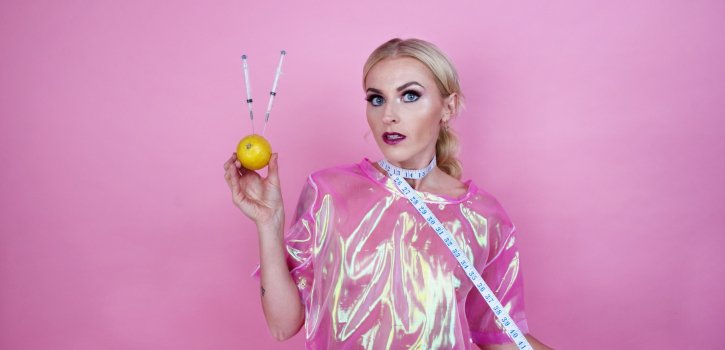
Charlotte Fox, Ouroboros

Following a run earlier this year at the Rosemary Branch, Charlotte is preparing to take the show to Edinburgh next month, where she hopes audiences will embrace its message and get involved. “It’s an explosive display on stage,” she says. “Ouroboros is like fireworks – a show that doesn’t come down, with highly physical and absurdist comedy elements, that discusses relevant and timely issues without being didactic. It has the ability to mix observational scenarios and parody them in a way that makes you laugh and cry before sending you away. It also combines music, dance, clowning, physical theatre, bouffon and a bit of mime!! One genre!? Naahh – chose ’em all!

“I’m looking forward to performing to a different audience everyday in Edinburgh. They all bring something different. You can sense it as soon as you step out. What one person might find disturbing can have another howling with laughter. It’s brilliant! I like sensing that, there’s interaction in this show and it’s fun as an actor discovering how you can play to the audience. Or how they are playing for you. I hope they’ll feel excited and moved by the whole experience, and have a willingness to re-examine their own lifestyle experiences, recall moments of similarity and most importantly laugh and perhaps squirm on the edge of their seats!”

The show, which is written, performed and directed by Charlotte, has been in development for the past year. “It’s been an incredible journey,” she says. “I wasn’t really too sure what to expect at the start – it was difficult, but I knew I was tapping into something important, I had an urge to keep exploring. I always knew the style of work I liked and had a vision of what I wanted to create. So collaborations with other like-minded theatre makers were made and Ouroboros started to flourish. I had a revelation when I realised not everyone will share your artistic vision. You have to be so strong and protect yourself against people who can try and contaminate your work… It was a big lesson for me.”

Performing the 60-minute solo show, in which Charlotte portrays “a conveyer belt of hyper-functional characters”, brings with it a number of physical and emotional challenges. “It’s a huge physical demand as a performer,” she says. “It’s also very close to the bone, which brings both a challenge and reward. I know that this show has left an impact on people in a similar situation. It’s sparked discussion. It’s also allowed me to find self-acceptance as an actor, allowing my own creativity and artistry to flourish regardless of what anyone says. You can decide to say yes to yourself.”