The Thelmas are an all-female theatre company founded by Madelaine Moore in response to a growing need for the support and development of new female writers. Most recently seen in London with the Offie-nominated Coconut, the company will next be making their Edinburgh debut with Ladykiller by Madeline Gould, which opens at The Pleasance on 1st August.
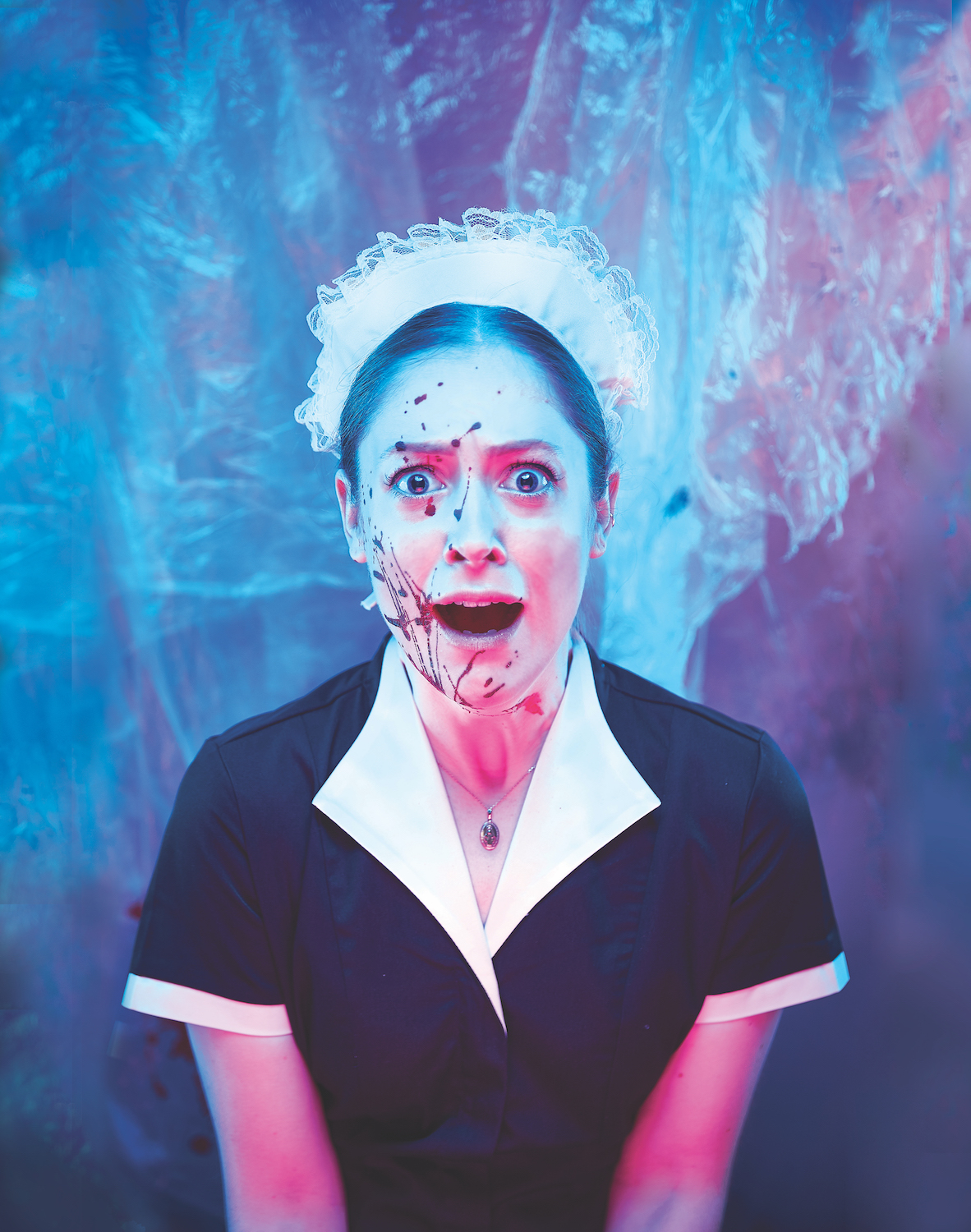
“Ladykiller is set in a hotel room, in the aftermath of a murder,” explains actor Hannah McClean. “When we meet HER, a hotel maid, she’s covered in blood and distressed – but it’s not what it looks like; she can explain…
“It’s clear who committed the crime, so the play is more of a Whydunit, than a Whodunit. It’s a very dark comedy with a few twists and turns along the way, which will leave you second guessing our protagonist.”
Photo credit: Greg Veit Photography
Madeline Gould wrote the play to explore women’s capacity for violence and criminality, after noticing a lack of complexity in the portrayal of female killers. “I’ve never read a script which focuses on female criminality and psychopathy,” says Hannah. “Characters like this are more often than not, written for men. I have read all too many scripts or watched shows where the female characters are portrayed as less complex than their male counterparts. Women are just as capable of the good, the bad and the ugly and this script explores that beautifully.
“My character is intelligent, charismatic and at times brutally honest, yet you never know where you stand with her. She is not someone you can root for, but she makes it hard for you not to. I can quite honestly say, I’ve never had the opportunity to play anyone quite like HER, nor have I read a script with a character like HER in it. We feel that our show depicts a female character in a way that hasn’t been seen before – truly, she breaks the mould. She is dark, she is dangerous and she is covered in blood.
“When I read the original script, when it debuted as a 15-minute piece in 2015, I was blown away by the writing, its twists and turns and its unapologetically dark humour. It’s now even bigger and better – and also really funny btw – and I’m absolutely thrilled I still get to don my blood soaked apron. At a time when we as a society are examining our gender roles more so than any other, the show taps into this conversation in a most unexpected way. I hope it gets people talking and debating …and laughing.”
Photo credit: Chris Mann Portraits
As well as The Thelmas’ Edinburgh debut, Ladykiller also marks Hannah’s first time performing at the Fringe: “I have always wanted to perform at the Edinburgh Fringe and for a long time I have wanted to perform in a one woman show; so to get the opportunity to tick both those boxes at once is so incredibly exciting. And terrifying! But mostly exciting,” she says. “I begged Maddie Gould to write the full length show after performing the original short in 2015, so now I just need to concentrate on making sure it was worth her while (please God!).”
When she’s not murdering people in hotel rooms, Hannah will be busy checking out some of the other shows heading to the Fringe this year. “So far, the shows that have caught my eye are – F**k You Pay Me at The Assembly Room – I saw this at The Vaults this year and loved it, so I can’t wait to see how it’s developed; The Half at The Pleasance (might have to catch that on my day off) looks great; and East Belfast Boy by Prime Cut Productions (have to support the home grown stuff and also, they’re great), to name a few. The exciting thing is discovering new stuff though, so I’ll be soaking up as much as I can.”
In the wake of the recent vote in Ireland to repeal the 8th Amendment, Laura Wyatt O’Keeffe’s play Vessel explores female empowerment at a very particular moment in history, and asks what happens once that freedom to choose has been won. Following successful preview performances at the Old Red Lion Theatre in London, the two-hander moves to Edinburgh’s Underbelly from 2nd August.
Photo credit: Emma Micallef
“Vessel is a show about women’s bodies, choice and love. Maia, a receptionist, and David, a journalist, embark on this journey that sees them navigating through a lot of their own personal difficulties to serve a greater purpose,” explains Edward De Gaetano, who plays David. “It’s set in pre-referendum Ireland when abortion is still illegal, and tells the story of Maia, a woman whose tweet about her unwanted pregnancy goes viral and she becomes the focus of public attention during the Repeal the 8th campaign. We see these characters awkwardly trying to get to know each other in the process, which at times can be quite endearing and/or funny!
“It’s a topical story that focuses on the individuals having to make important choices; the aftermath of the referendum that begins to explore a new meaning of choice for women. It celebrates women in many ways as it’s a female writer/performer creating theatre about women for women.”
Laura – a Brighton Fringe Award nominated performer, writer, facilitator, researcher, collaborator and activist – was inspired to write the play by recent events and by the evolving perception of women, not only in Ireland but across the world. “Prior to the recent referendum and until legislation is passed, each day nine Irish women will have boarded a plane to the UK, spent up to €1000 and been considered a criminal in the pursuit of a safe abortion,” she says. “I grew up in an Ireland where we did not talk about abortion, we did not talk about choice. Abortion was something that was talked about in hushed tones behind closed doors and it was always something that the person would regret.
“But something started to change around 2010 – people started talking, marching, campaigning. With the recent referendum there is no better time to tell these stories. Whether it’s the #metoo campaign or #Repealthe8th, we are finally having open and honest conversations about how society views women and the consequences. I wanted to tell this story for all these women and to continue to create platforms for having more of these conversations.
“So much of the theatre I see about women acknowledges and details female struggle and that’s it. Vessel is about exploring what happens after that struggle, what happens to the female character when she has freedom, when she has choice, when she is empowered? As a theatre maker I’m excited by the possibility of female focused narratives, not the retelling of female suffering. For women to keep moving forward socially and artistically we’ve got to start telling and listening to stories of female empowerment.”
Both Laura and Edward are now looking forward to taking the show to Edinburgh and sharing it with new audiences: “Being one of the biggest theatre festivals in the world, we’re excited to perform to such a diverse and international audience,” says Edward. “It’s a place where some of the best artists come to perform, challenge ideas and take a chance at new ideas. The energy and the work is immense and to be a part of that with such a topical play it’s extremely exciting. The Underbelly have been incredible to work with and we simply cannot wait to perform in such a great space being part of such a varied and brilliant programme!
“As with all festivals you really never know who you are going to meet or bump into; actors and performers have had their careers changed to the better after Edinburgh, so it’s really a place where opportunity meets chance.”
It’s also an opportunity to check out and be inspired by other work – and they already have plenty lined up: “Oh yes, there are loads! To start off with the specific shows we cannot wait to see are Fishamble’s Maz and Bricks by Eva O’Connor; Bottom by Will Hudson; Hightide’s Busking It by Danusia Samal; Frieda Loves Ya at Underbelly; everything at Paines Plough Roundabout; anything by Big in Belgium and Canada Hub; Woman of the Year by Anna Nicholson and In Their Footsteps by Ashley Adelman and Kelly Teaford. We both love comedy, well who doesn’t, so we will definitely be checking out some stand-up comedy gigs and whatever else comes our way – we can’t wait to be inspired by what we see!”
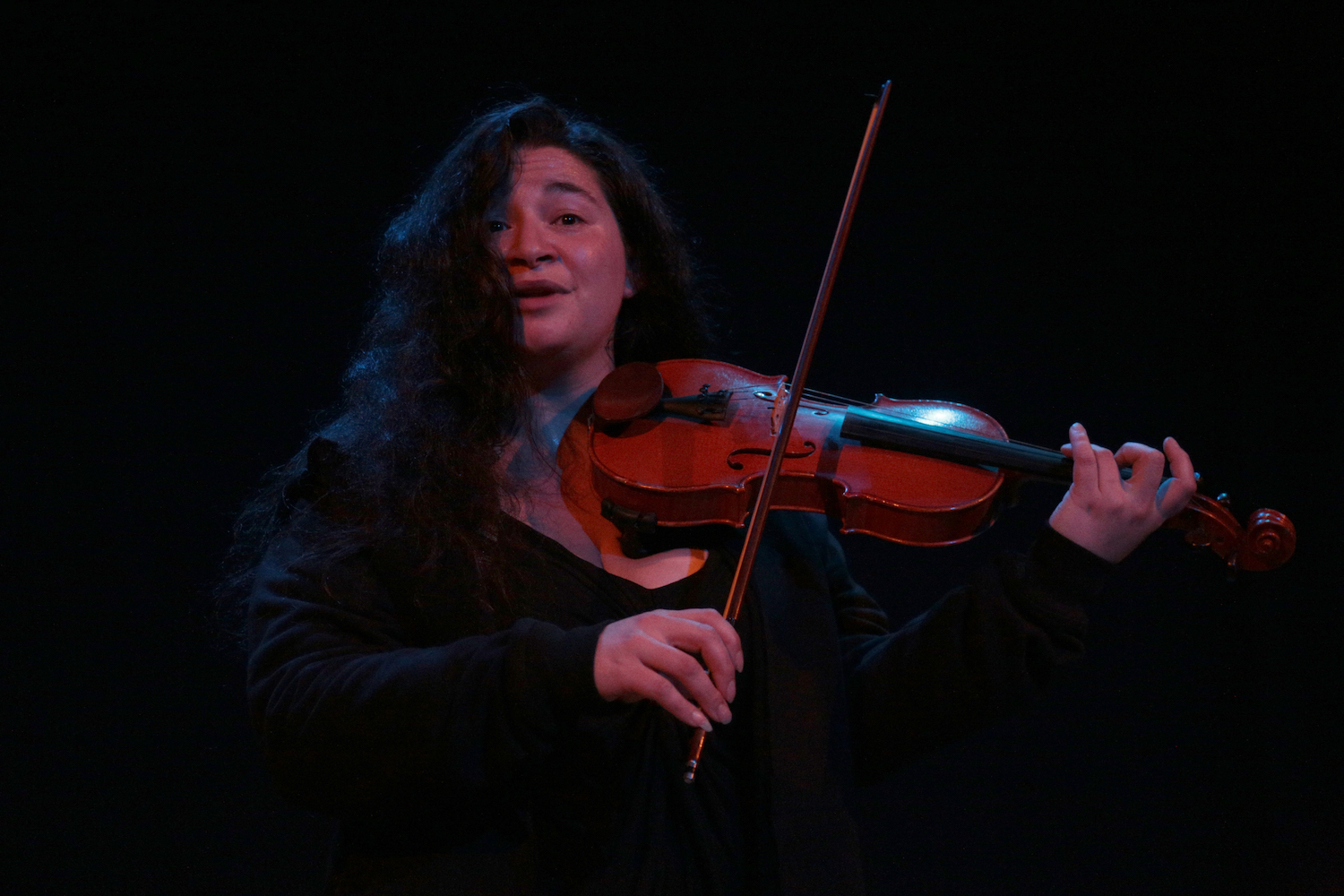
Miriam Gould is a theatre-maker, performer, musician and writer. In August her first solo show, Empty Room, comes to the Camden Fringe, drawing on Miriam’s own experience and family history, and exploring the many ways in which music can help us survive.
“Empty Room is about a family unit – a mother, father and daughter, who each, in their way, are struggling with life and using music to cope,” she explains. “In a wider sense, it’s about parenthood, childhood, and music. The parents are jazz musicians and the daughter is obsessed with the Soviet neo-classical composer Shostakovich. All three are using music in different ways in order to survive. In their own ways, they’re all trying to find coping mechanisms for the absurdity of existence.”
Empty Room is a very personal project for Miriam, and was inspired by her parents, who were both jazz musicians: “The music in the show, some live, some recorded, is either written or played by my parents or Shostakovich – with whom I am genuinely obsessed,” she says. “My mother wrote some incredible songs which describe what was going on, with a poetry that gets to the heart of things in a way simple text could never do. I have always been struck by the power of music to communicate a depth of experience and emotion that we otherwise struggle to convey.
“From the age of 6, it was just me and my Mum, and the fact that she managed to be a parent as well as a jazz singer still baffles me. But mostly it inspired me to make my own way. My father died – spoiler alert! – and the amount of love and respect for him in the jazz community makes me proud even though I had nothing to do with it. So I guess, to give a really boring answer, my parents have inspired me. Perhaps, more specifically, it’s my mother’s compassion and forgiveness that infuse the show.
“Oh, and Shostakovich. He was amazing. He lived in a place and time where writing a symphony was a life or death scenario. And still he made the music he needed to make. Even though he was censored in every other possible way, and at times showed real cowardice in order to survive, he spoke the truth in his music. So, yeah. Did I mention I love him?”
Photo credit: India Roper-Evans
Miriam started work on Empty Room all the way back in December 2014, and the following August performed a few works-in-progress in London and Canterbury. “It was just me, working in a room on my own. I’d never made my own work before. Then I got busy with other projects until November last year. I’d been wise enough to film the performances in 2015 and was able to show this to Alex Scott, the Artistic Director of Little Bulb Theatre, whom I very much wanted to be my dramaturg. I needed to not be on my own in a room for all the rest of the process.
“I’m currently in my last few days of tweaking the show based on feedback and how it felt to perform it in June when I had a couple of showings at Battersea Arts Centre. I really believe that sharing your work when it’s not finished, but you’re ready to share it, is so incredibly valuable. Especially with the right audience. BAC’s audiences are primed for scratch performances, so it’s such a great place to work and not be afraid of failing.
“When I first started working on the show, it was a revelation to me to perform as my mother and my father. I learnt so much about them by trying to get into their skin. It changed my life in a big way at the time. Now, I’m able to be more detached from the very close material. It’s obviously still important to be aware of how I’m doing emotionally throughout the performances, but the processing of the material happened in the rehearsal room.
“I love telling this story, more and more because of what it’s really about, and not because it’s autobiographical. I love sharing the idealism in it, the love and compassion, the passion and humour. I want to start a conversation with the audience. I always make a point to talk to as many people as possible after the shows, not to hear more about the performance, but much more to hear what it sparked in people’s minds or bodies.”
Although Empty Room is a very personal story, Miriam believes it will resonate with a lot of people: “I hope it allows people to rethink their relationship with their parents or children, especially if that relationship is strained. The younger version of myself in the show is very passionate and pretty awkward, so I think this will be familiar to how a lot of people feel even if they don’t show that side of themselves on a daily basis. I suppose I want it to be cathartic for the audience, that a space is created where they can have all the feelings and maybe connect with a younger, more naive part of themselves.
“On a less emotional level, I also hope that people will love the music, not just the jazz but also the Shostakovich. After the sharing in June someone said how rare it is for them to see someone play classical music. I have a massive bee in my bonnet about the (perceived?) elitism in classical music and I hope that by sharing some of the music I’m passionate about, some members of the audience might be tempted to seek it out for themselves.”
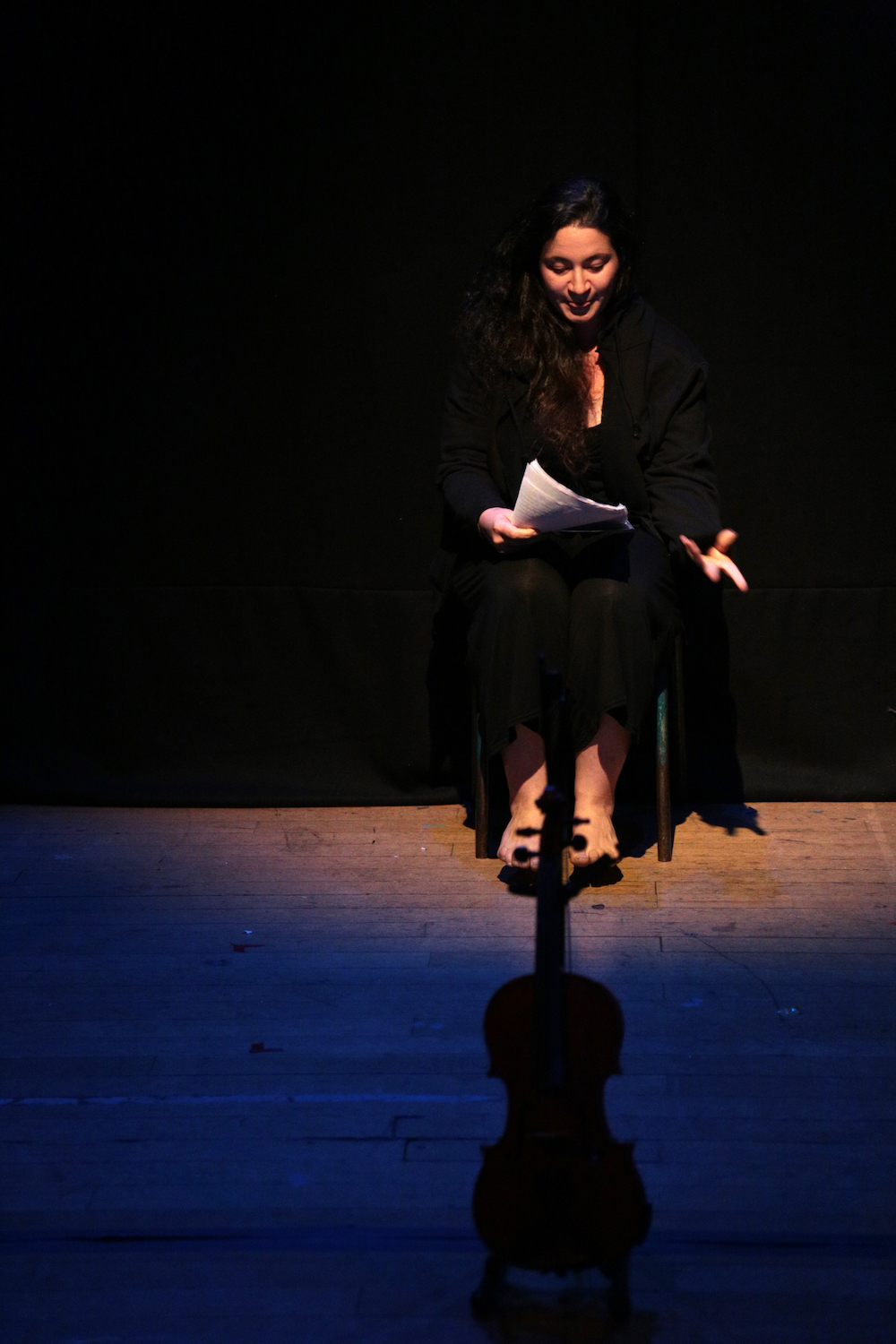
Photo credit: India Roper-Evans
A unique feature of the show is The Survival Playlist. “Basically, each audience member is given a slip on which to write a song that has helped them get through a difficult time at some point in their life,” says Miriam. “If they want to share more about this, they are welcome to do so. There is also a Twitter handle – #SurvivalPlaylist – through which I have gathered some gorgeous submissions already. To begin with, it will be published and continually added to on my website with links to the songs. Eventually I would like to make this playlist available on other platforms as well, through Spotify and hopefully a podcast.
“I think the most interesting thing about the Survival Playlist is not the actual playlist itself, but the conversations and memories that it sparks, as well as the simple fact that music means so much to us, especially when we’re hitting rock bottom, and the playlist is a celebration of music as a survival tool.”
As well as making work on her own, Miriam is also an Associate Artist with Little Bulb Theatre and the co-founder of female theatre duo Double Trouble Theatre, whose work focuses on real-life events through soundscapes, poetic imagery and story-telling.
“In a lot of ways, the idealism of Empty Room echoes my own belief in the arts,” she says. “I am convinced that we have evolved to make art for a reason, it’s not just some frivolous thing to keep us busy in between the important stuff like shopping. At the same time, I wish we as a culture would view artists more like craftspeople, less like it’s some martyr’s calling, and more like an occupation. Which it is.
“I want the work I make to draw people in, so it must be entertaining, but I don’t just want to tell people what they know already, or even worse, not tell them anything at all. Finding the balance between communicating something deeper and meaningful and making work that doesn’t empty theatres, I guess that’s something most artists are trying to achieve.
“I see art as socially cohesive, which surely must be even more important now that we’re all constantly being divided and pitted against one another. I don’t want my audience to agree with me. I want them to engage in the work and respond, in whatever way is best for them.”
Chickenshed is an inclusive theatre company that celebrates diversity in all its forms. Mr Stink is a story about a homeless man who’s befriended by a 12-year-old girl – the only person who ever bothers to stop and talk to him. Put the two together, and it’s pretty much a perfect fit.
The second novel from best-selling children’s author David Walliams is a heartwarming tale of friendship, loneliness and the social responsibility we all have to look out for our fellow human beings… even if they really, really stink. Adapted as a musical by director Lou Stein, it’s a colourful, funny and thought-provoking show for all ages, with songs that are so catchy you may well find yourself still singing them the next day, whether you want to or not (trust me on this, I speak from experience). And really, how can you not fall in love with a show that opens Act 2 with a musical number about sausages?
Photo credit: Caz Dyer for Chickenshed
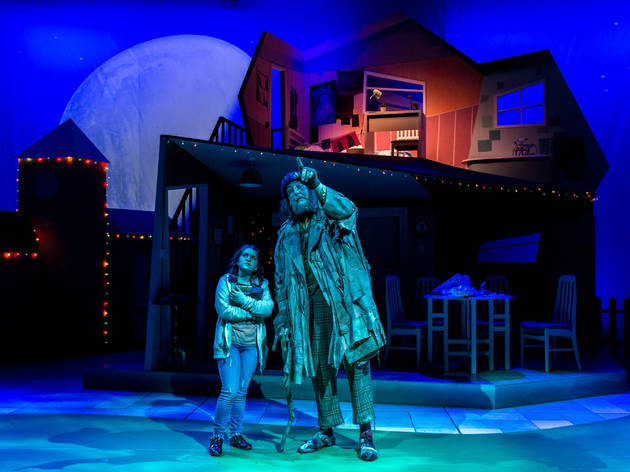
Mr Stink (Bradley Davis) is an old “vagabond”, to use his word, who arrives in town one day and takes up residence on a bench. He and his dog are ostracised by the local community because they smell so bad, until one day Chloe Crumb (Lydia Stables) stops to say hello. Chloe has a nice house and a family; she goes to a posh school and always has enough to eat. But she’s also lonely and feels unloved by her exhaustingly perfect sister Annabelle (Maddie Kavanagh) and above all by her mother (Belinda McGuirk), a determined social climber running for election as a local MP. One of her campaign promises is to get “soap-dodgers” off the streets, and so to protect her new friend, Chloe moves him into the garden shed – but he doesn’t stay hidden for long…
Chickenshed never fail to impress with the quality of their productions, and Mr Stink is no exception, showcasing some excellent performances from the whole cast, and in particular Bradley Davis and Lydia Stables (sharing the role with Lucy-Mae Beacock) as Mr Stink and Chloe. Their blossoming friendship is a joy to watch, with each of them helping the other in ways they could never have predicted. Alongside them, Belinda McGuirk and Maddie Kavanagh (sharing her role with Courtney Dayes) are enjoyably loathsome as Mrs Crumb and Annabelle, while Ashley Driver plays the hapless Mr Crumb – who spends most of his time hiding from his wife – to great comic effect.
There’s also a delightful appearance by Goutham Rohan as Raj, the local shopkeeper, who’s always on hand with some helpful advice or a Teenage Mutant Ninja Turtles stationery set. Oh, and did I mention Mr Stink marks the professional acting debut of a certain Jeremy Vine, who appears in a pre-recorded video segment as Sir Dave, the host of TV show Politics Today.
Photo credit: Caz Dyer for Chickenshed
The show looks amazing, too, with colourful and exceptionally detailed set and costumes designed by Keith Dunne, all of which are beautifully lit by Andrew Caddies. The musical numbers, written by Lou Stein and Dave Carey, may not add much to the story but they do provide a visual treat, and allow for the inclusion in the show of a small chorus ensemble, who execute Dina Williams’ choreography in the group numbers with flair and the boundless enthusiasm that’s such an irresistible feature of Chickenshed performances.
Like all good family shows, there’s something for everyone in Mr Stink; it’s a lot of fun and occasionally very silly, with humour that will tickle kids and adults alike. But it also makes a powerful point; while I don’t for a minute believe David Walliams wants us all to go out and find a homeless man to hide in the garden shed, what his story does show us is the importance of reaching out to help others, without making judgments about who they are or what they do. And that, I think, is a lesson we can all benefit from – whether we’re 8 or 80.
Can’t see the map on iPhone? Try turning your phone to landscape and that should sort it. I don’t know why but I’m working on it… 😉
It might be 20 years old, but Simon Stephens’ early play Bluebird could have been written yesterday – and not only because of the many very apt references to the stiflingly hot weather.
A play of two halves, the first act consists of a series of short encounters between taxi driver Jimmy and the various fares he picks up in his cab one summer night in London. As he drives them to their destination, each shares a bit of themselves with him – whether it’s bad jokes, philosophical musings or reliving a personal tragedy – and he in return reveals a little of his own story.
These short sketches are performed by a talented ensemble cast and are by turns funny, moving and intriguing; they feed, ultimately, into Jimmy’s tale, but they also stand alone as a snapshot of London in all its glorious randomness. And with more than one passenger expressing concerns about where we’re all headed, you could easily be forgiven for thinking this is a play for 2018, not 1998.
With the majority of the action taking place in one location – Jimmy’s car – director Adam Hemming keeps things visually interesting with a stage consisting of two intersecting runways, and the audience arranged at the four corners. With each new fare, the actors move to a new location on the stage, giving us a different perspective in more ways than one, and between scenes the characters we’ve met – or are about to meet – continue on with their night.
The only other set consists of a couple of chairs and various car parts which are arranged on stage one by one; during one scene Jimmy holds a steering wheel, for another he and his passenger sit behind the car headlights or between two wing mirrors. This, it turns out, is a neat visual metaphor for the play itself; just as each new encounter provides a little more of the puzzle that is Jimmy, so all the car parts are eventually reunited for the final emotionally charged scene with Claire, his estranged wife.
As the other actors rotate around him, Jonathan Keane maintains a steady, quiet presence throughout as Jimmy. He spends most of Act 1 listening to other people’s problems, taking care of them, and establishing himself firmly in our minds as a good guy – a guy who gets people home safe and lends an ear to those who need it. But there’s just enough of an edge to the character, and Jimmy’s conversations reveal sufficient snippets of information, to allow us to hazard a guess at what’s coming – even before he meets Claire, played by Anna Doolan with a poignant mix of anger, hurt and lingering affection. Their encounter sizzles with a gripping emotional intensity, before coming to a rather abrupt end that leaves us with many unanswered questions about the story we’ve just heard.
Despite this minor frustration, however, Bluebird successfully hits the emotional mark with its portrayal of a couple taking their first tentative steps towards some kind of reconciliation, and a man navigating his own unique and bumpy road to redemption. A moving study of grief and guilt, imaginatively staged and set in a London we can all recognise, this revival is well worth a visit.
Can’t see the map on iPhone? Try turning your phone to landscape and that should sort it. I don’t know why but I’m working on it… 😉





 Theatre Things