Review: Blind Man’s Song at the Pleasance

I’ll be honest – I had mixed feelings going in to Theatre Re’s Blind Man’s Song last night. On the one hand, I was looking forward to something a bit different. On the other, as a general rule I like my theatre with words – the more the better.

There are no words in Blind Man’s Song. But as it turns out, none are needed. The show uses a combination of mime, dance, sound, illusion and original music to tell a moving and surprisingly powerful tale of love and loss, which is accessible enough to follow what’s going on but still leaves room for each individual to interpret it in their own way. The main character, a blind musician (Alex Judd), leads us on a journey into the dream-like world of his own memory (or is it imagination…?), in which a chance encounter between two strangers is just the start of the story.

Photo Credit: Richard Davenport

Two mannequin-like figures (Guillaume Pigé and Selma Roth), their faces covered, bring this world to life while the musician plays. In the absence of facial expressions, it’s the music and movement that convey the emotion of the piece – and in doing so reveal how much it’s possible to share without words. The combination is so evocative that we can feel the joy, passion, rage and grief of all three characters, as the music skips, swells and storms around them.

Said music is all original composition for violin and piano by Alex Judd, making effective use of the loop pedal to create layers and waves of sound. A simple theme, picked out with one finger on the piano, is repeated throughout the show, finally taking its place at the heart of the blind man’s song for the spine-tingling finale. Meanwhile, in harsh contrast, discordant sound effects – a rattle of metal against metal, a loud feedback tone – interrupt to break the spell and go on just long enough to make us uncomfortable, in a reflection of the musician’s own internal struggle.
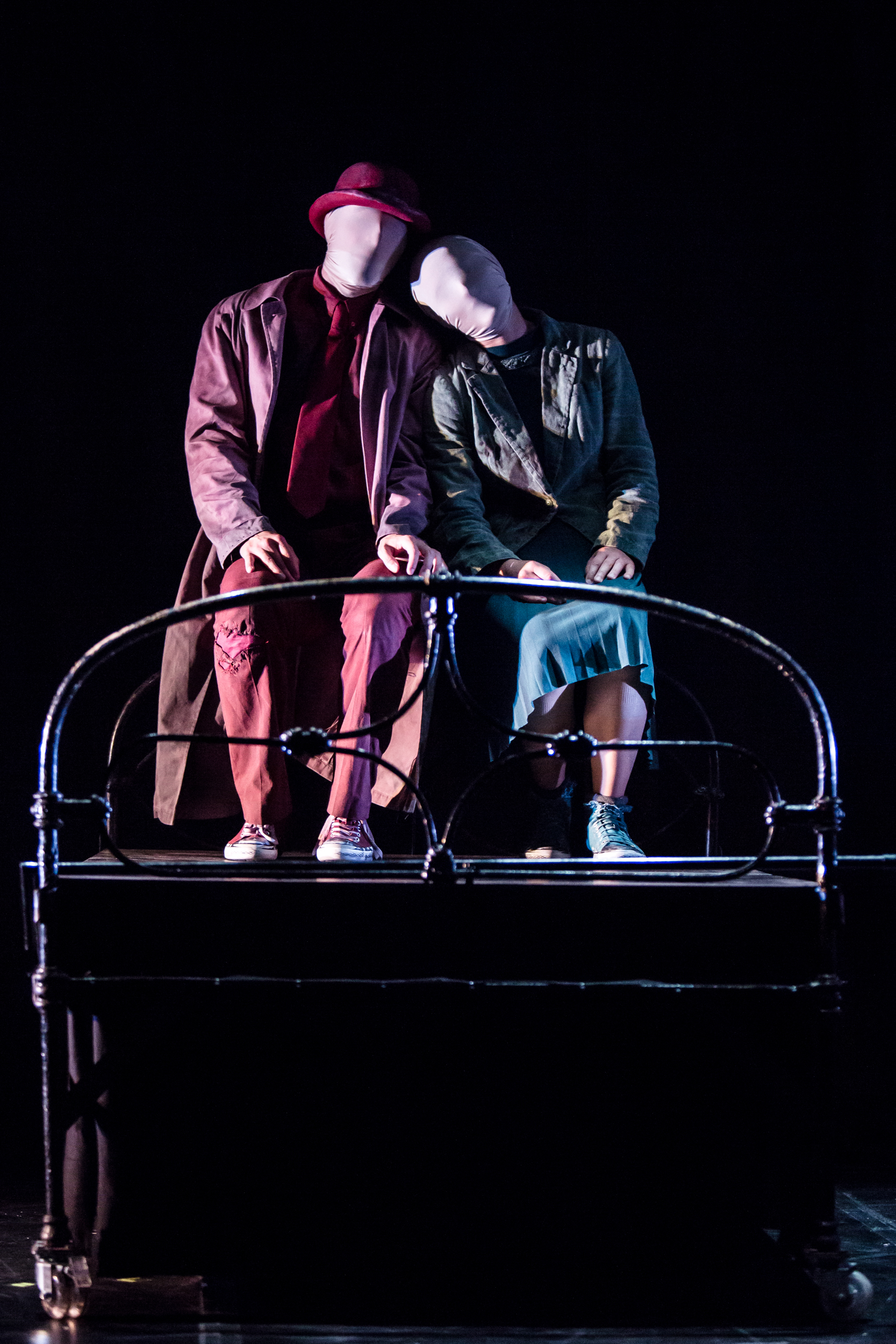
Photo Credit: Richard Davenport

The show was conceived and directed by Guillaume Pigé, one of the faceless figures who cover the stage with a fluid grace, at times in slow motion and at others with surprising speed. There’s creative use of the sparsely furnished set; I particularly enjoyed the conversion of the bed into a train. Like the performers, the bed and the piano are rarely still for long, giving the piece a feeling of perpetual motion and urgency.

Blind Man’s Song is proof, for me at least, that sometimes it’s good to step out of your comfort zone; I left the Pleasance feeling genuinely moved by the beauty of the story, music and performance. Who needs words?


Can’t see the map on iPhone? Try turning your phone to landscape and that should sort it. I don’t know why but I’m working on it… 😉
Review: Might Never Happen at King’s Head Theatre

We’ve all been there – you’re walking along, thinking your thoughts, and someone calls out, “Cheer up love, it might never happen!” A bit annoying, maybe, but basically harmless, right? But what if you’re on your way to work and you get wolf whistled, is that still okay? Or a guy sits next to you on the tube and won’t stop trying to chat you up even though you’re clearly uncomfortable? Or a stranger attacks you on the way home one night…?

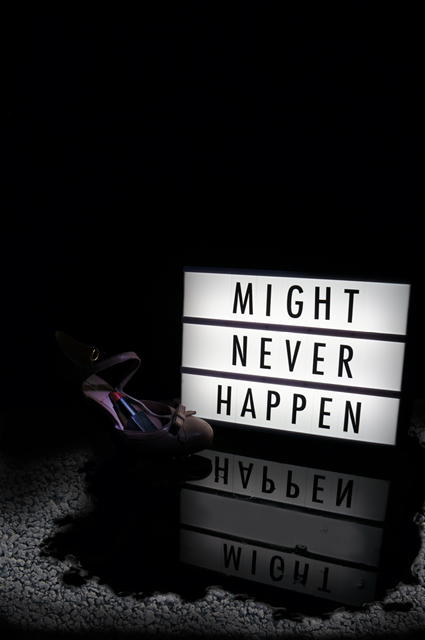
Where do we draw the line between what’s harmless, and what isn’t? This is one of the questions posed by Might Never Happen from Doll’s Eye Theatre, a thoughtful and commendably balanced exploration of the vast spectrum of acts that constitute street harassment. Written by members of the company, in collaboration with researchers Dr. Fiona Vera-Gray and Dr. Maria Garner, the show takes us through a series of individual scenes, performed by six actors. Some of them are funny, others horrifying, and still others unnervingly reminiscent of our own experiences – but all are designed to make us consider not only the actions themselves, but also the attitudes behind them.

IMG_6650

Although the main focus of the show is the risks faced by women, director Amy Ewbank maintains balance in both cast and content. So two male actors (Ashley Sean Cook and Paul Matania) join members of the all-female company (Catherine Deevy, Danielle Nott, Kirsty Osmon and Vicki Welles) to ensure we get to hear a man’s perspective, as perpetrator, observer and victim of street harassment. More than one scene presents us with the alternative view – from both men and women – that receiving a compliment from a stranger is something to be welcomed rather than condemned, while others challenge the culture of victim blaming, and the belief that street harassment is an inevitability we just have to learn to live with.

The result is a show that educates without preaching, throwing out a variety of different arguments for its audience to consider. It also lightens a heavy subject with some very funny moments, to make the point that harassment isn’t always scary (and therein lies one of the problems with defining and punishing it); sometimes it’s just a bit ridiculous, something to be laughed over and dismissed.

IMG_8217

The cast handle these shifts from dark to light and back again with ease, keeping each character distinct from the one before, so we have no trouble separating the woman who’s shocked by her boyfriend’s casual attitude towards complimenting strangers, for instance, from the one who herself feels that’s perfectly okay.

Though it’s minutely researched and carefully structured to cover many different facets of street harassment, Might Never Happen stops short of telling us what to think, or even suggesting solutions. Instead it sets out to provide us with the material we need to go away and start our own conversations about this huge and complex topic. And it reminds us that we all – male or female – have a voice in the discussion.


Can’t see the map on iPhone? Try turning your phone to landscape and that should sort it. I don’t know why but I’m working on it… 😉
Review: Blue on Blue at Tristan Bates Theatre

Dysfunctional family relationships get a fresh angle in Chips Hardy’s Blue on Blue, which ventures into areas other writers may fear to tread. A dark comedy about a wounded ex-soldier and his mentally fragile nephew, Blue on Blue is an intense and fast-paced examination of human relationships and the damage that can sometimes be inflicted by the very best of intentions.

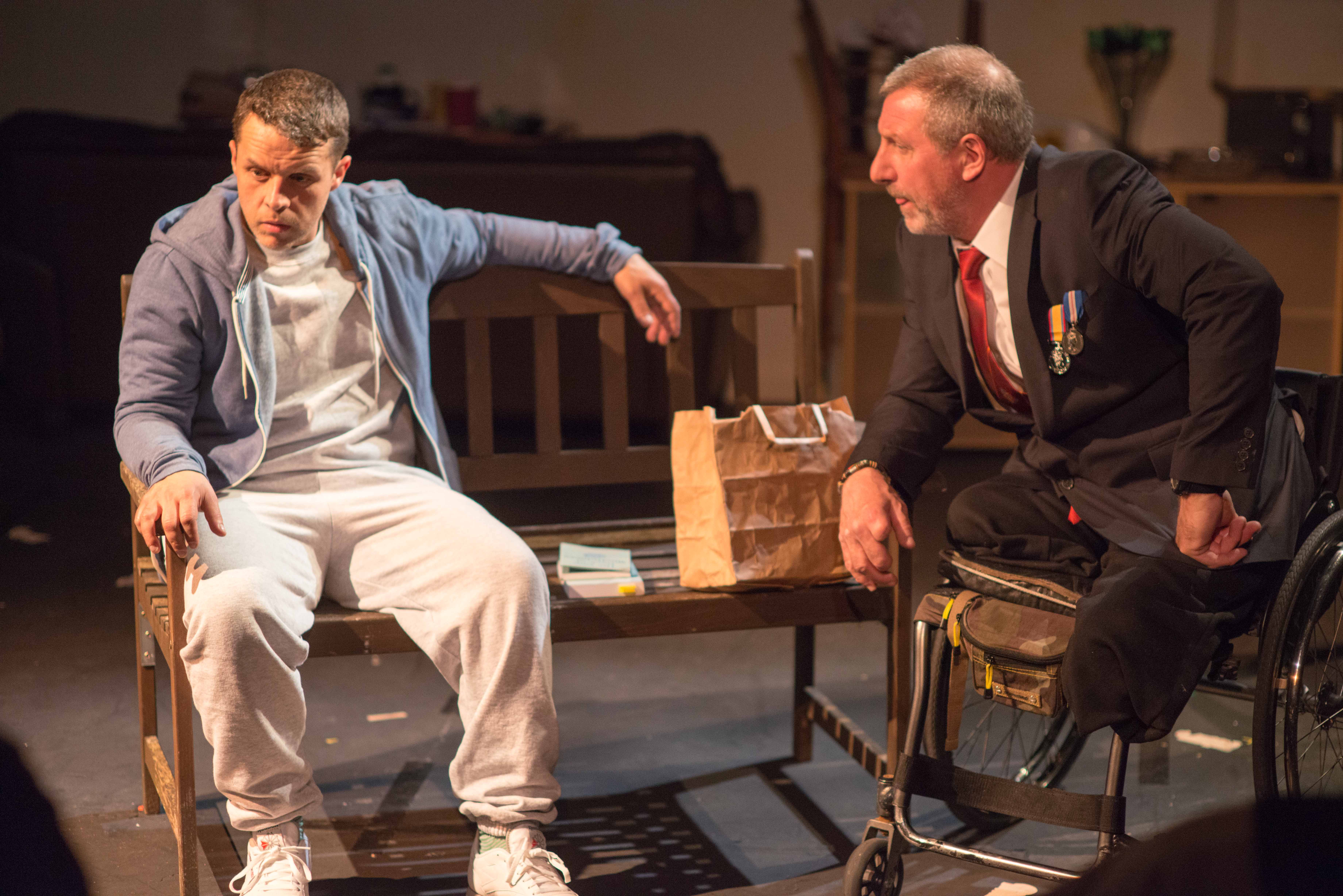
Former soldier Moss (Darren Swift) lost his legs to friendly fire while in combat, and now lives in a small, run-down flat with his nephew Carver (Daniel Gentely). The two have a fraught relationship, and what initially seems to be banter turns nasty when Moss reveals he’s been having weekly visits from Marta (Ida Bonnast), a perky Hungarian carer who’s unwittingly been going above and beyond her job description. Inevitably, the two men embark on a battle for Marta’s attention, which has unexpected consequences for all three of them when it becomes clear Moss isn’t the only one in need of help.

Photo credit: Gavin Watson

Neither of the male characters, on first encounter, is particularly likeable – both are foul-mouthed (the language in the first five minutes is not for the faint-hearted) and quick-tempered, and Carver’s a convicted burglar while Moss is an unashamed misogynist. Yet there are unexpected moments of tenderness and vulnerability between them as the play goes on that reveal there’s a lot more to their relationship, and it’s in these moments that actors Darren Swift (himself an ex-serviceman, who lost his legs to a terrorist bomb in Northern Ireland) and Daniel Gentely really shine. Ida Bonnast’s Marta, on the other hand, has the opposite trajectory; she starts out as a ray of sunshine in the men’s lives, but by the end of the play her presence has begun to feel intrusive and unwelcome.

Photo credit: Gavin Watson

Harry Burton’s production moves along rapidly, and while this maintains the energy of the play, there are times when the dialogue is delivered so quickly that it’s easy to miss important plot details. On the other hand, the scene changes seem to take an unnecessarily long time – with each scene quite distinct from the others, this doesn’t necessarily interrupt the flow, but it does contrast oddly with the rapid pace of the rest of the play.

Blue on Blue – a military term for friendly fire – subtly draws out the various ways in which the well-intentioned actions of allies can have catastrophic and life-changing consequences, not just in combat but in life in general. It’s a play that possibly needs to be seen more than once in order to unravel its multiple layers of meaning, but even on a first viewing Hardy’s writing provides plenty of food for thought.


Can’t see the map on iPhone? Try turning your phone to landscape and that should sort it. I don’t know why but I’m working on it… 😉

Review: The Taming of the Shrew at Above the Arts

The Taming of the Shrew is a comedy with a dark heart – a twisted little love story that’s generally considered one of Shakespeare’s most problematic. And for that very reason, it’s also a great candidate for a gender swap experiment. Nowadays, to watch a man attempt to control his wife by a combination of mental and physical torment is called abuse. But do we react the same when it’s a woman in charge, or is that just considered girl power?

Custom/Practice have taken on this question with great enthusiasm in their gender-reversed production of The Taming of the Shrew, the centrepiece of the inaugural Verve Festival at the Arts, celebrating cultural, ethnic and gender diversity in theatre. In this version of the story, the women hold all the power and it’s the men – trussed up in corsets and tottering around in women’s shoes – who must do as they’re told.

5M6A6610

Doing away with the framing story of Christopher Sly, we’re thrown straight into the action. Famously bad-tempered Katherina (Kazeem Tosin Amore) is forced against his will into marrying Petruchio (Martina Laird), who’s more than willing to take on a challenge in exchange for her husband’s generous dowry. This frees his younger brother, the young, handsome Bianca (Tim Bowie), who has plenty of women after him but hasn’t been allowed to marry until Katherina does. As Bianca’s suitors, exchanging increasingly insincere air kisses, battle for his affections, Katherina’s new wife sets out to break his spirit and bring him to heel through a systematic programme of abuse and neglect.

Perhaps surprisingly given the subject matter, this spirited, high-energy production directed by Rae McKen delivers plenty of laughs – not least, dare I say, in the moments when the actors throw Shakespeare’s script out the window and start ad libbing. Brigid Lohrey and Eugenia Caruso make a brilliant comedy duo as Bianca’s bumbling suitors Gremio and Hortensio – think Cinderella’s ugly sisters fighting over Prince Charming – while Kayla Miekle’s Tranio is the ultimate fairy godmother with attitude, and Lorenzo Martelli gets some of the biggest laughs as Petruchio’s long-suffering servant, Grumio.

Meanwhile, Martina Laird gives a captivating performance as Petruchio, at once seductive and tyrannical. Swaggering about the stage, she has a way of directing her asides straight at individual members of the audience that makes us feel somehow complicit in her torture of her husband. And while it’s hard not to laugh at Katherina’s desperate expression as Petruchio launches herself at him, all the time we’re uncomfortably aware that if it were a man behaving this way, we’d probably be appalled instead of amused.

5M6A6849

This is theatre with a dual purpose – to make us laugh, and make us think – and on both fronts, it delivers. In a fast and frantically paced production, the cast never miss a beat, and genuinely seem to be having as much fun as the audience (occasionally more). And while the play’s central theme is always going to be challenging, gender swap or no gender swap, the awkward final scene is softened here by a Beyonce-inspired finale that, much like the rest of the show, is impossible to resist.


Can’t see the map on iPhone? Try turning your phone to landscape and that should sort it. I don’t know why but I’m working on it… 😉

Review: Russian Dolls at King’s Head Theatre

Kate Lock’s Russian Dolls, winner of the 2015 Adrian Pagan award for new writing, brings together two unlikely companions – Hilda, blind, elderly and struggling to maintain her independence, and Camelia, who’s just got out of a young offenders’ institution and wants nothing more than to go back there. When she robs Hilda, a surprising connection is forged, and the two discover that their lives are actually not all that different.

Exploring as it does some difficult themes – abuse, loneliness, gang violence and addiction, among others – it would be easy for the play to become a bleak picture of two isolated souls just trying to survive. And while there’s certainly plenty in Hamish MacDougall’s production to shock and dismay, this brilliant two-hander is far from one-dimensional. Both Hilda and Camelia are strong-willed and proud, and they quite literally speak different languages, so the resulting clash of personalities allows for a good deal of humour alongside some genuinely heart-warming moments.

Russian Dolls at King's Head Theatre
Photo credit: Andreas Grieger
Playing these complex characters are two perfectly cast actresses, who each begin alone on stage with a soliloquy direct to the audience. Stephanie Fayerman’s Hilda is determined and stubborn, refusing to stop living her life or to give up the things she loves, and discussing the sudden total loss of her sight with a levity that only thinly masks her devastation. Meanwhile, Mollie Lambert takes Camelia, a character many would be all too ready to write off as a lost cause, and reveals her to be an affectionate, warm and funny girl, who loves her family and dreams of a better future. Like Hilda, her bravado hides an intense vulnerability, and her ambitions become all the more poignant as she’s inevitably drawn back into the repeating patterns of the world she’s left behind.

Becky-Dee Trevenen’s set takes in the whole width of the intimate space, encompassing Hilda’s front door, living room and kitchen. We never see outside the flat, only hearing second-hand about characters and events, and this heightens the sense of isolation for the two women. In fact the only time the story doesn’t feel completely natural is on the one occasion the outside world briefly enters their safe space, when Camelia arrives home with a gun she’s stolen from her brother and his gang. This results in a mildly chaotic scene in which she runs around the flat behind Hilda’s back, hiding the weapon somewhere new, only to pick it up again moments later and move it somewhere else – and finally putting it back where it was in the first place. When the gun then disappears in the following scene, it feels like a bit of an anticlimax, and we only learn its true significance much later.

Russian Dolls at King's Head Theatre
Photo credit: Andreas Grieger
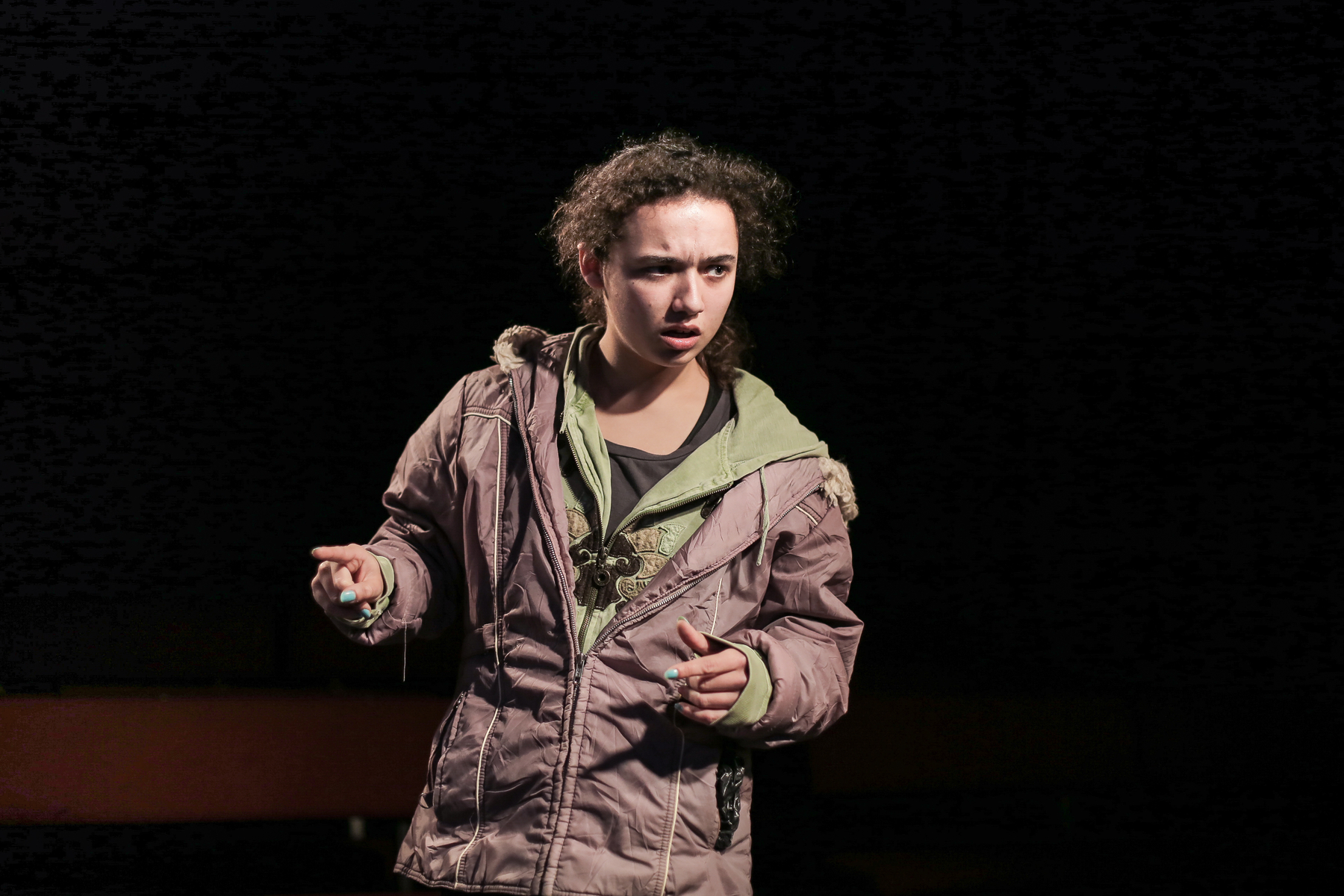
This thoughtful and moving play ends rather abruptly, with no clear resolution, but still manages to leave us feeling uplifted, despite some of the horrors that take place within it. Camelia and Hilda’s relationship begins as a practical arrangement – Camelia acts as Hilda’s eyes, while Hilda provides the authority and discipline Camelia’s never had from her own mother – but grows into one of genuine affection. This, along with the open-ended final scene, encourages us to go away considering how society needs to change before such stories can possibly have a happy ending.


Can’t see the map on iPhone? Try turning your phone to landscape and that should sort it. I don’t know why but I’m working on it… 😉