Review: I Capuleti e i Montecchi at Carousel

As I took my seat last night for Pop-Up Opera’s I Capuleti e i Montecchi, I heard someone explain, ‘It’s basically Romeo and Juliet without any of the nice bits.’ Which, as it turns out, is a pretty accurate summary of this opera by Vincenzo Bellini. By the time our story begins, Romeo and Giulietta are already embroiled in a secret love affair, helped by their friend Lorenzo, and Romeo’s on the run for killing her brother. Giulietta’s father, Capellio, decides to marry her off to Tebaldo, and in desperation she fakes her death. But Lorenzo’s prevented from getting a message to Romeo, who – as in Shakespeare’s version of the tale – goes to Giulietta’s tomb to kill himself.

Photo credit: Richard Lakos

Now, I haven’t seen a huge amount of opera, but I think it’s fair to assume this was quite a unique experience, even for those who have. First, the venue. Pop-Up Opera are a touring company who bring opera to new audiences in unusual locations; this particular tour will take them to the Asylum Chapel in Peckham, the London Museum of Water and Steam, and the spectacular Minack Theatre in Cornwall. In comparison, our venue – the basement bar of a restaurant in Marylebone – may not have been the most romantic, but it was still a suitably intimate and atmospheric setting, and my only complaint was that occasionally events took place on the other side of a concrete pillar.

The classic love story of Romeo and Giulietta has been reworked by stage director James Hurley into a modern thriller, in which the Montecchi and Capuleti are rival gangs locked in a long-running feud. Instead of swords and potions, this version has guns and pills, and unfolds on a set illuminated by harsh electric light and littered with crumpled paper and overturned chairs. From the outset, there are moments of brutal violence (I know I wasn’t the only audience member who flinched when Capellio advanced on a captive Romeo holding a pair of pliers), and the fact that we know how the story’s going to end does nothing to dispel the tension in what turns out to be a gripping drama.

Photo credit: Richard Lakos

In another original twist, Harry Percival’s English captions (inspired by Eurotrash, apparently) don’t seek to translate everything word for word, instead summarising each scene in the style of an old black and white movie. This has a dual effect: it means we get to concentrate on the action, and not spend an entire evening staring at the wall, and it allows a little more artistic licence with the translation – I can’t help wondering how Bellini would have felt about his hero being called an ‘asshole’, but it made me smile all the same.

But the modern translations, as amusing as they occasionally are, don’t detract from the beauty and emotion of Bellini’s score, or the quality of the performances – proving once and for all that you don’t necessarily need to understand every word to appreciate what’s going on. Each member of our cast – there are two on the tour – gives it everything, and it’s easy to forget there are only five of them, and that they’re backed by a single piano (played by musical director Berrak Dyer), not a full orchestra. Flora McIntosh’s Romeo is brash and reckless, while Cliff Zammit-Stevens is a sympathetic Tebaldo; an enemy he may be, but it’s clear he genuinely loves Giulietta and is as broken by her ‘death’ as his rival. Andrew Tipple’s proud Capellio is every inch the mafia boss, concerned only with family honour, even if it means rejecting his beloved daughter, and Matthew Palmer, in stark contrast, is a far gentler presence as the lovers’ mutual friend Lorenzo.

But it’s Alice Privett who gives the most memorable – and emotional – performance as Giulietta, a young woman caught between love and duty, and pulled this way and that by the headstrong men in her life. Her visible pain during the lovers’ final farewell means that emotions inevitably run high offstage as well as on.

Photo credit: Richard Lakos

Pop-Up Opera’s aim is to make opera accessible to a wider audience, people who may perhaps have dismissed it in the past as pretentious or boring. In this they certainly succeed, taking a classic story and giving it a modern twist, so that it feels fresh and exciting. And while it’s clear that they’re a company with a cheeky sense of humour, this doesn’t come at the expense of a high quality performance.

So if you think opera’s not for you, maybe give these guys a try, before you decide for sure…


Can’t see the map on iPhone? Try turning your phone to landscape and that should sort it. I don’t know why but I’m working on it… 😉

Review: Twelfth Night at French Protestant Church, Soho

Twelfth Night: a story of love, disguise and trickery, where nothing and nobody is quite what they seem. It seems fitting that a play in which appearance versus reality is such a prominent theme should be visually stunning, and Scena Mundi’s adaptation doesn’t disappoint; the French Protestant Church in Soho Square provides a unique and beautiful setting for what proves to be a classy production.

Shipwrecked in Illyria, Viola (Harriet Hare) disguises herself as a boy and gets a job working for the Duke Orsino (Pip Brignall). He sends her with messages of love to Olivia (Emma Hall), who falls instead for Viola – who unfortunately happens to be in love with Orsino. Then Viola’s twin brother Sebastian (Clare Brice) turns up, and everything gets even more confusing, before finally resolving itself in typically neat Shakespearean fashion. Meanwhile, Olivia’s drunken cousin Sir Toby Belch (Jack Christie) is hatching a plot with his friends Maria (Clare Brice again), Sir Andrew Aguecheek (Thomas Winsor) and Fabian (David Keogh) to make a fool of the pompous Malvolio (Martin Prest) by convincing him Olivia’s in love with him. And all this is quietly observed by the Fool, Feste (Edward Fisher) – who, ironically, may just be the wisest man on the stage.

Cecilia Dorland’s production takes as its starting point the vanity and self-obsession of Shakespeare’s characters, and transforms the aisle into a shiny blue catwalk for the play’s fashion show-inspired opening. Though the fashion theme doesn’t explicitly come up again after this scene, it’s present in Georgia Green’s costumes, which are somewhere between contemporary and modern, giving the play – and each character – a unique and timeless style that fits well in the unusual setting.

Photo credit: Jessy Boon Cowler

The cast do a great job of teasing out the complexities and less attractive aspects of their characters, and at the same time revealing the play to be more than a straightforward comedy that’s just out for laughs. Though there are a good number of laughs to be had – Martin Prest in particular gives an outstanding comic performance as Malvolio, with an array of disapproving facial expressions (and a surprising flexibility during the infamous yellow stockings scene), and the scene in which Orsino starts to feel an attraction to Viola in her boy’s disguise is both funny and sweetly touching. On the other hand, the later confusion between Viola and Sebastian falls a little bit flat, possibly because the two actors playing the twins look nothing alike.

While Malvolio is easy to laugh at because he’s so consistently unpleasant, there are other characters who turn unexpectedly to the dark side, and it’s these performances that prove most memorable. Sir Toby, played by Jack Christie, seems at first to be a loveable drunk, but ultimately reveals himself to be nothing more than a bully. Tricking Malvolio is one thing, but when he turns on his friend Sir Andrew (played with a child-like vulnerability by Thomas Winsor), it feels a step too far, and is actually a bit uncomfortable to watch. Edward Fisher’s Feste is also a mildly discomfiting presence; as the Fool, he provides entertainment through his wit and music, but at the same time has the feeling of a conductor, seeing and knowing all, with the power to make or break his fellow characters as he wishes.

Scena Mundi’s adaptation of Twelfth Night has plenty to recommend it: visually striking, with strong performances and several laugh out loud moments, the play also offers up a warning about the dangers of putting style over substance – particularly in matters of the heart. Great fun and well worth a look, especially if you enjoy your theatre in unusual locations.


Can’t see the map on iPhone? Try turning your phone to landscape and that should sort it. I don’t know why but I’m working on it… 😉

Review: Anna Karenina at Jack Studio Theatre

If, like me, you’ve often thought about reading Tolstoy but been put off just by looking at the list of characters, let alone the number of pages, help is at hand. In their first non-Shakespeare production, Arrows & Traps have pulled off the astonishing achievement of compressing a 1,000-page novel into a little under three hours, with a cast of just eight, whilst still remaining faithful to the plot.

Anna, the respected wife of provincial governor Karenin (Adam Elliott), abandons her duty and reputation when she’s swept into a passionate affair with the dashing Count Vronsky (Will Mytum). Meanwhile landowner Levin has money and power, and the freedom to do anything he likes, but is desperately in love with Kitty (Pippa Caddick), the woman he believes will give his life purpose. Anna and Levin’s lives fit together to make a whole, with each possessing what the other longs for, and Helen Edmundson’s adaptation, directed by Ross McGregor, highlights this synergy beautifully. The stories unfold in parallel, and though Anna and Levin have never met, from the outset each becomes the voice of reason for the other, the one they confide in and from whom they seek help and comfort. Their dialogue also serves a second, more practical purpose, filling in the gaps with regard to setting and context, so that each time one asks the other, ‘Where are you now?’ it’s as much for our benefit as theirs.

Anna Karenina

As a result, the production needs little in the way of set or props, and the story is carried almost wholly by the fantastic cast. Most of them take on multiple roles, but keep them perfectly distinct, so we always know who we’re looking at, and even the comparatively minor roles are memorable (I particularly enjoyed Hannah Wilder’s giggling, superficial Princess Betsy). The two leads, Ellie Jacob and David Paisley, each capture to perfection the essence of their character: Anna’s charm and quick wit, which enchant everyone she meets, have a similar effect on the audience, while Levin wins our sympathy as a good, honest man radiating quiet desperation at the lack of direction in his life.

A third plot thread involves Anna’s adulterous brother Stiva (Spencer Lee Osborne) and his long-suffering wife Dolly, who’s played by Cornelia Baumann in a truly heartbreaking performance. Of all the stories, Dolly’s is perhaps the most devastating, as she lets Anna convince her to remain in her unfaithful marriage, and consequently ends up feeling she’s never really lived at all.

What’s particularly impressive about Arrows & Traps’ production is the way it somehow manages to be both intimate and epic, getting right to the heart of the characters but also capturing the scale of the novel. There are a few moments – the ballroom, the races, and in particular Anna and Vronsky in the snow – that feel almost cinematic, which is quite an achievement on such a tiny little stage.

Anna Karenina

Anna Karenina has a bit of everything – romance, tragedy (by the way, the death scenes are brilliantly done, and in one case almost a bit too convincing), drama, social commentary, and even a few moments of comedy to lighten the mood. With 1,000 pages of text to condense down, it’s no surprise that this is an intense and gripping production – but one that I’d happily go and see again tomorrow.

It’s even made me consider reading the novel. Well, maybe…


Can’t see the map on iPhone? Try turning your phone to landscape and that should sort it. I don’t know why but I’m working on it… 😉
Review: Transports at the Pleasance

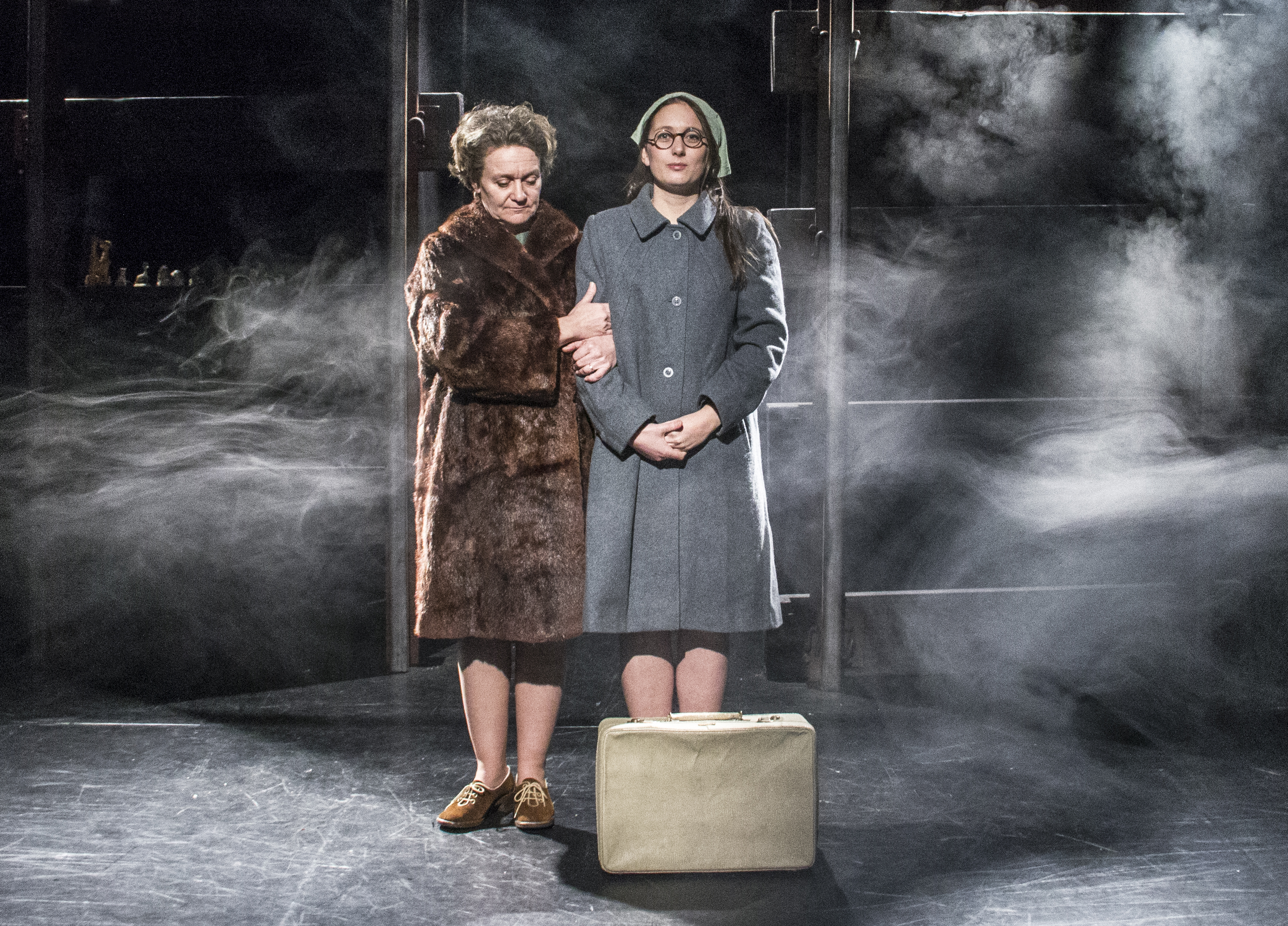
Pipeline Theatre’s Transports, first performed in 2013, has been revived for a national tour, and the timing couldn’t be more appropriate. Though the play never makes any explicit reference to the current refugee crisis, it nonetheless offers a fascinating and intensely powerful insight into the emotional impact of being forced from one’s home and into a strange, and sometimes hostile, environment.

Transports is the story of two teenage girls. Lotte, the quiet, polite daughter of a rich Jewish family in Germany, gets on a train for England in 1939, not realising that she’s saying goodbye to her loving parents for the final time. Years later, Lotte waits anxiously for the arrival of her first foster child, a sullen fifteen-year-old named Dinah, who never knew her parents and likes to boast about the time a doctor said she had psychopathic tendencies. The two girls couldn’t be more different – and yet their lives end up on parallel tracks, as both struggle to adapt to the new home they never asked to be sent to, and to cope with the traumas of their past.

Transports at Pleasance Theatre

The girls’ interlocking stories are seamlessly presented in flawless performances from its cast of two. Juliet Welch plays the older Lotte – kind-hearted, anxious, who swears by her weekly routine and talks too much when she’s nervous – and Mrs Weston, who takes in the teenaged Lotte on her arrival in England and soon grows to love her. (She also, briefly, plays Lotte’s mother.) Hannah Stephens, meanwhile, takes on the challenge of playing the hugely contrasting roles of the two teenagers. It’s incredible to watch the chemistry between the two actors, and how they’re transformed in every way – clothes, voice, body language – as they switch from one character to the other and back again.

Alan Munden’s set is simple and effective, dominated by two huge train tracks that run from floor to ceiling and frame the action. Everything we don’t see is brought to life by sound effects: passing traffic, the sounds of the school playground, and even Lotte’s cat, Oskar, feel as real as if they were right in front of us. During the opening scene, as Lotte and Dinah stood by the side of the road, I swear I could smell petrol fumes, and have no idea if this was an extraordinary attention to detail or just my imagination.

Transports, Pleasance Theatre

Unsurprisingly for a story that deals with the Holocaust and childhood trauma, Transports packs quite a punch, particularly in the second act (one scene drew an audible gasp from the audience; another had us all in floods of tears). The addition of poetry, in a surprising twist that makes us view Dinah’s character in a whole new way, only increases the emotional intensity – not to mention the revelation that Lotte’s story is based on that of a real person – designer Alan Munden’s mother, Liesl.

On the way out, someone asked me if I’d enjoyed the play, and I wasn’t sure how to respond, because I’m not sure this is the kind of story that you can enjoy. It’s intense, and shocking, and it made me feel very, very sad – not just for Lotte, Dinah and Liesl, but because now, all these years later, there are still people going through this kind of trauma every single day.

But was it brilliant? Absolutely. Transports is probably one of the most original and interesting pieces of theatre I’ve seen this year. Beautifully performed and lovingly produced, it’s a hugely important play that deserves to be seen.


Can’t see the map on iPhone? Try turning your phone to landscape and that should sort it. I don’t know why but I’m working on it… 😉

Review: Chicago at the Orchard Theatre

Yesterday evening, as my train ground to a halt somewhere outside Lewisham, I sent a little prayer to the train gods (a.k.a. Southeastern) to please sort it out and get me to the theatre on time. Quite apart from the fact that I hate being late for anything – especially the theatre – I was on my way to see Chicago, and I think most people would agree that if you miss the opening number of Chicago, you’ve missed one of the best bits.

Chicago on Tour

Fortunately, the train gods were in a good mood for a change, so I made it to the Orchard in time to sit back, relax and enjoy Kander and Ebb’s classic musical about “murder, greed, corruption, exploitation, adultery and treachery… all those things we hold near and dear to our hearts”. Set in the 1920s, Chicago is a darkly satirical story based on a play by Maurine Watkins (which in turn was inspired by real events). Wannabe star Roxie Hart murders her lover and ends up in prison alongside singer Velma Kelly, accused of killing her husband and sister. But when they both hire slick lawyer Billy Flynn, the women soon realise that innocence and guilt mean very little in the courts of Chicago, and that it’s the media, not the jury, that they need to win over.

With a minimalist set – the only props are a few chairs and a couple of ladders – and no need for any significant costume changes, all our attention is focused on the cast and their performances, and they don’t disappoint. This particular revival, the latest of many, features a star turn from Hayley Tamaddon as Roxie, while Sophie Carmen-Jones – who doesn’t get her name on the posters, but really should – razzle dazzles as queen bee Velma. Sam Bailey also stands out as Mama Morton; she’s a convincing figure of authority, but with a note of genuine affection for the women in her charge – and . And John Partridge is all charm and fancy footwork as Billy Flynn – though his vocals are noticeably less strong than those of his co-stars, this didn’t seem to dent the audience’s enthusiasm at the end of each number.

This could be because what makes Chicago such a fantastic show is the music – provided by Ben Atkinson’s enthusiastic orchestra, who are on stage throughout – and the Fosse-inspired choreography from Anne Reinking. These are the kinds of spectacular numbers that would glaringly expose any mistakes, but the cast don’t put a foot wrong; they’re perfectly in sync and working as one throughout – never more so than in the Press Conference Rag, which, along with All That Jazz, is one of the highlights of the show. That said, I really can’t pick a favourite song; they’re all so infectious and it’s no wonder the entire cast look like they’re having the time of their lives.

There’s a reason Chicago’s been a hit with audiences since its premiere in 1975: it’s slick, sexy (did I mention the ridiculously attractive cast?) and oh so stylish, with a satirical humour that makes for some great one-liners, but also makes a serious – and still relevant – point about the damaging and seemingly limitless power of the media to influence public opinion. Add to that the timeless score and slick choreography, and I’ve no doubt this show will be entertaining us for many years to come.

Chicago is at the Orchard Theatre until Saturday 5th March.