Review: The Last Ones at Jermyn Street Theatre

Guest review by Lucrezia Pollice

The wonders of human behaviour will never fail to inspire. Politics, domestics and history are all intertwined. In The Last Ones the Russian playwright Gorky, knowingly admired by Chekov, creates an honest tableau of life, power, conflict, love and devastation.

The play is set in the bloody aftermath of the 1905 revolution but focuses on the struggles of a corrupt tsarist police chief named Ivan Kolomiitsev and his family. After a failed assassination and unjust accusation, the family is left in utter confusion, not knowing who to trust nor what to believe. The father’s gambling, drinking and affairs waste away all their money, and the family is forced to take refuge at wealthy Uncle Yakov’s house.

Photo credit: Scott Rylander

The play asks us: do we really know each other? How can one come to terms with their father, husband, brother, lover being wrong? Looking into the life of a despised and hated man – we grow affectionate to his family and begin to unpeel the layers and grey areas present in the human body. Conveying these grey areas – evil is not absolute, it is not binary nor concrete.

It is not an easy play; character journeys are very weaved together and are slightly difficult to follow. Ivan, played by Daragh O’Malley and Sonia, played by Louise Gold, have five children: Alexander, Peter, Nadia, Vera, Lyubov. Some of the children follow the father’s footsteps into corruption, greed, alcoholism and gambling, whilst the younger ones are faced with many questions. The latter, Lyubov, is damned for being “crippled” by Ivan, who she discovers in the play is actually not her biological father. This is not news to the family as Ivan’s brother Yakov, played by Tim Woodward, and Sonia’s old love affair is not as secret as they would hope.

Ivan is attempting to bribe his way back into the police force and regain his power. However, power has a price. Peter and Vera begin to learn the truth about their father when a young man, a revolutionary, explains to him the facts. Then the mother of the innocent child incarcerated for Ivan’s assassination comes to the house to speak to Sonia, and things begin to unravel. Conflict increases throughout to finally culminate in a desolate open-ended finale, in which corruption and evil triumph over the rest.

Photo credit: Scott Rylander

Anthony Biggs’ production is intense and moving at times. The set, designed by Cecilia Trono, is simple, but appropriate to the atmosphere created. The performances fluctuate between moments of truthfulness and other slightly weaker moments, although the show kept my attention throughout and moved me with its passionate honesty. It is a play about people, the human body and mind. We too often forget the importance of focusing on the reasons and objectives behind our actions. The Last Ones brings them to the forefront, putting us face to face with difficult questions. What would you have done in their position?


Can’t see the map on iPhone? Try turning your phone to landscape and that should sort it. I don’t know why but I’m working on it… 😉
Review: The Enchanted at The Bunker

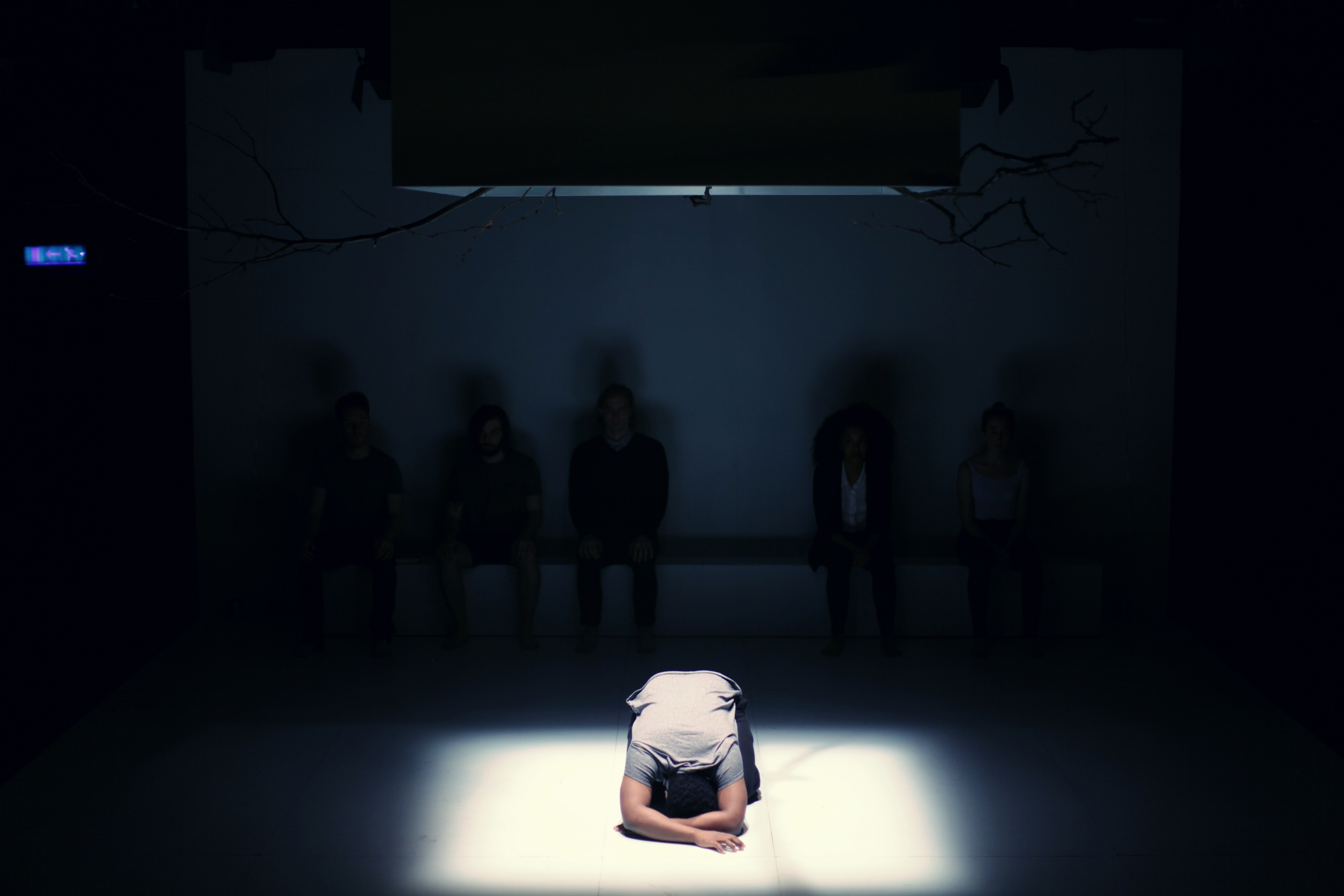
If you had to think of a word to describe death row, what would it be? Dark, perhaps. Hopeless. Desperate. Whatever word first comes to mind, probably one of the last would be enchanted. Yet this is how Pharmacy Theatre’s haunting play begins, as a death row inmate describes his surroundings in language so poetic and beautiful it seems impossible he could be talking about a prison where men and women who are despised and forgotten by society go to die.

Photo credit: Dina T

This is just one example from the play of how hope and redemption can be found in even the darkest of places… or people. The Enchanted – both the play and Rene Denfeld’s novel on which it’s based – tackles head on the assumptions we in the free world make daily about death row: everyone there is evil; they feel no love or remorse; they deserve to be where they are, and can have nothing to offer the world but more pain. It does this without making excuses or painting an unrealistically rosy picture: the two prisoners in the play are guilty men who’ve done terrible things, the full details of which – thankfully – we never learn. What’s more important is not what they’ve done, but why; at the play’s heart is a desperate need to understand, and as the actors scrawl words and images on the walls and floor in chalk, the set begins to resemble a big mind map trying to make sense of a huge and complex problem.

Condensing the multiple complex strands of the novel into 90 minutes, Joanna and Connie Treves’ skilful adaptation is narrated by Arden, a prisoner whose crimes are so terrible that nobody – not even other killers – ever speaks of them. In a spellbinding performance, Corey Montague-Sholay plays this character with an intense vulnerability that’s at odds with his role as murderer; every movement, gesture and facial expression, his childlike love of books and his poetic use of language to escape the confines of his world cry out to us that this is not an evil man, but rather one who’s been broken by life.

Perhaps more in keeping with our imagined idea of a death row inmate is York (Hunter Bishop), the man in the cell next door. Unpredictable, unstable and unkempt, all restless energy and crazy eyes, he’s done the unthinkable: given up on his appeals and decided he wants to die. The only person now standing between him and execution is The Lady (Jade Ogugua), an investigator who’s become a symbol of hope for everyone on the row. As she delves into York’s past, she uncovers a horrific tale of abuse and neglect – hauntingly portrayed by puppets, as if in a therapist’s office – that explains how he ended up a killer. But can she convince him to live – and is that even her ultimate goal, or does she have some other motivation for her tireless efforts to get inside the mind of a murderer?

Photo credit: Dina T

What comes across so well in the performance, movement (directed by Emily Orme) and language of all the actors is a deep sadness and sense of collective responsibility – not just from those who’ve committed crimes, but also from those around them, who failed to hear or react to their cries for help as they set off down the dark path that ends on death row. While in no way diminishing the responsibility of the individual for their own actions, the play makes it clear that society must take some of the blame; otherwise how can we ever hope to stop such crimes from happening?

Just as in life, there are no easy answers or neat endings in this dark and gripping tale – to suggest there are would be overly simplistic. The Enchanted isn’t a political drama but an urgent human one, shining a light on a world most of us can’t even imagine, and forcing us to confront and accept the flawed and forgotten humanity of those within it, before they run out of time.


Can’t see the map on iPhone? Try turning your phone to landscape and that should sort it. I don’t know why but I’m working on it… 😉

Review: LOOP at Theatre N16

Few things prompt more heated debate than our taste in music (it’s definitely the source of most tension in my office). We all think our own favourites are the best, and anyone who disagrees with us is automatically wrong. Yet our passion for music – any music – can also bring us together like little else, whether it’s casual banter with a stranger at a gig or a huge one-off event like last weekend’s One Love Manchester concert.

BoxLess Theatre’s LOOP takes us through three generations of one family, set to a soundtrack of the music that both unites and divides them. In the 1960s, a young woman leaves behind her home in London and sets off for a new life in Manchester. In the 80s, her teenage daughter comes home from a gig with a new boyfriend in tow – and in 2017, that same couple struggle to find common ground with their own 19-year-old son, who ultimately finds himself returning to his grandmother’s hometown in search of answers.

Though music is the common thread that links all three stories, it doesn’t dominate or overwhelm Alexander Knott’s script, which is very much character-driven. In a fast-moving introductory monologue delivered by Emily Thornton, we experience all the hopes and fears of The Woman as she leaves home for the first time and ventures out into a scary new world. Later, she returns as both mother and grandmother, perfectly capturing not only the physical changes but also the lifelong emotional fragility of a woman whose life hasn’t gone the way she hoped it would. James Demaine closes the show as the Young Man, with an equally powerful story of teenage angst and artistic ambition, but perhaps the most enjoyable – and humorous – scenes are those between the Boy and the Girl, played by Aaron Price and Rubie Ozanne, whose fledgling teenage romance is adorably awkward and very believable.

Completing the show’s finely tuned balance of words and music is the movement, directed by Zöe Grain. Working with a set that consists of just a few boxes that are rearranged for each new setting, the cast travel on trains, dance in clubs, and walk the busy city streets in this highly physical piece of theatre. In one effective scene, an act of violence becomes strangely beautiful as it unfolds in exquisite slow motion. Each of the four-strong ensemble performs these moves with precision, energy and perfect timing to bring their characters and the world around them to life.

LOOP has a little bit of everything; it’s funny and heartwarming yet not without moments of poignancy, and nostalgic but also very current – and by combining storytelling with movement and music, directors Alexander Knott and Zöe Grain have given the company an opportunity to demonstrate their broad range of talents. This is an exciting debut from BoxLess Theatre, and definitely worth a visit for music lovers of any generation.


Can’t see the map on iPhone? Try turning your phone to landscape and that should sort it. I don’t know why but I’m working on it… 😉

Review: Tom Molineaux at the Brockley Jack Studio Theatre

Guest review by Lucrezia Pollice

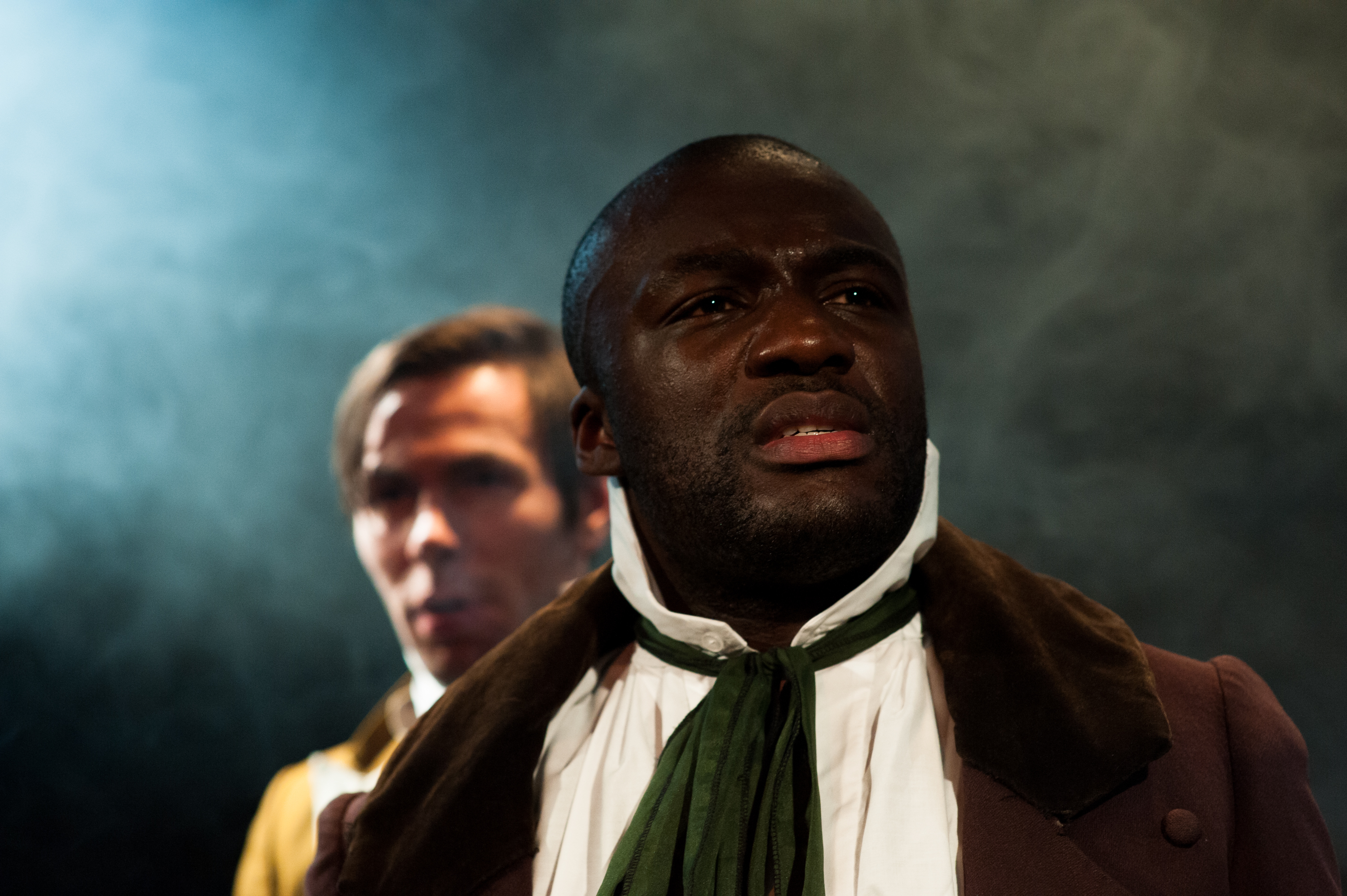
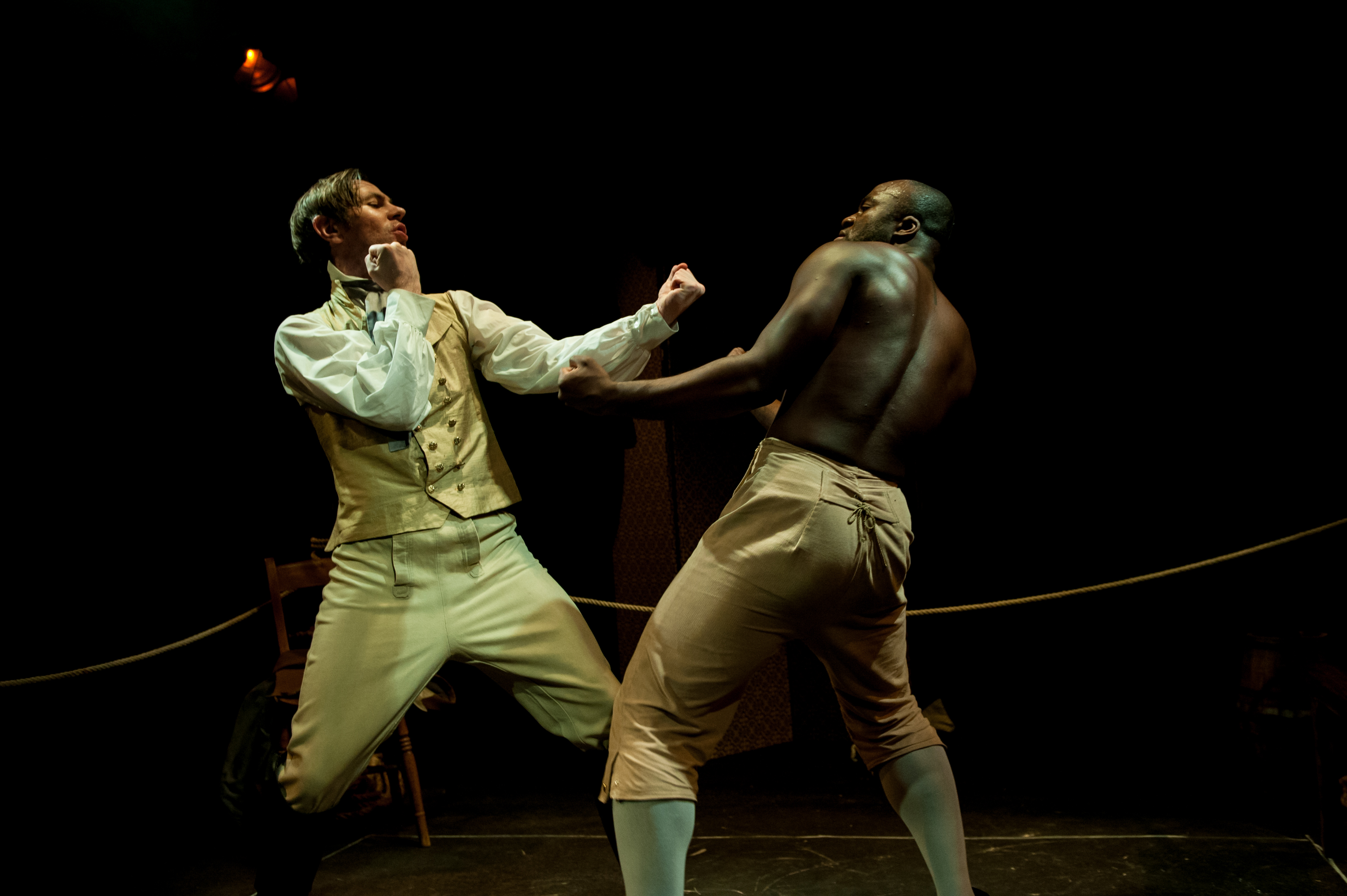
Tom Molineaux is an extraordinary true story about boxing, gambling and friendship. About a man who fights his way to freedom, but remains trapped in the injustices of society. A boxing ring, two men and some period costumes; nothing more is needed to bring this narrative to life. Tom Green’s compelling writing flows fluidly in an extremely believable manner, bringing us back to London in the nineteenth century whilst never losing the audience’s attention. Directing with simplicity and beauty, Kate Bannister constructs an extremely pleasurable evening.

Photo credit: Timothy Stubbs-Hughes

Nathan Medina skilfully plays the part of an African American boxer, born on the plantation in Virginia, with incredible force, leaving spectators astounded. Tom Molineaux is strong, powerful and will not stop until he beats everyone. Before the play begins, Tom is cherished in America for winning his master a great deal of money, which releases him from slavery and wins him freedom. It seems like nothing will bring him down, his determination and ambition to become world champion is too strong. He manages to convince the English champion Tom Cribb, who is retired, to fight him.

However, the play is not only about boxing, it is about so much more. About injustice, prejudice, loyalty and addictions. The story is narrated by another incredibly talented actor, Brandon O’Rourke, who plays Pierce Egan, a sports journalist who befriends Tom when he arrives to London. Pierce allows us to see the honest emotional turmoil which is present under Tom’s muscles and strength. Unfortunately, this is not a happy story. It is a true story. Will the former slave manage to gain his victory and make millions, or will he be crushed to the bottom by society’s injustice and greed?

Photo credit: Timothy Stubbs-Hughes

The performance is highly physical. The set is dark and misty. A seriousness in tone is most commonly present, but lighthearted moments are present too. One of my favourite moments is when Tom and Pierce come back drunk from a night out in 19th century London. The atmosphere transports you and allows one to imagine the streets of London back then, thanks to the accurate descriptions. Unfortunately, Tom and Pierce’s friendship is put to the test. Molineaux fights Cribb but the match is flawed, and Pierce knows. Will Pierce decide to lose the money he has bet on Cribb; or will he convey the truth and tell the world that Molineaux is the world’s biggest champion? Will Pierce fight the system or will Molineaux be representative of our unjust post-colonial society?

Courageous, powerful and human, this brilliant play packs a punch in more ways than one.


Can’t see the map on iPhone? Try turning your phone to landscape and that should sort it. I don’t know why but I’m working on it… 😉
Review: Contactless at The Hen and Chickens

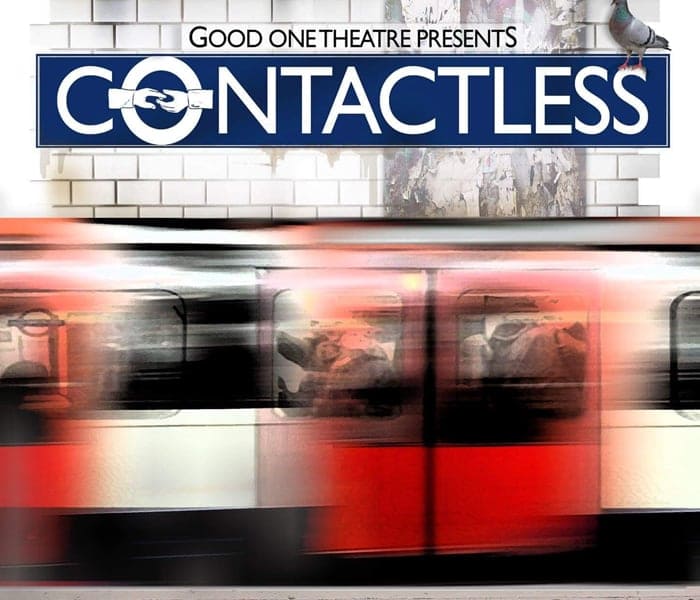
Nothing sums up the British quite like our relationship with public transport. It’s a world full of unspoken rules, which we like, and we reserve the right to be furious – silently, because we’re British – when those rules are not observed. Because there’s no chance of escape, the most insignificant moment becomes a massive deal, whether it’s the person next to us having a loud phone conversation, the cute stranger opposite catching our eye for the briefest of seconds, or the agony of trying to figure out if someone’s pregnant or not.

These are all moments anyone who spends any time on the London Underground can relate to, and they make up the backdrop to Tom Hartwell’s new comedy, Contactless, which takes us inside the world of the Tube to meet annoying passengers, overenthusiastic station announcers and even the original voice of “Mind the Gap”, Peter Lodge. These characters appear in a series of sketches that take recognisable situations and stereotypes to comical extremes (one of my favourites was the night tube, where passengers are tucked in with a blanket and hot chocolate while the driver reluctantly reads them a bedtime story).

While these characters are familiar to us, they’re all fictional – but Contactless also draws on historical fact and current affairs in the development of its main plot threads. Besides Peter Lodge, the sound engineer who inadvertently became the voice of the Underground, we also meet Emma Clarke, the voiceover artist who eventually replaced him, only to be sacked for comments that appeared to criticise the Underground. Meanwhile, a hapless union rep tries to reach an agreement in the tube strikes over ticket office closures and night working, and Peter’s widow Susan – who still works at Embankment 30 years later – struggles to keep up in a constantly changing world of progress and technology.

Directed by Phil Croft and performed by a versatile cast of six (Adam Elliot, Rosie Edwards, Hannah Jay, Jeryl Burgess, Stanton Cambridge and Will Hartley), the show’s style is reminiscent of spoof documentaries like Twenty Twelve, affectionately poking fun at a British institution that we love to complain about, but also wouldn’t want any other way (I kept half expecting David Tennant’s voiceover to start). The scenes referencing the strikes, while undoubtedly some of the funniest, also make a sharp political point; as union rep Rachel faces off against an army of incompetent and – in one case – sleazy civil servants, there’s never any doubt whose side we’re meant to be on, even before the hilarious first date scene in which a striking tube driver hammers home the main points of their argument.

There’s a further case against progress for the sake of it in the story of Susan, an unexpectedly poignant diversion inspired in part by Margaret McCollum, the widow whose pleas saw her late husband’s voiceover reinstated at Embankment. Ultimately, Hartwell’s message seems to be that the Tube is about people far more than processes. Drivers, passengers, station staff and yes, even the voiceover guys and girls come together to form a tapestry that’s rich with comic potential, and makes this cherished British institution what it is, in a way iPads and driverless trains never will.


Can’t see the map on iPhone? Try turning your phone to landscape and that should sort it. I don’t know why but I’m working on it… 😉