Interview: Jimmy Walters, The Trackers of Oxyrynchus

Following his acclaimed production of John Osborne’s A Subject of Scandal and Concern, director Jimmy Walters returns to the Finborough Theatre in January with Tony The Trackers of Oxyrhynchus by Tony Harrison. Tom Purbeck and Richard Glaves star in the play’s first London staging for nearly 30 years as Bernard Grenfell and Arthur Hunt, two archaeologists sent to Egypt to dig up lost poetry and plays, who end up becoming part of a story they’ve discovered.

“It was a whole new challenge with this project,” explains Jimmy. “I thought, do I want to do the same thing again or do I want to make apples and oranges? I think if you constantly put yourself outside of your comfort zone then that’s a much more exciting place to be.”

Photo credit: Robert Boulton

Despite the weighty title, audiences won’t need an in-depth knowledge of Greek literature to appreciate the play: “It helps to know that the satyr play was staged deliberately after three tragedies in order to lighten the mood of the evening, and that satyrs are half man half goat creatures with large penises. Other than that you can just be entertained and learn a lot, which is great. I would say that this is not a dense academic play, despite the long title. It’s completely accessible with some laugh out loud moments put up against some real poignancy. This is our most entertaining play we’ve done yet but also the most powerful. Hands down.”

This is not the first play Jimmy’s directed that hasn’t been performed for many years; he co-founded his company, Proud Haddock, to celebrate unearthed stories from classical playwrights. What’s the appeal of unearthing these buried treasures? “I think it’s that great thing of taking a playwright who’s loved by many and unearthing a story of theirs people don’t know very well. If you just perform the classics then it becomes more about people wondering how you are going to approach each scene. ‘I wonder how they’ll do the balcony scene’, and everyone pre-empts ‘to be or not to be’. To tell a story people aren’t familiar with by someone they regard as a genius has a very strong effect.”

The Trackers of Oxyrhynchus was originally written for a one-off performance in the ancient stadium of Delphi, and was later seen at the National Theatre. Jimmy believes that the absence of any other recent adaptations makes his job as director easier: “It’s why if you talk to actors who play roles other actors have played before, they try and avoid watching their performances. It narrows your choices and you can run the risk of imitating. Also, if I had access to lots of adaptations I’d probably freak myself out and put so much pressure on myself. I think at the end of the day it must come from you. Those instincts you have from reading the script are yours and you should just go for it.”

the-trackers-of-oxyrynchus-3

Tony Harrison is an award-winning poet-playwright, who last year won the David Cohen Prize for Literature. What is it that makes his writing so special? “He loves contrast,” says Jimmy. “He’s a poet, so that gives the play a rhythm and the contrasts are everywhere. Contemporary v period, ancient Greek language against modern day slang, high art against low art, rich against poor etc. He doesn’t deal with any grey areas. He makes the familiar strange, and takes things you’re used to hearing in a certain way and turns them on their head. It’s punchy, unapologetic and deeply affecting. You have to be careful with this word because it gets thrown around too often – but he is a genius.”

Although The Trackers of Oxyrhynchus deals with ancient texts, and is set in the early 20th century, it still has plenty to say to modern audiences: “Oh, big time,” Jimmy confirms. “The last section of the play actually takes place in modern day London and with everything that’s happened recently with Brexit and the lack of unity in the country, this couldn’t be more relevant. It could have been written yesterday.”

The Trackers of Oxyrhynchus is at the Finborough Theatre from 3rd-28th January.

Interview: Dominic Hedges, The Doppel Gang

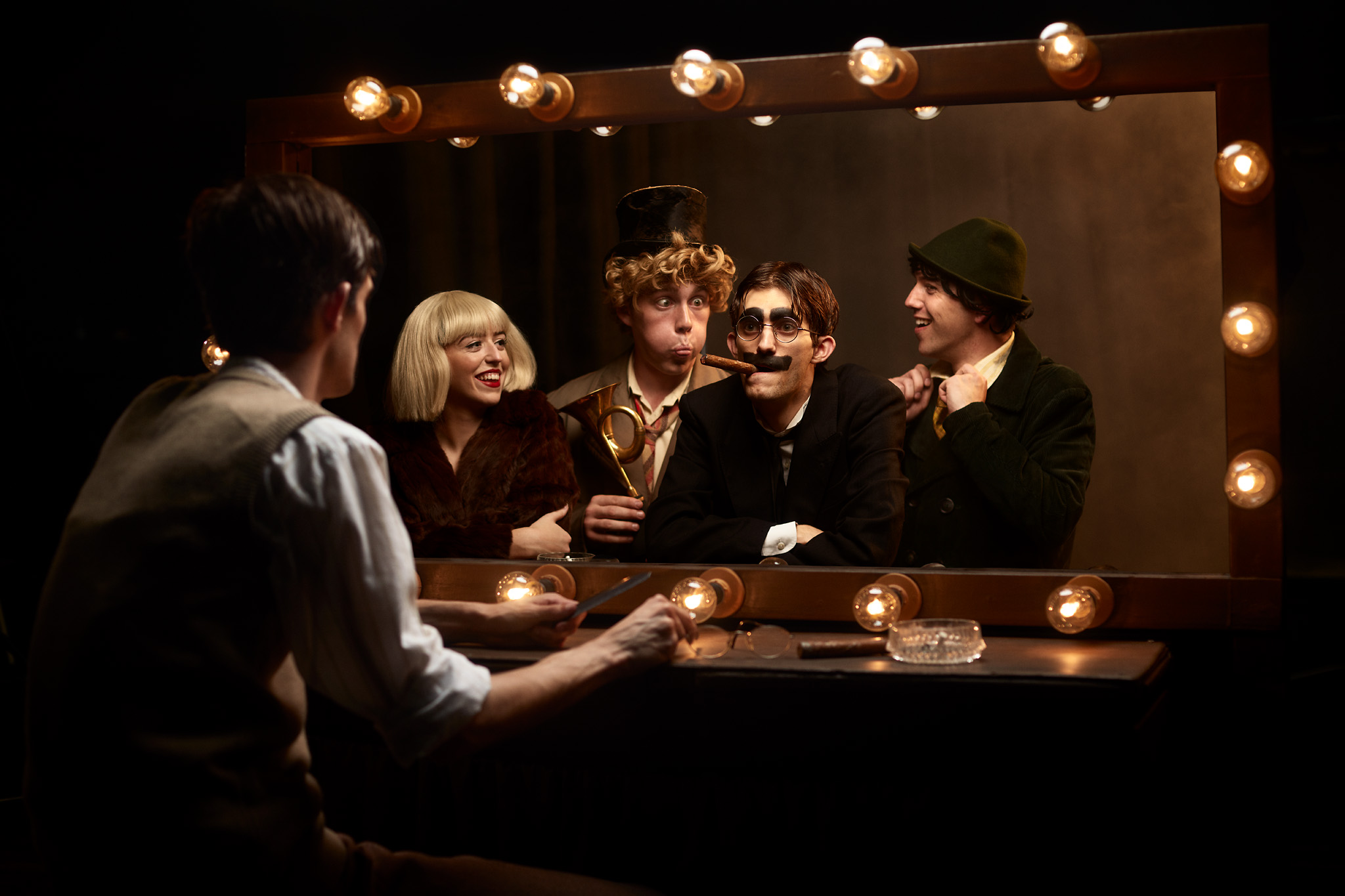
“The secret of good comedy is barking up the wrong tree,” says Dominic Hedges, a theatre and filmmaker from East London. His play, The Doppel Gang, is following up last year’s successful tour with a run at the Tristan Bates Theatre in the new year, presented by trio Just Some Theatre Company. Set in 1940s London, the play fuses the comedy of the Marx Brothers with classic British humour, against the all too serious backdrop of the Second World War and the Blitz. “Four conscription-dodging spivs try to save their crumbling theatre by impersonating the Marx Brothers, but naturally each party is in it for themselves,” summarises Dominic.

dominic-hedges-headshot-copy

The idea to write a play about the Marx Brothers came from Just Some Theatre Company: “They love the Marx Brothers! They approached me to write a piece for them and after a ton of knocking ideas about we decided that an out-and-out biography wasn’t what we wanted. So I took the floundering, double-dealing, British motley bunch route of old.”

So is this only a play for fans of the Marx Brothers? “No,” says Dominic. “It’s not a Marx Brothers tribute act. The show plays more as the recognisable British wartime drama-comedy where threads are pulled and twisted between characters, and misdirection and miscommunication lead to hilarious consequences, but then with this fat vein of Marx Brothers performance and wit bored through it.”

Generally considered to be among the most influential comedians of the 20th century, the popularity of the Marx Brothers continues to this day: “I think they tell jokes which we think we can write ourselves,” explains Dominic. “On paper they vary from rubbish Dad jokes to ingenious turns of phrase and wordplay. But when you hear the jokes delivered, especially when you watch them on film, each move of their comedy is unique and unmistakable. When U.S. film became more prevalent in the UK we lapped it up.”

Photo credit: Tom Barker

As a writer, Dominic has no qualms about handing his work over to a theatre company. “It’s exciting. The director Terence Mann is fantastic and we read from the same page more often than not. He knows what’s best for the show when they’re all in the room working and that’s something I had no interest in sticking my nose in! If it’s not as I envision it that’s probably a good thing. Having said that, if the zero-gravity scene on wires made the cut, I’ll be having words…

“My advice to a writer who’s just starting out would be: meet up with other writers, performers, artists, anybody you trust artistically, and read your work aloud. It’s the best thing in the world. Life is not a word processor. When I have serious doubts about my career choice it’s almost always because I’ve not heard my work aloud for a good while.”

And finally, who does Dominic think is funnier, Brits or Americans? His response is diplomatic: “Hmm… hard to say, but in a contest between the two, one of them is bound to win!”

The Doppel Gang is at Tristan Bates Theatre from 17th January-11th February.

Review: Day Job at the Bread and Roses Theatre

Guest review by Ross McGregor

Written and directed by Evi Stamatiou, this is the first production from Fanny Pack Theatre, an all-female collective founded by Rachel Scurlock and Maria Alexe. Their company seeks to produce “contemporary stories about contemporary women”, and has been set up to tackle theatrical gender inequality. In a recent interview with The Stage, the co-founders said they wished to focus on working with women who are “outside the industry norm”, and although this is perhaps a lofty way of saying “give character actors a chance”, Day Job proves that the actresses in this project should be anything but overlooked.

Photo credit: Minglu Wang

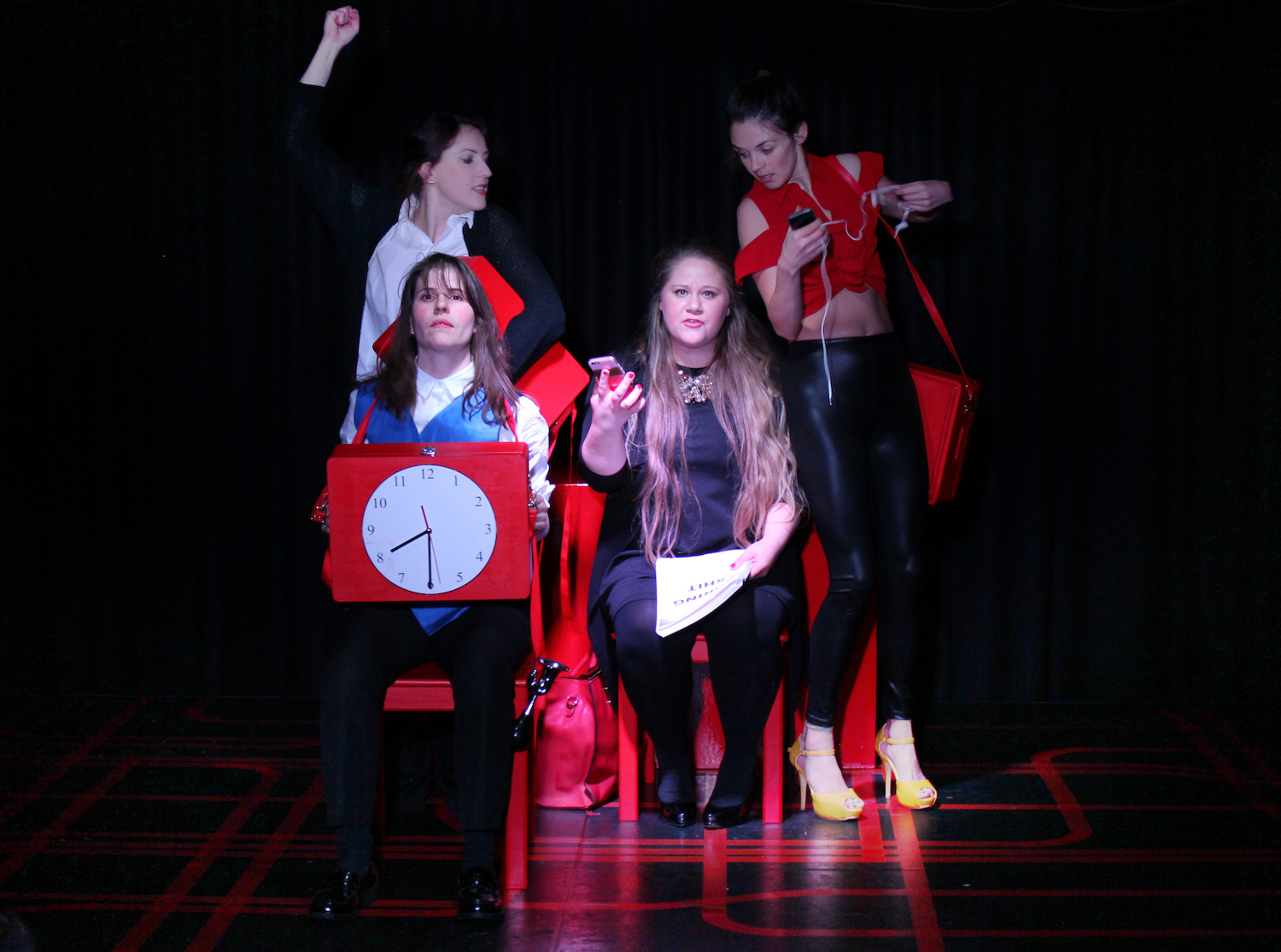
Constructed as a series of interlocking tales about the lives of four female artists struggling to make ends meet in modern day London, Fanny Pack Theatre have created an energised, vibrant, engaging and at times hilarious piece of new writing. The device that links the narratives is the fact that all four women share the same bus journey to work, and scenes switch and intersect with ease thanks to Minglu Wang’s simple yet effective (and entirely blood-red) set. There is a degree of physical theatre and symbolised movement that is incorporated more or less well into the piece and melds fluidly with the more script-based moments.

Of the three stories, Maria Alexe’s songstress French teacher stands out as the highlight. The tale of a woman needing to get to a potentially life-changing audition whilst being stuck between a gaggle of remedial students and an overbearing teaching supervisor was played to perfection by Maria Alexe, and the fact that it involved a degree of comfortable audience participation made it all the more enjoyable. As Alexe’s frustration and desperation with her predicament grew, so in turn did the hilarity of the scene, and for me it was the highlight of the production. 

Because unfortunately the other tales, one of baby-stealing escort service and a receptionist-murdering Devil Wears Prada rip-off were far too absurd and long-winded to maintain the laughter. With the French Class tale, it seemed obvious what we were in for: an hour of semi-autobiographical tales of the plight of being a part-time actress/full-time barmaid, but then shortly afterwards the subsequent stories descend into surreal tales from the underworld, with an infernal and demonic escort agency (with their contact phone number even ending in 666 we wave goodbye to subtlety) owning the rights to every baby their escorts produce, and a team of receptionists for “Dirty Business Inc.” (a company along the lines of Enron one assumes) being slaughtered by their line manager as the police break down the doors. The jokes started to flag here, and the characters, whilst ably held up by the talented cast, are just too two-dimensional and grotesque to warrant concern.  It’s also a shame that the writer/director/devisers picked sex worker as a generic female job – surely this experience is not as widespread and relatable as teaching, bus driving or receptionist? This decision is so clichéd that it feels like Fanny Pack are actually promoting the theatrical views their company attests to strive against. A misstep here, to my mind.

8-copy
Photo credit: Minglu Wang

These script qualms aside, it is the cast that deserve the highest praises. Switching from role to role in a matter of seconds, handling pathos and comedy with a clear aptitude, this quartet of actress prove that they’re a force to be reckoned with. Rachel Scurlock chews the scenery in every role she assumes, and is a complete delight to watch – she steals every scene and comes complete with an electricity in her eyes that makes her almost impossible to stop watching. Maria Alexe has a sultry, captivating and vivacious presence on stage, as well as a truly beautiful singing voice. Clare Langford is perhaps the most introverted and demure of the group, though this may be due to the selection of roles she’s given, and thrives when she is given the opportunity. Out of the four, Langford is the most underused, and this is a shame as she seems capable of tackling so much more than the material she was given. Stephanie Merulla as the enigmatic bus driver is the heart of the piece and holds the shows thematically together with a wry and knowing delivery, knowing how to hold back when needed and sharply point every punchline she’s given. 

Day Job is an entertaining night out held together by four very talented young women. The script needs work in terms of its focus, but the performers deal with this ably, allowing their natural talent and creativity shine through.

Find out more about Fanny Pack Theatre on their website.


Can’t see the map on iPhone? Try turning your phone to landscape and that should sort it. I don’t know why but I’m working on it… 😉

Review: Muted at the Bunker

Tucked away in a converted underground car park a few minutes from London Bridge is The Bunker, London’s newest (and quite possibly coolest) off-West End theatre. Its inaugural season continues with Muted, a new British musical that’s been several years in the making.

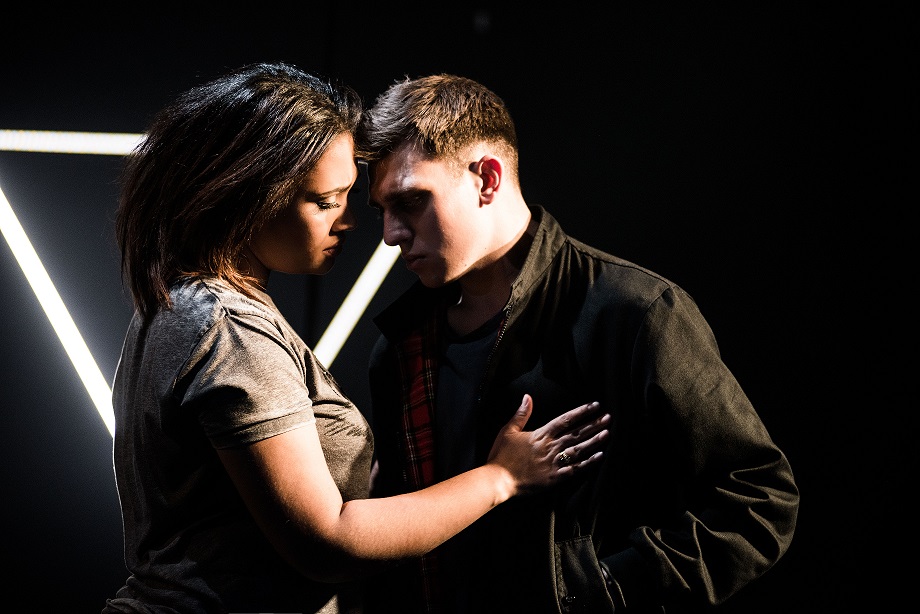
Written by Sarah Henley, with music and lyrics by Tim Prottey-Jones and Tori Allen-Martin, Muted is the story of Michael (David Leopold), a promising young musician rendered mute by the death of his mother (Helen Hobson) in a hit and run accident. Now cared for by his reluctant uncle (Mark Hawkins), he hasn’t seen any of his old friends for years – until his ex-girlfriend Lauren (Tori Allen-Martin), now in a relationship with his best friend Jake (Jos Slovick), comes to visit… and it becomes clear Michael isn’t the only one struggling to say what’s on his mind.

Photo credit: Savannah Photographic

The show was initially called After the Turn, but Muted feels like a more appropriate title – not only because of the subject matter but because it accurately sums up the musical itself. There are no big show-stopping song and dance numbers here; Muted is a quiet, reflective piece about the different ways we cope with loss, and the music is similarly gentle in tone, allowing the characters – most notably teenage Michael (Edd Campbell Bird), who speaks for his older self – to express what they can’t say in any other way. It’s music that makes an impression without needing to be catchy or toe-tapping, and left me wanting to listen to it all over again.

The story too is a bit of a slow-burner, with Act 1 focusing very much on establishing the back story, relationships and motivations of the characters, before the pace picks up in Act 2 and events begin to spiral out of control. The finale is undeniably beautiful, although it feels rather abrupt – everything falls suddenly into place in a conclusion that’s a bit too neat, especially after such a lengthy build-up.

In a uniformly strong cast, David Leopold is perfect as the damaged Michael. Unable to make a sound, he speaks volumes with his face and body language, expressing his vulnerability and frustration with a twitchy intensity and haunted gaze. His relationship with teenage Michael, played by Edd Campbell Bird, is particularly moving; radiating energy and assurance, the younger man acts simultaneously as a friend and a constant reminder of everything he’s lost. Equally flawless is Tori Allen-Martin as Lauren, who unlike Michael, talks too much – but beneath the chatter lies a young woman who’s just as fragile as her ex-boyfriend, and it’s not at all clear by the end of the story who needs whose help more.

Photo credit: Savannah Photographic

Jamie Jackson’s production is quite abstract, leaving much open to interpretation. The set, designed by Sarah Beaton, is simple and stark: a square walkway surrounding a shallow pool of water, at the centre of which sits the island representing Michael’s bedroom. (There’s also a swing hanging from the ceiling, which gets a lot of use throughout the show, although its significance is never totally clear.) And many of the songs are accompanied by gestures from the actors that fall somewhere between interpretive dance and a kind of sign language, stripping the story back to its core emotions and producing some of the most visually striking moments in the whole show.

Muted is a powerful new musical that appeals to every emotion; it’s at times desperately sad, at others laugh out loud funny, and concludes on a note of cautious optimism. Though the show’s not yet perfect, it certainly has the potential to be – and even now, there’s no doubt it’s been well worth waiting for.


Can’t see the map on iPhone? Try turning your phone to landscape and that should sort it. I don’t know why but I’m working on it… 😉

Review: Hamlet Part II at the Hen and Chickens

If you’ve ever wondered what happened next after the tragic conclusion of Shakespeare’s Hamlet (and let’s face it, who hasn’t?) an answer can be found in the snappily titled Hamlet Part II from the Theatre of Heaven & Hell, returning to the Hen and Chickens after an acclaimed run at this year’s Camden Fringe. Whether it’s the answer Shakespeare had in mind I’m not totally sure, but one thing is certain: it’s a lot of fun.

Fun? I hear you ask, and not without good reason. After all, most of us know how Hamlet (Part I) ends – bodies all over the stage and Denmark’s entire royal family wiped out in one bloody encounter. Making a comedy out of that scenario would take some doing, you could suggest. And yet when you stop and think about it, there actually is something slightly comical about a play in which every character gets wiped out; it’s so extreme that it almost crosses the line from tragedy to comedy.

image1

Writer Perry Pontac seizes upon this blurring of genres and runs with it, picking up not only on the excessive quantity of corpses but also the many other slightly ridiculous elements of Shakespeare that we all put up with because – well, it’s Shakespeare. The flowery language; the drawn-out death bed speeches; the Fool who talks complete nonsense; the soliloquies that none of the other characters ever hear, even though they’re standing two feet away… all make an appearance. The story’s also packed with references to Shakespeare’s other plays – some subtle, some not so much; you don’t have to be a major literature buff to find the humour in this very accessible show.

Part of Pontac’s ‘Codpieces’ trilogy, the story sees Seltazar (Darren Ruston) return home to Denmark, met by court librarian Fornia (Elena Clements) who reluctantly unfolds the recent tragic events; her list of the dead is so extensive she has to check them all off on a clipboard. Together, with a bit of ‘help’ from a passing Fool (Nicholas Bright), the two attempt to figure out who’s left to take over the throne – but just as they hit upon a solution, the rightful king (Brian Eastty) appears… and it’s not who you might expect.

All four cast members give it their all, though it’s Darren Ruston and Elena Clements who take centre stage as Seltazar and Fornia; their evolving love-hate relationship really is a hilarious joy to watch from beginning to end. And director Michael Ward finds opportunities for humour even when nobody’s saying a word; the opening moments are particularly enjoyable, and so totally unexpected it’s almost impossible not to laugh.

A common complaint about Hamlet is that it’s too long; there’s a lot of talking and not a lot of doing, and – let’s be honest – it’s not exactly the cheeriest of tales. No such problems with the sequel; at just 45 minutes, any hanging around is very much part of the joke, and unlike its predecessor, Pontac’s parody is genuinely a laugh a minute, whether you’re a Shakespeare fan or not. Though I can’t promise nobody dies in this one – it is still Hamlet, after all.


Can’t see the map on iPhone? Try turning your phone to landscape and that should sort it. I don’t know why but I’m working on it… 😉