Review: The Taming of the Shrew at Above the Arts

The Taming of the Shrew is a comedy with a dark heart – a twisted little love story that’s generally considered one of Shakespeare’s most problematic. And for that very reason, it’s also a great candidate for a gender swap experiment. Nowadays, to watch a man attempt to control his wife by a combination of mental and physical torment is called abuse. But do we react the same when it’s a woman in charge, or is that just considered girl power?

Custom/Practice have taken on this question with great enthusiasm in their gender-reversed production of The Taming of the Shrew, the centrepiece of the inaugural Verve Festival at the Arts, celebrating cultural, ethnic and gender diversity in theatre. In this version of the story, the women hold all the power and it’s the men – trussed up in corsets and tottering around in women’s shoes – who must do as they’re told.

5M6A6610

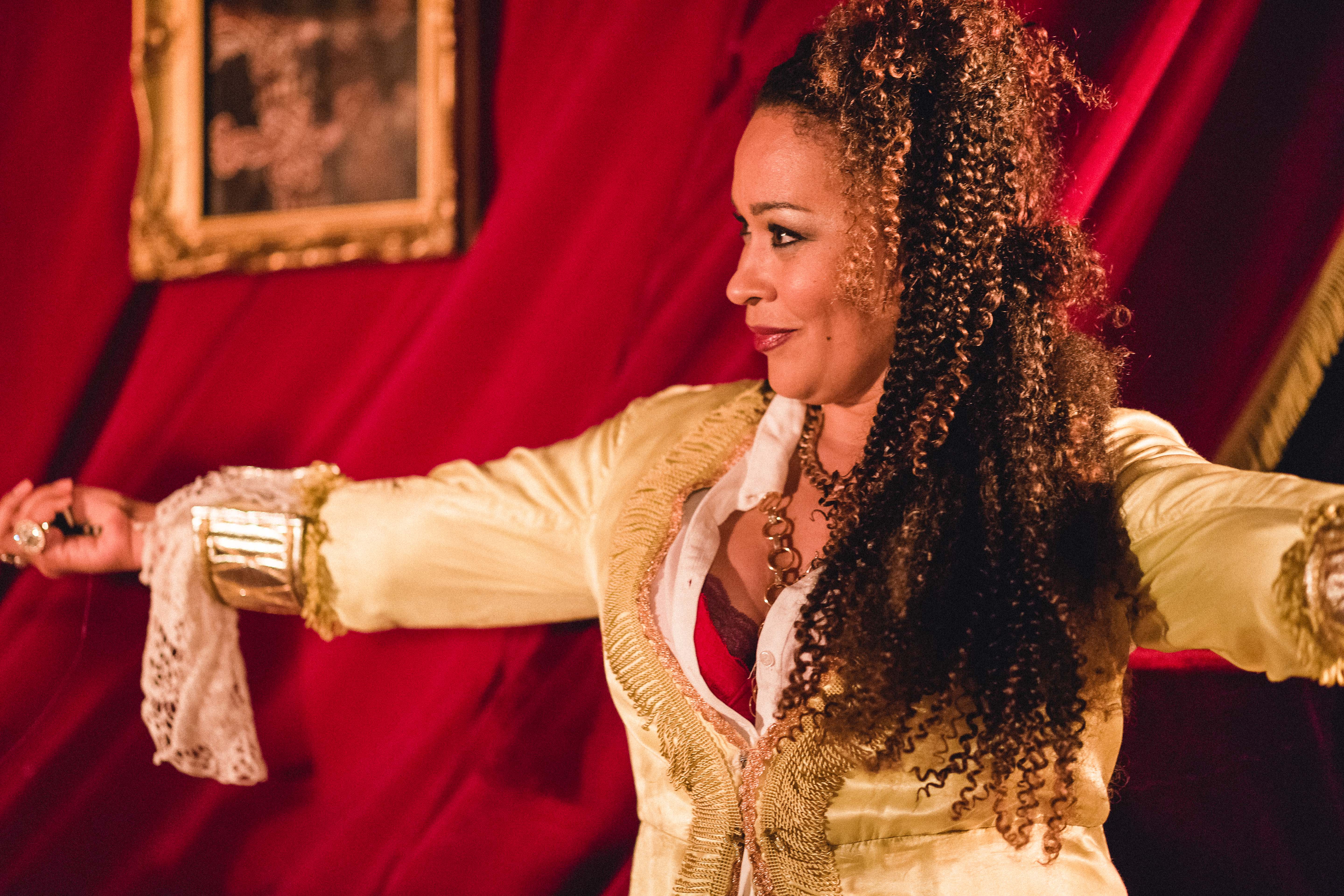
Doing away with the framing story of Christopher Sly, we’re thrown straight into the action. Famously bad-tempered Katherina (Kazeem Tosin Amore) is forced against his will into marrying Petruchio (Martina Laird), who’s more than willing to take on a challenge in exchange for her husband’s generous dowry. This frees his younger brother, the young, handsome Bianca (Tim Bowie), who has plenty of women after him but hasn’t been allowed to marry until Katherina does. As Bianca’s suitors, exchanging increasingly insincere air kisses, battle for his affections, Katherina’s new wife sets out to break his spirit and bring him to heel through a systematic programme of abuse and neglect.

Perhaps surprisingly given the subject matter, this spirited, high-energy production directed by Rae McKen delivers plenty of laughs – not least, dare I say, in the moments when the actors throw Shakespeare’s script out the window and start ad libbing. Brigid Lohrey and Eugenia Caruso make a brilliant comedy duo as Bianca’s bumbling suitors Gremio and Hortensio – think Cinderella’s ugly sisters fighting over Prince Charming – while Kayla Miekle’s Tranio is the ultimate fairy godmother with attitude, and Lorenzo Martelli gets some of the biggest laughs as Petruchio’s long-suffering servant, Grumio.

Meanwhile, Martina Laird gives a captivating performance as Petruchio, at once seductive and tyrannical. Swaggering about the stage, she has a way of directing her asides straight at individual members of the audience that makes us feel somehow complicit in her torture of her husband. And while it’s hard not to laugh at Katherina’s desperate expression as Petruchio launches herself at him, all the time we’re uncomfortably aware that if it were a man behaving this way, we’d probably be appalled instead of amused.
5M6A6849

This is theatre with a dual purpose – to make us laugh, and make us think – and on both fronts, it delivers. In a fast and frantically paced production, the cast never miss a beat, and genuinely seem to be having as much fun as the audience (occasionally more). And while the play’s central theme is always going to be challenging, gender swap or no gender swap, the awkward final scene is softened here by a Beyonce-inspired finale that, much like the rest of the show, is impossible to resist.


Can’t see the map on iPhone? Try turning your phone to landscape and that should sort it. I don’t know why but I’m working on it… 😉

Review: Russian Dolls at King’s Head Theatre

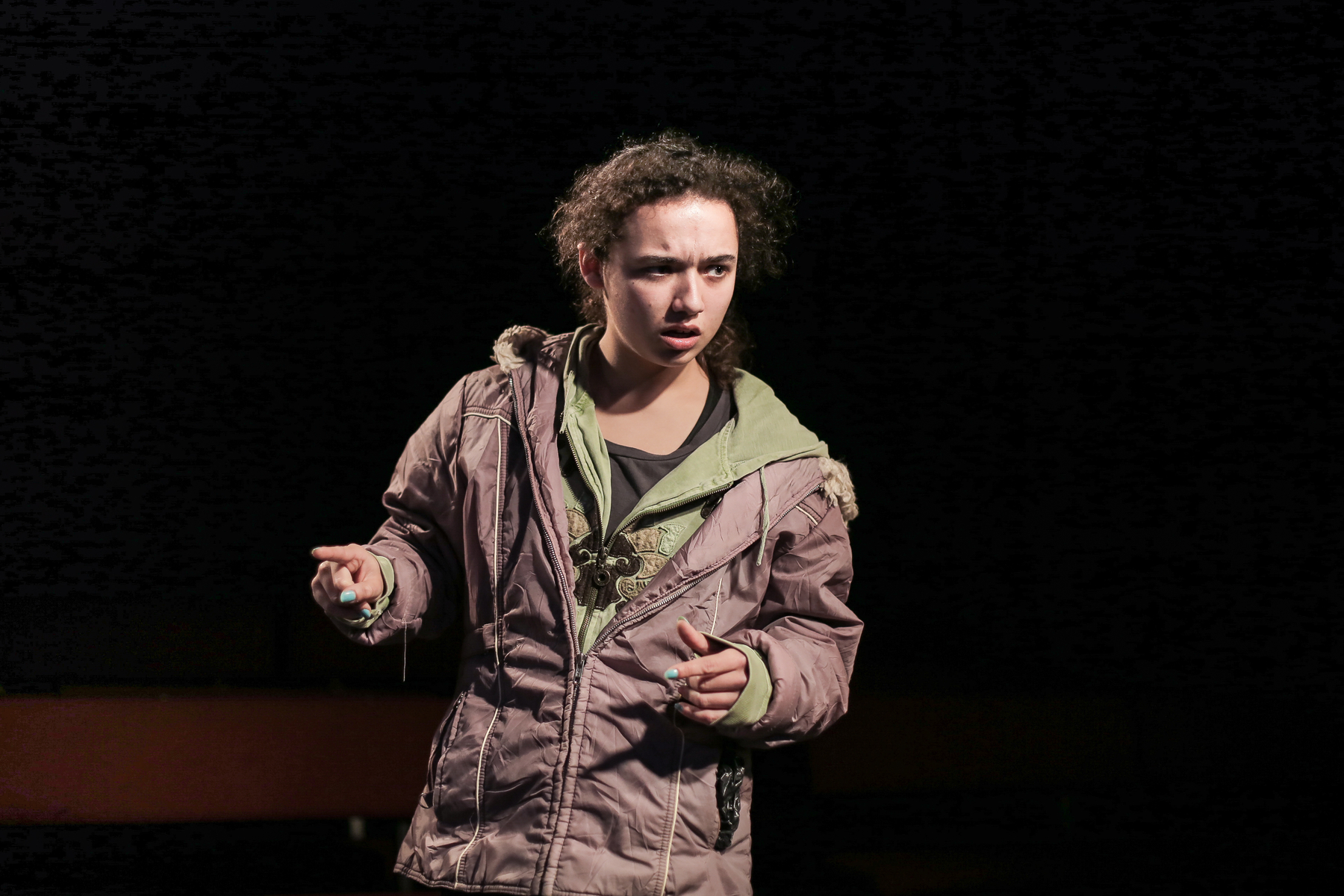
Kate Lock’s Russian Dolls, winner of the 2015 Adrian Pagan award for new writing, brings together two unlikely companions – Hilda, blind, elderly and struggling to maintain her independence, and Camelia, who’s just got out of a young offenders’ institution and wants nothing more than to go back there. When she robs Hilda, a surprising connection is forged, and the two discover that their lives are actually not all that different.

Exploring as it does some difficult themes – abuse, loneliness, gang violence and addiction, among others – it would be easy for the play to become a bleak picture of two isolated souls just trying to survive. And while there’s certainly plenty in Hamish MacDougall’s production to shock and dismay, this brilliant two-hander is far from one-dimensional. Both Hilda and Camelia are strong-willed and proud, and they quite literally speak different languages, so the resulting clash of personalities allows for a good deal of humour alongside some genuinely heart-warming moments.

Russian Dolls at King's Head Theatre
Photo credit: Andreas Grieger
Playing these complex characters are two perfectly cast actresses, who each begin alone on stage with a soliloquy direct to the audience. Stephanie Fayerman’s Hilda is determined and stubborn, refusing to stop living her life or to give up the things she loves, and discussing the sudden total loss of her sight with a levity that only thinly masks her devastation. Meanwhile, Mollie Lambert takes Camelia, a character many would be all too ready to write off as a lost cause, and reveals her to be an affectionate, warm and funny girl, who loves her family and dreams of a better future. Like Hilda, her bravado hides an intense vulnerability, and her ambitions become all the more poignant as she’s inevitably drawn back into the repeating patterns of the world she’s left behind.

Becky-Dee Trevenen’s set takes in the whole width of the intimate space, encompassing Hilda’s front door, living room and kitchen. We never see outside the flat, only hearing second-hand about characters and events, and this heightens the sense of isolation for the two women. In fact the only time the story doesn’t feel completely natural is on the one occasion the outside world briefly enters their safe space, when Camelia arrives home with a gun she’s stolen from her brother and his gang. This results in a mildly chaotic scene in which she runs around the flat behind Hilda’s back, hiding the weapon somewhere new, only to pick it up again moments later and move it somewhere else – and finally putting it back where it was in the first place. When the gun then disappears in the following scene, it feels like a bit of an anticlimax, and we only learn its true significance much later.

Russian Dolls at King's Head Theatre
Photo credit: Andreas Grieger
This thoughtful and moving play ends rather abruptly, with no clear resolution, but still manages to leave us feeling uplifted, despite some of the horrors that take place within it. Camelia and Hilda’s relationship begins as a practical arrangement – Camelia acts as Hilda’s eyes, while Hilda provides the authority and discipline Camelia’s never had from her own mother – but grows into one of genuine affection. This, along with the open-ended final scene, encourages us to go away considering how society needs to change before such stories can possibly have a happy ending.


Can’t see the map on iPhone? Try turning your phone to landscape and that should sort it. I don’t know why but I’m working on it… 😉
Review: Speaking in Tongues at Cockpit Theatre

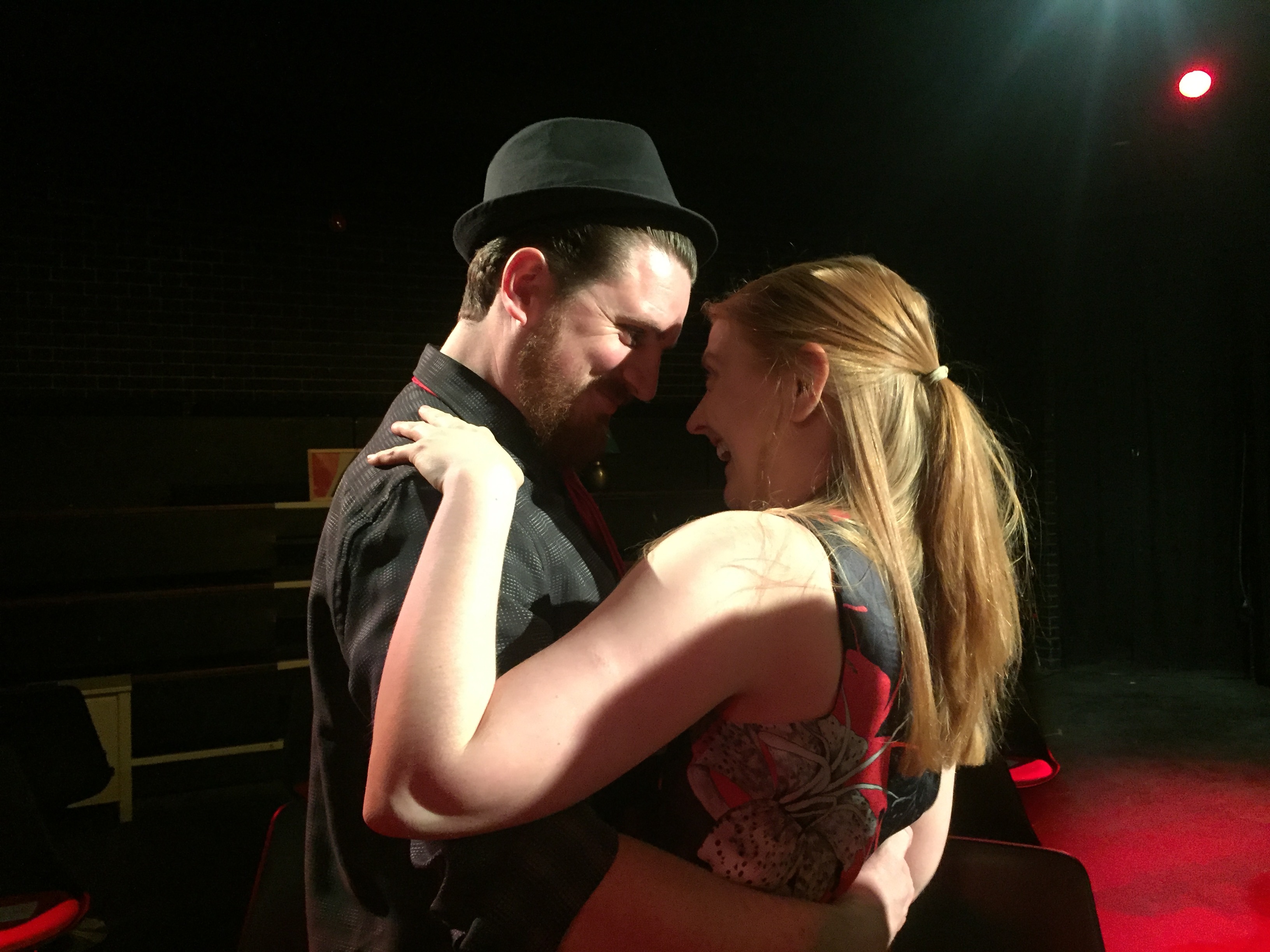
A man and a woman meet at a club and leave together. They’re both nervous… they’re also both married to other people. What they don’t know is that at the exact same time, their respective spouses are having a very similar encounter. But while their conversations mirror each other, sometimes word for word, ultimately the outcomes are different – only one couple actually goes through with it. The other, overcome with guilt, returns home to confess, only to discover their partners’ betrayal.

This all happens simultaneously – two couples, two rooms, two confessions, two marital breakdowns – within the first fifteen minutes of Andrew Bovell’s Speaking in Tongues. And that’s okay, because Doughnut Productions have more than one stage; in fact they have four. In a unique format, their productions take place predominantly around the sides of the room, while the audience watch from the centre, on chairs that swivel to face the action.

This is brilliant for many reasons: first, it means even if you’re stuck behind the tallest person in the room for one scene, they won’t be bothering you for long. Second, it allows for scenes like the one described above, where multiple events happen simultaneously but in different locations. And finally, it turns the play into a truly immersive experience; director Kathleen Douglas has the action literally taking place all around us, so it’s much easier to see how scenes mirror each other, and to get caught up in the drama.

Speaking in Tongues, Doughnut Productions
Photo credit: Doughnut Productions

And speaking of drama, there’s plenty to go around. In what initially seems an inexplicable twist, both couples reunite and share stories of odd encounters – one, with a man whose fiancée left him without explanation, the other with a neighbour who may or may not have murdered someone. It’s only in act 2 that these stories begin to make sense, as we meet another two couples and begin to truly appreciate the intricacy of Andrew Bovell’s script, where everything slots neatly together just in the nick of time… but still leaves us with enough unanswered questions to ensure we go away deep in thought.

Further emphasising how all the characters’ lives interconnect, a versatile cast of four play them all, switching roles at the interval, and each becoming the opposite of their act 1 self to the point where they’re almost unrecognisable. So Phil Aizlewood’s policeman becomes a murder suspect; Kate Austen’s betrayed wife a therapist. Most dramatic are the transformations of Georgina Periam, from ‘plain Jane’ to seductive therapy patient Sarah, and Andrew Seddon, the only actor to take on three roles – from the rambling but likeable Pete, he becomes fragile, obsessive Neil, and finally John, who seems oddly distant and unconcerned about the disappearance of his wife.

Speaking in Tongues is a tale of two halves – the first a reasonably straightforward, and frequently humorous, story about infidelity; the second a tense murder mystery. The common thread to both, though, is relationships: what it really means to love someone and what constitutes a betrayal. Interestingly, it also invites us to question our own response – why is it we’re prepared to laugh about adultery, but draw the line at murder? Is adultery now something we just accept without question, unless it brings with it darker consequences?

I’ll admit my primary reason for going along to this play was that I was intrigued by the swivel chairs. And don’t get me wrong, they’re great fun and work really well, especially with a story as segmented as this one. But the unusual format shouldn’t detract from the production itself, which is dramatic, compelling, and definitely left me wanting to see more from this innovative company.


Can’t see the map on iPhone? Try turning your phone to landscape and that should sort it. I don’t know why but I’m working on it… 😉

Review: I Capuleti e i Montecchi at Carousel

As I took my seat last night for Pop-Up Opera’s I Capuleti e i Montecchi, I heard someone explain, ‘It’s basically Romeo and Juliet without any of the nice bits.’ Which, as it turns out, is a pretty accurate summary of this opera by Vincenzo Bellini. By the time our story begins, Romeo and Giulietta are already embroiled in a secret love affair, helped by their friend Lorenzo, and Romeo’s on the run for killing her brother. Giulietta’s father, Capellio, decides to marry her off to Tebaldo, and in desperation she fakes her death. But Lorenzo’s prevented from getting a message to Romeo, who – as in Shakespeare’s version of the tale – goes to Giulietta’s tomb to kill himself.

Photo credit: Richard Lakos

Now, I haven’t seen a huge amount of opera, but I think it’s fair to assume this was quite a unique experience, even for those who have. First, the venue. Pop-Up Opera are a touring company who bring opera to new audiences in unusual locations; this particular tour will take them to the Asylum Chapel in Peckham, the London Museum of Water and Steam, and the spectacular Minack Theatre in Cornwall. In comparison, our venue – the basement bar of a restaurant in Marylebone – may not have been the most romantic, but it was still a suitably intimate and atmospheric setting, and my only complaint was that occasionally events took place on the other side of a concrete pillar.

The classic love story of Romeo and Giulietta has been reworked by stage director James Hurley into a modern thriller, in which the Montecchi and Capuleti are rival gangs locked in a long-running feud. Instead of swords and potions, this version has guns and pills, and unfolds on a set illuminated by harsh electric light and littered with crumpled paper and overturned chairs. From the outset, there are moments of brutal violence (I know I wasn’t the only audience member who flinched when Capellio advanced on a captive Romeo holding a pair of pliers), and the fact that we know how the story’s going to end does nothing to dispel the tension in what turns out to be a gripping drama.

Photo credit: Richard Lakos

In another original twist, Harry Percival’s English captions (inspired by Eurotrash, apparently) don’t seek to translate everything word for word, instead summarising each scene in the style of an old black and white movie. This has a dual effect: it means we get to concentrate on the action, and not spend an entire evening staring at the wall, and it allows a little more artistic licence with the translation – I can’t help wondering how Bellini would have felt about his hero being called an ‘asshole’, but it made me smile all the same.

But the modern translations, as amusing as they occasionally are, don’t detract from the beauty and emotion of Bellini’s score, or the quality of the performances – proving once and for all that you don’t necessarily need to understand every word to appreciate what’s going on. Each member of our cast – there are two on the tour – gives it everything, and it’s easy to forget there are only five of them, and that they’re backed by a single piano (played by musical director Berrak Dyer), not a full orchestra. Flora McIntosh’s Romeo is brash and reckless, while Cliff Zammit-Stevens is a sympathetic Tebaldo; an enemy he may be, but it’s clear he genuinely loves Giulietta and is as broken by her ‘death’ as his rival. Andrew Tipple’s proud Capellio is every inch the mafia boss, concerned only with family honour, even if it means rejecting his beloved daughter, and Matthew Palmer, in stark contrast, is a far gentler presence as the lovers’ mutual friend Lorenzo.

But it’s Alice Privett who gives the most memorable – and emotional – performance as Giulietta, a young woman caught between love and duty, and pulled this way and that by the headstrong men in her life. Her visible pain during the lovers’ final farewell means that emotions inevitably run high offstage as well as on.

Photo credit: Richard Lakos

Pop-Up Opera’s aim is to make opera accessible to a wider audience, people who may perhaps have dismissed it in the past as pretentious or boring. In this they certainly succeed, taking a classic story and giving it a modern twist, so that it feels fresh and exciting. And while it’s clear that they’re a company with a cheeky sense of humour, this doesn’t come at the expense of a high quality performance.

So if you think opera’s not for you, maybe give these guys a try, before you decide for sure…


Can’t see the map on iPhone? Try turning your phone to landscape and that should sort it. I don’t know why but I’m working on it… 😉

Review: Twelfth Night at French Protestant Church, Soho

Twelfth Night: a story of love, disguise and trickery, where nothing and nobody is quite what they seem. It seems fitting that a play in which appearance versus reality is such a prominent theme should be visually stunning, and Scena Mundi’s adaptation doesn’t disappoint; the French Protestant Church in Soho Square provides a unique and beautiful setting for what proves to be a classy production.

Shipwrecked in Illyria, Viola (Harriet Hare) disguises herself as a boy and gets a job working for the Duke Orsino (Pip Brignall). He sends her with messages of love to Olivia (Emma Hall), who falls instead for Viola – who unfortunately happens to be in love with Orsino. Then Viola’s twin brother Sebastian (Clare Brice) turns up, and everything gets even more confusing, before finally resolving itself in typically neat Shakespearean fashion. Meanwhile, Olivia’s drunken cousin Sir Toby Belch (Jack Christie) is hatching a plot with his friends Maria (Clare Brice again), Sir Andrew Aguecheek (Thomas Winsor) and Fabian (David Keogh) to make a fool of the pompous Malvolio (Martin Prest) by convincing him Olivia’s in love with him. And all this is quietly observed by the Fool, Feste (Edward Fisher) – who, ironically, may just be the wisest man on the stage.

Cecilia Dorland’s production takes as its starting point the vanity and self-obsession of Shakespeare’s characters, and transforms the aisle into a shiny blue catwalk for the play’s fashion show-inspired opening. Though the fashion theme doesn’t explicitly come up again after this scene, it’s present in Georgia Green’s costumes, which are somewhere between contemporary and modern, giving the play – and each character – a unique and timeless style that fits well in the unusual setting.

Photo credit: Jessy Boon Cowler

The cast do a great job of teasing out the complexities and less attractive aspects of their characters, and at the same time revealing the play to be more than a straightforward comedy that’s just out for laughs. Though there are a good number of laughs to be had – Martin Prest in particular gives an outstanding comic performance as Malvolio, with an array of disapproving facial expressions (and a surprising flexibility during the infamous yellow stockings scene), and the scene in which Orsino starts to feel an attraction to Viola in her boy’s disguise is both funny and sweetly touching. On the other hand, the later confusion between Viola and Sebastian falls a little bit flat, possibly because the two actors playing the twins look nothing alike.

While Malvolio is easy to laugh at because he’s so consistently unpleasant, there are other characters who turn unexpectedly to the dark side, and it’s these performances that prove most memorable. Sir Toby, played by Jack Christie, seems at first to be a loveable drunk, but ultimately reveals himself to be nothing more than a bully. Tricking Malvolio is one thing, but when he turns on his friend Sir Andrew (played with a child-like vulnerability by Thomas Winsor), it feels a step too far, and is actually a bit uncomfortable to watch. Edward Fisher’s Feste is also a mildly discomfiting presence; as the Fool, he provides entertainment through his wit and music, but at the same time has the feeling of a conductor, seeing and knowing all, with the power to make or break his fellow characters as he wishes.

Scena Mundi’s adaptation of Twelfth Night has plenty to recommend it: visually striking, with strong performances and several laugh out loud moments, the play also offers up a warning about the dangers of putting style over substance – particularly in matters of the heart. Great fun and well worth a look, especially if you enjoy your theatre in unusual locations.


Can’t see the map on iPhone? Try turning your phone to landscape and that should sort it. I don’t know why but I’m working on it… 😉