Review: The Canterbury Tales at Tower Theatre

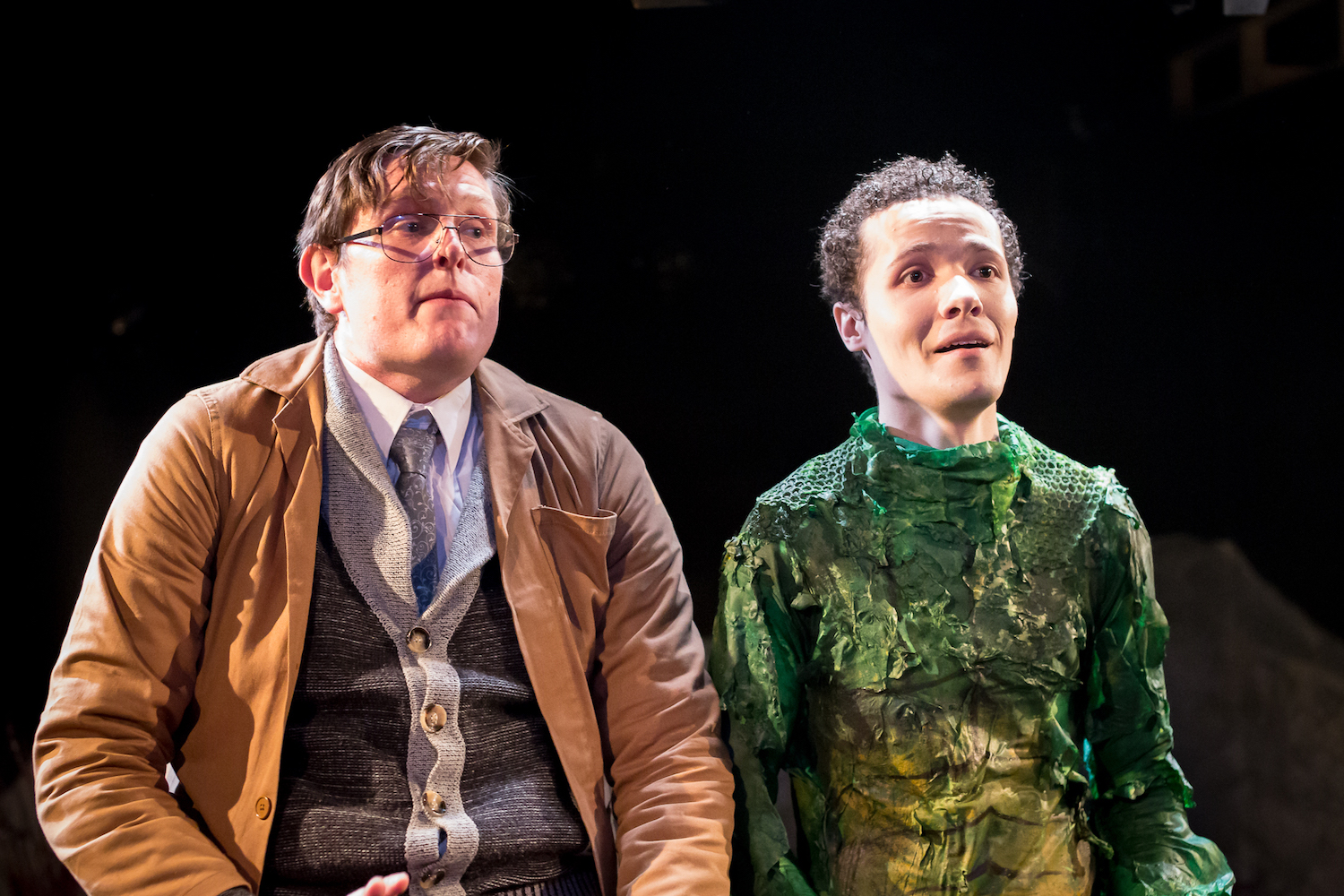
For someone who spends a lot of time sitting on stationary trains (and almost missed the start of this show because of a public transport delay), the premise of Tower Theatre’s new production of The Canterbury Tales is all too familiar. A group of passengers stranded on a train to Canterbury West – among them a soldier (Toñi Madja), a musician (Paul Willcocks), a librarian (Sarah Bower), a handywoman (Emily Carmichael) and a lawyer (Alistair Maydon) – are encouraged by the train guard (Alexa Wall) to turn to storytelling to pass the time, with each of them competing for the audience’s winning vote at the end of the evening.

Photo credit: Robert Piwko

Directed by Angharad Ormond, the resulting collection of tales is a slightly disjointed but wholly entertaining evening, alternating between comedy and tragedy, and with no shortage of topical commentary; though the tales are all based on stories written centuries ago, it doesn’t take too much of a twist to bring some of them bang up to date. Like Constance, the central character in the lawyer’s story, who’s forced to flee her home and later becomes the sole survivor of a slaughter at the hands of religious extremists; Griselda (Arabella Hornby), of the librarian’s tale, who’s trapped in an emotionally abusive marriage; or Alice (Deborah Ley), better known as the Wife of Bath, who’s been married five times but has never managed to achieve the one thing she really wants – gender equality. The production makes no secret of its political orientation in these moments, with cast members reciting key facts and headlines relating to the refugee crisis, and Alice referencing recent news from Alabama in her plea for women’s rights.

Unsurprisingly, this means that there are points in the production where things get very dark indeed, but luckily there’s also plenty of humour – much of it quite cheeky – to lighten the mood. Both the bookie (Ryan Williams) and the soldier entertain their audience with stories about two men chasing the same woman, set centuries apart but both with predictably disastrous results. The priest (Paul Graves), meanwhile, brings the evening to a cheery musical conclusion with his cautionary tale about the proud rooster Chauntecleer, who learns the dangers of falling for flattery.

Although each story only has one narrator, the production is a great example of ensemble performance, incorporating physical theatre, sign language and clowning at various points. Music also plays an important part in the show, whether it’s a cappella 60s hits, haunting folk melodies or tongue-in-cheek opera, and this adds an extra dimension to an already lively production, with strong vocals and harmonies from the whole cast and musical accompaniment provided by the multi-talented Paul Willcocks.
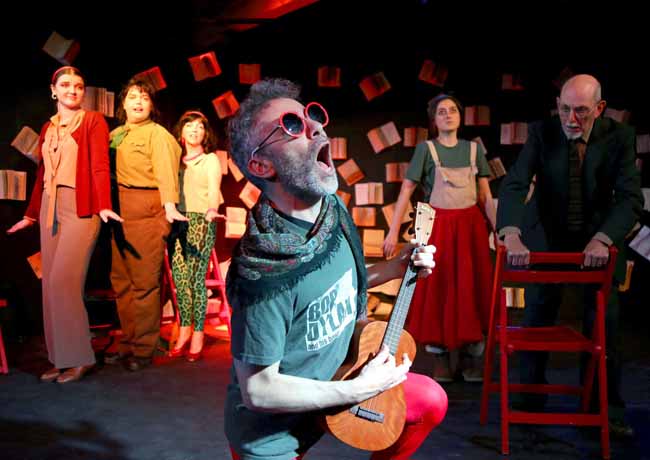
Photo credit: Robert Piwko

Parts of the show have a slightly improvised feel, and with more characters than stories I did leave wondering if a different combination of tales might be told each night – if so, this would be another clever twist (and would also keep the cast on their toes). Whether or not that’s true, though, this new take on The Canterbury Tales brings Chaucer well and truly into the 21st century, and is certainly a lot more accessible than the dry text most of us will remember studying at school. It’s great fun, slightly bonkers and well worth a visit.

The Canterbury Tales is at Tower Theatre until 20th July.

Review: One Giant Leap at the Brockley Jack Studio Theatre

Anna Karenina, Macbeth, Othello, Three Sisters, Frankenstein, The White Rose, Taro… Over the last five years, Arrows & Traps have proved time and again that they know how to do serious drama (and also that there are an awful lot of different ways to die). That label cannot be applied in any conceivable way to their new play One Giant Leap, which is a very silly story with no other mission in mind but providing two hours of pure entertainment.

Photo credit: Davor Tovarlaza @ The Ocular Creative

It’s 1969, and Apollo 11 is all set to launch for the Moon. But it’s too hot up there to film Neil Armstrong and Buzz Aldrin’s one small step for man, so CIA Agent Harris (Alex Stevens) has come to cash-strapped TV producer Edward Price (Christopher Tester) with a request: he needs him to fake the Moon Landing. There’s just one problem – Price’s cast and crew of misfits are too wrapped up in their own issues to focus on the job at hand, and time is ticking away…

Writer and director Ross McGregor has thrown literally everything at this historical sci-fi romantic comedy (there’s no kitchen sink but there is an alluring stepladder) and the result is an often chaotic but always enjoyable romp that culminates in a musical number I don’t think any of us will be forgetting any time soon. The characters are stereotypes – the arrogant leading man, the scantily clad actress, the frustrated producer – and the plot relatively predictable, but there’s enough detail to ensure none of them are ever lacking in substance. At times, this detail actually works against the production; with every character getting their own story, there’s a lot to try and keep track of at any given moment. This also means that the play’s conclusion, particularly following the unbridled hilarity of the Moon Landing sequence, feels a bit like a box ticking exercise to ensure we’re not left with any unfinished plot threads.

That said, one of the best things about One Giant Leap is that the cast are clearly having an absolute blast. It’s hard to tell who’s having more fun up there: Will Pinchin as Howard, the world’s clumsiest cameraman; Lucy Ioannou as sweet but insecure Alchamy; Steven Jeram as casanova Daniel; Vivian Belosky as sharp-tongued and quite possibly permanently green Linda. Alex Stevens’ CIA Agent Harris showcases some impressive accent switching (and interesting wardrobe choices), and Christopher Tester and Charlie Ryall engage in excellent verbal sparring as increasingly desperate ex-spouses Edward and Carol. And Daniel Ghezzi, appropriately enough, steals every scene he’s in as frustrated actor and lover of all things jazz hands, Perry.

Photo credit: Davor Tovarlaza @ The Ocular Creative

As Arrows & Traps arrives at a crossroads before embarking on a new chapter with The Strange Case of Jekyll & Hyde later this year, One Giant Leap feels like the company is taking a welcome opportunity to pause and let off some steam. It’s not Shakespeare, and it doesn’t have the beauty and eloquence of, say, The White Rose or Taro – though it is still visually quite a feast, with an incredible set designed by Justin Williams and some unforgettable costumes from Delyth Evans. I didn’t always know exactly what was going on but I had fun trying to figure it out, and sometimes that’s all you need. So why not boldly go and get a ticket for two hours of silliness and escapism, and – for once! – a happy ending.

One Giant Leap is at the Brockley Jack Studio Theatre until 27th July.

Review: Voices From Home at Theatre503

Since its inception in 2017, Broken Silence Theatre’s Voices From Home has been championing new writers from across the South East, and more importantly from outside the capital. Volume 3 found the event in a new home at Theatre503 and showcasing five original pieces on a variety of themes and covering a broad emotional spectrum.

Anatomy of a Victim by Rachel Tookey (Surrey) is an intriguing and slightly unsettling piece about the murder of a young woman. The play starts with an unsentimental laying out of the facts from A (Abbi Douetil) and B (Ella Dorman-Gajic), who are a bit disappointed at the clichéd nature of the young woman’s disappearance, and convinced they’ve just uncovered a huge miscarriage of justice. Which is all well and good, until we’re taken back to the beginning of the story, and meet Rebecca (Hatty Jones) – the victim – who at this point is still alive and well and full of plans for the future, as she tells her friend about a frightening encounter she’s just had with the boyfriend that A and B are so keen to exonerate. The play ends on an abrupt and ambiguous note, leaving us to make up our own minds about what really happened that night, and slightly chastened by the realisation that behind every sensational true crime documentary, there first has to be a real victim.

From the first Kent writer to be featured in Voices From Home, Mark Daniels’ My Boys is a bittersweet portrayal of a grieving family as they take their first steps towards reconciliation after a lengthy estrangement. Stacha Hicks gives a particularly powerful performance as the newly widowed but still delightfully stoical Pauline, alongside David Ellis and Steven Jeram as her sons Jamie and Lenny. Tomorrow is the funeral of their late dad Len, and as he lies in his open casket, the remaining family members finally have a chance to say all the things they couldn’t say before – but have they left it too late? Funny and sad in equal measure, this enjoyable play about family and forgiveness will make you want to call your loved ones (especially if you’ve not seen them in a while) just to say hi.

Also on the topic of grief, Like and Subscribe by Berkshire’s Rachel Causer sees another awkward reunion, this time between two former best friends. One, Polly (Alanna Flynn), has gone on to become a successful podcaster, while the other, Kas (Antonia Salib), has been struggling to come to terms with her mum’s death. With Polly portrayed as superficial and self-absorbed, we’re immediately inclined to dislike both her and her brand of forced positivity, particularly when she appears to be trying to capitalise on her friend’s grief. But things aren’t quite as simple as they seem, and behind the weird podcast voice and fixed grin, there’s more to Polly’s positivity than meets the eye. Like and Subscribe is a witty and relatable story about friendship and the lengths we’re prepared to go to convince the rest of the world we’re fine – even when we’re anything but.

In Losers by Precious Alabi (Essex), two complete strangers meet outside a club. It’s 31st October 2019, and Her (Dominique Moutia) is having a bad night when she runs into Him (Andy Sellers). He thinks she’s superficial, she thinks he’s rude – but as the minutes tick down towards Brexit, they realise that maybe they have more in common than they thought. Though it may sound like it, Losers isn’t really a political play; it’s about two human beings finding a brief connection in a world that’s not treating either of them particularly well, and the many ways in which we make assumptions about others based on first impressions. The conclusion – in which Her has a revelation about how badly she’s behaved – feels a little bit too neat and tidy, but were the piece to be expanded into something longer, there’s potential here for some really interesting character development on both sides.

Last but by no means least, My first time was in a parking lot by Phoebe Wood from Norfolk is a powerful and disturbing story of one woman’s teenage trauma and the lasting impact it’s had on her life, relationships and mental health. Though Mira (Eleanor Grace) talks about her first time with seeming nonchalance, each time she returns to the story it becomes a little clearer that there was a lot more to it than we first thought – and not in a good way. Eleanor Grace gives a brilliant solo performance as this complex character who masks her pain with humour, and while it’s difficult to watch, at the same time this is the kind of piece you want to see again because there’s so much detail in those few short minutes.

With high quality writing, direction and acting across the board, the third outing for Voices From Home was as enjoyable, varied and thought-provoking as the previous two, and as always, it’s refreshing to see talent from outside London being given a voice. Roll on the next one…

For more details about Voices From Home, visit brokensilencetheatre.com or follow @BrokenSilenceT

Review: Othello: Remixed at Omnibus Theatre

Updated and relocated to a London boxing club in 2019, Intermission Theatre Company’s reimagined Othello is an accessible and creative take on a Shakespearean classic. Othello (Kwame Reed) is the club’s star boxer, and when he chooses Michael Cassio (Micah Loubon) as his cornerman for the upcoming championship fight, a bitter Iago (Baba Oyejide) hatches a plan to bring him down. Taking emotional and financial advantage of Rico (Iain Gordon), who fancies Othello’s girlfriend Desdemona (Hoda Bentaher), Iago convinces Othello that she’s cheated on him with Cassio, and in doing so unleashes a violent chain of events that will ultimately end in tragedy.

Photo credit: Richard Jinman

Using the plot and key themes of Shakespeare’s original as a starting point, director Darren Raymond breathes new life into this story of jealousy, insecurity and deception. The dialogue interweaves Shakespearean verse with street slang, and also skilfully incorporates mobile phone use and a contemporary soundtrack, all of which makes the plot easier to follow and more relatable to a modern London audience (Othello and Desdemona being spotted together in Nando’s is a particularly nice touch). The action moves much faster than in the original, too, shaving a good hour off the traditional running time to come in at just two hours including interval, without losing any of the essential plot details.

Also interesting is the addition of a new character, the Referee, who acts as a physical embodiment of the jealousy that provokes both Iago and Othello into their actions. Played with sinuous malice by Danielle Adegoke, the Referee takes away a little of the responsibility from each man – while both are undeniably guilty, the audience is invited to question what led them to commit these crimes, instead of condemning them both out of hand as bad people. The play’s conclusion is also less bloody than the original, the violence less ruthless, and there’s an unexpected twist at the end that has the potential to write a very different story. (Sequel, anyone?)

The cast is made up of graduates from the Intermission Youth Theatre, which was set up to give opportunities to vulnerable young people from disadvantaged backgrounds. By setting the action in a boxing club which was established with the same goal in mind, Raymond paves the way for performances that feel grounded in reality. This is particularly true for Kwame Reed as Othello; throughout Act 1 he comes across as a decent guy who’s trying to leave behind a troubled past by channelling his aggression into something productive, whereas in Act 2 we see how easily and terrifyingly that pent-up violence can be misdirected. Baba Oyejide is also strong as Iago, confidently manipulating everyone around him – including the audience, who laugh along on more than one occasion – with a subtle mix of humour, veiled threat, and an occasional nod to the by now well-known concept of “fake news”.

Photo credit: Richard Jinman

It’s testament to the quality of the production that even if you know how the story ends, the final scene – in which the full impact of Iago’s scheming is realised by everyone – is still incredibly powerful and more than a little tense. For those who don’t know the story, meanwhile, or for those who’ve never had the opportunity or inclination to see Shakespeare done the “traditional way”, Othello: Remixed is an ideal introduction. In touching on topical issues like knife and gun crime, drugs, discrimination, misogyny and the disaffection of young people in the UK today, the production demonstrates how Shakespeare’s work speaks for, and should therefore be available to, everyone. It’s fresh, fun and action-packed with an explosive finale, and I can’t imagine Shakespeare would want it any other way.

Review: Dark Sublime at Trafalgar Studios

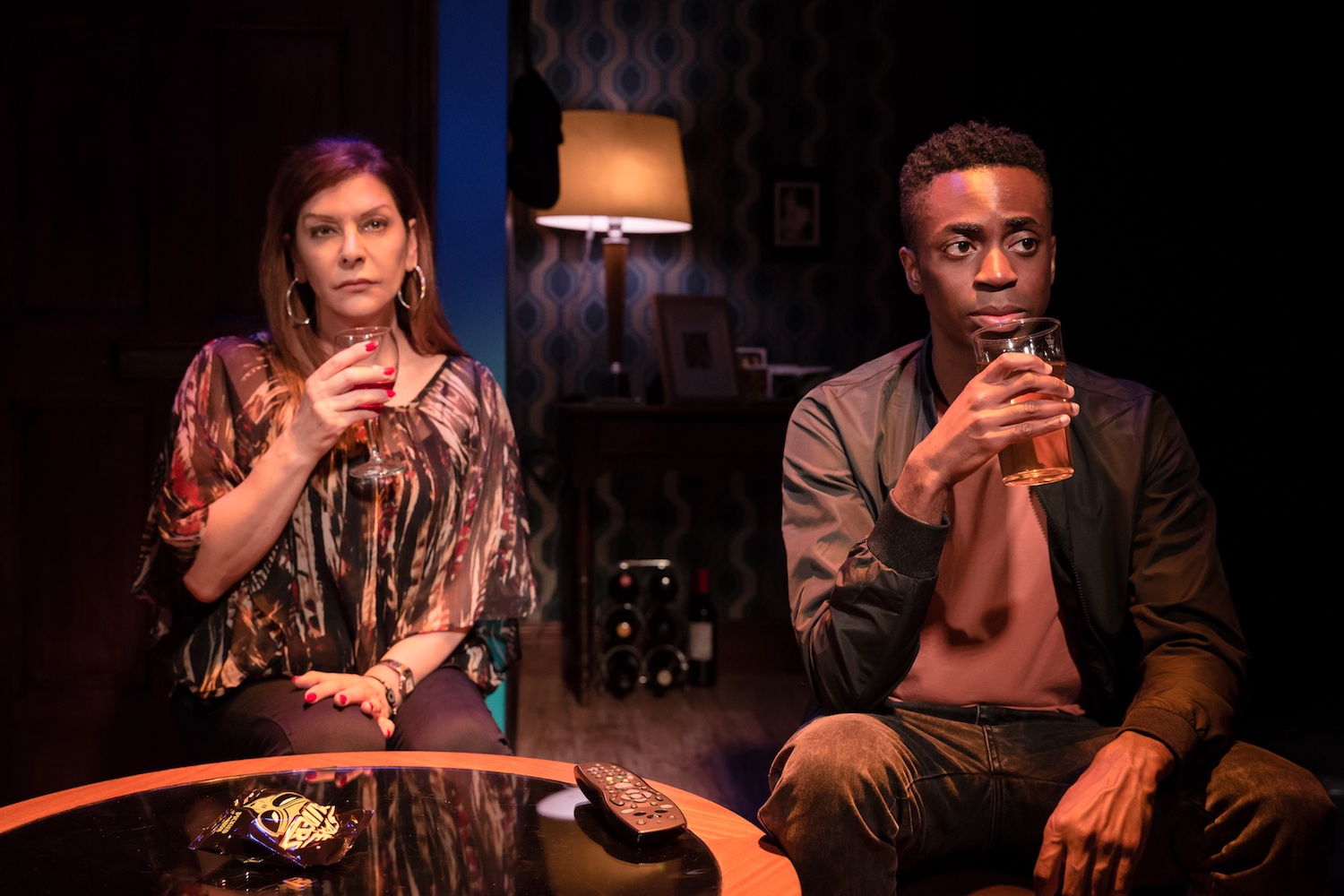
Marianne (Marina Sirtis) is an actress, best known for her role in cult 70s sci-fi TV show The Dark Sublime. She’s done plenty of other acting work in the intervening four decades but the role of Ragana is the one she can’t shake off, even though to her, it’s the one that means the least. When Dark Sublime superfan Oli (Kwaku Mills) – who wasn’t even born when the series first aired on TV – tracks her down, an unlikely friendship develops. But what begins as an opportunity for Marianne to bask in the glory of her past ultimately forces her to confront the complications of her present, and in particular the unrequited love she feels for her best friend Kate (Jacqueline King).

Photo credit: Scott Rylander

One of the production’s biggest draws (the other being Mark Gatiss as the voice of a robot) is star Marina Sirtis, who is herself well known for playing the role of Deanna Troi in seven series of Star Trek: The Next Generation. While writer Michael Dennis didn’t create the role of Marianne specifically for Sirtis, he could very well have done, and this gives the character a sense of genuine depth; each time she expresses bewilderment at the unquestioning adoration of her fans, the audience understands that the emotion comes from a real place.

Real world parallels aside, Sirtis generally impresses with her portrayal of Marianne. Though she’s always quick with a witty comeback, it’s clear quite early on that the character is also really struggling to figure out where she fits in a world that no longer seems to have a place for her. Kate has a new partner – the younger, attractive, intelligent Suzanne (Sophie Ward) – and Marianne’s acting career seems to have stalled to the point where earning even £40 feels like a windfall. It’s little wonder she jumps at the chance to meet Oli, who idolises her Dark Sublime character and reminds her of who she used to be.

Speaking of Oli, Kwaku Mills is a delight, his charm and enthusiasm lighting up the room every time he’s on stage. Oli has issues of his own that mirror Marianne’s – he’s also in love with his best friend, but unlike Marianne, he’s prepared to do something about it. Much is made of his youth and his obsession with The Dark Sublime, as if those are reasons to dismiss him, and yet he repeatedly shows more maturity and a deeper understanding of the world than Marianne, who prefers to drown her problems in alcohol.

During one of their early conversations, Marianne reveals to an excited Oli that another episode of the show was written but never shown on TV, scenes from which are revealed intermittently throughout the show. These are, for the most part, played for laughs by Simon Thorp, who’s clearly enjoying himself immensely as the heroic Commander Vykar (and just as much in a brief appearance in the real world as obnoxious actor Bob). So it comes as something of a surprise when the final scene, which brings in the whole cast, gets pretty deep and is ultimately revealed to be symbolic of Marianne’s own personal journey.

Tim McQuillen-Wright’s attractive and intimate set design places us right in Marianne’s living room, although not all the action takes place there. There’s a console cunningly concealed in the coffee table, suitably 70s sci-fi lighting when called for, and a TV screen that doubles as a backdrop when scenes occur elsewhere. This sort of works, although the size of the screen isn’t really sufficient to properly distract us from the stylish decor of the flat and convince us we’re really in the park or a cheap hotel.

Photo credit: Scott Rylander

The other issue with the play is that at 2 hours 40 minutes it just feels a bit longer than it needs to be. Even before bringing in the deleted scenes from the TV show, there are several plot threads going on – Marianne’s career and her relationships with both Kate and Oli, Oli’s friendship with Joel (who never actually appears), Kate’s romance with Suzanne – and in tying them all up the script begins at times to feel slightly sluggish and repetitive. That said, the closing scene, which references the poem by W.H. Auden that gives the play its title, is rather lovely and feels like a fitting end to the story.

For fans of British TV from the 70s and 80s, Dark Sublime is probably a bit of a must-see, if only so you can sit and cheerily sing along to the Cadbury Fudge jingle before the play begins (yes, I did that). But there’s lots more to recommend it besides nostalgia. This is a rare personal drama about an older gay woman trying to find her place and identity in a changing world, with plenty of laughs – particularly aimed at the world of showbiz – and some interesting questions about the nature of fandom. A bit long perhaps, but still well worth a watch.

Dark Sublime is at Trafalgar Studios 2 until 3rd August.