Review: It Is So Ordered at the Pleasance

We usually only get to hear about miscarriages of justice once they’re over – and when that happens there’s an expectation that we should be celebrating. Of course it’s good news when an innocent man or woman is released from a sentence they never should have received – but shouldn’t we also feel some anger, and a desire to change the system that imposed the sentence in the first place, stealing years or even decades from someone’s life? Why congratulate the people who got it wrong when we should be making sure they can’t ever do it again?

Photo credit: Tim Hall

It was this anger that prompted Conor Carroll to begin writing It Is So Ordered, after hearing the true story of Ricky Jackson, an African American man who spent 39 years in prison in the USA for a crime he didn’t commit. Jackson’s conviction was based on the coerced testimony of a young boy, and his release only secured when the same witness finally felt able to reveal the truth four decades later.

Opening during the Harlem Race Riots of 1964, the play begins with the fatal shooting of a shop owner and the arrest of teenage brothers Johnny and Craig. A younger boy, Bobby (Faaiz Mbelizi), is interrogated by the police and forced into giving evidence at the brothers’ trial. While Craig accepts a deal and is later released on parole, Johnny (Simon Mokhele) continues to protest his innocence and ends up with a life sentence. But he’s not the only one – Bobby must live every day with the knowledge of what he’s done, unable to retract his story for fear of repercussions for himself and his family.

Carroll’s passion for his subject is clear in every moment of this intense, urgent play, and in the heartfelt, utterly convincing performances of Faaiz Mbelizi and Simon Mokhele. As Johnny’s imprisonment stops being something that happened years ago and stretches into our own lifetimes – a reference to 9/11 revealing just how long it’s been – we’re forced to consider whether things have really changed all that much, even now, in terms of the U.S. justice system and the mistreatment by police of African Americans, which continues to make headlines today.

The play’s message is one that needs to be heard, and director Lucy Curtis opts for a stripped-back production that allows us to focus without any distractions. Carroll’s words fly thick and fast as the actors pace the floor, unafraid to make direct, confrontational eye contact with the audience. While on paper their lives may seem like opposites, in reality neither man is truly free, and their lines fit together seamlessly to form a single narrative of horrifying injustice. The stage becomes an evidence room of sorts as key details – dates, names, the outline of the murder victim and of the interrogation room – are scribbled in chalk on the floor and walls so that our eyes are constantly drawn back to them. There’s certainly a case to be answered… but it’s not Johnny or Bobby who should be on trial here.

Photo credit: Tim Hall

And yet. Despite all this, there’s a note of resilience and hope for a better future, even in the darkest moments. When the two men lift their voices and sing together of their determination to one day be free, we feel that perhaps all isn’t yet completely lost. And when Johnny begs Bobby to stand up and be heard, we know full well he’s not only addressing the other man, but the whole room – and beyond.

We never get to witness the celebratory moment of Johnny’s long-awaited release from prison, though it’s fair to assume this is imminent as the stage goes dark. Consequently, we leave the theatre feeling not relaxed and reassured by the story’s happy ending, but filled with a lingering fury at everything that’s gone before it. It Is So Ordered is a gripping and powerful hour of theatre that deserves to be seen – and acted upon.


Can’t see the map on iPhone? Try turning your phone to landscape and that should sort it. I don’t know why but I’m working on it… 😉

Review: Miss Nightingale at The Vaults

Matthew Bugg’s acclaimed WW2 musical Miss Nightingale may just have found its spiritual home at The Vaults. Entering the warren of dimly lit underground tunnels, we’re handed a chocolate bar and a programme designed to look like a ration book before stepping into the auditorium, which could very easily be an air raid shelter. As trains rumble in and out of Waterloo Station above our heads, it’s not a huge stretch to imagine what we’re actually hearing is bombs falling, and it’s almost a surprise to emerge into Launcelot Street and find all the buildings intact and ourselves back in the 21st century.

Photo credit: Robert Workman
Miss Nightingale does many things all at once. It’s a touching story of forbidden love, a social commentary on gay and women’s rights, and a feel-good (and really quite naughty) musical. By rights it probably should feel like a bit of a jumble, and it’s true that some elements of the plot end up a little sketchy through sheer lack of time – yet it’s impossible not to get swept up in the charm and sheer joy of it all.

It’s 1942, and war hero Sir Frank Worthington-Blythe (Nicholas Coutu-Langmead) hires Maggie Brown (Tamar Broadbent), a feisty nurse from oop north, to perform in his new club. The two quickly grow close, but Maggie’s already in a relationship with dodgy wheeler-dealer Tom (Niall Kerrigan) – and besides, it’s her friend and songwriter George (Conor O’Kane), a Polish Jew still in mourning for both his lost family and his beloved Berlin, who’s secretly captured Frank’s heart.

Forced by the law and social expectations to keep their illicit love affair under wraps, the two men end up embroiling both themselves and Maggie in a complex tangle of broken hearts and false hopes – all the while maintaining a facade of determined jollity in order to keep up morale. This is Britain, after all, and the show must go on, whatever dramas may be unfolding behind the scenes.

And there’s no doubt Miss Nightingale‘s outrageous comedy numbers know how to lift the spirits. Laden with every innuendo you can think of – and a few that you might not – they provide welcome light relief from the intensity of Frank and George’s tempestuous love affair, and particularly from the disturbing realisation that less than 100 years ago, gay couples still risked social ruin or even prison just for the chance to be together. (And worse – there’s a moment in Act 2 when George reflects on the unfairness of being persecuted in the country he came to seeking refuge; as recent events have shown all too clearly, these words could just as easily be spoken today.)

Photo credit: Robert Workman
The whole cast of actor-musicians are clearly in their element during the rude bits (and let’s be honest, who wouldn’t get a bit of a buzz out of a song whose main lyric is, “You’ve got to get your sausage where you can”?) but Matthew Bugg’s score demands a softer side too, particularly from the show’s three main stars, all of whom impress with their powerful vocals. Though best known as a comedian, Tamar Broadbent reveals she can do serious just as successfully, while Nicholas Coutu-Langmead and Conor O’Kane maintain an ideal balance in their blossoming on-stage relationship, with Frank’s timidity and stiff upper lip perfectly countered by George’s volatility and flamboyance.

This is the fifth production of Miss Nightingale, and it’s not hard to see why the show keeps returning – it really is the best of British, in more ways than one. Yes, it’s a huge amount of fun, but there’s a more serious point to all this. We might not be at war any more, but that doesn’t mean there aren’t still battles to be fought – and in an increasingly troubled world, this show reminds us that it’s as important as ever to stand up and be counted.


Can’t see the map on iPhone? Try turning your phone to landscape and that should sort it. I don’t know why but I’m working on it… 😉

Review: Chinglish at Park Theatre

Bad Chinese to English translations are the stuff of internet legend. My personal favourite sign – ‘Do not Disturb, Tiny Grass is Dreaming’ – sadly doesn’t make it into David Henry Hwang’s Chinglish, but there are still plenty of hearty belly laughs to go around in this comedy with hidden depths about an American businessman trying to make it in China.

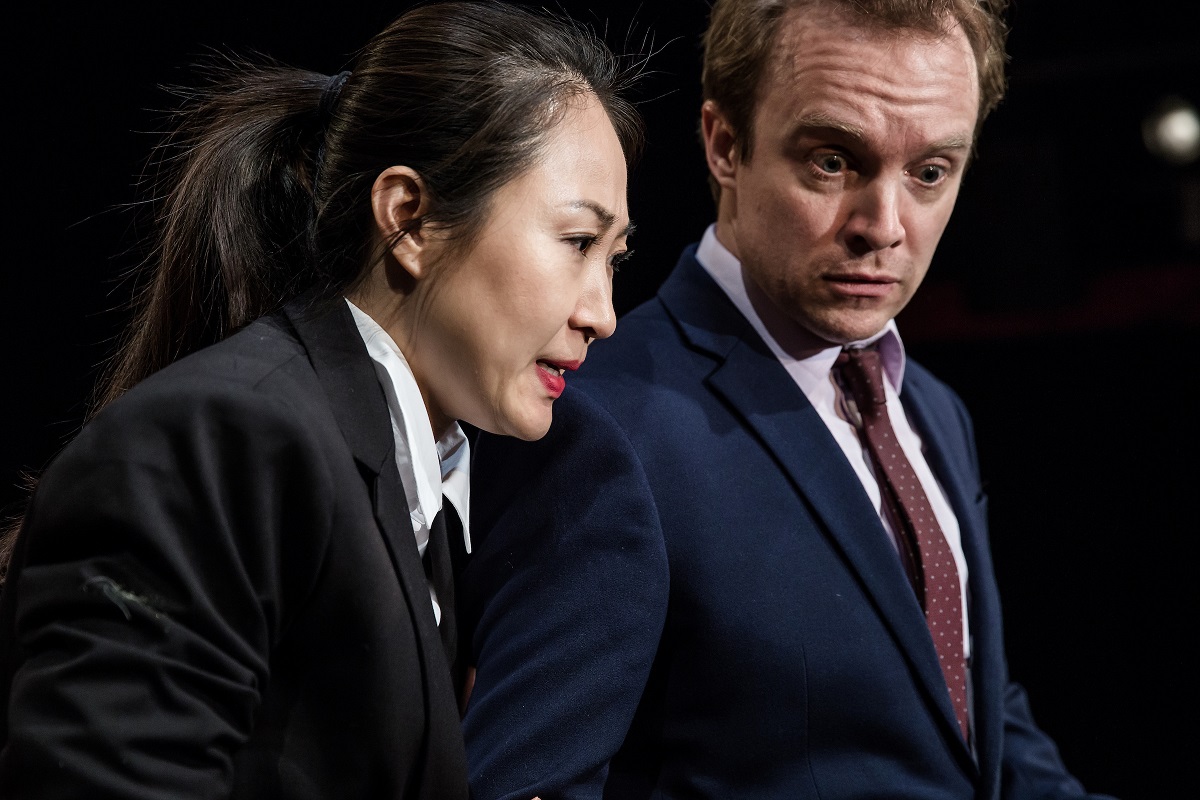
Daniel (Gyuri Sarossy) has spotted an opportunity for his Cleveland-based firm – supplying signage for a new arts centre in Guiyang. The only problem? He doesn’t speak the language or understand the culture. Employing the services of Peter (Duncan Harte), a fluent Chinese-speaking British “consultant”, Daniel pitches his proposal to a government minister (Lobo Chan) and finds himself getting along a little too well with vice-minister Xi Yan (Candy Ma). Chaos, confusion and rumours of corruption ensue… but who really has the upper hand – and why?

Photo credit: Richard Davenport for The Other Richard

A strong cast, directed by Andrew Keates, handle the bilingual script with ease, with Candy Ma and Duncan Harte particularly impressive as they slip effortlessly from Mandarin to English and back again. Gyuri Sarossy, meanwhile, hits exactly the right note as the bewildered Daniel, his early cockiness fading rapidly as he begins to realise what he’s got himself into, and his later scenes with Ma are loaded with an unexpected emotional intensity.

Though a good proportion of the script is in Chinese, the audience never feels lost in translation, thanks to the provision of surtitles throughout (though this does sometimes mean turning away from the actor who’s speaking in order to keep up with what they’re saying). This gives us an advantage over most of the characters, who only speak either English or Chinese, and allows us to appreciate the humour in both the hilariously inept efforts of the Chinese interpreters and Daniel’s fumbling attempts to speak Mandarin himself. There’s no question of taking sides; the good-natured humour targets both East and West equally, warding off any accusations of prejudice in either direction.

Ironically, from our privileged position of bilingualism, one of the hardest scenes to follow is mostly in English (in fact it’s so tricky that we share the characters’ jubilation and relief when they finally understand each other). And it’s here that Hwang moves away from light comedy, and into something altogether more complex. This isn’t just an opportunity for us all to have a good laugh at people making language mistakes – and just as well; as funny as these undoubtedly are, a solid two hours of them might be a bit exhausting.

Where the play really gets interesting is in its exploration of the fundamental difference in business, political and cultural practices between East and West. As business consultant Peter discovers to his cost, sometimes even being able to speak the local lingo like a native isn’t enough; in such vastly different cultures, a word that’s directly translated from one language to another can still mean something completely different.

Photo credit: Richard Davenport for The Other Richard

Just as fascinating as the script is Tim McQuillen-Wright’s set, which begins as a simple panelled wall but then unfolds like origami (yes I know, wrong country) to reveal hidden doors, windows, a restaurant kitchen and even a bedroom. As a result, each scene change offers an intriguing opportunity to see what it’ll do – and where it’ll take us – next.

Chinglish is a lot of fun, with some great comic performances and a few unexpected twists and turns that prove worth waiting for. But it’s also a genuinely interesting play to watch, from both a linguistic and business perspective. Not everyone ends up getting what they want (in fact, make that hardly anyone), but the bittersweet conclusion comes with some important lessons for everyone involved – and lends new meaning to Daniel’s own top tip to “always bring your own translator”.

And if you just enjoy laughing at funny Chinese signs – well, it’s got plenty of those too.


Can’t see the map on iPhone? Try turning your phone to landscape and that should sort it. I don’t know why but I’m working on it… 😉
Review: Oyster Boy at the Marlowe Studio

Haste Theatre’s award-winning Oyster Boy was inspired by Tim Burton’s short poem, The Melancholy Death of Oyster Boy. The original title leaves little to the imagination in terms of the story’s gloomy conclusion, though Haste have given their unfortunate hero a slightly less horrific end, and the show has an altogether more light-hearted tone than Burton’s typically dark tale.

Set in 1950s Coney Island, this is the story of ice cream seller Jim (Valeria Compagnoni) who falls in love with Alice (Lexie McDougall) when he saves her from a shark. After overindulging in a French restaurant on their wedding night, nine months later the couple are taken aback when their son Sam is born with a large oyster shell-shaped head. Despite the support of his friends Molly and Polly, all the adults in the local community are horrified by the otherwise utterly inoffensive Sam, and when his parents’ attempts to find a medical solution end in failure, they’re faced with a tragic decision about his future.

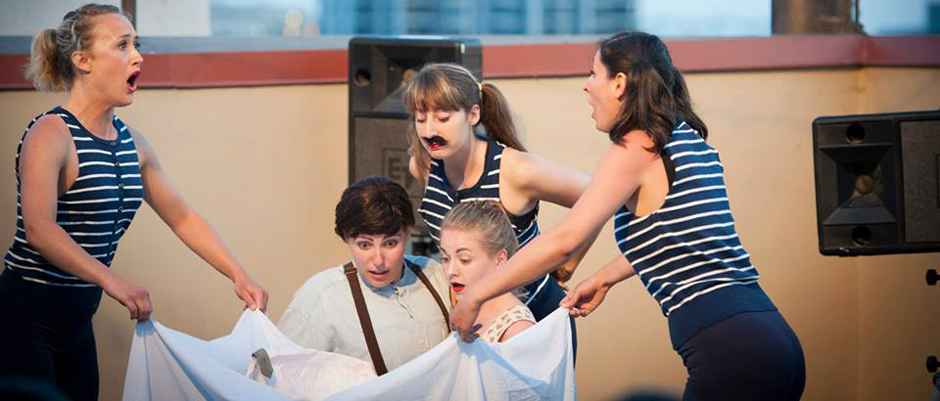
The show is a perfect showcase for Haste’s creativity and versatility (not to mention multilingualism), blending music, dance, puppetry and physical theatre to bring Sam’s story to life. An empty stage is transformed into the seaside setting through knowingly simple touches: a large piece of blue cloth becomes the sea, complete with cardboard dolphins and sharks, while the cast don stick-on fake moustaches and adopt over-the-top accents, conjuring up tables and counters with nothing more than a tablecloth held by the corners. The overall effect is bright, colourful and with a charming, slightly homemade feel that proves sometimes a lot can be said with very little.

This theme continues with Sam himself, who appears only in puppet form… but don’t be fooled into thinking that means he’s not real. Skilfully manipulated by the cast, Sam very much comes to life before our eyes – even indulging in a spot of kite-surfing at one point – and demonstrates all the emotions and qualities of any other little boy. He laughs, cries, feels fear and shows courage, and this really helps to drive home the show’s message about looking past physical appearance to get to know the person underneath.

Musical interludes fill in the details of the story as time passes, with a barbershop quartet chorus (Jesse Dupré, Elly-Beaman Brinklow, Tamara Saffir and Sophie Taylor, who also each take on a multitude of roles) determinedly trying to keep things upbeat even when the story’s taking one of its darker turns. Music is also used, rather differently but no less effectively, as the show comes to its melancholy yet strangely beautiful conclusion.

The cast are clearly thoroughly enjoying themselves, hamming it up as their various larger than life characters and throwing themselves enthusiastically into the dance numbers. Occasionally it all gets a little bit manic – I must admit I slightly lost track of what was going on during the doctor scene, perhaps due to a bit of unscripted banter with an audience member – but on the whole the company’s obvious joy in what they’re doing is infectious and gives us just as many laughs as the jokes within the script.

Oyster Boy is a story about acceptance and friendship, which gets its message across even without the neat, happy ending we might expect from a family show (though it’s still not as gory as the opening lines suggest). It’s all very surreal but a lot of fun, and a great hour’s entertainment for audiences of all ages.

Oyster Boy is at Edinburgh’s Assembly George Square from 2nd-28th August.

Review: The Mutant Man at The Space

On the surface, Christopher’s Bryant’s The Mutant Man is a crime drama; we open in a courtroom, as two identically dressed actors – one male, one female – unpack an assortment of items in evidence bags. But it doesn’t take long to understand there’s a lot more going on here than a straightforward murder trial. The defendant, Harry Leo Crawford, was born Eugenia Falleni and has been living as a man for years, and when his gender identity is made public, it becomes the key piece of evidence leading to his conviction.

Photo credit: Greg Veit

The timeline of the play jumps back and forward in time, sometimes quite rapidly, piecing together Harry’s life story as he struggles to live in a body that doesn’t represent who he really is. Bryant’s language is often poetic, but holds nothing back – we get a detailed description of how Harry was able to convince not one but two wives of his anatomical masculinity, and there’s a brutally explicit account of his rape and subsequent pregnancy by a sea captain who discovered his secret. Simultaneously the court case unfolds, with characters from Harry’s past reappearing to speak against him, and both gripping stories build to a climax as we learn what really happened to Annie, and the inevitable conclusion of the trial.

The central character is played beautifully by two actors – Clementine Mills as Harry and Matthew Coulton as Eugenia – a simple yet highly effective way of separating the two personas. Eugenia is submissive, anxious and seems constantly uncomfortable in her own skin, while Harry, though played by an actor who’s physically shorter, seems far larger in stature and confidence. At one point they deliver overlapping monologues that sum up the distinction: “I’m terribly afraid,” says Eugenia, while Harry states defiantly, “I’m not afraid.” The one phrase they have in common: “I did not kill this woman.”

The two actors also play all the other characters, and herein lies one of my few gripes about the production: though some attempt is made to physically differentiate, with the actors adopting different postures and ways of speaking, it’s not always easy to tell who we’re looking at – often we’re halfway through a character’s testimony in court before we realise who they are and what relevance they have to the case.

Photo credit: Greg Veit

Though the set appears simple, the production is actually incredibly complex and rich in detail. Director Heather Fairbairn equips her actors with a range of props, which gradually emerge from those evidence bags we saw earlier and show how every detail of Harry’s past has come to be used against him. In addition, the production makes highly effective use of lamps, microphones and cameras, often projecting close-ups of evidence on to the large video screen at the back of the stage, and culminating in a powerful image that represents Harry’s confusion and disdain for his own body. There are occasional sound issues; the actors have so much to do with props to unpack and countless small costume changes as they slip from one character to the next, that at times the acoustics work against them and their words are lost – but the most important moments are delivered direct to the audience with clarity and passion.

The play doesn’t try to tell us everything, but instead gives us just enough to send us away disturbed and sufficiently intrigued to read up on Harry’s story for ourselves. Though we may comfort ourselves with the knowledge that such a travesty of justice couldn’t happen today, The Mutant Man does force us to confront the question of how gender diversity is still viewed and (mis)understood a century on from the events depicted. A gripping and thought-provoking 70 minutes, and well worth a visit.


Can’t see the map on iPhone? Try turning your phone to landscape and that should sort it. I don’t know why but I’m working on it… 😉