Review: Big Guns at the Yard Theatre

Guest review by Ross McGregor

Big Guns at The Yard is a new play by Nina Segal, after her debut at the Gate Theatre in 2016, with In The Night Time (Before The Sun Rises). Featuring a cast of two, Debra Baker and Jessye Romeo, and skilfully directed by Dan Hutton, Big Guns is a nerve-shreddingly uncomfortable watch about the anxiety of living in our modern western world where everyone is emotionally isolated but obsessively cyber-connecting.

Photo credit: Mark Douet

The plot of the piece is somewhat difficult to pin down without writing a thesis on the script, but it is perhaps best described as a dramatic poem, in a modern style, split between two voices, dealing with the growing fear of terrorism or attack, from the perspective of a forum board commenter, or serial tweeter. This ever-present sense of foreboding and threat is symbolised verbally by the oft-repeated phrase “The man with the gun…” This means that there is a third presence in the room with these women, invisible to us, unknown beyond his gender and the fact that he is armed, but still demanding that they validate, investigate and justify their own existences.

The style of the show is perhaps a visual radio play. The beauty and power of the production is in the smooth and meticulously paced patter between the two unnamed speakers, and a gorgeous horror soundscape designed by Kieran Lucas. At multiple points the stage is plunged into darkness and all we experience is either the amplified and sometimes distorted voices of the actresses, playing over a series of ominous chord progressions or precise and stilted sound effects. There is very little blocking to speak of, and the production makes no apologies for that. The performers are static and seated on the floor of the sloped stage for almost all of the production, but the whirling stream of consciousness style of the poetic text cares neither for naturalism nor visual pieces as we’re thrown somewhat chaotically through a series of interlocking vignettes, and provides all the movement that we could wish for – we just hear it instead of seeing it.

“Big Guns,” the back of the programme states, “is the prickling at the back of your neck, the faint taste of blood on your teeth, the could-be sounds of a strange figure in the semi-darkness. The YouTube clip you hope doesn’t load but can’t help watching.” And yes, Big Guns is all those things, however due to the jarring and whirling speed at which the script is delivered, as well as how the writing leaps over and through narratives with complications, contradictions and repetitions, you emerge from the play’s conclusion with not a lot more understanding of the play’s subject than when you went in.

Segal’s script is packed full of details and imagery, whipped through by Romeo and Baker with a delicious enjoyment of diction and a verve of delivery. It is confusing, mesmerising and captivating. You may not understand every second – hell, there was a good ten minutes where I possessed not a clue what was happening – but it’s done well and with enough grace that you go with it in the hope that the message might permeate your eardrums via some kind of verbal osmosis. Perhaps to some people’s tastes this might be too abstract and pretentious in terms of the script’s ambivalence for conventional narrative or character – the actors are deliberately non-characterised and are in essence interchangeable in terms of their delivery and viewpoints, but what matters is the poetry and meter of Segal’s verse, and here Baker and Romeo shine as pure masters/mistresses of their craft. Baker is in equal parts gleeful and nonchalant, but possesses moments of unbridled pathos in the face of Romeo’s antagonism and provocation. The stunningly beautiful Romeo allows Segal’s words to trip and fly from her mouth, her eyes glittering in the red darkness, drawing us in and devastating us with emotion in the final fourth-wall breaking moments of the production.

Photo credit: Mark Douet

There is an element of the production that speaks about our over-reliance on technology and social media, and our inability to restrain ourselves from online obsessions, and though I didn’t quite get how that ties into the afore/ever-mentioned “Man With The Gun”, in general the atmosphere and tension created by the piece is phenomenal. It plays to our own paranoia and fears, of violence, of disruption and chaos, and it does this wonderfully well.

Obviously the topical timing with the recent attack in London pushes the subject matter’s concerns right to the front of our minds, but the writer is skilful enough to not languish on gratuity. The similarities between us and the speakers may be narrowing with every passing crisis that we face, as unfathomable violence keeps breaking into our consciousness, but ultimately the play’s message is one of positivity and togetherness. There is a way to beat the Man With The Gun. Lose the fear. Embrace acceptance, and – ironically considering the play’s lack of visual elements – open your eyes to who exactly the Man With The Gun is.

Big Guns is a powerful piece of writing that makes a good play – but potentially an even better podcast.


Can’t see the map on iPhone? Try turning your phone to landscape and that should sort it. I don’t know why but I’m working on it… 😉

Review: Kicked in the Sh*tter at the Hope Theatre

The title of Leon Fleming’s new play could hardly be more appropriate, because watching it actually does feel like being kicked, if not in the sh*tter then somewhere equally painful. Fearless and brutal, the play forces us to confront two of our society’s most common and damaging assumptions – that anyone on benefits must be a work-shy scrounger, and that anyone who suffers with depression must be a malingerer – and establishes an unsurprising but often-forgotten link between poverty and mental health issues.

Photo credit: Ashley Carter

We first meet the two unnamed siblings, Her and Him, as kids – planning their futures with an optimism that becomes increasingly heartbreaking as we flash forward to how things have actually turned out. She’s now a single mother of two, while he’s struggling with depression and living in squalor. Neither has a job – he because he doesn’t feel able to work; she because someone needs to stay home and take care of their sick mum – and both ultimately find themselves at the mercy of a system that deals in check boxes and endless forms, rather than the many shades of grey that make up real human lives. Which is not to say Kicked in the Sh*tter is necessarily a political play – Fleming’s careful to make clear that the health and social care professionals are doing their best within a flawed system, and that’s as far as the criticism goes. This is a story about people, not politics.

In keeping with this, director Scott Le Crass (who previously collaborated with Fleming on the critically acclaimed Sid) keeps things simple. The set, designed by Justin Williams and Jonny Rust, is made up of large boxes that resemble dark concrete, and are manoeuvred into position by the actors to become a bed, sofa, table… Consequently, our focus remains on the characters, and particularly on the powerful performances given by Helen Budge and James Clay. In a series of short, punchy scenes that jump around in time and space, they show us the despair of a mother unable to provide tea for her kids, and the helplessness of a young man fighting not only his illness but also the assumptions of those who think he’s faking.

Between the two we see genuine affection, but also a constant battle as to who’s got it worse, resulting in a downward spiral from which there seems to be only one escape. As Scott Le Crass points out in his programme notes, this is not poverty porn; there’s no abuse of the system here, no smoking, drinking or fancy phones at the taxpayer’s expense – just two people genuinely struggling to survive against ever-increasing odds.

Photo credit: Ashley Carter

At the heart of the 75-minute play is a raw, honest account of mental illness, and the sobering realisation that it can strike anyone, anywhere, at any time – even those who think they’re holding it all together. But it’s not all doom and gloom. There’s actually a lot of humour in the play, a hopeful message that desperate times may reveal us to be capable of much more than we thought, along with an encouragement to share our struggles with those closest to us, rather than battling on alone.

It’s not necessary to read the programme notes from Leon Fleming and Scott Le Crass to understand this is a passion project; there’s an intensity to the writing and production that grabs you by the throat and doesn’t let go. And for those of us who are able to put dinner on the table every night, it’s a wake-up call – a reminder of just how fortunate we are, but also of how unfairly we sometimes judge those who most need our help.


Can’t see the map on iPhone? Try turning your phone to landscape and that should sort it. I don’t know why but I’m working on it… 😉
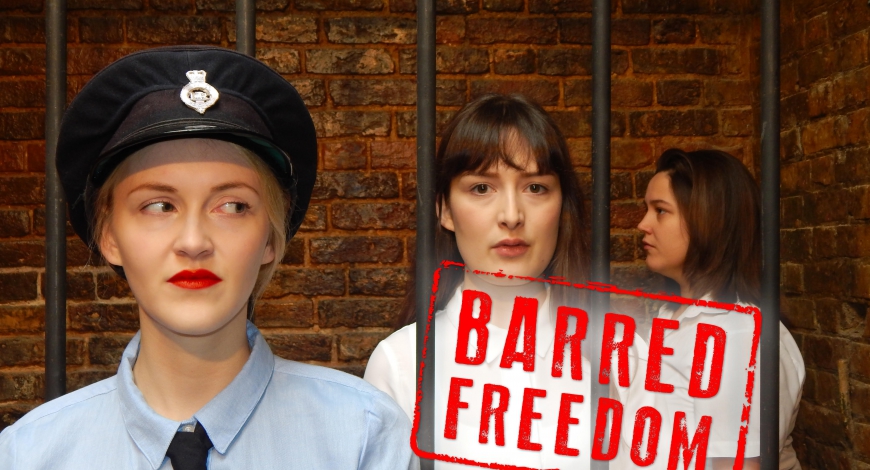
Review: Barred Freedom at the Cockpit Theatre

Barred Freedom is the ambitious first project from producer and actor Matthew Hawes. Written by Eugene Ambrose, the play has two casts, one male and one female, who’ll take to the stage on alternating nights throughout this week’s run at the Cockpit Theatre. It’s an interesting idea – the play examines not only the experience of being in prison for each set of characters, but also the developing friendship between them, both of which I imagine could play out quite differently for men and women – and it’s a pity that limited time allows only one viewing.

Anyway, for the purposes of this review, let’s discuss the boys, who are directed by Asia Osborne (while writer Eugene Ambrose directs the female cast). Set in a prison in the 1970s, the story introduces us to well-spoken, educated and – let’s be honest – insufferable know-it-all Wentworth (Adam Sabatti), who’s a new arrival in prison having murdered his spouse (one downfall of the gender neutral approach is that this unlikely word keeps coming up in conversation). His cellmate Dawson (Matthew Hawes) is the polar opposite – he’s been in and out of prison for years, can’t read or write, and spends most of the time having to decipher his Cockney rhyming slang for Wentworth, who unsurprisingly prefers Latin. The two men have been locked in their cell for an indefinite amount of time because of a riot in another wing, and try to alleviate the boredom by talking and playing games, before turning their attention to plotting an escape.

Both Matthew Hawes and Adam Sabatti – along with Mark Loveday, who plays thuggish prison guard Deacon – make their professional theatre debuts with enthusiastic and reasonably polished performances; Hawes is particularly engaging as Dawson, a cheeky chappy with hidden depths and a kind heart. Even so, there are times when the play could use a bit of action. The conversation between the two prisoners takes some interesting twists and turns, but confined as they are to one place (with only their bunks, a table and chairs, and a bucket – which fortunately never gets used – to work with), the story doesn’t really go anywhere and meanders along from one subject to the next, ending on a sweet but rather subdued note instead of the explosive twist ending I’d hoped for.

There’s definitely potential here, though; there are a few almost-incidents that could be developed, and with a bit of pruning (we probably only needed one alphabet game, for instance) the play could be a really interesting one-act piece exploring the true nature of freedom, which ultimately emerges as the story’s central theme. More could also be made of Deacon’s character; his appearances are few and far between, and seem to serve primarily as bonding opportunities for the two cellmates. He’s a bit of a stereotype – bullying prison guard who thinks the prisoners’ lives belong to him – but right at the end, Mark Loveday’s performance reveals a hint of uncertainty that could be explored further. Maybe the prisoners aren’t the only ones looking for a way to escape their grim reality? 

For a debut production, Barred Freedom is off to a promising start, with solid performances and some thought-provoking questions to take away and mull over. It needs a bit of honing, but I’ll be interested to see how the play develops from here.


Can’t see the map on iPhone? Try turning your phone to landscape and that should sort it. I don’t know why but I’m working on it… 😉

Review: The Wedding Singer at the Orchard Theatre

The Wedding Singer‘s first show at the Orchard Theatre had the ultimate happy ending last night, when a member of the audience got down on one knee and proposed to his girlfriend live on stage. Still, even without that added bonus, you’d have to be a pretty hardened cynic not to come away from this show feeling a little bit in love with love. (And this from someone who by the interval was identifying most with the song about how rubbish it is to be single at a wedding.)

Based on the movie starring Adam Sandler and Drew Barrymore, this is the story of Robbie Hart (Jon Robyns), a wedding singer who loves helping happy couples celebrate their big day. But then his own fiancée Linda (Tara Verloop) jilts him at the altar and suddenly Robbie’s not so keen on romance any more – until he becomes friends with, and inevitably falls for, waitress Julia (Cassie Compton). The only problem is, Julia’s just got engaged to sleazy Wall Street banker Glen (Ray Quinn), while her cousin Holly (Roxanne Pallett) has her eye on Robbie. A brief spell in a dumpster, a trip to Vegas and one wildly inappropriate granny dance later, can true love win out?

Photo credit: Darren Bell

Fans of the movie won’t be disappointed, as the musical is pretty faithful to Tim Herlihy’s story, with just a bit of a tweak at the end – and it even includes a couple of original songs sung by Adam Sandler in the film, though the majority of the musical numbers are new, written by Matthew Sklar and Chad Beguelin for the stage. It’s a catchy score, with a good balance of big dance numbers and soaring ballads, a smattering of so-bad-they’re-fabulous lyrics (“oh Linda you make me feel… like a furtrapper clubbing a seal”) and enough of an 80s flavour to help us over any disappointment at not hearing all the classic tunes from the movie.

And it’s not just the music; 80s-inspired set, costume and script mean this is very much a nostalgia trip in every way for those of us old enough to remember that far back. After enjoying clips from retro movies before the show, a brief ride in the DeLorean transports us back to 1985 and a world of big hair and even bigger mobile phones, where Starbucks is just thinking about going national and the height of ambition for any musician is to work with the same guys as Bon Jovi.

Photo credit: Darren Bell

Jon Robyns leads an impressive cast (and a particularly hard-working ensemble) with a performance so engaging he has the audience half in love with him within minutes, so that when he gets his heart broken and goes to the dark side, his self-pity is endearing rather than annoying. Ray Quinn is suitably obnoxious as Robbie’s love rival Glen, really coming into his own in Act 2 with a show-stealing dance number that’s just one example of Nick Winston’s brilliant choreography. Cassie Compton’s Julia is sweetness personified, and both she and Roxanne Pallett as Holly impress with their powerful vocals, while Ruth Madoc – who the 80s kids among us will remember from Hi-de-Hi! – makes a welcome but all-too-brief appearance as Robbie’s grandma Rosie.

There’s so much to enjoy about The Wedding Singer – it’s funny, with a great cast (shout-out also to Ashley Emerson and Samuel Holmes as Robbie’s bandmates), toe-tapping tunes, engaging characters and a classic rom-com storyline that means you’re pretty much guaranteed to leave with a smile on your face – even if you don’t get to witness a marriage proposal – and reminiscing fondly about the good old days.

The Wedding Singer is at the Orchard Theatre until 25th March.

Review: Rounds at the Blue Elephant Theatre

It’s been a long old week. A couple of work trips and several late nights meant that by the time Friday rolled around, I was feeling pretty shattered and wanted nothing more than to go home and collapse into bed.

Why am I telling you this? Because fortunately, I have an office job where being tired might mean I’m a bit less productive than usual, but isn’t a matter of life or death. Now imagine being that tired and having to carry out complex medical procedures, or administer drugs that could, in the wrong dosage, prove lethal. And then imagine it’s your very first day as a junior doctor, you don’t know where anything is and suddenly you’re responsible for real patients in real pain, who expect you to know exactly what to do to help them.

In Resuscitate Theatre’s Rounds, six junior doctors are about to learn that just wanting to help people – which seems the most fundamental requirement for a medical professional – may not be enough. The show touches on several of the issues facing the people we rely on to keep us healthy… and it’s terrifying. Long shifts, abuse – racist and sexist – from patients, indifferent management and the fear of knowing one wrong move could cost someone their life are all piled on top of the usual problems faced by 20-somethings just out of uni, like romance, fitting in with colleagues and finding a work/life balance (and someone to feed the cat).

Directed by Anna Marshall, an internationally diverse cast (Christina Carty, Alex Hinson, Nicolas Pimpare, Penelope Rodie, Iain Gibbons and Adam Deane) bring to life the six young doctors, each of them coping in their own way – and some better than others – with the pressures and insecurities of their job. At just an hour in length, the show gives some of the characters a little more air-time than others, with one in particular ultimately taking centre stage in a conclusion that’s simultaneously shocking and somehow inevitable. This is both a blessing and a curse: on the one hand, it means we don’t really get to know the characters that well; on the other, by spreading the focus quite thinly the show is able to demonstrate the vast number of problems that need to be addressed.

The set, designed by Naomi Kuyck-Cohen, is deceptively simple, made up of six medical screens which form a vital part of the show’s choreography. The movement sequences within Rounds tell us just as much as any of the dialogue scenes; choreographed by Lexi Clare and directed by Davide Vox, they effectively convey the frantic nature of an average day through the repetition of routine tasks like checking x-rays or scrubbing up for surgery, while curtains are whisked aside again and again as the doctors treat a seemingly endless stream of patients.

Penny Rodie, Rounds

The characters on stage are fictional, but based on real stories (in fact the show was devised with input from junior doctors) and it’s sobering to realise that they represent the doctors treating us and our loved ones every day, in increasingly difficult circumstances. When the show was first performed at last year’s Illuminate Festival, the junior doctors’ dispute with the government was making headlines. Though it may no longer be the top story, that doesn’t mean the problem’s gone away, and if anything, shows like Rounds are more important than ever, to keep the problems faced by junior doctors – and the NHS in general – in the spotlight. And on a more personal level, it may make the rest of us think twice before complaining about a bad day at work.


Can’t see the map on iPhone? Try turning your phone to landscape and that should sort it. I don’t know why but I’m working on it… 😉