Review: Hyem (yem, hjem, home) at Theatre 503

A quick examination of the cluttered living room set of Philip Correia’s debut play Hyem (yem, hjem, home) suggests we’re in the domain of a slightly eccentric collector. Family photos are proudly displayed alongside – amongst other assorted oddities – Viking helmets, guns, some ugly animal ornaments and a side table adorned with a gold dildo. Oh and let’s not forget the glass tank, which turns out to contain a six foot python.

In fact, Jasmine Swan’s set is a pretty accurate metaphor for the home of Mick and Sylv. Located on a dodgy estate in Northumberland, the house provides a refuge of sorts for an assortment of local kids, all of whom for whatever reason feel they have nowhere else to go. It’s not hard to see why they keep coming back – at Mick and Sylv’s they can smoke, drink and party as much as they like, and far from trying to keep boys and girls away from each other, romantic liaisons are actively encouraged.

Photo credit: Nick Rutter

But though the couple clearly care about their young visitors, there’s something not quite right about the whole setup, and once we learn the neighbours have been talking (not to mention throwing bricks through the window) it becomes more and more difficult to see it all as entirely innocent.

Correia clearly doesn’t believe in making it easy for us, and Jonny Kelly’s production keeps things ambiguous throughout, hinting at just enough of an uncomfortably physical relationship between Mick and newcomer Dummey – a fatherless thirteen-year-old who bears an uncanny resemblance to Mick’s absent son – to fuel our suspicions, but never quite enough to prove anything. Ryan Nolan and Patrick Driver play this relationship perfectly; seen from one perspective it’s heartwarming, from another quite disturbing.

Both also excel individually – as Dummey, Nolan displays all the hilarious awkwardness of any teenage boy just discovering girls for the first time. But there’s also a touching vulnerability to the character; at the end of the day, Dummey just wants someone, anyone, to want him. Driver explodes on to the stage as cheerful Cockney Mick, “the Pied Piper of Fountain Park”, who seems – for better or worse, and despite his clearly genuine love for his wife – to only really come alive when he’s surrounded by young people.

Charlie Hardwick is perfectly cast as Mick’s wife Sylv, her bawdy good humour dissolving over time as she becomes increasingly concerned about her husband’s behaviour. Here too there’s ambiguity, and it’s sometimes difficult to tell if she’s afraid of what people think, or if she has suspicions of her own. Sylv totally steals the show in the closing moments, baring her soul in a powerful rant against those who judge the way she’s chosen to live her life. With similarly strong and complex performances from the other cast members – Sarah Balfour, Aimee Kelly and Joe Blakemore as the lost souls who currently complete Mick and Sylv’s unconventional “family” – the stage is set for 90 minutes of unsettling but compelling domestic drama, which has the potential to develop in all kinds of directions.

Photo credit: Nick Rutter

Another great thing about the play – a production from NorthSee Theatre – is its use of language, and specifically the Geordie dialect, which is thick enough to be authentic but not so much that the dialogue becomes difficult to understand for audiences outside the North East.

Hyem is a layered, intriguing play that draws us into the home of its title and invites us to join the party, yet still somehow leaves us feeling slightly out in the cold, wondering what’s really going on inside. Not one for those who like all their loose ends neatly tied up, maybe – but if you’re okay with a bit of ambiguity, this fascinating exploration of what really makes a house a home is definitely worth checking out.


Can’t see the map on iPhone? Try turning your phone to landscape and that should sort it. I don’t know why but I’m working on it… 😉

Review: Oh What A Lovely War at Oldham Coliseum

Guest review by Aleks Anders

Starting in 2014, and no doubt continuing right up until the end of 2018, Britain has been commemorating the centenary of World War 1. The Great War, The War To End All Wars. I have seen some extremely moving tributes both theatrical and musical, and now The Coliseum Theatre in Oldham opens its Autumn season with something which is a little of both, Oh What A Lovely War. A pioneering and daring work in its time, Joan Littlewood and her Theatre Workshop in London’s Stratford East came up with a dark satire which parodies the war and those in charge of it, commenting on its futility and political motivations through sharp humour and song.

Photo credit: Joel Chester Fildes

If this doesn’t sound too hard to imagine and a little lame, then remember this was premiered in 1963 when the constraints of theatre were much more rigid than today, and also that at that time, it was less than 20 years since the end of World War 2, with both The Cold War and The Vietnam War still continuing.

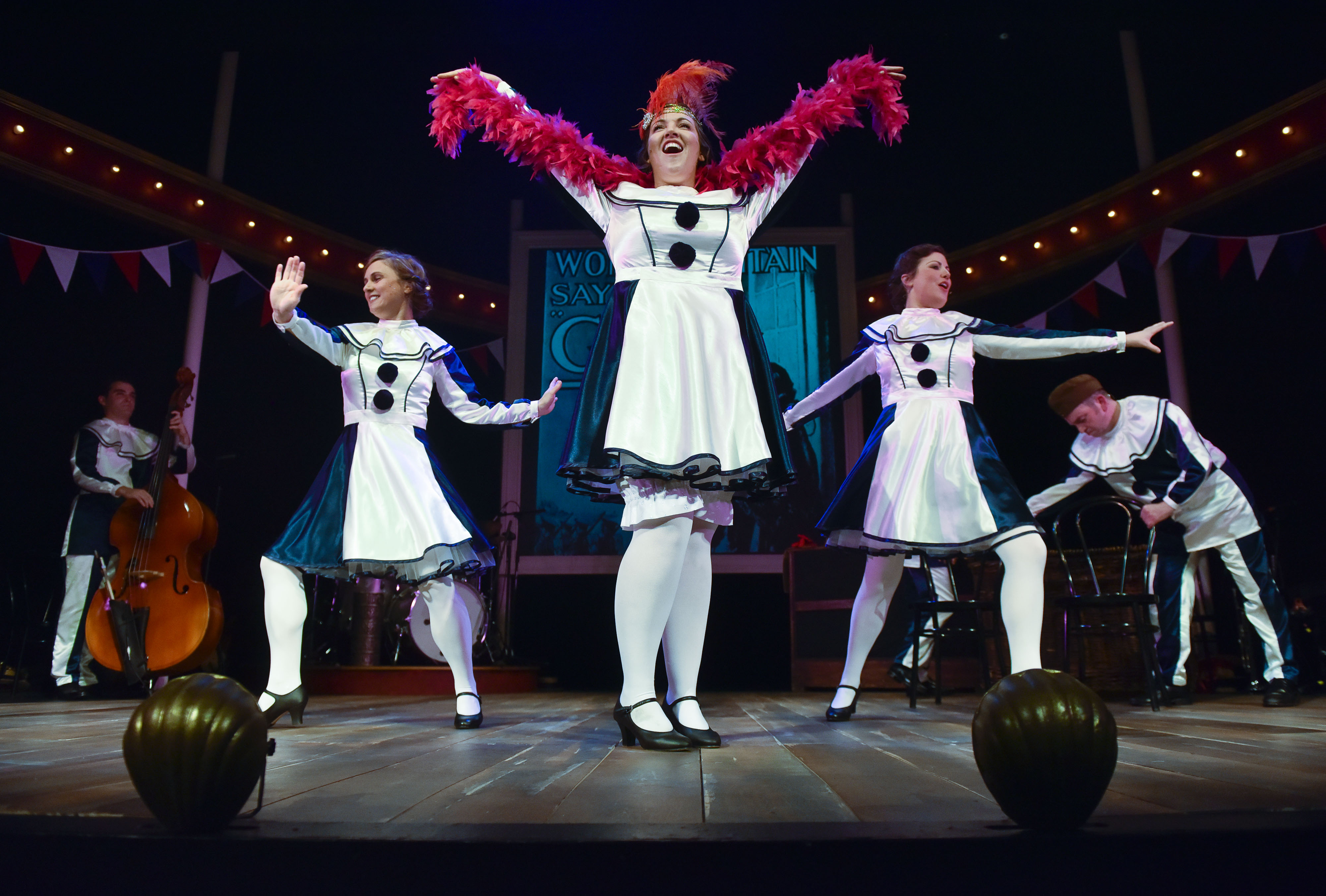
Littlewood uses the songs of the period to great effect, interspersing them throughout with little vignettes as the cast of ten dressed in costumes reminiscent of the old Music Hall Pierrettes take on multifarious characters ranging from civilian, military and political persons from Britain, France, Germany, Belgium, Russian etc, presenting “the ever popular, ‘War Games'”.

To aid us all in this, since this is a history lesson on four years of fighting on a scale never before encountered, there is a large screen in the centre of the stage upon which helpful photographs, documents, maps and information – all historically accurate – are displayed. In fact, Foxton has designed a simple and yet superb set. A circular ‘stage’ around which the performers and their props and instruments wait in Brechtian fashion, with a false gallery and prosc arch, bunting, the royal Coat Of Arms, and footlights. Just what one would have expected to find at the theatre at the end of a pier in those days.

There are ten performers in all; but don’t ask me to tell you how many characters they play between them! However, their character changes are swift and clever, with the simple addition of a hat or scarf, or perhaps even just an umbrella. They are also multi-talented as indeed they all must also sing, dance and play at least one musical instrument, as they were also the show’s band, “The Merry Roosters”. And so, piano, bass, clarinet, trombone, drum kit, and goodness knows what else were played by those members not actually involved in the acting of each scenelet.

I must say right now that under normal circumstances I am absolutely no fan of actor-musicians; and I still think I would have enjoyed the show more had they been separate, but it certainly didn’t bother me anywhere near as much as I thought it would, and for a show of this particular style, and the lovely Brechtian directing by the Coliseum’s Artistic Director Kevin Shaw, it was apt and fitted well. I do feel though that some of the songs would have benefited from a fuller sound vocally; although the harmonies were lovely, they were a little sparse.

Photo credit: Joel Chester Fildes

In fact Shaw has brought out the best from both his cast and the show in this. It could do with being a little pacier; I felt especially the first half dragged ever so slightly (perhaps because the audience didn’t really “get it”) but hopefully given a few more runs for it to “bed-in” the pace will naturally quicken anyway. Beverley Norris-Edmunds should also be commended here too for her lovely choreography. Stylistically perfect and worked excellently.

It is almost impossible to single out certain cast members from others in a show such as this, a true ensemble piece in every regard, but I cannot leave this review without mentioning them, as they are all excellent. They are Isobel Bates, Matt Connor, Richard J. Fletcher, Jeffrey Harmer, Barbara Hockaday, Anthony Hunt, Thom Petty, Lauryn Redding, Reece Richardson, and David Westbrook. My favourite number from the evening though simply has to be the lovely acapella rendering of When This Lousy War Is Over.

Oh What A Lovely War may not prove to be everyone’s cup of tea (but I guess the same can be said of any piece of theatre); however, I do believe that the Coliseum have got another hit show on their hands with this one. Poignant, relevant, and also very funny, true to the spirit and concept of the original production. Well done chaps!

Oh What A Lovely War is at the Oldham Coliseum until 30th September.

Review: Window at the Bread and Roses Theatre

In a world of reality TV and social media, it’s all too easy to fall into the habit of obsessively observing other people’s lives, and then comparing them to our own. In Ron Elisha’s Window, this voyeurism reaches new heights when married couple Grace and Jimmy spot their neighbours having sex, seemingly at all hours of the day and night.

It all begins as a bit of slightly naughty fun, even helping to rekindle the dormant sex life of the exhausted new parents. But when Grace falls pregnant with their second child, her interest in the young, beautiful couple across the way – in her mind, an earlier version of herself and Jimmy – starts to develop into an unhealthy obsession that affects her work, health and family life.

Photo credit: Greg Goodale

The two-hander play deals sensitively with issues of pre- and post-natal depression, with Idgie Beau giving a strong performance as an increasingly distressed Grace. Charles Warner is equally impressive as Jimmy, whose initial amusement soon gives way to concern for the wellbeing of his wife and baby, balanced against his frustration over her neglect of their family. Although there are moments in the story of their relationship that feel unlikely, the actors’ portrayal of it is entirely convincing.

Covering five years without ever leaving the couple’s bedroom, it would have been easy for scenes to run together, but director Dave Spencer breaks up the action with costume changes and brief musical interludes, while references in the script keep us up to speed on how much time has passed. Even so, things do start to slow ever so slightly towards the end, as the subjects of Grace’s obsession go through a personal crisis, and she dissolves again and again into panicked tears on their behalf while Jimmy tries to console her. It’s only when she finally takes action that the cycle is broken, and Grace’s recovery can begin – a moment that’s beautifully played by the actors but in terms of plot development feels a bit too neat, given all that’s gone before.

There are a few other moments where we’re required to suspend our disbelief in order to make the story work: the fact that the neighbours would never, in five years, consider closing the curtains or turning the light off, for instance; or that given the ever more blatant gawking from Grace and Jimmy, who can clearly see every detail, the other couple would never notice them. But that’s what makes the play such a perfect metaphor for social media – by putting our lives on display, we effectively open the curtains and allow anyone to see in. We know they’re there, and we kind of like it that way… but providing others with free access to our everyday lives means they inevitably see the bad as well as the good.

Photo credit: Greg Goodale

The situation in which Grace and Jimmy find themselves is one that the vast majority of us will never need to deal with (or let’s hope not, anyway) – but that doesn’t stop Window being highly relevant to a generation that’s as addicted to sharing as we are to observing. Although it could use a little more pace towards the end, this is an entertaining and unsettling new play that will definitely make you think twice about leaving the curtains open.


Can’t see the map on iPhone? Try turning your phone to landscape and that should sort it. I don’t know why but I’m working on it… 😉
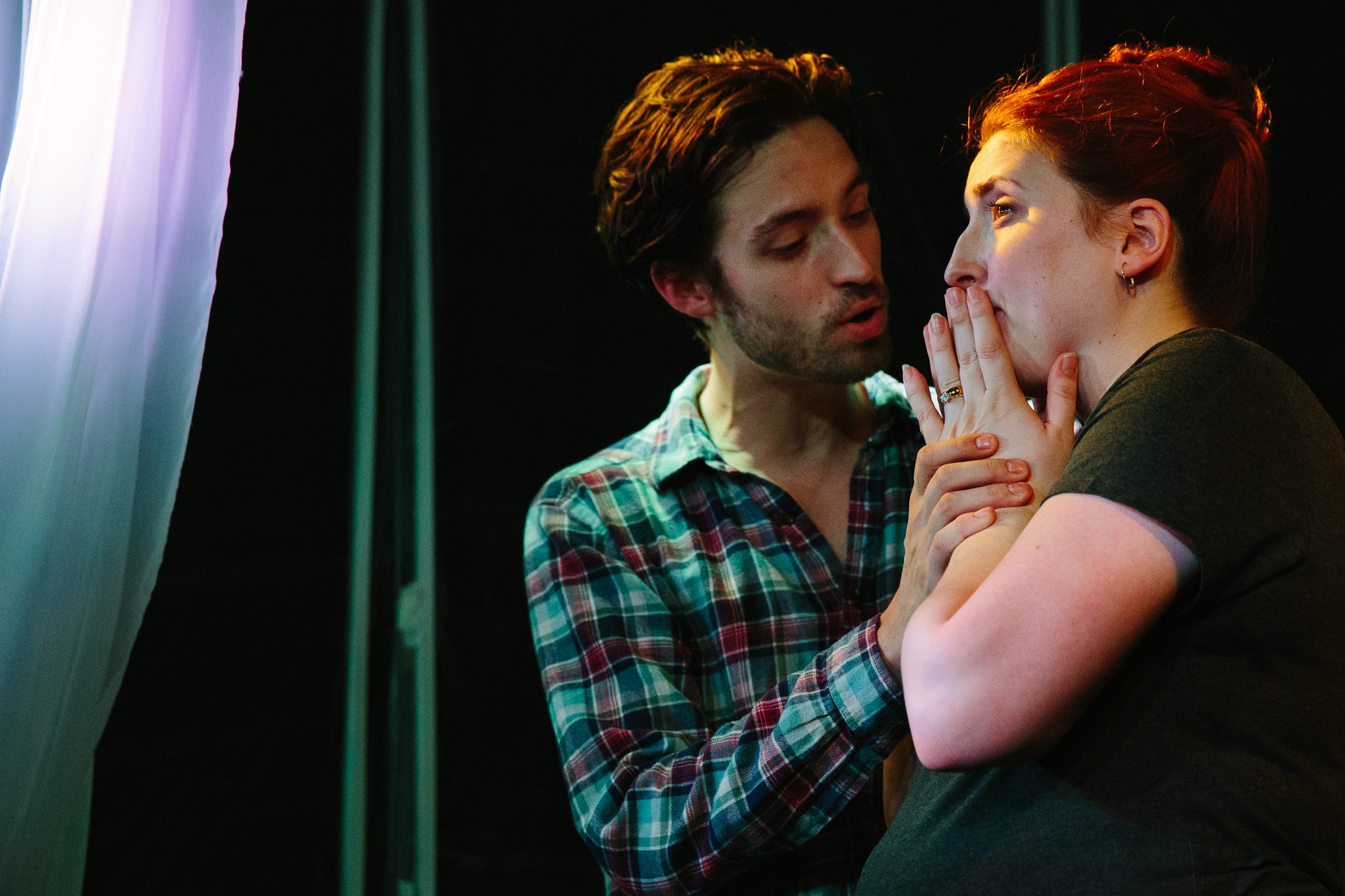
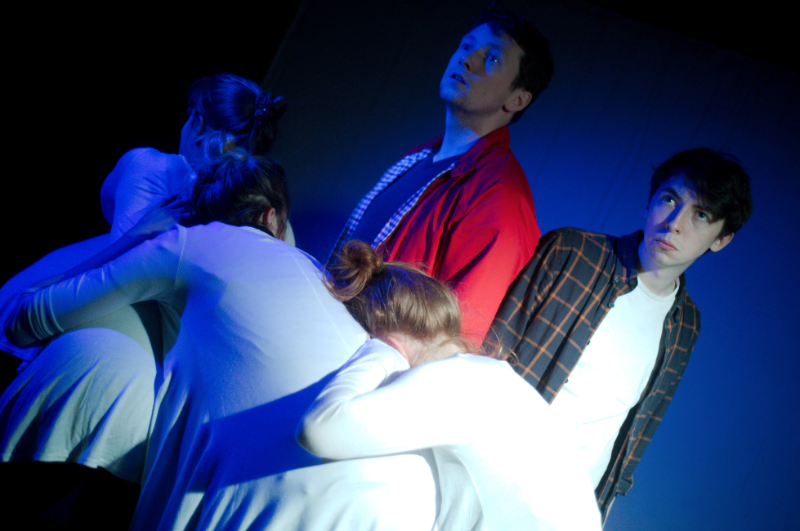
Review: Eyes Closed, Ears Covered at The Bunker

In Alex Gwyther’s thriller Eyes Closed, Ears Covered, two teenage boys bunk off school and go on an adventure to Brighton. It’s obvious from the start that the two friends have a complex and potentially unhealthy relationship – and when something terrible happens on the beach, it falls to two frustrated police officers to try and make sense of the day’s events.

Much like the officers, the audience must piece together the clues to work out the real story behind Aaron and Seb’s day trip – and when the final piece of the jigsaw slots into place moments before the play ends, the truth turns out to be as shocking as it is satisfying. I love a well-written thriller that really keeps you guessing, and this play definitely falls into that category.

Photo credit: Anton Belmonté of 176 Flamingo Lane

Many of the characters in Derek Anderson’s production feature only as Big Brother-esque voiceovers, which means all our attention is focused on the story’s three leads. Danny-Boy Hatchard takes control in the first act as Aaron, who’s the mastermind behind the adventure. Outgoing and often very funny, he can also be unpredictable and aggressive when things don’t go his way… and he wields a disturbing amount of power over the naive and socially awkward Seb.

Act 2 abandons the police station and is carried by the excellent Joe Idris-Roberts, who takes us back in time to explore the tender relationship between ten-year-old Seb and his mother Lily, played by Phoebe Thomas. As well as answering a lot of the questions posed by Act 1, this part of the play also leads us into increasingly dark territory (there’s very little laughter to be heard after the interval), touching on themes of domestic violence and mental health as it paves the way for the story’s dramatic conclusion.

A simple set proves no obstacle to the storytelling, with some impeccably timed movement (directed by Jonnie Riordan) helping to build a picture of the characters’ surroundings, and Norvydas Genys’ lighting design keeping the action moving between locations, as well as back and forth in time. There’s also a great moment at the beginning of Act 2, when Lily replaces a photo of herself, appearing on stage as if by magic.

Photo credit: Anton Belmonté of 176 Flamingo Lane

There’s just one niggle for me about the play, namely the decision to set it in the 1980s. This isn’t particularly borne out by the story (I remember just one popular culture reference to Tom Selleck as a relevant movie star), and putting 30 years between the events of the play and its audience suggests they have no relevance today – when in fact the opposite is true.

That said, this is without doubt a compelling and well executed piece of theatre, which grabs our attention from the start and never loses its intensity. With three brilliant performances and a dramatic twist ending, this dark thriller is well worth a visit.


Can’t see the map on iPhone? Try turning your phone to landscape and that should sort it. I don’t know why but I’m working on it… 😉

Review: Dante’s Divine Comedy at Barons Court Theatre

I mean this in the nicest way possible… but if you’re looking for a theatre in which to stage a play about descending into hell, I can think of few better than Barons Court. Partly because you actually do have to descend a flight of stairs to get there, but mostly because with its low arched ceilings and shadowy corners, it guarantees an atmospheric setting for any production.

The directors of So It Goes Theatre clearly had a similar instinct, and have returned to Barons Court for a second time with their adaptation of Dante’s Divine Comedy, based on the epic 14th century poem by Dante Alighieri. A dark tale of suffering and loss, this modern retelling also has an unexpectedly wry sense of humour, and is packed full of witty one-liners that are often as surprising as they are enjoyable. Who knew hell would be so funny? (Although I suppose the clue’s in the title…)

Following the death of Beatrice, the woman he loves, Dante’s about to kill himself when up pops the Roman poet Virgil, who takes him on a slightly grim guided tour of hell and purgatory before dropping him off at the gates of paradise, where Beatrice awaits. But their reunion may not be quite as joyous as expected…

Alex Chard is great as the depressed yet determined Dante, really coming into his own in the second half of the production when he has the opportunity to get into some meaty theological debate. His budding bromance with Virgil, played by Jack Blackburn, is fun but also surprisingly touching, particularly the moment when Dante promises to have a word with God about getting his new best mate through the Pearly Gates. Their witty banter, right up to the moment Virgil leaves, means the icy encounter that follows with Kathryn Taylor-Gears’ Beatrice is all the more jarring.

A hard-working and incredibly versatile all-female Chorus (Sofia Greenacre, Marialuisa Ferro, Sophia Speakman and Michaela Mackenzie, along with Kathryn Taylor-Gears) accompany Dante on every step of his journey, as the condemned souls suffering the countless torments of hell, those unfortunates stuck in the limbo of purgatory – brilliantly reimagined as the mind-numbing boredom of a daily commute – and the shockingly unpleasant residents of heaven. I’d go so far as to say that the Chorus steal the show in the first part of the play; their pain, fear and anger grows ever more palpable as Dante and Virgil descend deeper into the inferno.

It would be easy to assume that a small cast of seven, in a tiny pub theatre, might not be able to quite reproduce the epic scale of heaven and hell – but Douglas Baker’s production is a masterclass in how to do a lot with very little. A couple of handheld torches, a few chairs, a balloon and some cardboard cut-outs prove more than enough to create some fantastic effects, particularly when combined with video projections and some exquisite movement sequences directed by Matthew Coulton. The whole show is so absorbing, in fact, that it comes as something of a shock when Virgil suddenly breaks the fourth wall and reminds Dante – and us – that we’re just watching a piece of theatre created by the man himself; all his suffering is entirely self-inflicted.

I don’t know much about Dante’s original poem (though I may check it now), and I’m definitely no theologian – but neither is really necessary in order to appreciate this creative, powerful and really enjoyable production. So again, in the nicest possible way – I politely recommend that you go to hell.


Can’t see the map on iPhone? Try turning your phone to landscape and that should sort it. I don’t know why but I’m working on it… 😉