Review: The Strange Case of Dr Jekyll and Mr Hyde at Greenwich Theatre

Nick Lane’s new adaptation of The Strange Case of Dr Jekyll and Mr Hyde takes the gothic novella by Robert Louis Stevenson and fills in some of the gaps. While this might not please everyone, I must admit I haven’t read the book, so personally I had no problem with the plot’s bare bones being substantially fleshed out. Inspired by Lane’s own experience following an accident that permanently damaged his neck and back, this production humanises the troubled Dr Jekyll and offers some justification for his actions… and even manages to raise a bit of sympathy for the villainous Mr Hyde.

The basic plot of the novella is reasonably well known; mild-mannered, respected scientist Dr Jekyll invents a serum that transforms him into a violent, remorseless alter ego: Mr Hyde. In this version, however, he also has a love interest – his friend Hastie’s wife Eleanor, whose fascination with his work and dissatisfaction with her own uninspiring life make her an unwitting catalyst to the devastating events that follow.

Photo credit: Alex Harvey-Brown

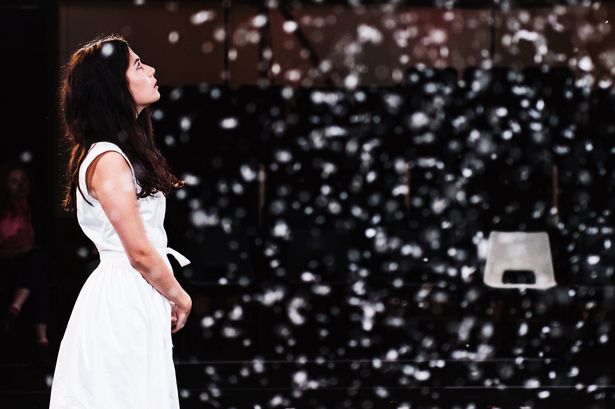
The cast is small – just four actors play all the characters between them – but perfectly formed, working comfortably together as an ensemble but also impressing individually. Jack Bannell in particular gives an excellent physical performance, his demeanour, voice, and personality completely changing before our eyes as he transforms from the stooped figure of Jekyll into the cold, predatory Hyde. At first brusque and dismissive, Jekyll is softened by his love for Eleanor and his own weakening body, his desperation over both causing him to experiment on himself. Knowing this, it’s easier to understand – even if still impossible to condone – what led him to this point, and to sympathise with the temptation that keeps drawing him back to the physically stronger and more passionate Hyde.

Paige Round is similarly impressive as Eleanor. Far from a token love interest, she finds herself on her own dark path as she breaks away from good guy husband Hastie and is drawn inexorably to Hyde. It’s a bit of a cliché, maybe – women like a bad boy, etc – but the actors make it believable, with a sizzling chemistry that’s noticeably absent between Eleanor and Ashley Sean-Cook’s nice but boring Hastie. The inclusion of Eleanor also allows for a bit of discussion on gender issues; both Hastie and Jekyll initially dismiss her interest in and understanding of their work, and it’s largely Hastie’s expectation that she stay at home and play the little wife that pushes her towards Hyde in the first place.

The cast is completed by Zach Lee as Jekyll’s concerned friend and lawyer Gabriel Utterson; though his primary role is to narrate the uncovering of Jekyll’s secret, he also appears in arguably the most visually striking scene in the play: an intense, dramatic slow motion sequence that’s so perfectly choreographed we can feel every blow.
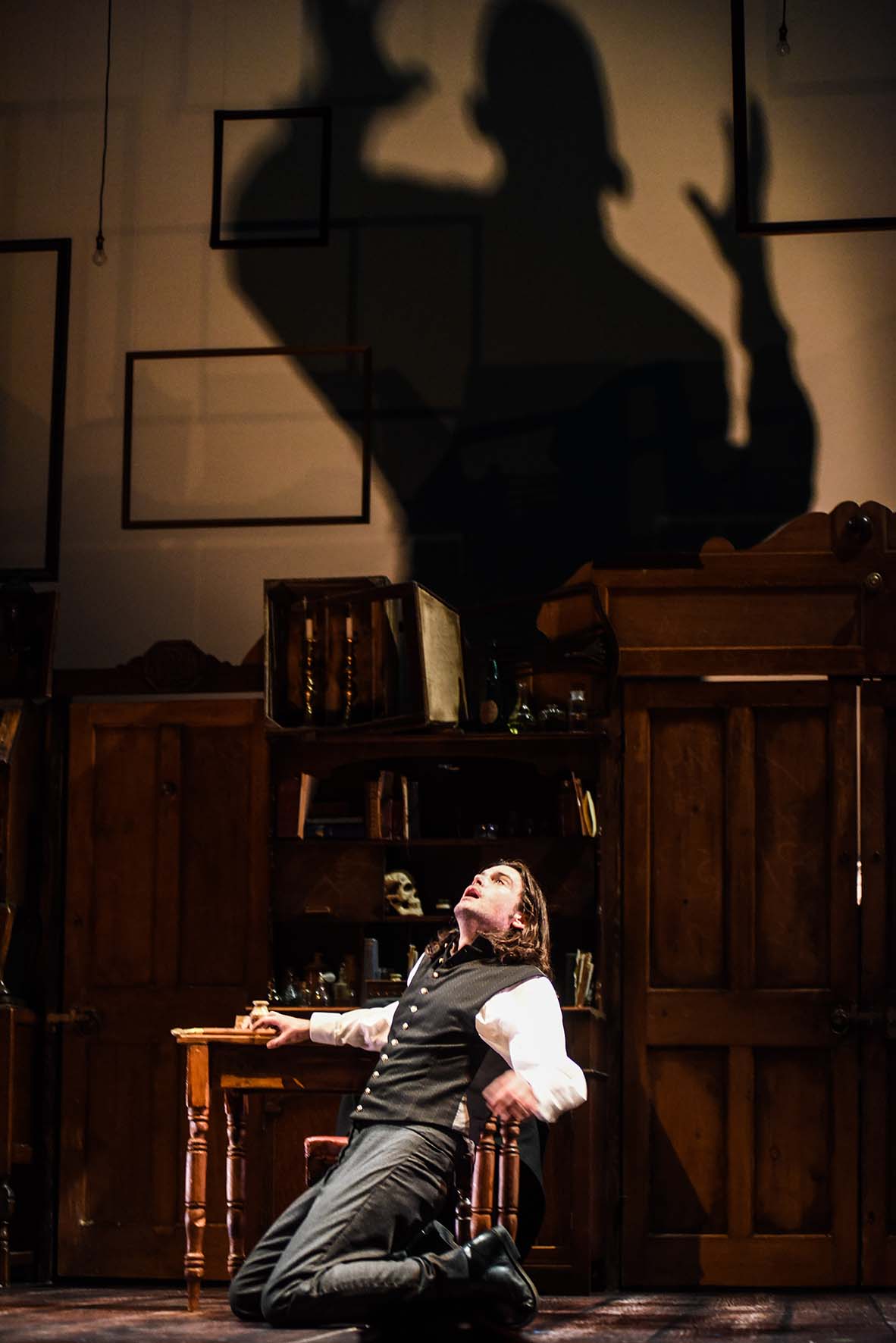
Photo credit: Alex Harvey-Brown

The play’s performances are supported by Claire Childs’ lighting design, which makes great use of bold colours and projected shadows to establish a threatening atmosphere from the beginning, and haunting melodies composed by Tristan Parkes beautifully performed by Paige Round and the rest of the cast.

While perhaps not the story Robert Louis Stevenson intended, The Strange Case of Dr Jekyll and Mr Hyde does remain faithful to the central plot, and offers an interesting – if rather more forgiving – interpretation of the story and its central character. Touching on a variety of themes, including gender issues, mental health and the ethical responsibilities of science, this chilling new adaptation certainly gives us plenty to think about.


Can’t see the map on iPhone? Try turning your phone to landscape and that should sort it. I don’t know why but I’m working on it… 😉

Review: Frankenstein at the Jack Studio Theatre

It’s quite a feat to breathe new life into one of the world’s most popular and iconic novels – but there’s no doubt Arrows & Traps’ Ross McGregor has succeeded with his adaptation of Frankenstein. Like the novel, it tells both Frankenstein’s and the Creature’s story, but reframes these within a fascinating insight into the life of their creator, Mary Shelley. The result is thrilling, poignant, often surprisingly funny and – unsurprisingly – visually beautiful, and it allows us to consider the themes of the novel in a whole new way.

Photo credit: Davor Tovarlaza @ The Ocular Creative

In fact, this is much more Mary’s story than it is Frankenstein’s, and the always brilliant Cornelia Baumann leads the cast with a moving portrayal of the troubled writer, now older and suffering with ill health and bad memories. Drawn into a passionate romance with the poet Percy Bysshe Shelley when she was still a teenager, despite the disapproval of society and the attempts of her father William Godwin to keep them apart, she went on to face the tragic loss of three of her four children, a near-fatal miscarriage and then the death of her husband in a shipwreck not long afterwards. In light of all this, it makes sense that the adaptation of her novel focuses primarily on the relationship between parent and child, and invites us to question what it is that makes someone a parent in the first place.

A real highlight of the show is seeing Will Pinchin – the Arrows’ Movement Director – take to the stage for the first time as the Creature. Having admired his work in many previous productions, it’s great to see it in the flesh, and his performance proves to be worth the wait. Unlike the classic Hollywood portrayal of Frankenstein’s Monster who was “born” evil, this Creature starts out as a gentle soul, a frightened, child-like figure eager to learn and play. It’s the rejection of those he loves that creates the monster, and Pinchin’s cold fury and sharp intellect in the play’s later scenes are far more chilling than any lumbering movie depiction. Christopher Tester’s Frankenstein, meanwhile, undergoes a similar transformation from a likeable, earnest young geek to an obsessive genius, capable of creating life but not appreciating its true worth.

With three interwoven stories, all taking place at different times and in different locations and a lot of historical information to digest, there are occasions when it becomes a little hard to follow; some knowledge of the novel is also probably an advantage to help pinpoint where we are in the chain of events. But the skill of the actors (and a few swift wardrobe changes) ensures that despite some significant multi-roling – particularly from Oliver Brassell, who plays no fewer than four major characters – we can always identify who we’re looking at.

Photo credit: Davor Tovarlaza @ The Ocular Creative

Another bonus is the presence of some strong female characters. Shelley’s novel is dominated by men, but here we have not only Mary herself but also her two sisters Fanny and Claire – as well as Agatha, the young blind woman who teaches the Creature to speak and read. Played by Zoe Dales, she’s enjoyably feisty and sarcastic, but also a rare source of compassion in a world that’s far too quick to reject them both just because they’re different.

As in all Arrows productions, there’s also a lot going on visually – from Odin Corie’s steampunk-inspired costumes to Ben Jacobs’ lighting design, which combined with sound from Alistair Lax creates some striking moments. Most impressive is the sequence in which the Creature first comes to life; it never fails to amaze how this company can create such drama on such a small stage.

Frankenstein is the first Arrows show written by artistic director Ross McGregor, who must be feeling a certain sympathy for Mary Shelley seeing his baby come to life on stage every night. But I don’t think this ingenious creation will be turning on its parent any time soon.


Can’t see the map on iPhone? Try turning your phone to landscape and that should sort it. I don’t know why but I’m working on it… 😉
Review: A Judgement in Stone at the Orchard Theatre

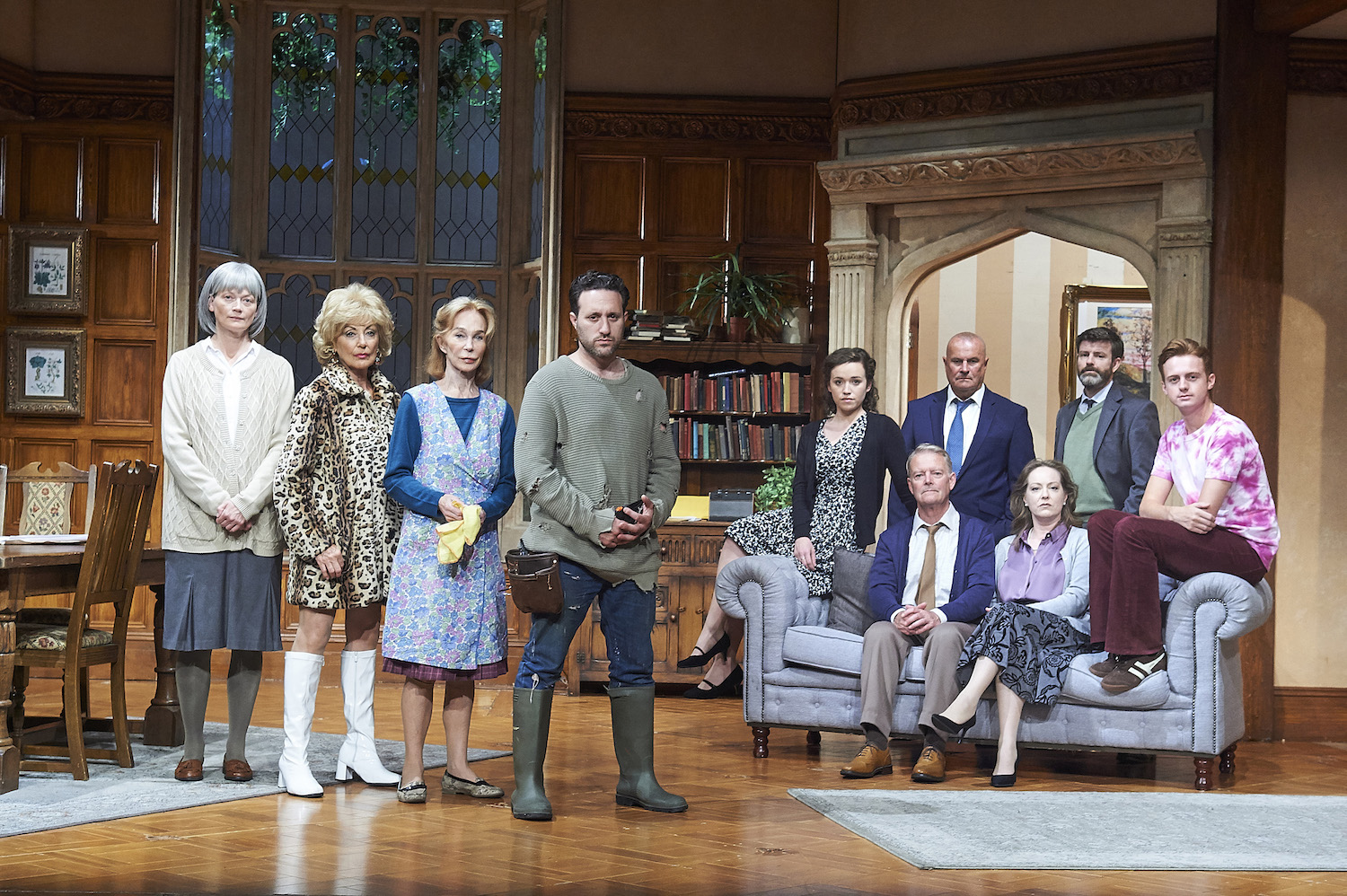
Ruth Rendell was once described in The Sunday Times as “the best woman crime writer since Christie” – so it seems fitting that Bill Kenwright’s Classic Thriller Company, having presumably run out of Agatha Christie stories to stage, has chosen one of Rendell’s most famous works for their latest production. A Judgement in Stone unpicks the story of a grisly mass shooting, but despite commendable performances from an impressive cast of household names, it doesn’t quite succeed in blowing its audience away.

Photo credit: Geraint Lewis

Largely, I think this is simply because it’s not Agatha Christie. Her stories work on stage because often they take place in one location, so focusing all the action in a single room doesn’t feel limiting, and because they build to a big reveal of a shocking, clever twist based on clues that have been liberally scattered throughout the play. Rendell’s novel opens by revealing both murderer and motive; it wasn’t really intended as a murder mystery so much as an exploration of social class divisions in the 1970s. Simon Brett and Antony Lampard’s adaptation forces the story into the classic whodunnit mould, meaning a lot of that subtlety is lost, and we spend the whole evening waiting for a twist that, unfortunately, never comes.


That said, it’s an entertaining enough production, and director Roy Marsden certainly succeeds in ramping up the suspense, particularly in Act 2. The play opens some weeks after the murders of the wealthy Coverdale family, as a detective from London – called in by someone important in the Government – arrives to help the local police solve the crime. The story then unfolds in a series of flashbacks, beginning when Eunice first joins the family and building up to the night of the murder nine months later. In between, the two police detectives interview various suspects (at the murder scene, rather bizarrely) on their way to solving the crime, which eventually happens more by luck than judgement; there’s certainly no Poirot-esque flash of inspiration that suddenly makes sense of everything, and this also contributes to the play’s rather subdued conclusion.

Photo credit: Geraint Lewis

The cast do a good job with some slightly sketchy roles (apart from one brief exchange about family life and fish paste sandwiches, for instance, we learn next to nothing about Chris Ellison and Ben Nealon’s police detectives, who only really seem to be there to set up the next flashback). Sophie Ward is great as the awkward, slightly eccentric housekeeper Eunice, while Deborah Grant has perhaps a bit too much fun as her religious fanatic best friend Joan, and there’s a solid performance from Blue’s Antony Costa as Rodger Meadows, the family’s gardener with a dodgy past.

Having seen and enjoyed several productions from the Agatha Christie Theatre Company, which work so well on stage, I can’t help but feel a little disappointed with this latest offering. But here’s a twist: I do now want to read Ruth Rendell’s novel. Although I don’t feel it entirely works as a play, the story and characters have enough potential that I’m intrigued to find out everything the stage version didn’t tell me. And fans of Ruth Rendell’s novels, who already know how the story ends, may enjoy this fresh take on a favourite.

A Judgement in Stone is at the Orchard Theatre until 30th September.

Review: Our Town at The Royal Exchange Theatre

Guest review by Aleks Anders

Of all twentieth century classics, Thornton Wilder’s Our Town must be one of the most difficult to produce and hardest to understand plays for both cast and audience alike. In fact, ever since its first performance in 1938, it has continued to be misunderstood and misrepresented. However, there is some theatrical irony in this, since the play itself deals with misunderstanding and misrepresentation on a human scale.

It’s a very odd play, there’s no denying that, and in 1930s America would have been considered ground-breaking too.

It uses the device of it being a play within a play, the play being set in the theatre where the play is taking place, if you see what I mean. The cast are on stage and the Stage Manager enters and mediates between being the actual Stage Manager of the one play whilst narrating the story of the play to the audience of the other play. And if you’re not confused by that, you might just “get it”.

The play is very Brechtian in feel. There is no set, no scenery, miming is the order of the day, as well as speaking directly to and questioning the audience, and all the cast are wearing modern contemporary informal clothes. The Stage Manager sets the scene… Our Town is the fictional small town of Grover’s Corners, New Hampshire, USA, and at the start of the play it is 1901. The play is in three acts and the first act is nothing more than a scene-setting scene, setting the scene and seeing the set-up (apologies to Mr. Bennett). However this first scene is not only necessary to allow us to understand the two acts that follow, it is also this act that has made directors and producers of productions past think that the play is a lyrical pastiche and a yearning on the part of the writer for simpler and happier times. But the play is darker, so much darker than that, and with the second act, despite the play’s upbeat documentary nature, we get a hint of what is to come. It is the third act which acts like a wake-up call to us all. Live our every moment to its fullest and feel, and see as hard and as long as possible, because there is beauty in the little things, and it is the little things that matter.

It’s also a very brave choice of play for any theatre company to attempt, and so kudos to The Royal Exchange for grabbing the challenge firmly and squarely and giving it their best shot. The only question is; did they score a goal? And the answer to that is, I am uncertain. I am not sufficiently learned on Wilder’s oeuvre to know whether or not this production ticked all the boxes for him; I can only go off my own reaction to the play, and of those around me in the theatre. Did I enjoy the play? I am again uncertain, since enjoyment seems the wrong terminology for what I witnessed. Although I wasn’t bored, and there was plenty of humour and bonhomie within the play, or at least the first two acts. But did the play stand up and grab me by the throat to leave a lasting impression on me? No, sadly it didn’t.

I think this is perhaps due to two things which I simply didn’t like about this production. I can only think these were directorial choices rather than scripted, and I must admit was somewhat put off the play because of them. The first is that some of the audience are invited to sit on plastic chairs on the stage, and become a part of the play for those not on the stage. I really liked the idea at first when I took my seat, as the stage was full of people sitting at desks crowded together and chatting. It looked like a school canteen. I understood the relevance for using audience in this way, as the director Sarah Frankcom is using every trick in the book to make this play relevant for our multi-cultural 21st century ‘town’ and therefore inviting audience to become a part of a play that challenges and distorts reality brings much more a community feel to the whole. It almost works in the first act, but in the second and third acts it’s odd and seems wholly inappropriate for them to be on stage.

And the second choice made by Frankcom is that only the Stage Manager should use an American accent. I think I understand what she’s trying to do here too, and say that this town, these people, these situations transcend time and place, but nevertheless, as a personal choice at least, they should all be speaking with the correct accent.

Frankcom’s directing, however, is consistent and intelligent. She realises that this play is about community and celebrating (the brevity of ?) life; and this doesn’t stop in the theatre, but continues in the auditorium too where each evening a community choir serenades patrons with a repertoire that includes the hymn sung several times over in the play itself, Blessed Be The Ties That Bind.

Youssef Kerkour, despite his stature, is a very gentle character, and his demeanour – as well as his New Hampshire accent and lumberjack style checked shirt – fit perfectly. Easy to watch and understand. However, his performance is somewhat eclipsed by the stunning and superbly simple and naturalistic acting style of Norah Lopez Holden as Emily. In a play which requires a certain approach to the acting in order for it to work, Holden hits the nail firmly and squarely on the head, balancing her every emotion to perfection. 

It is a large cast play, 15 characters in total, and these are augmented further by Frankcom using members of both the Royal Exchange Young Company and The Royal Exchange Company Of Elders, so the stage need never be bare and this somehow negates the idea of adding audience members to the throng. However, the main protagonists in the play are well cast, and Patrick Elue works excellently opposite Holden as a wide-eyed innocent turning into a more mature farmer widower, with Nicholas Khan pitching his role as Emily’s doctor father with aplomb.

The production as a whole does work, but on leaving I had the feeling that it could have worked better. Just don’t ask me how or why. However, that is just my own reaction to the production and the curtain call was warmly received, so do go along and judge it for yourselves. It’s a rarely performed piece of classic 20th century literature, waiting and ready for you to take whatever you can from it.

Our Town is at The Royal Exchange Theatre, Manchester until 14th October.

Review: The State of Things at Jack Studio Theatre

My theatregoing habit began, more years ago than I like to admit, with a love of musicals – and even now if you put a gun to my head and made me choose a favourite type of theatre, they’d probably still come out on top. So it’s no great surprise that the words “a new musical” always give me a little bit of a thrill – especially when said new musical is coming from The AC Group, whose previous productions have earned widespread acclaim.

So, did The State of Things live up to expectations? Absolutely. It’s got everything – catchy songs, talented actor-musicians, and a story that’s easily relatable for anyone who’s ever felt frustrated by politics (or indeed ever been a teenager).

Photo credit: Headshot Toby

Written by Thomas Attwood and Elliot Clay, The State of Things is about seven friends who discover the A Level Music class they were all planning to take next year is being axed because of lack of funds. Unable to convince their headteacher (“Maggie”) to reinstate the course, they decide to take matters into their own hands and raise the issue with their local MP. But unfortunately they’re teenagers, so not only is their political experience and knowledge a bit sketchy, but other things keep getting in the way, like exam revision, raging hormones and, in one case, a serious family situation.

Ultimately, though, it all circles back to politics, and that’s the core of the story: the frustration of young people who have the necessary understanding but zero power to influence decisions about the future they’ll have to live with. While some of the friends know little about politics (“I looked it up, the Tories are the ones in power”), others are surprisingly knowledgable and passionate about issues affecting not just their school but the local area as a whole. If anything at times they’re a bit too eloquent to be believable – but the show has a point to make, and in the absence of any grownups on stage, it has to fall to the teenagers, however unlikely this might feel.

As if to balance this out, the exceptional cast of actor-musicians bring their teenage characters to well-rounded life, with all the confusion and embarrassment that’s a painful but inevitable part of growing up. There’s a lot of humour, particularly in their various romantic fumblings – Jaz (Rosa Lukacs) gets jealous when boyfriend Beefy (Toby Lee) talks to his French teacher; Adam (Elliot Clay) can barely bring himself to say a word to his crush Ruth (Hana Stewart), and then when he does he says all the wrong things. Class clown Will (James William-Pattison) is secretly totally confused about whether he’s gay or not, while laid back Aussie Sam (Peter Cerlienco) barely notices gender at all. And then there’s Kat (Nell Hardy), the only member of the group who remains single-mindedly focused on their cause – largely because she has nowhere else to go to pursue her passion.

Photo credit: Headshot Toby

The score features a nice mix of upbeat toe-tappers and stirring ballads, all apparently written by the young musicians. Perhaps because of this, they all fit very naturally within the flow of the production (directed by writer Thomas Attwood), and fulfil the dual purpose of driving the story forward and showcasing the talent that could be squandered as a result of cancelling the music course.

If you love a good musical and want to be entertained for an evening, I recommend The State of Things. If you’re interested in the uncertain future of arts education, I recommend The State of Things. If you’re a young person frustrated by the decisions made for you by older generations… well, you get the idea. Basically, this is a thoroughly enjoyable new musical from a talented team – but with an important point to make as well. What’s not to love?


Can’t see the map on iPhone? Try turning your phone to landscape and that should sort it. I don’t know why but I’m working on it… 😉