Review: All Male H.M.S. Pinafore at Hackney Empire

As a newcomer not just to H.M.S. Pinafore but to Gilbert and Sullivan in general (hangs head in shame), I wasn’t quite sure what to expect from an all male version of the popular comic opera – but it’s safe to say I’m officially sold. Inspired by memories of childhood productions at her girls only school, director Sasha Regan has assembled a talented and enthusiastic cast who know how to have fun with the concept, but never compromise on the quality of their performance.

This version of H.M.S. Pinafore sees some bored sailors on a World War II battleship entertaining themselves by recreating the story of humble sailor Ralph Rackstraw, who’s in love with his captain’s daughter, Josephine. It seems like Josephine might just feel the same way, but she’s held back by Ralph’s social inferiority and her father’s wish that she should marry the ridiculous (but rich) Sir Joseph Porter, K.C.B., the First Lord of the Admiralty. One melodramatic suicide attempt later, the lovers decide to elope but are caught by her father, and all seems lost until the revelation of a bizarre secret sets everything right and brings the story to a neat and happy -if a teeny bit weird – conclusion.
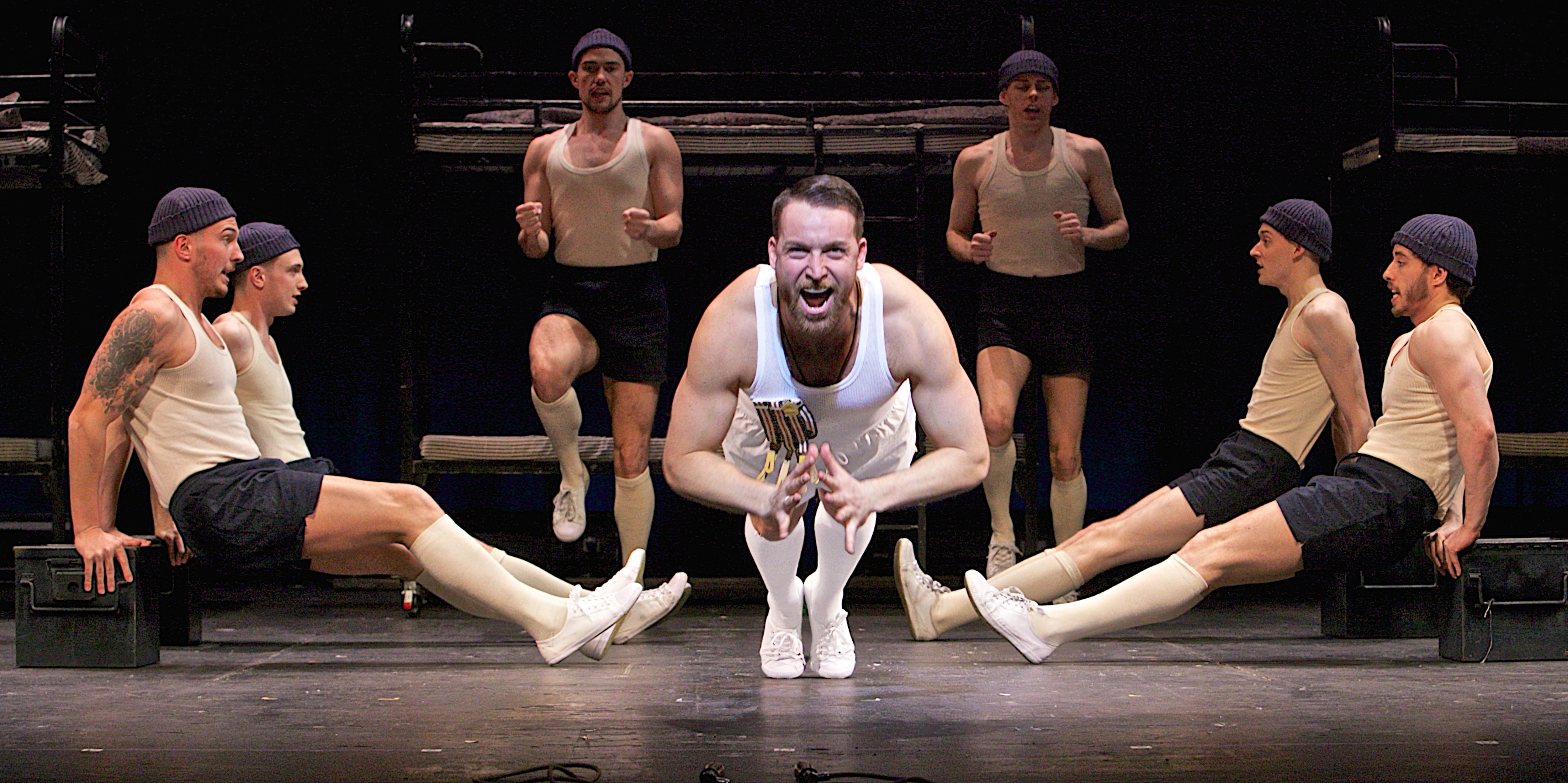
Photo credit: Francis Loney
The show was written as light entertainment, poking affectionate fun at the English obsession with class, and the allocation of positions of power based on social standing rather than any kind of ability. The main target of the satire is the diminutive and rosy-cheeked Sir Joseph, whose pomposity is softened only by his unfailingly good manners. Michael Burgen plays his character’s absurdities to the max, sharing some particularly enjoyable comic scenes with Neil Moors’ Captain Corcoran. 

But there’s additional enjoyment to be had here in watching the male actors camp it up in the female roles, a task to which they devote themselves with great enthusiasm. It’s an idea that could have gone horribly wrong – but any fears that the all male casting might lead the show to feel gimmicky, or that the quality of the musical numbers could suffer from the absence of female voices, are quickly dispelled by some fabulous performances from male and female characters alike, backed by musical director Richard Bates on piano. Ben Irish, in particular, is exquisite as Josephine, his clear, beautiful falsetto hitting the high notes with enviable ease.
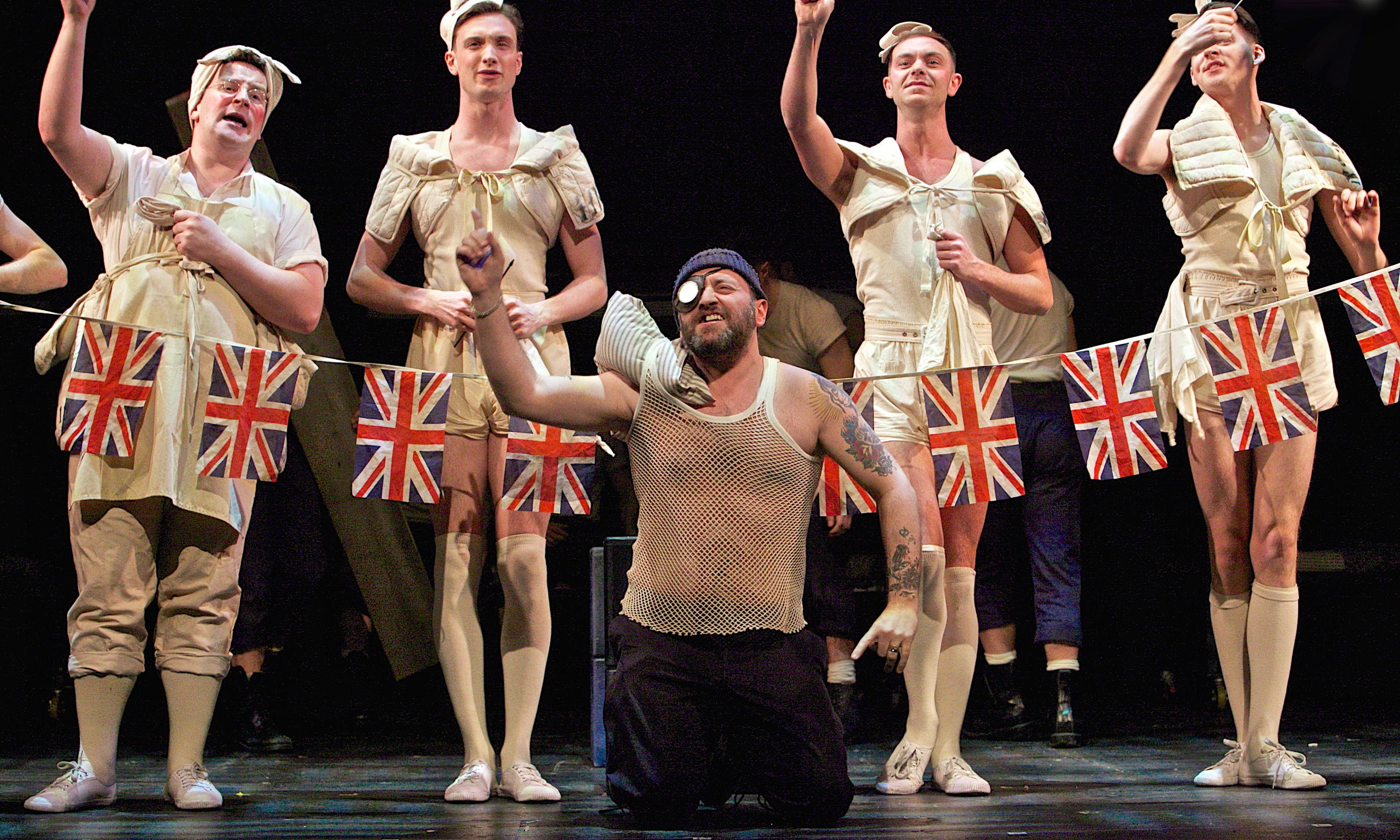
Photo credit: Francis Loney
Lizzi Gee’s choreography is slick and polished, and the show is full of energy and movement, so there’s literally never a dull moment, whether the actors are somersaulting or skipping across the set. The simple staging, which sees a rope, a few boxes and some bunk beds used to great creative effect, is a charming reminder that sometimes you don’t need big budgets, an enormous orchestra or complex special effects to make fantastic theatre, as long as you’ve got enthusiasm, energy and a desire to entertain – oh, and a few catchy tunes. These are things this production and its fantastic cast have in buckets, and the result is as enjoyable to watch as any lavish West End show. Highly recommended.


Can’t see the map on iPhone? Try turning your phone to landscape and that should sort it. I don’t know why but I’m working on it… 😉
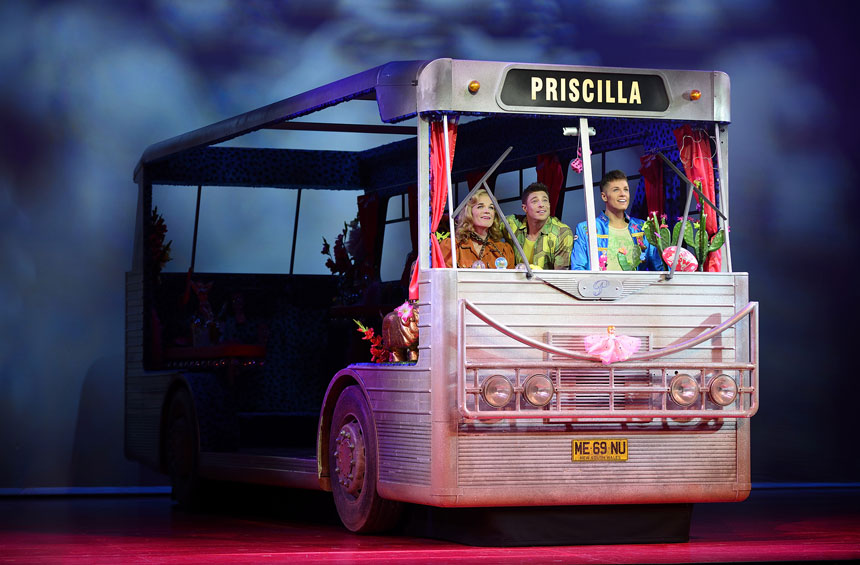
Review: Priscilla, Queen of the Desert at the Orchard Theatre

If there was ever a movie crying out to be turned into a musical, it’s 1994 Aussie hit, Priscilla. The addition of disco classics to this fabulously flamboyant tale of three friends on a road trip through the desert feels like the most natural thing in the world, and the resulting show is an infectiously joyful cocktail, which is guaranteed to brighten up even the dreariest Monday.

Tick (a.k.a. Mitzi), a disillusioned drag queen, invites his friends Adam (a.k.a. Felicia) and Bernadette (formerly Ralph) to join him in a new act in Alice Springs, but doesn’t tell them he has his own reason for going. So, hopping aboard their very own party bus, Priscilla, the three set off from Sydney on a journey of self-discovery that will bring arguments, revelations and a bucketload of innuendo.

Photo credit: Paul Coltas & Darren Bell

Blue’s Duncan James seems totally at ease with both his male and female personas, not to mention an increasingly outrageous wardrobe, and gives a strong performance as the conflicted Tick. He’s joined by Simon Green, as Bernadette, a sophisticated lady who just happens to have once been a man, and who lives in fear that her best days – and her chances of finding Mr Right – are behind her. Her scathing one-liners are usually directed at Felicia, played by a deliciously camp Adam Bailey. Unlike Tick, he’s completely comfortable with who he is, and demonstrates it by being fabulously over the top, but not always showing the sensitivity to others that he expects for himself.

This show is a lot more just its stars, though, and has three unsung heroes (if you’ll pardon the pun) in the Divas. With the main characters’ act consisting of them lip syncing to pop songs, someone has to provide the soundtrack, and Lisa-Marie Holmes, Laura Mansell and Catherine Mort deliver a sensational performance. (This is all the more impressive considering they’re suspended from the roof by wires for most of the show.) There’s a brilliantly unhinged turn from Julie Yammanee as Cynthia, Philip Childs is a loveable hero as Bob – and the whole cast exude so much energy throughout that it’s impossible to resist the urge to get up and join in for the final medley.

And while we’re talking about unsung heroes, a quick word for the incredible wardrobe department, led by Suzanne Runciman. The outfits are not only visually stunning but also seemingly limitless; I don’t think I’ve ever seen a show with so many lightning-fast costume changes, and yet there’s not a wig out of place.

Photo credit: Paul Coltas & Darren Bell

Priscilla is a camp extravaganza – quirky, cheeky and endlessly entertaining, with a fantastic disco soundtrack featuring the likes of I Will Survive, Venus and Hot Stuff. But the show’s not just about glitterballs and glamour; it has a serious point to make too about the importance of both accepting ourselves for who we are, and allowing others to be themselves too.

Bit cheesy? Absolutely. But when you’re having this much fun, who cares…

Priscilla, Queen of the Desert is at the Orchard Theatre, Dartford until 30th April.

Review: A Midsummer Night’s Dream at the Marlowe Theatre

In case anyone’s missed it, this year is the 400th anniversary of Shakespeare’s death. To mark the life and achievements of one of our greatest Britons, the RSC has embarked on a massive and daunting task: a new production of A Midsummer Night’s Dream, bringing together an ethnically diverse cast made up of professionals and amateurs to celebrate the universal scope of not only Shakespeare, but theatre in general.

It’s a risky project, fraught with challenges and potential pitfalls, but there’s no sign of nerves from the cast at the Marlowe, which includes members of local group the Canterbury Players and children from King Ethelbert School in Birchington. It seems unfair to label the newcomers ‘amateurs’, though; all take to the stage with such aplomb – in particular Lisa Nightingale, who almost steals the whole show as the RSC’s first ever female Bottom – that you’d think they’ve been performing with the company all their lives.

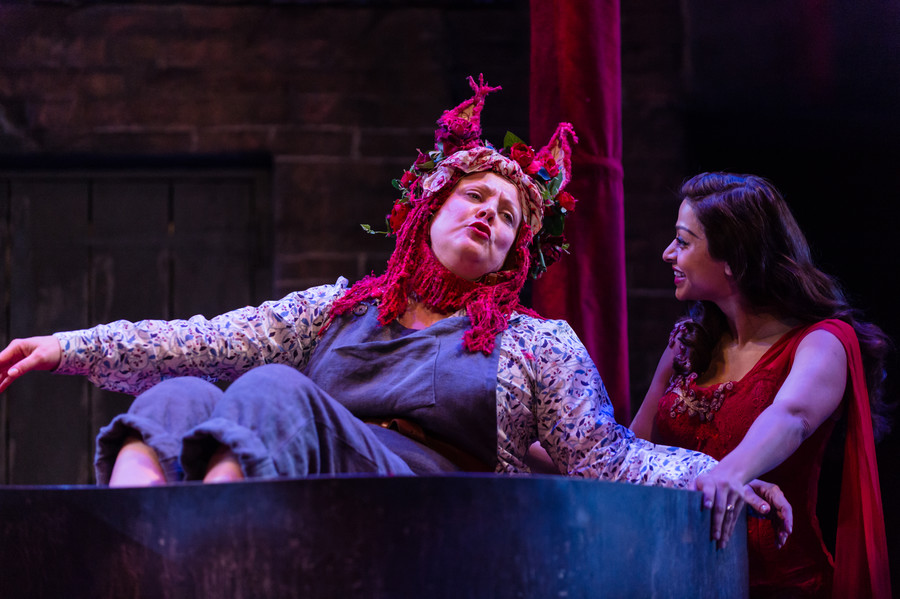
Photo credit: Topher McGrillis (c) RSC
Director Erica Whyman has set the familiar tale in a crumbling, post-war Britain, a time of hardship but also of hope for a brighter future. As the nation prepares for a royal wedding, four lovers escape into the woods, and a band of amateur actors meet to rehearse a play. But little do they all know they’re entering a world of fairy magic and mischief, and that after this night, their lives will never be the same again. A Midsummer Night’s Dream is one of Shakespeare’s more accessible plays – there’s a reason we all studied it at school – and there’s plenty to enjoy for young and old audience members alike in this chaotic and colourful version.

In an excellent cast, Lucy Ellinson shines with her spiky-haired Puck. Clearly enjoying doing her master’s bidding and causing as much chaos as she can, she covers every inch of Tom Piper’s versatile set (and beyond) with seemingly limitless energy. There’s great physical comedy from the four lovers (Mercy Ojelade, Laura Riseborough, Chris Nayak and Jack Holden) as the men threaten violence and the women actually attempt it – and as Oberon and Titania, Chu Omambala and Ayesha Dharker bring a vibrant party atmosphere to their fairy realm.

Photo credit: Topher McGrillis (c) RSC
A Midsummer Night’s Dream is a timeless and irresistible story about love, and the things we’re willing to do for it. Whether it’s romantic love, parental love or simply a love for our art, it can lead us into madness – but it can also inspire us to greatness. It’s fair to say there’s more than a hint of madness about the RSC’s epic scheme to create a Play for the Nation… but there’s plenty of greatness too – not just for those of us who already love Shakespeare but, more importantly, for the next generation of theatre lovers. Here’s to another 400 years!

A Midsummer Night’s Dream is at the Marlowe Theatre, Canterbury, until 23rd April.

Review: The Taming of the Shrew at Above the Arts

The Taming of the Shrew is a comedy with a dark heart – a twisted little love story that’s generally considered one of Shakespeare’s most problematic. And for that very reason, it’s also a great candidate for a gender swap experiment. Nowadays, to watch a man attempt to control his wife by a combination of mental and physical torment is called abuse. But do we react the same when it’s a woman in charge, or is that just considered girl power?

Custom/Practice have taken on this question with great enthusiasm in their gender-reversed production of The Taming of the Shrew, the centrepiece of the inaugural Verve Festival at the Arts, celebrating cultural, ethnic and gender diversity in theatre. In this version of the story, the women hold all the power and it’s the men – trussed up in corsets and tottering around in women’s shoes – who must do as they’re told.

5M6A6610

Doing away with the framing story of Christopher Sly, we’re thrown straight into the action. Famously bad-tempered Katherina (Kazeem Tosin Amore) is forced against his will into marrying Petruchio (Martina Laird), who’s more than willing to take on a challenge in exchange for her husband’s generous dowry. This frees his younger brother, the young, handsome Bianca (Tim Bowie), who has plenty of women after him but hasn’t been allowed to marry until Katherina does. As Bianca’s suitors, exchanging increasingly insincere air kisses, battle for his affections, Katherina’s new wife sets out to break his spirit and bring him to heel through a systematic programme of abuse and neglect.

Perhaps surprisingly given the subject matter, this spirited, high-energy production directed by Rae McKen delivers plenty of laughs – not least, dare I say, in the moments when the actors throw Shakespeare’s script out the window and start ad libbing. Brigid Lohrey and Eugenia Caruso make a brilliant comedy duo as Bianca’s bumbling suitors Gremio and Hortensio – think Cinderella’s ugly sisters fighting over Prince Charming – while Kayla Miekle’s Tranio is the ultimate fairy godmother with attitude, and Lorenzo Martelli gets some of the biggest laughs as Petruchio’s long-suffering servant, Grumio.

Meanwhile, Martina Laird gives a captivating performance as Petruchio, at once seductive and tyrannical. Swaggering about the stage, she has a way of directing her asides straight at individual members of the audience that makes us feel somehow complicit in her torture of her husband. And while it’s hard not to laugh at Katherina’s desperate expression as Petruchio launches herself at him, all the time we’re uncomfortably aware that if it were a man behaving this way, we’d probably be appalled instead of amused.

5M6A6849

This is theatre with a dual purpose – to make us laugh, and make us think – and on both fronts, it delivers. In a fast and frantically paced production, the cast never miss a beat, and genuinely seem to be having as much fun as the audience (occasionally more). And while the play’s central theme is always going to be challenging, gender swap or no gender swap, the awkward final scene is softened here by a Beyonce-inspired finale that, much like the rest of the show, is impossible to resist.


Can’t see the map on iPhone? Try turning your phone to landscape and that should sort it. I don’t know why but I’m working on it… 😉

Review: Russian Dolls at King’s Head Theatre

Kate Lock’s Russian Dolls, winner of the 2015 Adrian Pagan award for new writing, brings together two unlikely companions – Hilda, blind, elderly and struggling to maintain her independence, and Camelia, who’s just got out of a young offenders’ institution and wants nothing more than to go back there. When she robs Hilda, a surprising connection is forged, and the two discover that their lives are actually not all that different.

Exploring as it does some difficult themes – abuse, loneliness, gang violence and addiction, among others – it would be easy for the play to become a bleak picture of two isolated souls just trying to survive. And while there’s certainly plenty in Hamish MacDougall’s production to shock and dismay, this brilliant two-hander is far from one-dimensional. Both Hilda and Camelia are strong-willed and proud, and they quite literally speak different languages, so the resulting clash of personalities allows for a good deal of humour alongside some genuinely heart-warming moments.

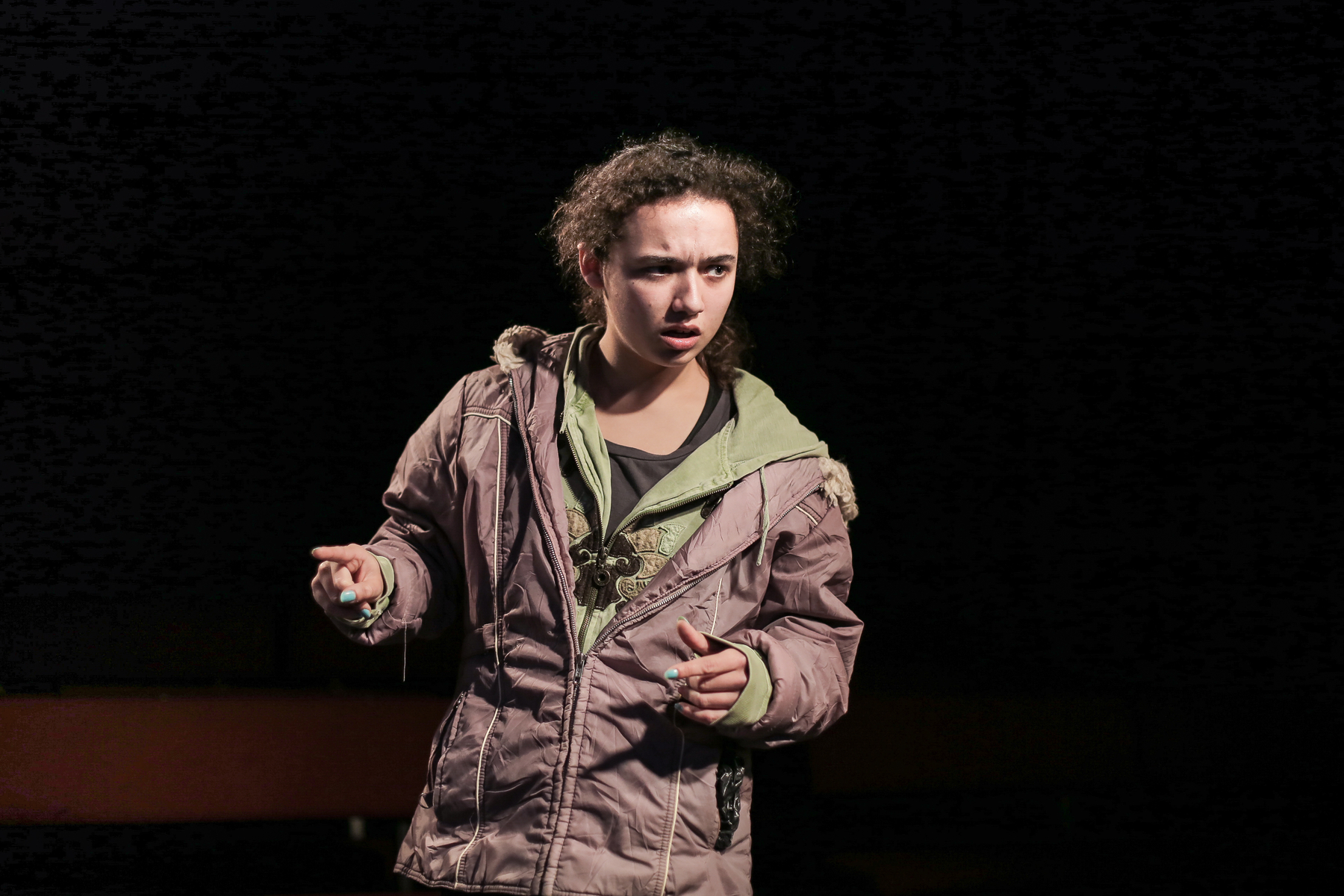
Russian Dolls at King's Head Theatre
Photo credit: Andreas Grieger
Playing these complex characters are two perfectly cast actresses, who each begin alone on stage with a soliloquy direct to the audience. Stephanie Fayerman’s Hilda is determined and stubborn, refusing to stop living her life or to give up the things she loves, and discussing the sudden total loss of her sight with a levity that only thinly masks her devastation. Meanwhile, Mollie Lambert takes Camelia, a character many would be all too ready to write off as a lost cause, and reveals her to be an affectionate, warm and funny girl, who loves her family and dreams of a better future. Like Hilda, her bravado hides an intense vulnerability, and her ambitions become all the more poignant as she’s inevitably drawn back into the repeating patterns of the world she’s left behind.

Becky-Dee Trevenen’s set takes in the whole width of the intimate space, encompassing Hilda’s front door, living room and kitchen. We never see outside the flat, only hearing second-hand about characters and events, and this heightens the sense of isolation for the two women. In fact the only time the story doesn’t feel completely natural is on the one occasion the outside world briefly enters their safe space, when Camelia arrives home with a gun she’s stolen from her brother and his gang. This results in a mildly chaotic scene in which she runs around the flat behind Hilda’s back, hiding the weapon somewhere new, only to pick it up again moments later and move it somewhere else – and finally putting it back where it was in the first place. When the gun then disappears in the following scene, it feels like a bit of an anticlimax, and we only learn its true significance much later.

Russian Dolls at King's Head Theatre
Photo credit: Andreas Grieger
This thoughtful and moving play ends rather abruptly, with no clear resolution, but still manages to leave us feeling uplifted, despite some of the horrors that take place within it. Camelia and Hilda’s relationship begins as a practical arrangement – Camelia acts as Hilda’s eyes, while Hilda provides the authority and discipline Camelia’s never had from her own mother – but grows into one of genuine affection. This, along with the open-ended final scene, encourages us to go away considering how society needs to change before such stories can possibly have a happy ending.


Can’t see the map on iPhone? Try turning your phone to landscape and that should sort it. I don’t know why but I’m working on it… 😉