Review: Speaking in Tongues at Cockpit Theatre

A man and a woman meet at a club and leave together. They’re both nervous… they’re also both married to other people. What they don’t know is that at the exact same time, their respective spouses are having a very similar encounter. But while their conversations mirror each other, sometimes word for word, ultimately the outcomes are different – only one couple actually goes through with it. The other, overcome with guilt, returns home to confess, only to discover their partners’ betrayal.

This all happens simultaneously – two couples, two rooms, two confessions, two marital breakdowns – within the first fifteen minutes of Andrew Bovell’s Speaking in Tongues. And that’s okay, because Doughnut Productions have more than one stage; in fact they have four. In a unique format, their productions take place predominantly around the sides of the room, while the audience watch from the centre, on chairs that swivel to face the action.

This is brilliant for many reasons: first, it means even if you’re stuck behind the tallest person in the room for one scene, they won’t be bothering you for long. Second, it allows for scenes like the one described above, where multiple events happen simultaneously but in different locations. And finally, it turns the play into a truly immersive experience; director Kathleen Douglas has the action literally taking place all around us, so it’s much easier to see how scenes mirror each other, and to get caught up in the drama.
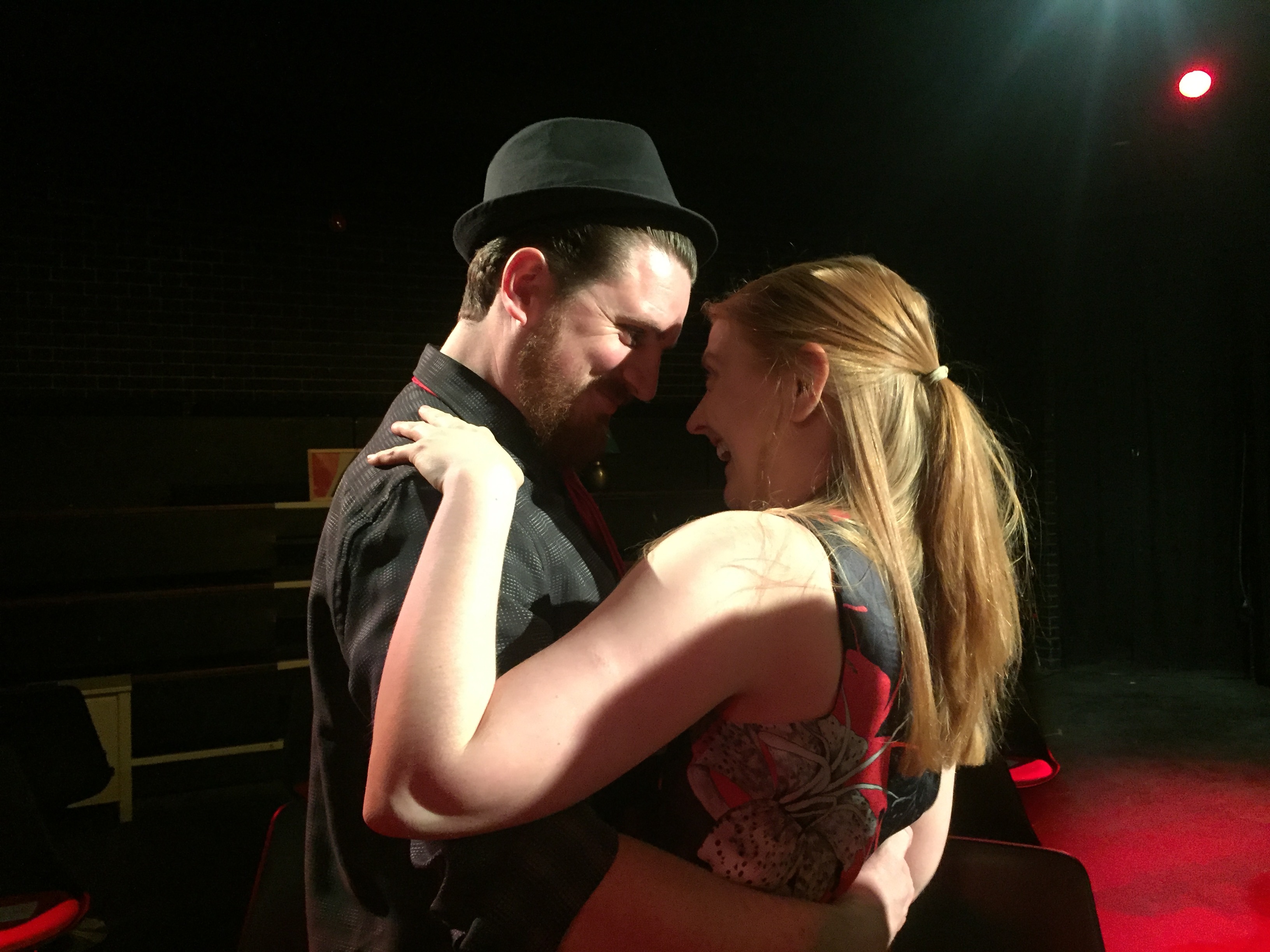
Speaking in Tongues, Doughnut Productions
Photo credit: Doughnut Productions

And speaking of drama, there’s plenty to go around. In what initially seems an inexplicable twist, both couples reunite and share stories of odd encounters – one, with a man whose fiancée left him without explanation, the other with a neighbour who may or may not have murdered someone. It’s only in act 2 that these stories begin to make sense, as we meet another two couples and begin to truly appreciate the intricacy of Andrew Bovell’s script, where everything slots neatly together just in the nick of time… but still leaves us with enough unanswered questions to ensure we go away deep in thought.

Further emphasising how all the characters’ lives interconnect, a versatile cast of four play them all, switching roles at the interval, and each becoming the opposite of their act 1 self to the point where they’re almost unrecognisable. So Phil Aizlewood’s policeman becomes a murder suspect; Kate Austen’s betrayed wife a therapist. Most dramatic are the transformations of Georgina Periam, from ‘plain Jane’ to seductive therapy patient Sarah, and Andrew Seddon, the only actor to take on three roles – from the rambling but likeable Pete, he becomes fragile, obsessive Neil, and finally John, who seems oddly distant and unconcerned about the disappearance of his wife.

Speaking in Tongues is a tale of two halves – the first a reasonably straightforward, and frequently humorous, story about infidelity; the second a tense murder mystery. The common thread to both, though, is relationships: what it really means to love someone and what constitutes a betrayal. Interestingly, it also invites us to question our own response – why is it we’re prepared to laugh about adultery, but draw the line at murder? Is adultery now something we just accept without question, unless it brings with it darker consequences?

I’ll admit my primary reason for going along to this play was that I was intrigued by the swivel chairs. And don’t get me wrong, they’re great fun and work really well, especially with a story as segmented as this one. But the unusual format shouldn’t detract from the production itself, which is dramatic, compelling, and definitely left me wanting to see more from this innovative company.


Can’t see the map on iPhone? Try turning your phone to landscape and that should sort it. I don’t know why but I’m working on it… 😉

Review: I Capuleti e i Montecchi at Carousel

As I took my seat last night for Pop-Up Opera’s I Capuleti e i Montecchi, I heard someone explain, ‘It’s basically Romeo and Juliet without any of the nice bits.’ Which, as it turns out, is a pretty accurate summary of this opera by Vincenzo Bellini. By the time our story begins, Romeo and Giulietta are already embroiled in a secret love affair, helped by their friend Lorenzo, and Romeo’s on the run for killing her brother. Giulietta’s father, Capellio, decides to marry her off to Tebaldo, and in desperation she fakes her death. But Lorenzo’s prevented from getting a message to Romeo, who – as in Shakespeare’s version of the tale – goes to Giulietta’s tomb to kill himself.

Photo credit: Richard Lakos

Now, I haven’t seen a huge amount of opera, but I think it’s fair to assume this was quite a unique experience, even for those who have. First, the venue. Pop-Up Opera are a touring company who bring opera to new audiences in unusual locations; this particular tour will take them to the Asylum Chapel in Peckham, the London Museum of Water and Steam, and the spectacular Minack Theatre in Cornwall. In comparison, our venue – the basement bar of a restaurant in Marylebone – may not have been the most romantic, but it was still a suitably intimate and atmospheric setting, and my only complaint was that occasionally events took place on the other side of a concrete pillar.

The classic love story of Romeo and Giulietta has been reworked by stage director James Hurley into a modern thriller, in which the Montecchi and Capuleti are rival gangs locked in a long-running feud. Instead of swords and potions, this version has guns and pills, and unfolds on a set illuminated by harsh electric light and littered with crumpled paper and overturned chairs. From the outset, there are moments of brutal violence (I know I wasn’t the only audience member who flinched when Capellio advanced on a captive Romeo holding a pair of pliers), and the fact that we know how the story’s going to end does nothing to dispel the tension in what turns out to be a gripping drama.

Photo credit: Richard Lakos

In another original twist, Harry Percival’s English captions (inspired by Eurotrash, apparently) don’t seek to translate everything word for word, instead summarising each scene in the style of an old black and white movie. This has a dual effect: it means we get to concentrate on the action, and not spend an entire evening staring at the wall, and it allows a little more artistic licence with the translation – I can’t help wondering how Bellini would have felt about his hero being called an ‘asshole’, but it made me smile all the same.

But the modern translations, as amusing as they occasionally are, don’t detract from the beauty and emotion of Bellini’s score, or the quality of the performances – proving once and for all that you don’t necessarily need to understand every word to appreciate what’s going on. Each member of our cast – there are two on the tour – gives it everything, and it’s easy to forget there are only five of them, and that they’re backed by a single piano (played by musical director Berrak Dyer), not a full orchestra. Flora McIntosh’s Romeo is brash and reckless, while Cliff Zammit-Stevens is a sympathetic Tebaldo; an enemy he may be, but it’s clear he genuinely loves Giulietta and is as broken by her ‘death’ as his rival. Andrew Tipple’s proud Capellio is every inch the mafia boss, concerned only with family honour, even if it means rejecting his beloved daughter, and Matthew Palmer, in stark contrast, is a far gentler presence as the lovers’ mutual friend Lorenzo.

But it’s Alice Privett who gives the most memorable – and emotional – performance as Giulietta, a young woman caught between love and duty, and pulled this way and that by the headstrong men in her life. Her visible pain during the lovers’ final farewell means that emotions inevitably run high offstage as well as on.

Photo credit: Richard Lakos

Pop-Up Opera’s aim is to make opera accessible to a wider audience, people who may perhaps have dismissed it in the past as pretentious or boring. In this they certainly succeed, taking a classic story and giving it a modern twist, so that it feels fresh and exciting. And while it’s clear that they’re a company with a cheeky sense of humour, this doesn’t come at the expense of a high quality performance.

So if you think opera’s not for you, maybe give these guys a try, before you decide for sure…


Can’t see the map on iPhone? Try turning your phone to landscape and that should sort it. I don’t know why but I’m working on it… 😉

Review: Twelfth Night at French Protestant Church, Soho

Twelfth Night: a story of love, disguise and trickery, where nothing and nobody is quite what they seem. It seems fitting that a play in which appearance versus reality is such a prominent theme should be visually stunning, and Scena Mundi’s adaptation doesn’t disappoint; the French Protestant Church in Soho Square provides a unique and beautiful setting for what proves to be a classy production.

Shipwrecked in Illyria, Viola (Harriet Hare) disguises herself as a boy and gets a job working for the Duke Orsino (Pip Brignall). He sends her with messages of love to Olivia (Emma Hall), who falls instead for Viola – who unfortunately happens to be in love with Orsino. Then Viola’s twin brother Sebastian (Clare Brice) turns up, and everything gets even more confusing, before finally resolving itself in typically neat Shakespearean fashion. Meanwhile, Olivia’s drunken cousin Sir Toby Belch (Jack Christie) is hatching a plot with his friends Maria (Clare Brice again), Sir Andrew Aguecheek (Thomas Winsor) and Fabian (David Keogh) to make a fool of the pompous Malvolio (Martin Prest) by convincing him Olivia’s in love with him. And all this is quietly observed by the Fool, Feste (Edward Fisher) – who, ironically, may just be the wisest man on the stage.

Cecilia Dorland’s production takes as its starting point the vanity and self-obsession of Shakespeare’s characters, and transforms the aisle into a shiny blue catwalk for the play’s fashion show-inspired opening. Though the fashion theme doesn’t explicitly come up again after this scene, it’s present in Georgia Green’s costumes, which are somewhere between contemporary and modern, giving the play – and each character – a unique and timeless style that fits well in the unusual setting.

Photo credit: Jessy Boon Cowler

The cast do a great job of teasing out the complexities and less attractive aspects of their characters, and at the same time revealing the play to be more than a straightforward comedy that’s just out for laughs. Though there are a good number of laughs to be had – Martin Prest in particular gives an outstanding comic performance as Malvolio, with an array of disapproving facial expressions (and a surprising flexibility during the infamous yellow stockings scene), and the scene in which Orsino starts to feel an attraction to Viola in her boy’s disguise is both funny and sweetly touching. On the other hand, the later confusion between Viola and Sebastian falls a little bit flat, possibly because the two actors playing the twins look nothing alike.

While Malvolio is easy to laugh at because he’s so consistently unpleasant, there are other characters who turn unexpectedly to the dark side, and it’s these performances that prove most memorable. Sir Toby, played by Jack Christie, seems at first to be a loveable drunk, but ultimately reveals himself to be nothing more than a bully. Tricking Malvolio is one thing, but when he turns on his friend Sir Andrew (played with a child-like vulnerability by Thomas Winsor), it feels a step too far, and is actually a bit uncomfortable to watch. Edward Fisher’s Feste is also a mildly discomfiting presence; as the Fool, he provides entertainment through his wit and music, but at the same time has the feeling of a conductor, seeing and knowing all, with the power to make or break his fellow characters as he wishes.

Scena Mundi’s adaptation of Twelfth Night has plenty to recommend it: visually striking, with strong performances and several laugh out loud moments, the play also offers up a warning about the dangers of putting style over substance – particularly in matters of the heart. Great fun and well worth a look, especially if you enjoy your theatre in unusual locations.


Can’t see the map on iPhone? Try turning your phone to landscape and that should sort it. I don’t know why but I’m working on it… 😉

Review: Anna Karenina at Jack Studio Theatre

If, like me, you’ve often thought about reading Tolstoy but been put off just by looking at the list of characters, let alone the number of pages, help is at hand. In their first non-Shakespeare production, Arrows & Traps have pulled off the astonishing achievement of compressing a 1,000-page novel into a little under three hours, with a cast of just eight, whilst still remaining faithful to the plot.

Anna, the respected wife of provincial governor Karenin (Adam Elliott), abandons her duty and reputation when she’s swept into a passionate affair with the dashing Count Vronsky (Will Mytum). Meanwhile landowner Levin has money and power, and the freedom to do anything he likes, but is desperately in love with Kitty (Pippa Caddick), the woman he believes will give his life purpose. Anna and Levin’s lives fit together to make a whole, with each possessing what the other longs for, and Helen Edmundson’s adaptation, directed by Ross McGregor, highlights this synergy beautifully. The stories unfold in parallel, and though Anna and Levin have never met, from the outset each becomes the voice of reason for the other, the one they confide in and from whom they seek help and comfort. Their dialogue also serves a second, more practical purpose, filling in the gaps with regard to setting and context, so that each time one asks the other, ‘Where are you now?’ it’s as much for our benefit as theirs.

Anna Karenina

As a result, the production needs little in the way of set or props, and the story is carried almost wholly by the fantastic cast. Most of them take on multiple roles, but keep them perfectly distinct, so we always know who we’re looking at, and even the comparatively minor roles are memorable (I particularly enjoyed Hannah Wilder’s giggling, superficial Princess Betsy). The two leads, Ellie Jacob and David Paisley, each capture to perfection the essence of their character: Anna’s charm and quick wit, which enchant everyone she meets, have a similar effect on the audience, while Levin wins our sympathy as a good, honest man radiating quiet desperation at the lack of direction in his life.

A third plot thread involves Anna’s adulterous brother Stiva (Spencer Lee Osborne) and his long-suffering wife Dolly, who’s played by Cornelia Baumann in a truly heartbreaking performance. Of all the stories, Dolly’s is perhaps the most devastating, as she lets Anna convince her to remain in her unfaithful marriage, and consequently ends up feeling she’s never really lived at all.

What’s particularly impressive about Arrows & Traps’ production is the way it somehow manages to be both intimate and epic, getting right to the heart of the characters but also capturing the scale of the novel. There are a few moments – the ballroom, the races, and in particular Anna and Vronsky in the snow – that feel almost cinematic, which is quite an achievement on such a tiny little stage.

Anna Karenina

Anna Karenina has a bit of everything – romance, tragedy (by the way, the death scenes are brilliantly done, and in one case almost a bit too convincing), drama, social commentary, and even a few moments of comedy to lighten the mood. With 1,000 pages of text to condense down, it’s no surprise that this is an intense and gripping production – but one that I’d happily go and see again tomorrow.

It’s even made me consider reading the novel. Well, maybe…


Can’t see the map on iPhone? Try turning your phone to landscape and that should sort it. I don’t know why but I’m working on it… 😉

Review: Merit at Finborough Theatre

Merit, a two-hander by Alexandra Wood, begins with a bombshell. Against all the odds, recent graduate Sofia’s landed a job as PA to one of Spain’s richest bankers, but is appalled when her polite, middle-class mother, Patricia, questions what she had to give in order to get it.

And so begins the story of a complex mother-daughter relationship, against a backdrop of economic instability. It turns out the argument that opens the play is just one of many; these are two women with fundamentally different ideas on just about everything, not least money and social responsibility. Each scene moves us on a little in time and features a new disagreement, as Sofia’s fortunes improve, while those of her parents decline, and her mother’s driven to increasingly drastic action. Ultimately, the play ends on another bombshell, albeit one that’s somehow a bit predictable and yet still seems hard to believe.

Merit at the Finborough
Photo credit: Robert Workman
Merit tackles some interesting themes, though, and skilfully introduces a cast of unseen characters, each with their own attitudes towards the economic situation. Most prominent of all is Antonio, Sofia’s boss, who gives away much of what he earns but still manages to live comfortably, and in doing so gains Sofia’s unswerving devotion and Patricia’s equally resolute disdain. As the trigger for most of their arguments, Antonio becomes almost a third main character in the story, a representative of his class whose actions – for better or worse – have an impact on so many.

Karen Ascoe and Ellie Turner both give compelling performances as Patricia and Sofia; the tension between them is palpable throughout as the advantage swings one way and then the other. Neither is perfect, and yet both at different times earn the audience’s sympathy, though we naturally side with Sofia pretty much from the start. Some of the dialogue feels a little unnatural – I can’t imagine too many young women use the word ‘rapacious’ in everyday conversation – but flows well between the two.

Tom Littler’s direction sees each scene change punctuated by flashing lights and loud music, and the two women mirror each other’s movements as they dress – perhaps the one and only time they’re in sync with each other. It’s almost like this is their time to prepare for the next battle, but who will emerge the victor each time remains in doubt. Meanwhile Phil Lindley’s set features a door at either side – one for home, one for work – with an open space in between providing an arena for Sofia and Patricia’s clashes.

Merit is an intriguing play, drawing on themes we’re all familiar with, but setting the story in a country where the economic crisis was much deeper, which enables the plot to go to greater extremes; the only problem is it’s so extreme it becomes hard to believe or relate to. Perhaps with a little more personal background, we could better understand how the mild-mannered Patricia ends up taking the path she does. Nevertheless, this is a thought-provoking piece, skilfully staged and performed, with plenty to think about after you leave the theatre.


Can’t see the map on iPhone? Try turning your phone to landscape and that should sort it. I don’t know why but I’m working on it… 😉