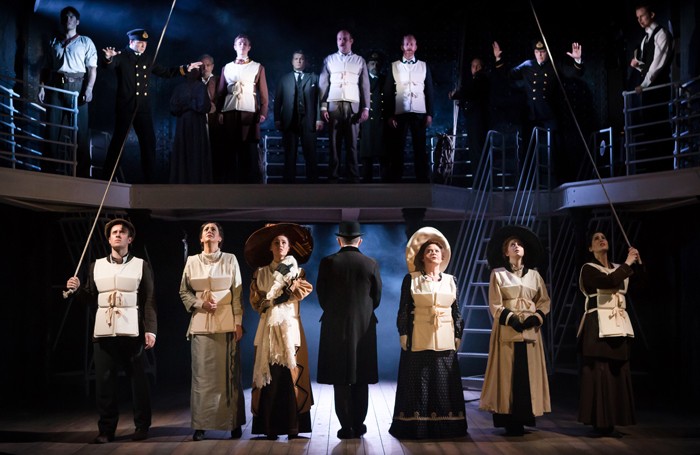
Review: Happy to Help at Park Theatre

If you thought a supermarket was nothing more than a place to pick up a pint of milk, think again. Happy To Help by Michael Ross opens the door to Frisca, the UK’s biggest supermarket chain, and takes us behind the scenes for one dramatic week, to reveal the internal politics and daily power struggles hidden behind the brand’s cheerful public face. It’s a sharp, clever comedy but with a serious message, in which the huge corporation is likened to an autocratic state, where speaking out against the regime can have dire consequences.

UK managing director Tony (Charles Armstrong) is doing his Secret Millionaire bit, on the advice of American boss Huck (David Bauckham), going behind the scenes at a Frisca branch to mingle with the workers. But little does he know that store manager Vicky (Katherine Kotz) has her own agenda… Meanwhile disgruntled employees Elliott (Jonny Weldon) and Myra (Rachel Marwood) are whispering about unions, and wannabe rockstar Josh (Ben Mann) has no intention of sticking around for long, even if he is everyone’s favourite shelf-stacker. For Frisca’s customers, it’ll be just another week, but behind the scenes everything’s about to change as a hilarious, shocking and unsettling chain of events is set in motion.
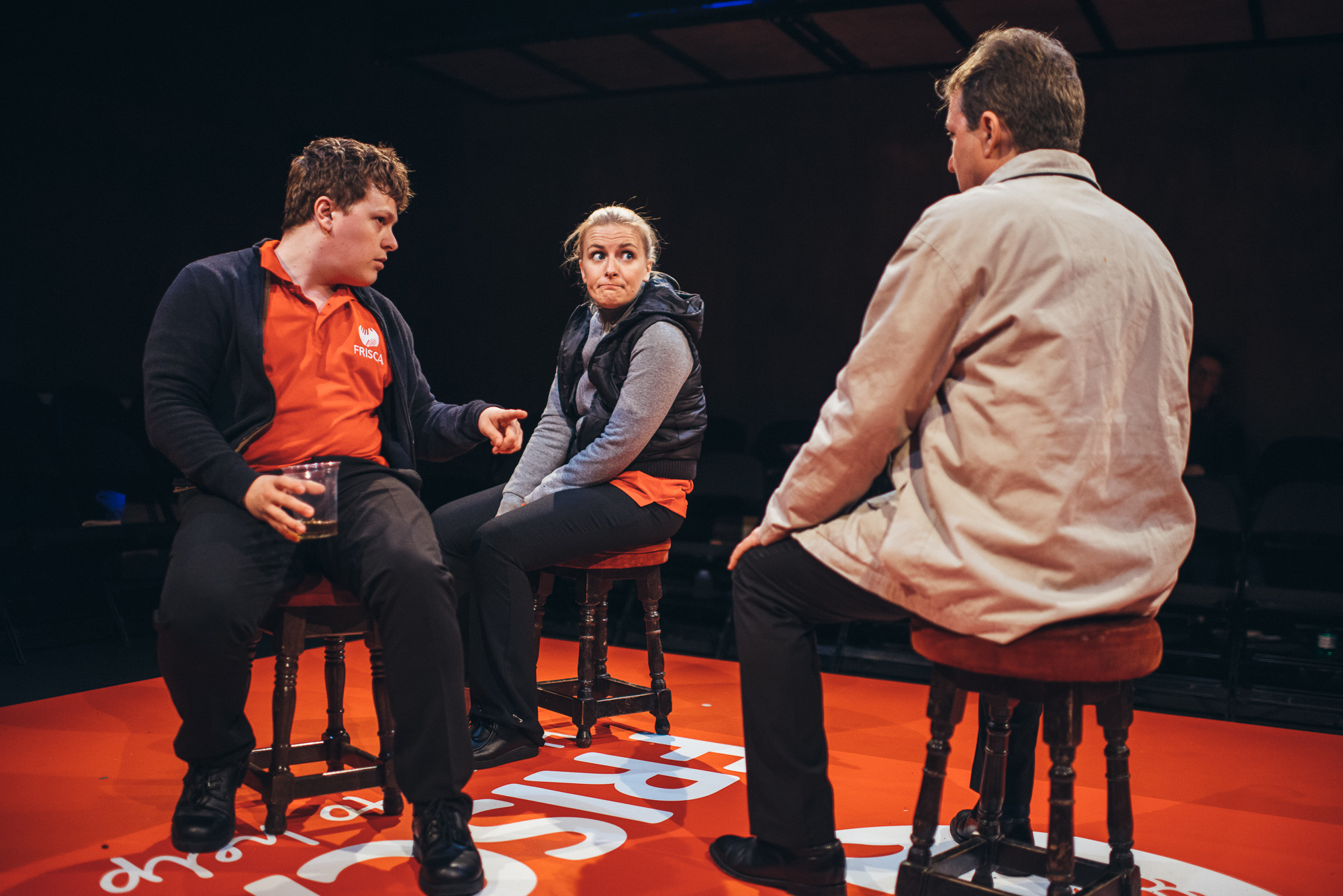
Photo credit: David Monteith-Hodge

In a fantastic cast, Katherine Kotz gives a stand-out performance as the manipulative Vicky; with a sunny smile that never reaches her eyes, she prowls the stage, a figure of absolute authority and control – but with a slightly manic air that suggests she could lose it at any moment. Ben Mann also shines as the brashly confident Josh, who thinks he’s got it made by being teacher’s pet. The confrontation between Vicky and Josh at the end of Act 1 is masterfully constructed and performed; much like Josh, we don’t realise what’s happening until it’s too late.

Perhaps the biggest personality on stage, though – both literally (the brand name is emblazoned across Emma Tompkins’ set) and figuratively – is Frisca itself, a business so wildly successful that it’s come to dominate every area of our lives, without ever pausing to consider who might be suffering as a result. Directed by Roxy Cook, the play skilfully contrasts Frisca’s shiny public image with the less than glamorous reality, in which employees are devalued, dissatisfied, and anything but ‘happy to help’. Each scene change is punctuated by a soundtrack of till beeps and monotonous store announcements, and there’s even a perky (and frustratingly catchy) Frisca song. It’s a world governed by ridiculous rules and regulations, whose absurdity is hammered home by Tony – the man who wrote them – now having to abide by them.
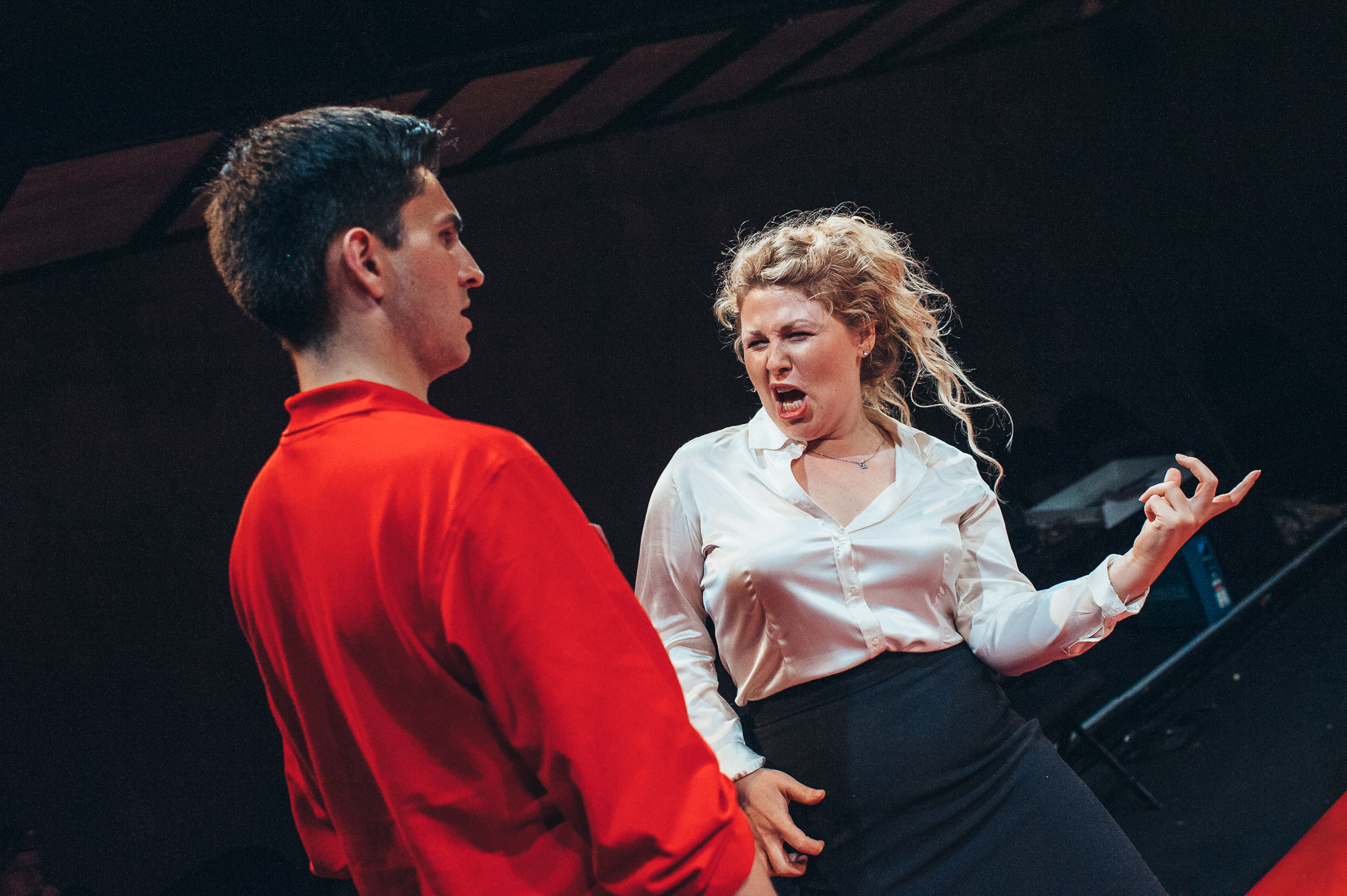
Photo credit: David Monteith-Hodge

But Happy To Help, which was shortlisted for the Liverpool Hope Playwriting Prize in 2015, is also a stark warning about the power that big businesses are allowed to wield over both us as consumers and the smaller firms that get in their way. As much as we may laugh watching the play, it actually paints a pretty bleak picture, and though the twist in the tale isn’t difficult to see coming, it still makes a powerful point. And it may make you think twice about ever setting foot in a supermarket again… at least until the next time you run out of milk, anyway.


Can’t see the map on iPhone? Try turning your phone to landscape and that should sort it. I don’t know why but I’m working on it… 😉

Review: The Return of the Marionettes at Bridewell Theatre

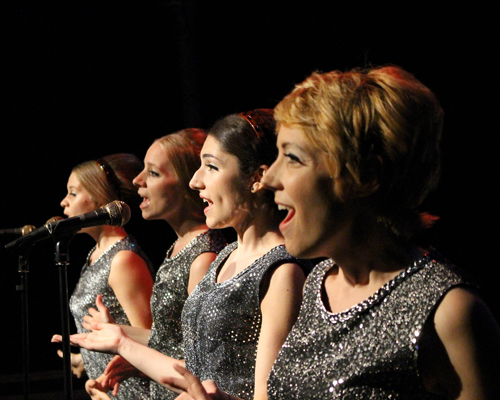
Welcome to the 1960s, where girl group The Marionettes are taking to the stage at the height of their fame. But as they come to the end of their final number, one of the girls runs from the stage in tears. And that, we learn from their manager George Ellis, is the end of the Marionettes.

Until now (well – 1984, anyway): 20 years later, the girls are back together for a one-off reunion show that could see their career picking up where they left off. But with so much history to work through – personal and professional – can they put the past behind them and deliver the show their adoring fans have been waiting for?

13412175_10154979027938289_5124830498646302303_o

Writers Peter and Phillip Ley of Tower Theatre Company take us back to the start of the story, introducing us to four giggling schoolgirls who call themselves the Moonbeams, and charting their progress to the top. Along the way, we’re treated to 18 original songs that capture the spirit of the 60s and – like all the best songs from that period – are easy to pick up and totally infectious. (Two days later, I’m still singing the Marionettes’ first big hit, Dynamite.) Polished performances from the cast, along with Ruth Sullivan’s choreography and costumes from Lynda Twidale, mean the musical numbers do a great job of transporting us back in time.

Photo credit: Robert Piwko

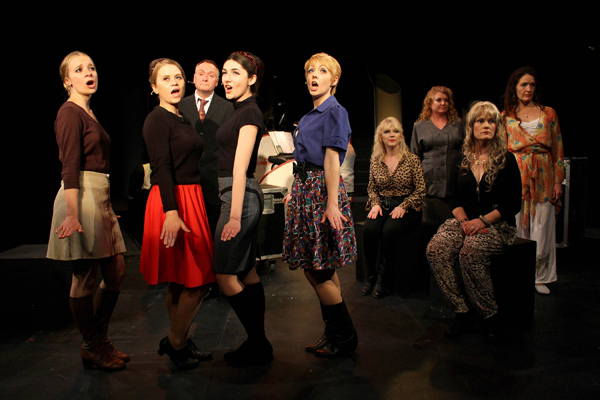
A dual cast of actresses play the Marionettes then and now, which enables the two groups to share the stage, with the older women often observing their younger selves and providing commentary on events as they unfold. Angharad Ormond and Stella Henney earn their place as lead vocalist Cathy with some impressive performances, but both also reveal a touching vulnerability hidden beneath a veneer of false confidence. Meanwhile Fiorella Osborne and Annette Ross show the fiery passion and determination that have always made Mary the true leader of the Marionettes.

What works really well is the way the dynamic of the group picks up where it left off 20 years ago – the professional tension between Mary and Cathy continues, there’s tension of a whole other kind between Mary and George, and the Meltzer sisters (Olivia Barton-Fisher and Jessica O’Toole as the younger, Deborah Ley and Annemarie Fearnley as the older) are enjoying the moment and providing light relief with their banter. The transition is aided by the constant, reassuring presence of Brad Johnson as both the older and younger George, along with Julian Farrance as heartless record boss Allan Tyrell.

Photo credit: Robert Piwko

Despite a few small stumbles in the spoken scenes, and some sound issues – the live band, led by musical director Colin Guthrie, are fabulous but occasionally drown out the actors – there are a lot of great things about this show, and opening with the break-up of the band creates an enjoyable suspense as we wait to see not only what eventually proved to be the last straw, but whether the women can now overcome their differences. It would have been nice to see more of the simmering romance between Mary and George; considering their feelings for each other are still present and obvious to everyone 20 years later, there are very few references to it in the flashbacks. And while it’s a challenge to recreate the sensation of a huge sell-out gig in an intimate fringe setting, there’s a lovely moment with some crazy fans, which helps demonstrate just how big the group were at the height of their fame.

The Return of the Marionettes is a thoroughly enjoyable take on the familiar ‘rags to riches to ruin to redemption’ story we’ve come to know and love from shows like Jersey Boys and Dreamgirls. With a soundtrack of irresistible songs, some strong vocal performances and a rousing finale, this is a show with great potential, which is pretty much guaranteed to send audiences out with a smile on their face and a skip in their step.


Can’t see the map on iPhone? Try turning your phone to landscape and that should sort it. I don’t know why but I’m working on it… 😉
Review: Titanic at Charing Cross Theatre

There are a few events in history that we all just sort of know about, without necessarily remembering how or why. Henry VIII and his wives would be one; the World Wars, obviously… and the sinking of the Titanic is another. It’s an event so legendary, and so much a part of our national history, that sometimes we forget the sheer scale of the tragedy that claimed 1,517 lives in the early hours of April 15th, 1912.

This probably wasn’t helped by James Cameron’s blockbuster movie – which happened to coincide with my teenage years, so I make no apology for the fact I saw it five times at the cinema. As much as we all cried when she let go (admit it), the film went so overboard – sorry – on the special effects that as Celine Dion sang us out, the story of the Titanic still felt like just that: a story.

Photo credit: Scott Rylander

Maury Yeston and Peter Stone’s Tony award-winning musical, which was first performed on Broadway in 1997, approaches telling the story in a similar way to the movie it preceded. Act 1 (pre-iceberg) is considerably longer than Act 2, setting the scene and introducing us to the lives, loves, hopes and fears of a cross-section of the people aboard the ship: passengers – from first, second and third class, and all based on real people – and crew, from Barrett the stoker all the way up to Captain Smith. But with no Jack and Rose to hog the limelight, and despite the need to keep over twenty characters straight in our heads, we care about the fate of every single one. There’s also a lovely touch at the end of the show, which ensures we leave thinking not just about the people on stage, but about everyone who perished in those icy Atlantic waters.

Of course no portrayal of the Titanic would be complete without an element of social commentary; the theme of class runs throughout the show, without ever lecturing (because, let’s be honest, it doesn’t really need to). Heartbreakingly, it’s the third class passengers who are most likeable, and have the most to look forward to, yet we know from the start it’ll be they who are more likely to perish, simply because of where they come from.

Photo credit: Scott Rylander

It’s quite a feat to not only recreate on stage a ship with over 2,000 people on board, but then to sink it too. And yet somehow, despite the relatively intimate setting and with surprisingly little in the way of special effects, Thom Southerland’s production feels like an epic. Partly this is down to the incredible cast, who rotate through a multitude of roles, costumes and accents, giving the sensation there are hundreds of them instead of a couple of dozen. And it’s partly a result of David Woodhead’s multi-level and constantly moving set, which brings us right on board the Titanic, so that we feel the same awe as the passengers and crew on their first sighting.

But it’s mostly due to Maury Yeston’s music, with new arrangements by Ian Weinberger and directed by Joanna Cichonska, which is nothing short of exquisite. The show is a true ensemble piece, and while the solo numbers are fantastic, it’s when the cast and orchestra all come together – whether in hope as the ship sets sail, panic as it begins to sink, or grief as loved ones are separated – that the music quite literally soars, filling every inch of the space with its stunning harmonies.

Unlike its ill-fated subject, Titanic looks set to repeat the resounding triumph of its 2013 run at Southwark Playhouse. It’s a show that deserves a larger stage and a much wider audience. I know I’m gushing, but that’s how much I loved it – and I’m a grown-up now (or so they tell me), so I can’t even put my reaction down to a teenage crush on Leonardo DiCaprio.

Thank you so much to boxoffice.co.uk for the opportunity to review this show.

Review: Richard O’Brien’s Rocky Horror Show at the Orchard Theatre

I have to confess something… until last night, I was a Rocky Horror virgin. Richard O’Brien’s classic musical is not so much a stage show as a phenomenon with a life of its own, and seeing it for the first time feels a bit like stumbling into a club of which you’re not a member. There are weird outfits, private jokes and choreographed dance moves – and that’s just the audience.

Fortunately, initiation into the Rocky Horror club is not only painless, but a lot of fun. And one thing becomes abundantly clear from the first moment: if you love this show, you will love this show. It’s a classic of such epic proportions, with such a devoted following, that it doesn’t really matter who’s in it, or where you see it; unless something goes horribly wrong, a Rocky Horror fan – old or new – is pretty much guaranteed a good time.

ROCKY_PRODUCTION_11

For the record, though, the touring production of Rocky Horror currently making a stop at the Orchard Theatre is of the highest quality, whether you’ve seen the show hundreds of times or you’re a slightly bewildered newbie. Slick, sexy and spectacular, it has a wicked sense of humour matched only by the increasingly cheeky responses being shouted by the Dartford audience, which the cast – particularly Norman Pace as the Narrator – handle with great aplomb.

Richard Meek and Lauren Ingram are perky and loveable as newly engaged Brad and Janet, who find themselves drawn into the bizarre world of Dr Frank-N-Furter when they get a flat tyre on a stormy night. Kristian Lavercombe is irresistibly creepy as Riff Raff, Dominic Andersen sets everyone’s pulses racing as Rocky and Sophie Linder-Lee’s Columbia is a brilliantly unhinged groupie. But the stage really belongs to Liam Tamne as Frank-N-Furter, the Sweet Transvestite from Transsexual, Transylvania; hilarious, seductive and quite, quite mad (not to mention a bit chainsaw-happy), he has both his guests and the audience in the palm of his hand from the start.

ROCKY_PRODUCTION_240

Oh, and the songs. Well, we all know the songs, right? Dammit Janet, Sweet Transvestite, Hot Patootie… Even for a first-timer, they’re pretty hard to resist – and come on, who never did the Time Warp at their school disco? There were a couple of occasions when the band drowned out the vocals a bit, but by that point things had got so bonkers I’d long since given up on keeping track of what was happening anyway.

Don’t think of Rocky Horror as a musical. It’s an experience: one I’m glad to have had – and that I won’t soon forget…

Richard O’Brien’s Rocky Horror Show is at the Orchard Theatre until 11th June 2016.

Review: A Subject of Scandal and Concern at Finborough Theatre

John Osborne’s A Subject of Scandal and Concern was written in 1960 as a TV drama starring Richard Burton. Now adapted by Jimmy Walters of Proud Haddock, the play gets its long-awaited London debut in the intimate setting of the Finborough Theatre.

Based on true events, A Subject of Scandal and Concern tells the story of George Jacob Holyoake, the last man to stand trial for blasphemy in England. On his way from Birmingham to Bristol in 1842, the young teacher stops in Cheltenham to give a lecture, where his determination to speak his mind will prove to be his downfall. Despite the efforts of a parade of lawyers, journalists and churchmen to break him, however, Holyoake maintains a steadfast resistance, even when it ends up costing him everything.

Photo credit: Samuel Taylor

Jamie Muscato gives a riveting performance as the unfortunate Holyoake, an unassuming figure who overcomes a severe stammer to make his case with passion and conviction. It’s a testament to Muscato’s presence and performance that even during his lengthy courtroom speech, we still hang on his every word. He’s joined by a versatile cast of five, who take on a multitude of roles; Edmund Digby-Jones impresses with an astonishingly fast and fluent delivery of the indictment against Holyoake, while Doron Davidson plays no less than five characters, each with a different accent and personality.

In addition to playing multiple roles within the story, the cast also constantly rearrange the simple wooden frames that make up Philip Lindley’s set, to become a jail cell, a courtroom, a kitchen and, most memorably, the ever-changing road from Birmingham to Bristol. There’s something almost mesmerising about the graceful movement of the actors as they move the pieces around, and it gives the play a dynamic feel, as if it’s taking place on a much larger stage.

Photo credit: Samuel Taylor
 Much like its title, A Subject of Scandal and Concern is a very wordy play; it’s worth getting hold of a copy of the play text to read through afterwards if you can. But what could have been a pretty heavy hour is broken up by moments of humour, and a vein of quiet sarcasm runs throughout the play. The authority figures ranged against Holyoake are all faintly ridiculous, but there’s a note of censure against the protagonist too, particularly towards the end of the play. As explained by the narrator in his closing lines, the play doesn’t seek to provide answers; this is not a story with a moral, and we must draw our own conclusions. Nonetheless, this is a fascinating tale, which still resonates today in its references to freedom of speech and the influence of religion in everyday life. This buried treasure has finally seen the light of day, and it was well worth the wait.


Can’t see the map on iPhone? Try turning your phone to landscape and that should sort it. I don’t know why but I’m working on it… 😉