I last saw Scena Mundi Theatre Company performing Twelfth Night at the stunning French Protestant Church in Soho Square earlier this year. This week they were back, in an equally beautiful venue, with a one night only performance of the same play… but a very different adaptation.
Billed as ‘the new masters of concise classics’, the Scena Mundi Mechanicals specialise in short versions of Shakespeare’s plays, inspired by the memorable amateur actors of A Midsummer Night’s Dream. It’s an intriguing and clever concept, which makes Shakespeare’s work very accessible and adds an original twist to a play many of us will have seen a good few times before. As the four actors – Masters Phil, Jack, Ned and Martin – divide up the roles between them, the stage is set for chaos and comedy, featuring a bearded lady, a dodgy wig, floating hats, and of course yellow stockings.
Photo credit: Jim Templeton-Cross
Given the complex storyline of Twelfth Night, director Cecilia Dorland has done well to cut the script down to almost exactly an hour in a way that still makes sense, and leaves us with a whistle-stop tour of all the key points and characters (well, almost – we’re forced to lose Maria, with Sir Toby Belch taking her place as the architect of Malvolio’s downfall). The performance too, with all its swift costume and character changes, is very skilfully executed by the four-man cast of Pip Brignall, Jack Christie, Edward Fisher and Martin Prest, with nicely understated musical support from flautist Emma Hall.
In fact if anything it’s a bit too well executed – the Mechanicals concept is introduced at the beginning but then seems largely forgotten during the play itself, and though there’s the occasional missing prop or actor’s tantrum, the production on the whole is extremely polished. It feels odd to complain that the acting in a play is too good, but what makes the Midsummer Night’s Dream Mechanicals fun to watch is the fact that their performance is so shambolic, and there’s potential in Scena Mundi’s adaptation for even more well-intentioned mayhem. This band of Mechanicals never get their lines wrong, forget which part they’re playing, or stop the performance to explain to the audience what’s going on; the director never has to intervene, and aside from one brief exchange at the beginning of the show, nobody tries to play all the parts. None of which is a bad thing – it just feels like the framing concept could be further developed for maximum comedy value.
Photo credit: Jim Templeton-Cross
All that said, this is already a highly original and entertaining production of a classic play. As a bite-sized introduction to Twelfth Night, it’s perfect for newcomers to Shakespeare, who might find the usual two-and-a-half or even three-hour stretch a bit much to take. And let’s be honest, it’s always fun to watch good actors acting badly. This one-off performance was the first in a series of events at St Giles in the Fields to launch Scena Mundi’s 2017 season, and I look forward to seeing more of them in the coming months.
Can’t see the map on iPhone? Try turning your phone to landscape and that should sort it. I don’t know why but I’m working on it… 😉
The tried and tested conventions of the pantomime form are entrenched in our theatrical consciousness as deeply as Yorrick’s skull or Earnest’s mother’s handbag. The plucky principal boy (played by a girl), a 4th wall-breaking dame (played by a man), the slapstick comedy (borrowed from commedia dell-arte), the audience participation and the musical numbers all wrapped in a mythical fable. Panto season is old. But it is also, for theatre managers, big business. The pressure is on, then, with every theatre in the country performing the same set of fairy-tales, to make your pantomime a sure-fire success.
At Theatre Royal Stratford East, director Kerry Michael and writer Paul Sirett have done exactly that. Sinbad The Sailor is a family-orientated festival of fun that honours the traditional archetypes of the pantomime form whilst allowing for refreshing modern twists. It is a fast and fluid, beautifully-realised pageant that champions community, acceptance and friendship.
The story is simple enough: Sinbad is in a competition for the love of a beautiful princess. It’s a race to find an artefact, the use of which ultimately sums up the production’s focus on the power of the human heart. It’s a quest across the sea, filled with monsters, pirates, giant monkeys, jungle fevers, rebellious genies, love, laughter and magic.
Photo credit: Sharron Wallace
Sirret’s sharp-tongued and astute script, as well as Michael’s meticulous direction make the action sing, with scenes interlocking and careening the audience through the adventure plot. There was a tendency to rely too much on Donald Trump jokes, which I suppose is only to be expected this year, but I did feel their power and punch would have been strengthened had they been fewer. Wayne Nunes and Perry Melius’s music and lyrics serenades us into the exotic world of the story – the highlight being a phenomenal gospel revival church number for the Genies – whilst carefully dipping into modern pop culture.
Rina Fatania plays the Green Genie Uzz. Fatania is simply a force of nature; her neck-high pantaloons are bursting with an effervescent energy. She is the purest essence of a clown I’ve ever seen, and her mastery of her character arc is at once charming, gorgeous and irrepressibly endearing. At her side is Globe Theatre veteran Michael Bertenshaw as the villain Prince Naw-Ze Uzz. A veritable jedi of the medium, Bertenshaw fulfils the Dame/Buttons roles here as the primary link to the audience. This is an interesting inversion of the form on the writer’s part, and Bertenshaw flourishes majestically in his cutting social commentary. His gimlet-eyed, glee-filled confessional with the audience is flawless, and his scenes with Fatania become a masterclass in comic timing.
Alim Jayda also deserves mention for his star turn as Captain Greenbeard, a cross between Beetlejuice, Alan Carr, Jack Sparrow and The Hitcher from The Mighty Boosh. Jayda commands the stage in every scene he’s in, and infuses the role with a verve and vitality that reveals the considerable depth of his talent, and his ease in the medium. This young man has a bright future ahead of him.
Drama school graduate Julian Capolei plays the eponymous role of renowned adventurer Sinbad, another twist on the form being that it is actually his sister Sinbadda, played by Gabby Wong, who’s responsible for all the adventures, whilst Sinbad stays cosy and safe writing stories. The duo make a perfect pair, wide-eyed and happy-go-lucky, their onstage chemistry and affection for each other palpable. Along for the adventure is Marianna Neofitou as the Princess, who actually spends the majority of the play dressed as a young man, another clever inversion of the “principal boy” form, transforming her from the usual female prize/hostage to an active participant of the adventure. Capolei and Neofitou indulge in some wonderfully-realised gender-bending romance, revelling in the Twelfth Night-esquesexuality questions that plague Sinbad as his feelings for the feminine young man grow. It’s a beautiful thing to watch and perfectly rebrands the hetero-narrative of a panto romance with an arresting metrosexual and modern twist.
Photo credit: Sharron Wallace
Rounding off the band of heroes is Funky the Monkey, puppeteered and performed by Gemma Salter. Funky is clearly an inclusion for the younger viewers, and yet Salter fills the puppet with a cheeky irrepressible charm that reveals a performance of precision and an undeniable skill for the medium. After the first few minutes, Salter disappeared, and the puppet came to life, and that I think, is a truly magical achievement. Salter is blessed with an electric stage presence that delivers nuanced and poignant comedy. She convivially scampers across the stage with a delightful charm, imbuing Funky with all the qualities that a young person could want in their best friend.
Ben Goffe plays the Sultan, father to the Princess, but it’s in his other character-based roles where he truly shines. Whether as an off-shore delivery man, a nine-headed monster, or a soul-singing genie, he emanates a versatile and capricious glee. Goffe and Josephine Melville (Clanker and Sultana) also provide one of the most beautiful and stylish tap routines, harkening back to the halcyon days of Fred Astaire and Ginger Rogers – a moment both tragic and uplifting.
Johnny Amobi is the Nurse, and whilst this role is presumably supposed to fill the “dame” requirement, Amobi has transcended the casting and delivered a multi-layered and deeply faceted performance that perhaps would be more suited to Ru Paul’s Drag Race. It offers a modern take on the role, and perhaps a much needed representation of trans-issues for the medium. He is not simply a man in a dress, he is a force of acceptance and discovery, and should be applauded for creating a loveable, twerking-winking-singing queen of the comebacks.
The set is simple in nature, and has a certain charm in the sense of its nod to kitsch and gaudiness, often drawing back to let the actors have full use of the space. Particular kudos must go to special effects consultant Scott Penrose, whose use of high-calibre magic stage effects were truly spell-binding at points and incredibly effective at selling the more supernatural elements of the production. There were slightly too many points where lights were shone directly in the audience’s faces to cover a trick – the creatives should have faith perhaps in their own illusory skills and not seek to hide so much of what is a fantastically designed production in terms of its business.
In its final moments, Sinbad the Sailor reminds us through its closing song that there is more that connects us than that which divides us, that we are all one people, and our strength is at its zenith when we are united. And, in the last days of 2016, this seems incredibly timely and well-judged. Stratford East have a pantomime that is hilarious, warm and filled with heart – but most of all, its message for us right now is a vital one.
Can’t see the map on iPhone? Try turning your phone to landscape and that should sort it. I don’t know why but I’m working on it… 😉
The other day, I was trying to explain to a friend from overseas what a pantomime is. I’m not sure I did a very good job; in fact I think I might have scared him a bit. And it was only when I tried to describe the concept to someone who’s never seen a panto before that I realised quite how random – not to mention incredibly British – the whole business is.
I’m not sure what my friend would make of Snow White and the Seven Dwarfs, this year’s festive offering at the Orchard Theatre, Dartford. Besides all the usual panto jokes and conventions, not to mention songs (it seems Justin Timberlake’s Can’t Stop The Feeling is this year’s musical number of choice), it also stars TV’s Joe Pasquale, who’s both a much-loved British entertainer and something of an acquired taste.
Like most pantos, the show’s appeal depends primarily on that of its star – if you’re a fan, you’ll have a great time; if not, you may find it a bit hard going. Act 1 of Snow White is very much the Joe Pasquale show; all the other characters become rather secondary while he – as Snow White’s lady’s maid’s son Muddles – messes about, makes fart jokes and interrupts (at length) Snow White’s big romantic moment/mannequin challenge with the dashing Prince Calum of Kent. It’s not sophisticated humour, but we knew that going in; this is basically Joe Pasquale doing what he does best, and his trademark comedy style proves a resounding hit with kids and adults alike.
Act 2 allows the rest of the excellent cast a bit more stage time. Ceri Dupree is particularly fun as Dame Dolly Diamond, in costumes that grow increasingly outrageous and enormous as the show goes on, and Rachel Stanley is a fabulously wicked and deranged Queen Sadista. As Snow White, Victoria Serra doesn’t have a huge amount to do besides fall in love and do the dwarfs’ housework – even her poisoned apple snooze only lasts a couple of minutes – but impresses in the musical numbers with her beautiful voice. Alexis Gerred throws himself energetically into his role as love interest Prince Calum, enduring Pasquale’s playful torture with cheerful good humour, and I wish we could have seen more of the dwarfs who, despite being spectacularly un-PC, brought a cheeky charm to their reworked version of You Raise Me Up (“I now feel four foot tall”).
A couple of words of warning: there are a lot of flashing lights in the show, which are used to great effect at scene changes but can also be slightly headache-inducing. And the show may be a bit frightening for young children; I heard one little girl during the interval talking plaintively about “the scary man in the mirror”, while the 3D segment in Act 2 takes us on a mad dash through the forest and face to face with a variety of nightmarish creatures. (Think Aragog in Harry Potter 2, and you’ll get the idea.)
Technological wizardry aside, Snow White is very much a classic panto; all the familiar cheesy jokes are in there, and just because we know they’re coming it doesn’t make them any less fun (there’s also plenty of humour specifically for the adults, which – I hope – will sail right over the kids’ heads). Joe Pasquale is a likeable lead, supported by a strong and polished cast who all look like they’re having a great time. And that’s a surefire way to ensure the audience do, too.
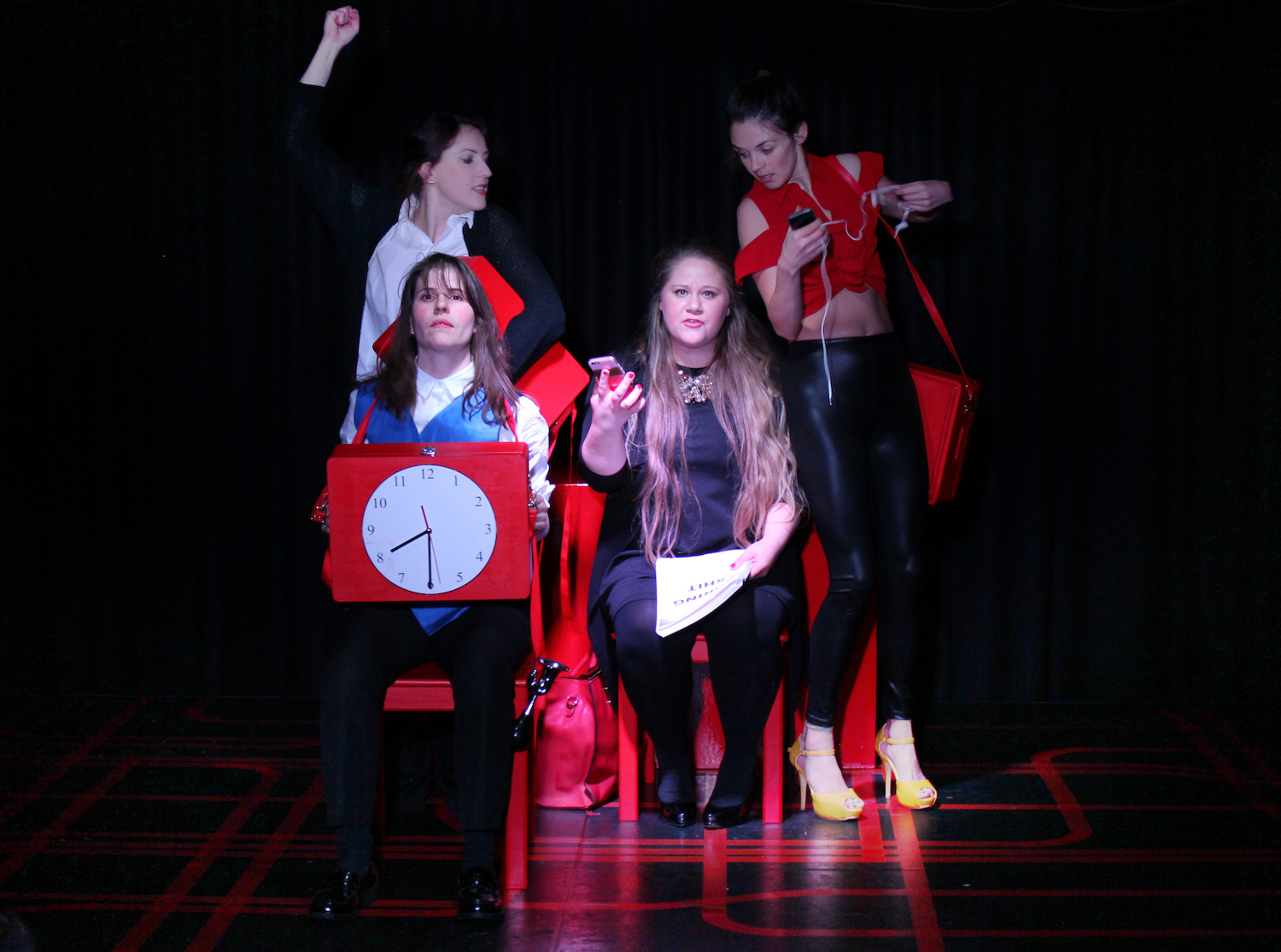
Written and directed by Evi Stamatiou, this is the first production from Fanny Pack Theatre, an all-female collective founded by Rachel Scurlock and Maria Alexe. Their company seeks to produce “contemporary stories about contemporary women”, and has been set up to tackle theatrical gender inequality. In a recent interview with The Stage, the co-founders said they wished to focus on working with women who are “outside the industry norm”, and although this is perhaps a lofty way of saying “give character actors a chance”, Day Job proves that the actresses in this project should be anything but overlooked.
Photo credit: Minglu Wang
Constructed as a series of interlocking tales about the lives of four female artists struggling to make ends meet in modern day London, Fanny Pack Theatre have created an energised, vibrant, engaging and at times hilarious piece of new writing. The device that links the narratives is the fact that all four women share the same bus journey to work, and scenes switch and intersect with ease thanks to Minglu Wang’s simple yet effective (and entirely blood-red) set. There is a degree of physical theatre and symbolised movement that is incorporated more or less well into the piece and melds fluidly with the more script-based moments.
Of the three stories, Maria Alexe’s songstress French teacher stands out as the highlight. The tale of a woman needing to get to a potentially life-changing audition whilst being stuck between a gaggle of remedial students and an overbearing teaching supervisor was played to perfection by Maria Alexe, and the fact that it involved a degree of comfortable audience participation made it all the more enjoyable. As Alexe’s frustration and desperation with her predicament grew, so in turn did the hilarity of the scene, and for me it was the highlight of the production.
Because unfortunately the other tales, one of baby-stealing escort service and a receptionist-murdering Devil Wears Prada rip-off were far too absurd and long-winded to maintain the laughter. With the French Class tale, it seemed obvious what we were in for: an hour of semi-autobiographical tales of the plight of being a part-time actress/full-time barmaid, but then shortly afterwards the subsequent stories descend into surreal tales from the underworld, with an infernal and demonic escort agency (with their contact phone number even ending in 666 we wave goodbye to subtlety) owning the rights to every baby their escorts produce, and a team of receptionists for “Dirty Business Inc.” (a company along the lines of Enron one assumes) being slaughtered by their line manager as the police break down the doors. The jokes started to flag here, and the characters, whilst ably held up by the talented cast, are just too two-dimensional and grotesque to warrant concern. It’s also a shame that the writer/director/devisers picked sex worker as a generic female job – surely this experience is not as widespread and relatable as teaching, bus driving or receptionist? This decision is so clichéd that it feels like Fanny Pack are actually promoting the theatrical views their company attests to strive against. A misstep here, to my mind.
Photo credit: Minglu Wang
These script qualms aside, it is the cast that deserve the highest praises. Switching from role to role in a matter of seconds, handling pathos and comedy with a clear aptitude, this quartet of actress prove that they’re a force to be reckoned with. Rachel Scurlock chews the scenery in every role she assumes, and is a complete delight to watch – she steals every scene and comes complete with an electricity in her eyes that makes her almost impossible to stop watching. Maria Alexe has a sultry, captivating and vivacious presence on stage, as well as a truly beautiful singing voice. Clare Langford is perhaps the most introverted and demure of the group, though this may be due to the selection of roles she’s given, and thrives when she is given the opportunity. Out of the four, Langford is the most underused, and this is a shame as she seems capable of tackling so much more than the material she was given. Stephanie Merulla as the enigmatic bus driver is the heart of the piece and holds the shows thematically together with a wry and knowing delivery, knowing how to hold back when needed and sharply point every punchline she’s given.
Day Job is an entertaining night out held together by four very talented young women. The script needs work in terms of its focus, but the performers deal with this ably, allowing their natural talent and creativity shine through.
Tucked away in a converted underground car park a few minutes from London Bridge is The Bunker, London’s newest (and quite possibly coolest) off-West End theatre. Its inaugural season continues with Muted, a new British musical that’s been several years in the making.
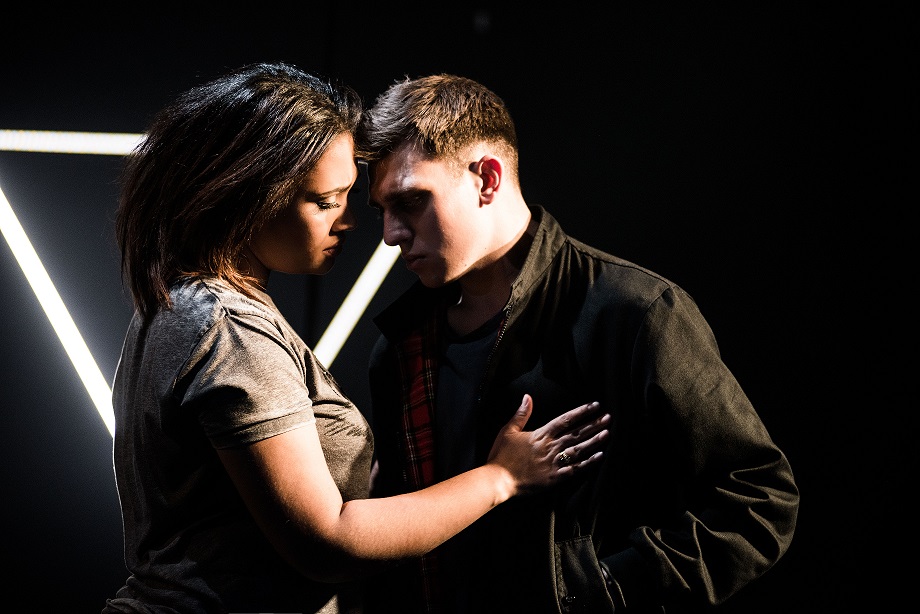
Written by Sarah Henley, with music and lyrics by Tim Prottey-Jones and Tori Allen-Martin, Muted is the story of Michael (David Leopold), a promising young musician rendered mute by the death of his mother (Helen Hobson) in a hit and run accident. Now cared for by his reluctant uncle (Mark Hawkins), he hasn’t seen any of his old friends for years – until his ex-girlfriend Lauren (Tori Allen-Martin), now in a relationship with his best friend Jake (Jos Slovick), comes to visit… and it becomes clear Michael isn’t the only one struggling to say what’s on his mind.
Photo credit: Savannah Photographic
The show was initially called After the Turn, but Muted feels like a more appropriate title – not only because of the subject matter but because it accurately sums up the musical itself. There are no big show-stopping song and dance numbers here; Muted is a quiet, reflective piece about the different ways we cope with loss, and the music is similarly gentle in tone, allowing the characters – most notably teenage Michael (Edd Campbell Bird), who speaks for his older self – to express what they can’t say in any other way. It’s music that makes an impression without needing to be catchy or toe-tapping, and left me wanting to listen to it all over again.
The story too is a bit of a slow-burner, with Act 1 focusing very much on establishing the back story, relationships and motivations of the characters, before the pace picks up in Act 2 and events begin to spiral out of control. The finale is undeniably beautiful, although it feels rather abrupt – everything falls suddenly into place in a conclusion that’s a bit too neat, especially after such a lengthy build-up.
In a uniformly strong cast, David Leopold is perfect as the damaged Michael. Unable to make a sound, he speaks volumes with his face and body language, expressing his vulnerability and frustration with a twitchy intensity and haunted gaze. His relationship with teenage Michael, played by Edd Campbell Bird, is particularly moving; radiating energy and assurance, the younger man acts simultaneously as a friend and a constant reminder of everything he’s lost. Equally flawless is Tori Allen-Martin as Lauren, who unlike Michael, talks too much – but beneath the chatter lies a young woman who’s just as fragile as her ex-boyfriend, and it’s not at all clear by the end of the story who needs whose help more.
Photo credit: Savannah Photographic
Jamie Jackson’s production is quite abstract, leaving much open to interpretation. The set, designed by Sarah Beaton, is simple and stark: a square walkway surrounding a shallow pool of water, at the centre of which sits the island representing Michael’s bedroom. (There’s also a swing hanging from the ceiling, which gets a lot of use throughout the show, although its significance is never totally clear.) And many of the songs are accompanied by gestures from the actors that fall somewhere between interpretive dance and a kind of sign language, stripping the story back to its core emotions and producing some of the most visually striking moments in the whole show.
Muted is a powerful new musical that appeals to every emotion; it’s at times desperately sad, at others laugh out loud funny, and concludes on a note of cautious optimism. Though the show’s not yet perfect, it certainly has the potential to be – and even now, there’s no doubt it’s been well worth waiting for.
Can’t see the map on iPhone? Try turning your phone to landscape and that should sort it. I don’t know why but I’m working on it… 😉




 Theatre Things