Review: House on Haunted Hill at Leicester Square Theatre

You know you’re in for an interesting evening at the theatre when you’re greeted by a man in a biohazard suit handing out ping pong balls. For those who saw the Lampoons’ last show, Attack of the Giant Leeches, this will come as no surprise. For those who didn’t, get ready for quite the experience, as the team return with their latest production, House on Haunted Hill. Based (incredibly loosely, one suspects) on the 1959 Vincent Price movie of the same name, it features a special guest appearance from “Vincent Price” himself, complete with questionable moustache and wildly fluctuating accent.

Photo credit: Headshot Toby

The plot, such as it is, revolves around four unsuspecting guests invited by Mr Price to stay the night in a haunted house. If they make it through, they’ll win $10,000 – which we’re reminded in the programme was a lot of money back then. Cue severed heads in suitcases, blood dripping from the ceiling, and a balaclava ballet band performing Swan Lake (what do you mean, that wasn’t in the movie?).

It very quickly becomes clear – if the ping pong balls didn’t already make the point – that this is not a show we’re supposed to take seriously, or even really understand; I’m none the wiser as to what actually happens in the film. Despite the name, it’s not very scary – but it is extremely silly, and who doesn’t love a bit of silliness every now and again?

Responsible for all this mayhem is a cast of very funny actors – Adam Elliott, Oliver Malam, Christina Baston and Josh Harvey (and guests) – who don’t mind making complete fools of themselves or potentially getting hurt and/or choking on a pickle. (This is particularly entertaining when you’ve seen two of them before in very serious plays…) Anyone who enjoys the antics of Mischief Theatre will recognise the same talent here for making chaos look effortless. The Lampoons operate on a significantly smaller budget, but they don’t let that stop them; quite the opposite – they embrace their limitations and turn them to their advantage, with hilariously dodgy effects, props and accessories that are just one more source of laughs. After a while it becomes hard to tell what’s planned and what just sort of happens, but the cast take it all in their stride, with just the occasional mid-scene fit of helpless giggles. And while I wouldn’t go so far as to say front row beware, it’s worth knowing that audience participation is enthusiastically encouraged and responded to by the actors.
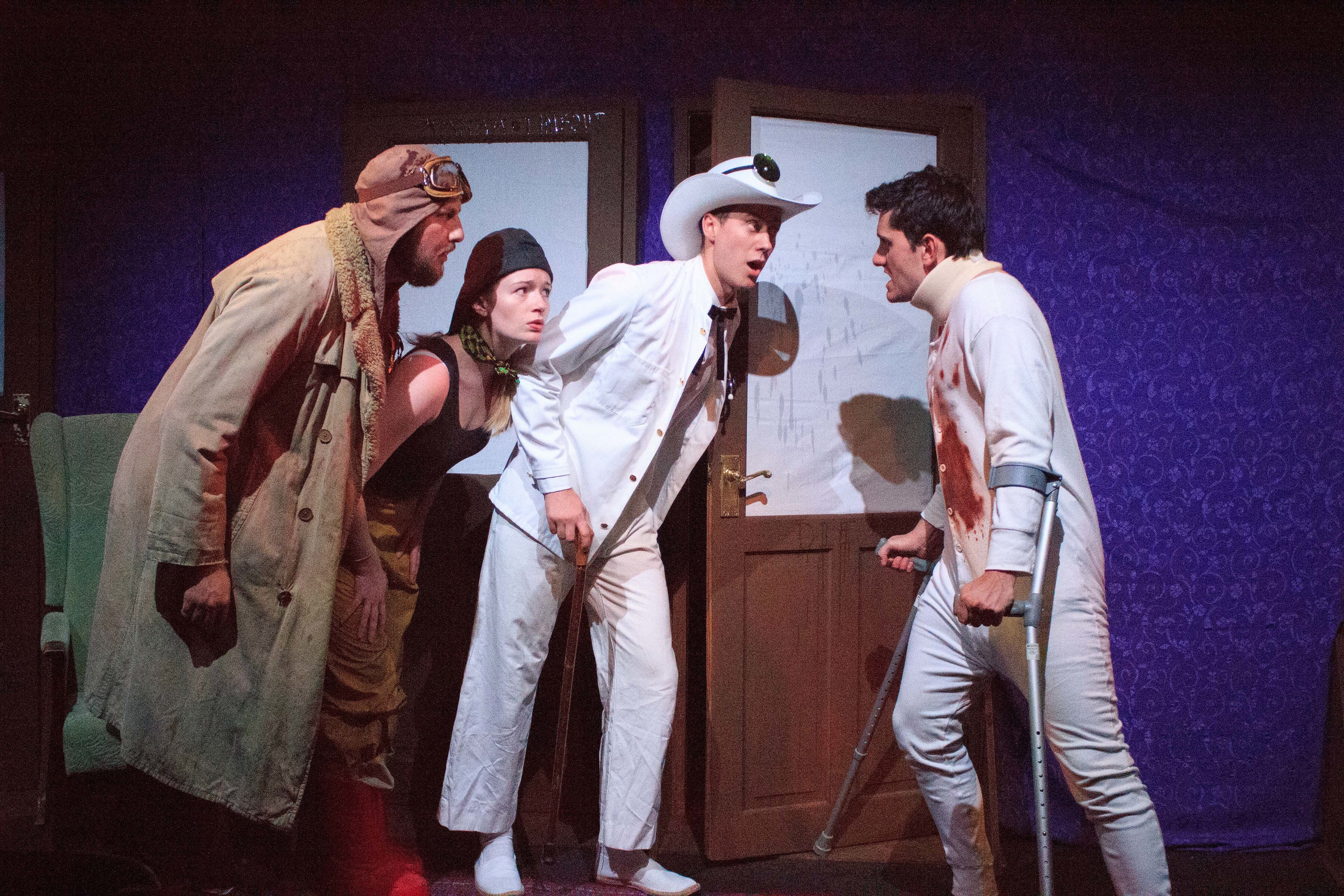
Photo credit: Headshot Toby

As a result, it should come as no surprise that we frequently meander away entirely from the plot – though in some cases this is (again, quite deliberately and openly) just a ploy to keep us occupied while someone gets changed for the next scene. If you like to follow everything that’s going on, this may not be the show for you. If, on the other hand, you quite like not having a clue what might happen next, you’ll love it. And if you’re a fan of Vincent Price movies… well, you might just be a bit confused.


Can’t see the map on iPhone? Try turning your phone to landscape and that should sort it. I don’t know why but I’m working on it… 😉

Review: The Trap at Omnibus Theatre

With Christmas approaching far too quickly, more than one mind will be turning to the question of finances. So it’s an apt time of year to stage Kieran Lynn’s satirical comedy The Trap, which is set in a branch of the Debt Duck, a high street payday loans company where it’s not only the customers who are in need of bailing out.

Clem just got fired. Tom’s struggling to pay his rent. They just so happen to know there’s 10 grand in the safe, and plans are a bit of a speciality of Clem’s… Unfortunately, their ill-conceived heist is interrupted by branch manager Alan – and chaos ensues. But it’s fine, because it’s only stealing if you get caught, right?

Photo credit: Laura Harling
As we all know, companies like the Debt Duck may be legal but are also far from ethical, taking advantage of desperate people by offering a short-term fix in exchange for long-term misery. The employees of the branch are all too aware of the parallels between themselves and the Estonian gangsters who turn up later on in the story – but ironically they depend on the company for their own financial survival, and are consequently just as trapped as their unfortunate customers. Incoming government regulations are the catalyst, jeopardising the future of the Debt Duck and everyone caught within its vicious circle, and setting the scene for a debate about the ethics of capitalism.

Fortunately, we’re saved from anything too heavy by a witty script from Kieran Lynn, who clearly shares regional manager Meryl’s love for a good metaphor, and four strong comic performances from the cast (Jahvel Hall, Sophie Guiver, Andrew Macbean and Wendy Kweh). All four characters are somewhat ethically challenged – with the exception of Jahvel Hall’s Tom, who keeps trying to do the right thing in the face of intense peer pressure – but they’re also incompetent enough as both moneylenders and criminals that we just end up feeling sorry for them (Andrew Macbean cuts a particularly pathetic figure as the hapless Alan). The true villain of the piece is the unseen, mythical figure of company boss Trevor Wynyard, who has the power to make or break everyone else’s lives whilst remaining untouchable himself.

Photo credit: Laura Harling
Sarah Beaton’s set recreates the Debt Duck office in realistic detail, with director Dan Ayling centring the action along the middle of the space, with the audience seated on three sides. The lighting design from Jamie Platt not only helps us keep up with the story’s two distinct timelines (one night, one day) but also creates just the right level of drama at key moments. On a similar note, I feel I should mention the office’s temperamental burglar alarm (sound by Edward Lewis) which plays such a major role in proceedings it’s practically a fifth character.

While the play doesn’t exactly tell us anything we didn’t already know (payday loans companies are bad, basically), it is very funny – but is careful to target its satire at the perpetrators rather than taking cheap shots at the victims, so we don’t feel bad for laughing loudly and often. Recommended for a fun – and affordable – night out.


Can’t see the map on iPhone? Try turning your phone to landscape and that should sort it. I don’t know why but I’m working on it… 😉

Review: Scratch the Surface: The Female Playwright at The Bread and Roses Theatre

The third Scratch the Surface event from Instinct Theatre produced a collection of five very different pieces, with one thing in common: they were all created by women. Covering a range of themes from mental illness to manspreading, the evening brought together an enjoyable and innovative showcase of new writing talent.

Written and performed by Amelia Sweetland, Sharp Edges (directed by Nathan Theys) got the ball rolling with a portrayal of anxiety that’s all too recognisable. Sophie’s having a party, even though she doesn’t really want to – but she’s invited her boss and can’t back down now, despite being almost paralysed by anxiety. And the only person she can talk to about it all… is herself. Gentle humour and extreme Britishness collide with the desperate poignancy of a young woman who knows her irrational fears and lifelong need for perfection are holding her back, but is powerless to get past them.

The second piece, #iAmResilient by Lucrezia Pollice, was easily the most ambitious, combining theatre with audiovisual content to paint a picture of millennial life. Using a screen to show us text, Tinder and Facebook conversations is an inspired touch, given that most of us probably have more interactions on screen than in person these days. That said, future performances could definitely benefit from a bigger screen, to allow everyone to see what’s happening. The piece covers several themes but its main focus falls on Maria, and an honest exploration of the impact of her mental health issues on her relationship with her housemates. #iAmResilient has some interesting ideas, but definitely feels like a snippet of a longer piece, so it will be interesting to see how it develops from here.

Maternity by Stephanie Silver is a comedy, but even this very funny piece has a sting in the tail. Laura’s about to leave work to have a baby, but is anxious that she won’t make a good mum. Even so, her well-intentioned friend Kate is determined to give her a good send-off, whether she wants one or not. In a clever twist, the play sets up the two characters then, without warning, turns our opinions of them on their head. We’re still laughing, but now it’s tinged with a hint of sadness on one hand, and shock on the other. Even so, Laura’s honesty about her fears – however exaggerated in this case – is actually quite refreshing in a world that constantly sells the idea all women are natural mothers.

Saturday Night (directed by Laura Clifford), one of six monologues from Francesca Mepham’s collection No One Wants a Pretty Girl, finds Amber sitting alone at home watching Doctor Who. She’s just split up from her boyfriend (again) and can’t seem to connect with her friends, who just want to go out every weekend rather than catch up with her. A short but heartfelt monologue about loneliness and not quite fitting in, this is a piece of writing that reaches out to anyone who’s ever found themselves in Amber’s shoes – getting pulled back into an unhealthy relationship just for the sake of feeling loved.

And finally, the evening ended on a raucous note with Manspreading by Laura Hall (directed by Niamh Handley-Vaughan), in which the drunken conversation of three young women on a night out turns to the antisocial habit that is manspreading. More specifically, they’re outraged by the fact that it should be the exclusive domain of men – like Yorkie bars all over again, as one of them points out. It’s all very lighthearted and over-the-top, but the play does raise some interesting discussion points about gender roles and differing social interpretations of male and female body language, which seem particularly relevant in light of recent media events.

It’s always interesting to see new writing at such an early stage in its development, and on this occasion particularly exciting to see it all coming from female playwrights. Once again, Instinct Theatre have put together an  evening that provided its audience with plenty of food for thought, but also five talented writers to keep our eye on in the future.

For future Scratch the Surface events, follow @InstinctTheatre on Twitter.


Can’t see the map on iPhone? Try turning your phone to landscape and that should sort it. I don’t know why but I’m working on it… 😉
Review: Happy yet? at the Courtyard Theatre

“Why can’t you just be happy?” asks one of the characters in Katie Berglöf’s debut play, Happy yet? To people who’ve never lived with depression or anxiety, they can be difficult concepts to understand – particularly, perhaps, in Sweden, which is famous for being one of the happiest countries in the world.

Enter Torsten Sandqvist. He’s nearly 40, unemployed, and living in his brother and sister-in-law’s attic room in Stockholm. For as long as anyone can remember he’s been writing a play, but between staying in bed until 3pm and going out with a new girl each night, he’s not getting much work done. As his family grow ever more frustrated, the only person Torsten can really talk to is his young niece, Nina – but she never goes to school, and nobody else seems aware of her presence…

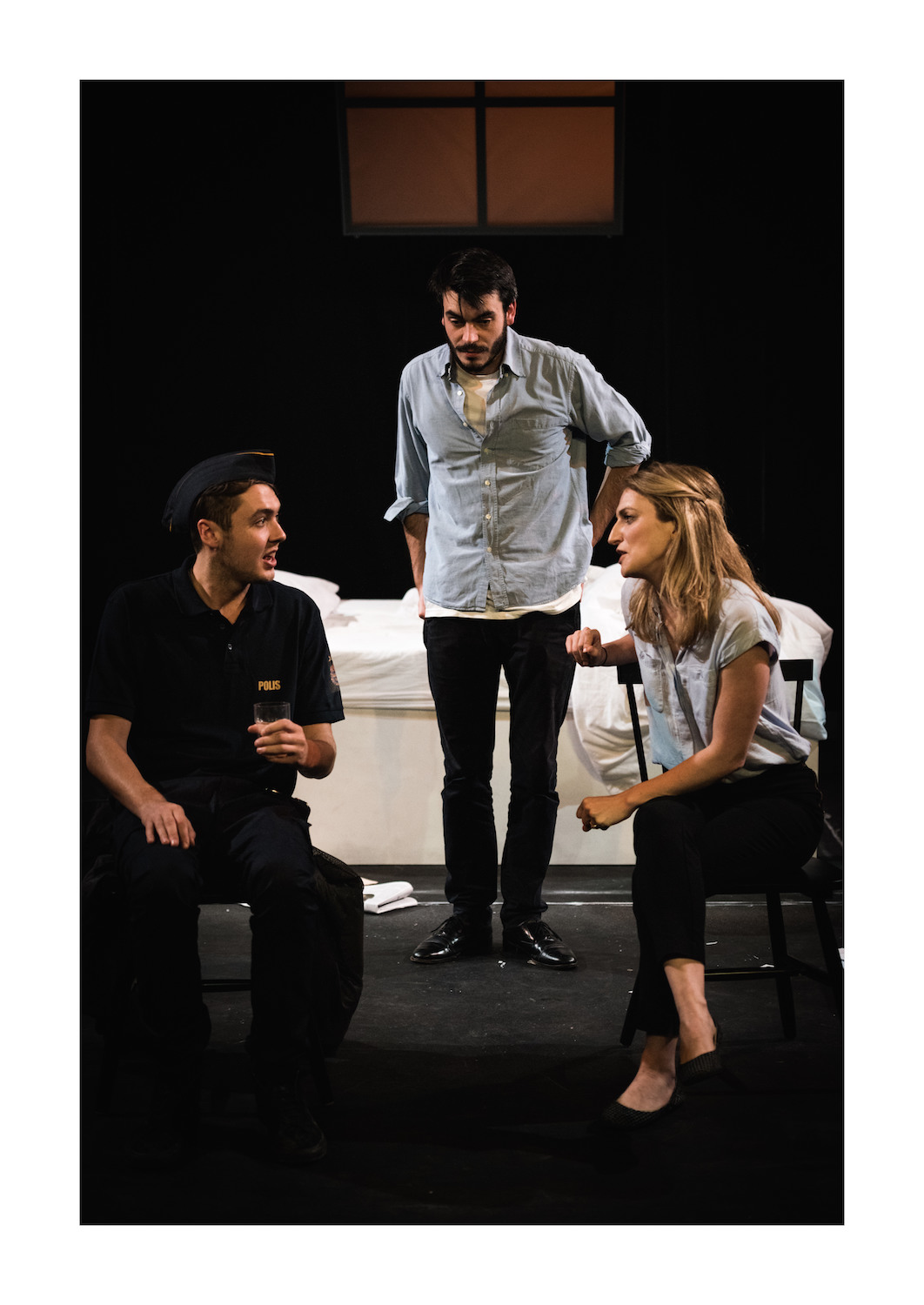
Inspired by the traumatic personal experience of losing her uncle to suicide, Katie Berglöf has written an enlightening, often troubling but just as often unexpectedly humorous depiction of what depression looks and feels like from both sides of the story. The most important lesson we learn is that depression doesn’t necessarily mean you’re miserable all the time. On a good day, Torsten is hilarious, wildly optimistic and everyone’s best friend (at one point, he convinces a police officer who’s come to arrest his brother to go drinking with him instead). Unfortunately he also can’t stop lying to make himself look good, and after one crazy scheme too many, it’s no surprise his brother’s patience is starting to wear a little thin.

A charismatic David Beatty does a great job of navigating Torsten’s highs and lows, in a world that tries its best but never quite gets to grips with what it’s like to be him. This world is represented by Piers Hunt, Molly Merwin and Lucinda Turner as his brother, sister-in-law and girlfriend, who clearly love him and want to help but have no idea how. The play aims to explore the impact of mental health issues not only on the individual but also on those closest to them, and is careful to make clear that Torsten’s family are suffering too. In fact, the only entirely unsympathetic character in the play is the mental health professional who aggressively questions Torsten about his problems, but offers no answers – unless you also count his unseen parents and other siblings, who we learn rejected him long ago for what they saw as his weakness.

It’s a shame that the play’s ending leaves a few too many unanswered questions – particularly surrounding the ever-present Nina, played by Minnie Murphy. It’s obvious from the start that there’s more to their relationship than meets the eye, but the (almost) complete lack of clues as to how or why she became Torsten’s confidant is a bit frustrating, and I found myself waiting for a revelation that never came.

Even so, the play’s message and intention come through loud and clear. It’s so important to keep talking about mental health, and Happy yet? plays its part by offering a very personal insight into one family’s struggle to find an answer to an unanswerable question. In particular, the play challenges the misconception that happiness is something which can be turned on or off at will, and encourages understanding instead of judgment. And if it feels a little unfinished, that’s okay – this is, after all, a conversation that’s far from over.


Can’t see the map on iPhone? Try turning your phone to landscape and that should sort it. I don’t know why but I’m working on it… 😉
Review: A Nazi Comparison at Waterloo East Theatre

Based on Schlageter by Hanns Johst – Hitler’s favourite playwright – Craft Theatre’s A Nazi Comparison makes some solid points and clearly has good intentions. I really wanted to like it, but an unnecessary excess of drama makes it difficult to see past the tears and shouting to get to the message behind.

Clare is a PR student at UCL preparing for a big presentation, but after one of her lecturers lends her a copy of Schlageter and she falls for a guy at a Grenfell protest, she starts looking into the unnerving similarities between Nazi propaganda and the rhetoric of today’s press. It doesn’t take long for her to realise that if you replaced “Jews” with “Muslims” in the speeches, it sounds very much like something Donald Trump would say. In the end, unable to stomach the idea of joining a PR machine that knowingly misleads the public, she withdraws from her degree course in sensational fashion.

So far, so good. After we’re treated to a short video presentation about the unfair representation of Jeremy Corbyn by the British media, Louise Goodfield delivers Clare’s fateful presentation with genuine passion – and even if it does start to feel a bit like we’ve wandered into a political rally rather than a play, you can’t help but admire her for having the courage of her convictions and standing up for what she believes is right. Unfortunately, her mum (Helen Foster) doesn’t even attempt to feel the same way, and it’s not long before the two are embroiled in a screaming row – not their first or last of the evening – about all the ways she’s endangered her future. Nor is her mum the only one who can’t understand her decision, and soon Clare finds herself living in a squat with Craig (Craig Edgely), the guy from the Grenfell protest. This goes well for a while – the exact timeframe of the play is unclear – until Craig decides group leader Lucas (Lucas John Mahoney) and his strategy of peaceful protest aren’t working for him any more. Cue more shouting and a dramatic off-stage twist, followed by an even more dramatic on-stage finale.

All this drama starts to get in the way more and more as the play enters its second hour. Nobody seems capable of having a rational discussion; every conversation quickly turns into an argument, with people shouting over each other, sobbing, wailing and generally being far more melodramatic than seems necessary. By the end, it’s all unfortunately a bit of a mess, and not at all clear any more what point is being made, who we’re supposed to be supporting or why.

All that said, there are some very touching scenes between Clare and her dad (Thomas Thoroe), who unlike his ex-wife at least tries to understand where his daughter’s coming from. The physical ensemble work is very slick, particularly in the montage sequence (a bizarrely timed comic interlude) and after each scene, when the cast somersault across the stage like ninjas to get in position for the next. And there’s no faulting the conviction of the company; I would just have liked a bit less raw emotion and a bit more rational debate to help me understand what, beyond the obvious Nazi comparison, I was meant to be taking away.


Can’t see the map on iPhone? Try turning your phone to landscape and that should sort it. I don’t know why but I’m working on it… 😉