Interview: Penny Rodie and Davide Vox, Rounds

Rounds, which opens this week at the Illuminate Festival in Wimbledon, follows six junior doctors as they try to balance their demanding jobs with a life outside work. It’s a hugely topical subject, and while they’ve avoided taking a political stance, Resuscitate Theatre are hoping the show will open audience’s eyes to the pressures – both personal and professional – faced by junior doctors every day.

Rounds Image

“I don’t think there could be a more relevant time to be doing a show like this. I’m proud of the work we’ve done and hope that the production is able to convey to audiences what it’s like to be coping with life, death and the pressures of an overstretched NHS on a daily basis,” explains Penny Rodie, who plays Dr. Lucy Wright.

“Lucy’s a hard working overachiever who often feels that her best isn’t good enough. She found things tough at medical school so is determined to prove that she’s a capable and confident doctor. Her single-mindedness means she struggles to form the close relationships she’d hoped to have with her fellow doctors, and this leads her to make some questionable choices.”

Davide Vox plays Dr. Giobbe Poretti: “Giobbe is a young Italian doctor that moved to the UK one year before the events of Rounds, in order to pursue his career in medicine. During the show we see him facing the difficulties of being a foreign doctor in an English hospital, being alone and far away from his friends and family, and struggling to create new relationships with the other doctors that revolve around him.

“We’ve taken the decision to face the issue by purely presenting junior doctors’ everyday lives, rather than push a preconception on the strikes and political situation. This gave us the chance to focus on their human relationships and feelings. When does anyone ever think about their doctor’s everyday life?”

The show’s been in development for a few months, incorporating material gained from interviews with junior doctors and the actors’ own personal research. Davide interviewed Italian doctors living and practising in the UK, and says he discovered things he would never have known:

“Lack of time for family and friends (an Italian junior doctor gets an average of 2 or 3 minutes every two weeks to speak with their relatives on Skype, as they’re constantly pushed to work not only inside the hospitals but also on their own to try and solve the natural language gap), pressure to constantly work on ameliorating their English, and racism are still big problems for all Italian doctors. Of course I was also able to relate and bring in part of my personal experience as an immigrant.

“The biggest surprise was probably that, despite the fact that they are praised and extremely respected for their professionalism, Italian doctors, like all doctors coming from non-English speaking countries, are periodically tested on their language knowledge, no matter how long they’ve been living in the country. Apparently the English test is quite challenging, even for British doctors, and one small failure can cost you a full year of mandatory break. Foreign doctors are absolutely not supported and it just doubles the pressure they’re put under.”
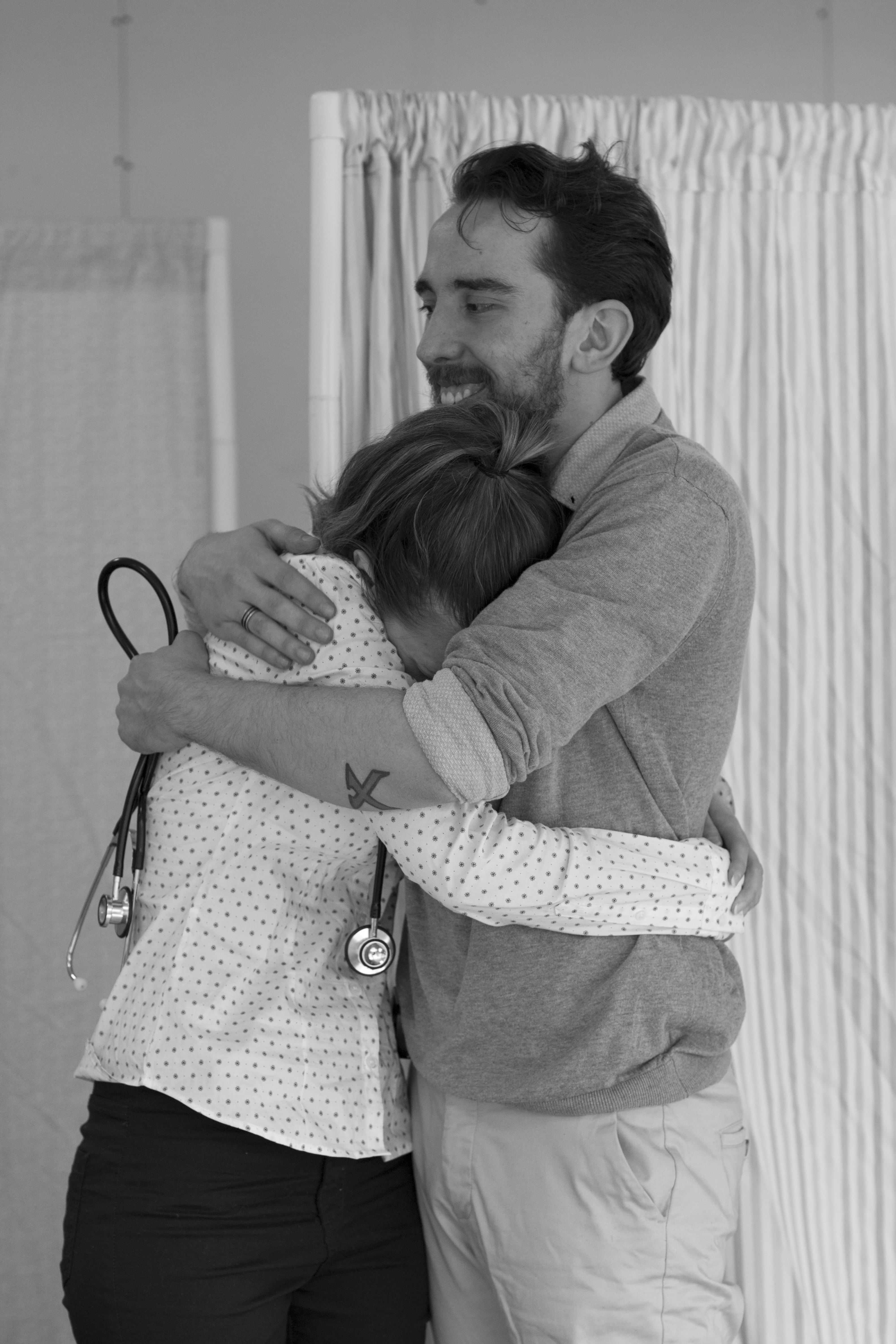
Wimbledon Rehearsal (13 of 15)

Penny took a different approach: “I focussed my research on mental health problems amongst doctors and NHS workers in general, as this is something that has affected Lucy’s life and continues to do so. I learnt about the stigma that still surrounds mental health issues, symptoms and triggers, and looked at how this might affect what happens in the workplace.

“I looked at a few distressing case studies where doctors’ mental health deteriorated, and found that the procedures of the General Medical Council in these circumstances can often just pile more pressure on rather than providing the support required. I came away with a sense that these were caring people whose profession failed them.

“I hope audiences have empathy for Lucy’s situation and come away with an appreciation of just how tough it can be to get through each day, no matter how passionately she might want to help people.”

Davide hopes the show will move people. “I’d like them to go away feeling related to the characters we’re bringing on stage, understanding all the turmoil, hopes and dreams of these human beings. I hope they’ll also be able to get what it means to be an immigrant and how difficult it is to be far away from home, from your family and friends, no matter where you actually come from. How the choice of leaving for another place is never easy and it always come with a lot of sacrifices.”

Rounds is at New Wimbledon Studio on 18th and 19th May.

Interview: Joe Sellman-Leava, Labels

Joe Sellman-Leava is co-artistic director of Worklight Theatre, and writer of the award-winning Labels, a solo show that tells a very personal story and invites us to consider its implications on a much broader political scale. In this interview, Joe explains a little about the show’s background, and how it’s been received so far.

Labels can currently be seen at Theatre Royal Stratford East until 30th April – you can read my 5-star review over at Carn’s Theatre Passion – before embarking on a national tour.

If you could sum up the show in one sentence, what would it be?

A personal, political odyssey through right-wing rhetoric, prejudice and family. 

What inspired you to write Labels?

I was in a drama workshop at Exeter University in 2009, exploring racism and inequality. It was led by Emma Thompson, who was doing a series of talks and events at the University after her son Tindy experienced racist abuse during his degree. I wrote the beginnings of what eventually became Labels, in preparation for that workshop. Afterwards I kept writing and developing it in small bites. A year later, in early 2015, with a general election looming and national debate dominated by anti-immigration rhetoric, I felt it was time to finish the show and start touring it.

Emma Thompson described the show as “simple, powerful, important and funny”. What does it mean to you to have such a successful and influential supporter?

It means a lot! Firstly, it’s a huge validation, especially when the show was initially inspired by her workshop. Also, getting new audiences to trust you is hard, and Emma’s words have meant that people who might never have connected with us have now seen the show, told their friends and will hopefully stay interested in what Worklight are doing next.

Photo credit: Ben Borely

The show is obviously very current. Did it develop in the way you expected when you started writing it, or has it taken other directions as a result of world events?

Specific events in the last 12 months or so have definitely made their impact on the show, and we felt we had a responsibility to respond to what was happening given the themes and content of the show. That said, things were different 6 years ago when I started writing this, and different again when my parents were experiencing some of the things the show discusses. As well as responding to what’s happening now, we’ve always tried to acknowledge the timeless elements of the show (people have always migrated), as well as the fact that history repeats itself: for instance, we cite Enoch Powell’s speeches alongside those of David Cameron and Nigel Farage.

You share several very personal and quite difficult memories – both your own and your family’s. Has that been hard, and does it get any easier the more you perform the show?

It’s not hard performing it, but creating the show had its challenges with regard to including personal stories. So much of the content is derived from my parents’ first hand experiences of racism, as well as other experiences or conversations within our family. When the story isn’t yours alone, you have to tread carefully so no one feels used, or exploited when it’s made public. So yes, performing the show feels fine, but getting the show to a place where it did justice to the people whose stories it’s built on, that was challenging!

How have audiences responded? Have you had any unexpected reactions?

Responses have been very positive: after most shows people are keen to chat and lots of them tell us how the story resonated because they’ve experienced racism or other forms of prejudice in their own lives. Or because they’ve seen a friend or family member on the receiving end of those experiences. As for unexpected reactions…there are sometimes people who disagree with certain opinions expressed in the show, and to be honest we always welcome this. Theatre should be a space where people can discuss, debate, disagree, and Worklight try to embrace the opportunity live performance has to create this kind of experience for audiences which, for instance, film or TV can’t in quite the same way.

Photo credit: Anna Bruce

You do a lot of impressions in Labels. Which was the toughest one to get the hang of? And which is your favourite?

I find the Australian accent quite tricky, so Tony Abbott is probably the toughest! My favourite is Ed Miliband… let’s hope he finds something new to do soon, or I’ll have to retire his impression!

When did Katharina [Reinthaller, the director] come on board? How has it been working with her on developing the show?

Katharina came on board in March 2015, via Jessica Beck – a director both of us have worked with a lot. Her input as director and dramaturg has been invaluable and took the show forward in new, exciting ways. She has a fantastic ear for the power of language, imagery and the way stories resonate, so the countless hours spent working through the many, many drafts of the text with her were a joy. And her equally brilliant eye for proxemics, energetic shifts and rhythmic changes meant she took the performance to a new level. It’s her first collaboration with Worklight and we’re thrilled she’ll be directing our next show, Fix!

How does it feel to be launching the new theatre space at Stratford East?

It’s a real privilege and very exciting! Stratford East is truly committed to being “a people’s theatre” and you can see this in their programme, their audiences, the very building itself. We couldn’t think of a better fit for the show.

What’s one thing you hope your audiences will take away from the show?

We want people to leave thinking about and talking about what they’ve seen!

Interview: Toby Peach, The Eulogy of Toby Peach

Toby Peach has fought cancer twice – once at age 19 and again at 21. Now he’s taking his one-man show, The Eulogy of Toby Peach, on a UK tour, starting at London’s VAULT Festival and running from 17th-21st February.

The show, which won the IdeasTap Underbelly Award in 2015 and proved a five-star hit in Edinburgh, is a brave and humorous exploration of what cancer’s all about, through Toby’s own story. It’s also a really important show, given that 1 in 2 of us will experience cancer in our lifetime, and I’m grateful to Toby for taking the time to tell me a little more about it.

What prompted you to share your story?

I developed a short story for BAC’s London Stories back at the end of 2013, it dipped into my journey with cancer and it was the first time I had decided to speak about it. The response was fantastic and I decided I wanted to delve deeper into that world, as I realised I had no idea what had happened. I’d been through this life-changing event and I had no idea what had happened – it was all a blur. I realised that I didn’t know what cancer was. This thing that nearly took my life and I had no idea.

If, hauntingly, it is now 1 in 2 of us who will experience what cancer is, shouldn’t we know what it is? As it became apparent that cancer was just me, then how am I still here? This question prompted a deeper exploration and with it came a discovery that I wanted to share.

The Eulogy of Toby Peach

How long has the show taken to develop? 

After BAC and with the help of Old Vic New Voices I developed the show so I could scratch it and then the unbelievable happened and I won the IdeasTap Underbelly Award. I was blown away as it meant I had to make the whole bloody show!

After assembling a cracking team I headed out to Plymouth Fringe Festival to scratch the show further and experience solo performance – I had never performed a solo show before so it was very daunting. Then came Edinburgh; we had a fantastic month getting it out there for the first time and were overwhelmed by the positive feedback to the show from audiences, press and industry alike, as well as being inspired by the learnings and ideas taken away from the experience.

So after all of that we come to VAULT festival, and as we’ve just received Arts Council, National Lottery and Wellcome Trust funding, we can’t wait to get started and develop this show further to reach more audiences in the future. 

Has it taken any unexpected directions?

This has been my first experience of writing, and also solo work, so the whole experience has been quite unexpected. I have strange moments when I’m performing when I realise ‘Oh yer, this happened!’ or a version of it. I mean I never did have an affair with an IV Stand but that relationship was present – so sometimes I’ll be dancing away with IVY (my IV Stand girlfriend) and then it’ll hit me again. It’s an odd experience.

What’s been the highlight so far?

Since Edinburgh I’ve been off to perform the show a number of times and had the honour of taking it to Teenage Cancer Trust’s conference, Find Your Sense of Tumour, for 300 young people who have or have had cancer and their support teams; this was an incredible experience and extremely rewarding.

I was very nervous about performing for them, as I knew they related so much with the subject matter, but they were laughing at lines that people don’t normally get and they loved it. People expect you can’t laugh at cancer but especially when you’re young and you’ve been through it, they understand there are things that if you look at it again are fairly amusing. I spoke to so many afterwards about what it meant to them and that meant the world to me.

Can you sum up the show in one sentence?

From diagnosis to remission, relapse and treatment, experience a young man’s journey with cancer in this honest, fascinating and inspiring exploration of modern science and the wonders of the human body. 

What are you hoping audiences will take away from it?

I hope they take away the hardest word to say with cancer… Hope. The show doesn’t say we’ve been lucky and we should be thankful for that, it says we are here because of certain reasons and we have a hell of a way to go – but we are trying. Chemotherapy was only trialled 69 years ago… look how far we’ve come.

Finally, what would be your advice to someone currently living with cancer?

That is a very tricky question to answer, as everyone has his or her own unique experience with cancer. I can’t say there is a right way or wrong way to live with cancer. For me, it took a long time but I wanted to explore what had happened so I didn’t hide from it. I have scars, everyone gets them throughout life, but I realised it isn’t about how we get our scars; for me it’s about how we wear them in the here and now that matters.

See The Eulogy of Toby Peach from 17th-21st February at the VAULT Festival, London.

Toby will also be running a free workshop called Creativity Saving Lives, exploring the background to the show, on 21st February at 2pm.