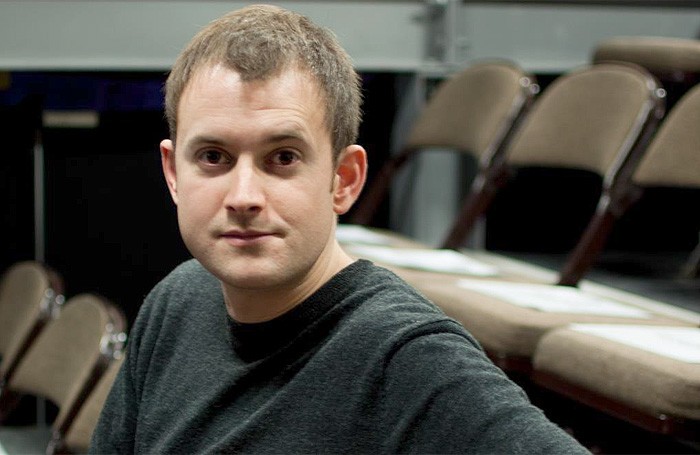
Owen Calvert-Lyons was recently appointed as the new Head of Theatre and Artists’ Development at Ovalhouse Theatre in South London. The former artistic director of The Point and The Berry theatres in Hampshire joins the Ovalhouse team as they prepare to move to a new home in Brixton in 2019.
So what does a Head of Theatre and Artists’ Development actually do? “My role is to ensure that art and artists are at the centre of everything that we do,” explains Owen. “I want to give a voice to a new generation of artists, particularly those from South East London. I will programme the mainhouse (Downstairs) and studio (Upstairs) theatres, commission artists to create new works and I’ll build an artist development programme which supports, nurtures and champions artists.
“My first season of programming will be Spring 2017, which will see a really exciting mix of new and familiar artists presenting bold and innovative productions. Before that, in July we have Seiriol Davies’ How to Win Against History, which is a hilarious, anarchic new musical.”
The new Head of Theatre is full of plans for audiences and artists alike: “I want to grow our audiences. I want people from across London to see Ovalhouse as a place that they can come to enjoy performances by the most exciting artists around.
“And I want us to be an artist’s first port of call when they have a great idea. A place where they can make their vision a reality. Ultimately, artists want to create great work and audiences want to see great work. We are creating an environment in which artists and audiences can come together to explore new ideas.
“Ovalhouse is a special venue, with a long history of radicalism. This has meant something different for every decade: feminist theatre, LGBT theatre, political theatre, performance as protest etc. This has meant that Ovalhouse has been a space for new ideas and new voices, which is always where the most exciting work comes from. We are in the process of defining what we think radicalism means for 21st century artists and audiences.”
Owen joins fellow new recruits Stella Kanu (Executive Producer) and Gary Johnson (General Manager) at a huge moment in the theatre’s history, as plans get underway for the move to Brixton: “Stella and Gary are great.They are bringing new ideas and new ways of working.This has engendered a feeling of energy and optimism amongst the whole team, so that we are all working together to ensure that Ovalhouse has a really exciting future.
“The whole team is bubbling with excitement about the move. The new venue will be right in the heart of Brixton. One of the things that makes it distinctive is that it will have seven rehearsal rooms, so it will be a creation centre full of artists making extraordinary things.
“Many of the spaces will be rigged for aerial work, so we will be able to support the development of contemporary circus as well as theatre and dance. The two new performance spaces will be bigger than the existing Ovalhouse studios and better equipped, so we can make even more exciting work for even bigger audiences.”
Find out more about How To Win Against History, and see what else is coming up in the Ovalhouse Spring/Summer 2016 season at www.ovalhouse.com.
“The little gardener worked very hard but he was just too little to make a difference. One night, he makes a wish ‘for a little bit of help’ and as he sleeps the local children, inspired by his beautiful flower, help bring his garden to life.”
Photo credit: Eva Sampson
So begins the story of Emily Hughes’ The Little Gardener, adapted by How It Ended, in association with Scamp Theatre. Dramaturg and co-artistic director Teresa Burns explains what drew the company to the story:
“We’re big fans of Emily Hughes so we were very excited about the book’s release last year. The Little Gardener felt like perfect subject material for adaptation, particularly outdoor theatre – not only because of its setting but because of its message about community. The story beautifully illustrates the impact an act of kindness can make on a person’s life and how it can inspire them to carry on.
We’d love our audiences to take away a sense of community; a feeling that by working together you can make something really special.”
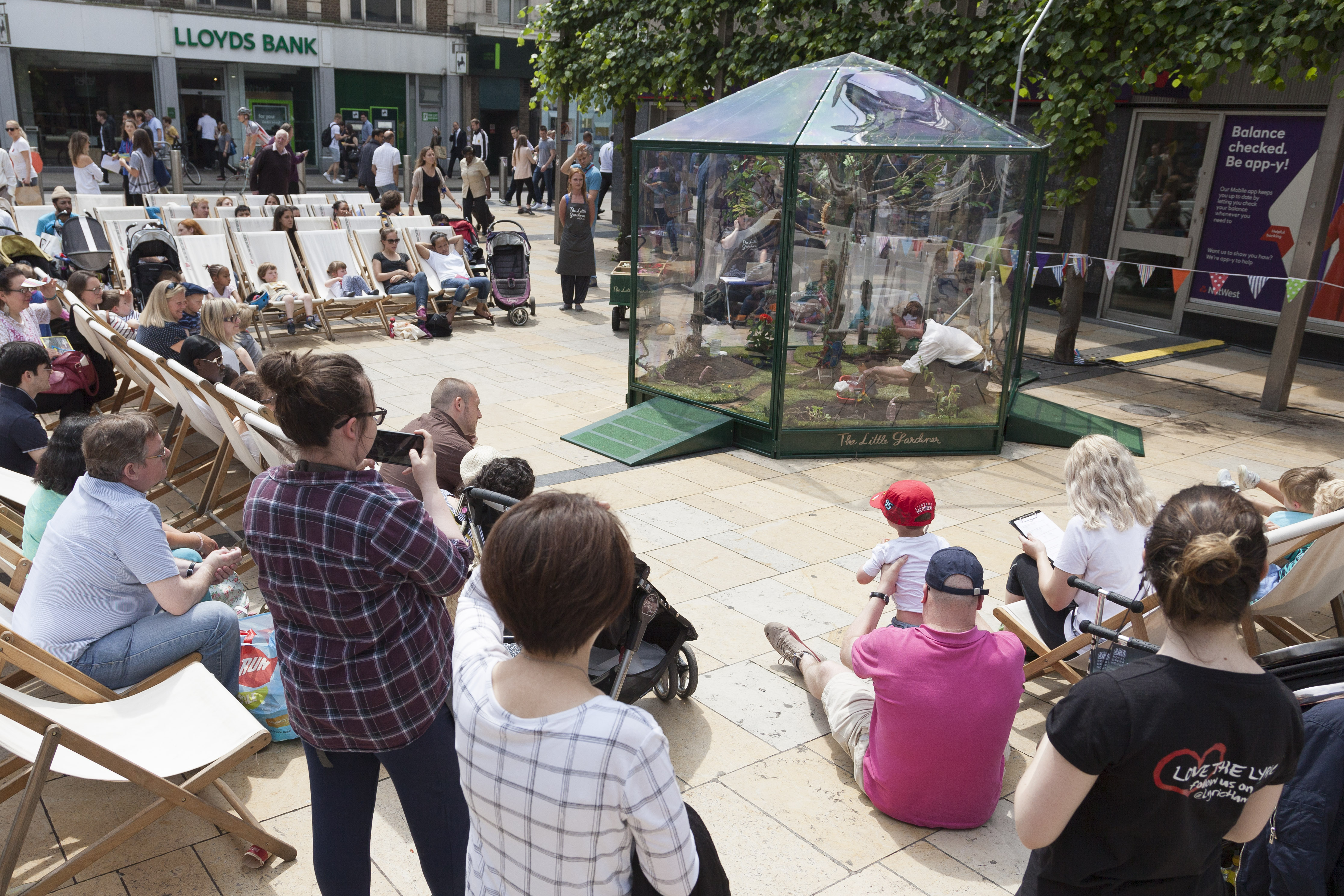
The play, which is currently touring and free to attend, is set in a greenhouse, containing a real garden. “The greenhouse is interactive in the sense that it can be opened up to allow children inside. Inside the greenhouse sits a large tree (wherein the Little Gardener sleeps) and flower beds – ready for planting! The set is designed and built by James Lewis, who’s done a remarkable job. The set breaks down into 28 pieces and we tour with over 100 flowers.”
Photo credit: Rachel Ferriman
It’s not the company’s first collaboration with author Emily Hughes. “Last year, we worked with Emily on the stage adaptation of her debut book Wild and we conducted a really successful period of research and development. We’re hoping to bring Wild to theatres in 2017.
“Emily is such a joy to work with. From day one she has been so warm and encouraging. She isn’t precious about her work and pushes us to delve deeper or go darker, which is really freeing.”
The fact that The Little Gardener is an interactive show does bring with it an element of unpredictability: “Every audience is different, so we’ve tried our best to prepare for every perceivable eventuality. But of course audiences will always surprise you! Some children are very comfortable with handling plants and getting their hands dirty, whilst others are understandably more hesitant, so it’s about making those children feel at ease. For each performance we have a lovely team of Production Assistants/Gardeners who are there to make sure the audience are happy.”
How It Ended’s goal is to excite young audiences and inspire the next generation of theatre makers. “The honesty and responsiveness of children is fantastic. They certainly let you know how they feel about the show whether it be positive or negative – you know where you stand! But making work for young children is boundlessly rewarding, they give back in ways older audiences don’t.
“When we opened the show last week at The Lyric we had lots of children linger around the greenhouse with their parents after the show. They wanted to make comments on the show and ask questions about the flowers and the greenhouse – which was wonderful. It’s great to see them discussing the show, as it hopefully challenges their expectations of what theatre can be.”
Les Femmes Ridicule are Alice Robinson, Siobhan McKiernan and Margot Courtemanche, who together aim to create highly entertaining, moving and fresh work that directly engages with their audience. Following recent performances at the Brighton Festival, the trio are about to bring their show In The Gut to London for a short tour.
“In The Gut broaches the subjects of pregnancy, childbirth and parenthood; tackling tragic themes, such as miscarriage and infertility, with a thoughtful and comedic approach,” explains director Alice Robinson. “The audience will be introduced to different scenarios that offer alternative perspectives and approaches to the subjects – from the ridiculous and strange, to the dramatic and poignant.
“The show came about as an off shoot of another project that failed, which we’re really glad about! The three of us found we had so much to say on the topic of fertility and potential motherhood, and that we shared a slightly dark and silly sense of humour.”
In The Gut is Les Femmes Ridicules’ first show as a trio, and they’ve enjoyed working together. “It’s been really good! We’ve devised the show from our collective imaginations and passions, and that’s always a big process. As devisers our process is ongoing as we meet our audiences and continue to respond to them. We’ve laughed a lot in rehearsals and been really honest throughout, which is essential.”
The company hope to raise awareness for miscarriages in all relationships and are delighted to have the support of the Miscarriage Association and the Maternal Mental Health Alliance. “They really helped us in the research stage and opened our eyes to the impact of miscarriage on men, women and their families. We have been handing out Miscarriage Association leaflets at the shows and hope to promote the incredible services that they offer.
“In the Gut is direct in its staging of the fears around pregnancy. It doesn’t take sides, or preach, it’s unafraid of looking ugly, of moving its audiences and of playing with them.”
The RADA-trained trio’s creative process starts with simple improvisation. “I just shout things – ideas, thoughts, questions – at the other two and they plough on, adapting to what’s said in their own way. We all feed off each other’s ideas and we ended up with something we could never imagine on our own. Everything starts with a hunch, a question or something really silly like trying to outdo each other with a mime of the worst birth possible… and off we go!
“We think comedy is a brilliant way to open up a discussion, to heal and to set us free! There is humour in everything and releasing or acknowledging that is more interesting than ignoring it. Our audiences have taken the show really well, in that they have responded differently and personally. They have laughed and been moved. We’ve had midwives, parents, grandparents, people who don’t want children, young adults, people who do and people who can’t. There’s something for everyone, and everyone has an opinion on the subject matter, which is a great start.”
Pop-up Opera was established in 2011 with the goal of encouraging more people to see and enjoy opera. After recently performing their first ever tragedy, I Capuleti e i Montecchi, the company return to comedy for their new production of Rossini’s Il Barbiere di Siviglia, which will – as always – take them to some unique and unforgettable venues around the UK.
Director Clementine Lovell founded Pop-up Opera on her return from living in Italy. “When I began training as an opera singer I had mixed reactions from my friends. Opera wasn’t really their thing – one even claimed to be ‘allergic’ to it. That stayed with me, and I wanted to prove them wrong, to show them that opera could be magical, hilarious, devastating or moving.
“Opera is so much a part of Italian culture, so broadly appreciated, and is performed everywhere, not just in the big houses. I grew up in a small village in the UK miles from an opera house. We never went to see it, it wasn’t an option. My uncle has a barn where he hosts folk and blues events and we put on an opera there for a largely non opera going audience. They loved it. It made me think about how the setting can have a bearing on people’s enjoyment, or their willingness to give it a go.”
Photo credit: Richard Lakos
Each new space presents a unique challenge: “The production grows and evolves as it pops up in different places. We stage it in the rehearsal room and then adapt it to embrace each venue, so every night is different. The performance spaces vary wildly in size, shape, acoustic, feeling. We get in to the space on the day and start working out the entrances, exits, how to involve the audience… The performers have to think on their feet and be willing to allow some freedom and spontaneity. I think this keeps it fresh and creates a very special atmosphere.”
Clementine has countless happy memories of the unusual venues in which the company have performed. “One of our first venues was a boat made of scrap metal in Shoreham. The stairs were made out of an old car and the room we performed in had previously been part of a bus. We once performed 100ft underground in Clearwell Caves – to make some of the entrances the singers had to grope their way down a very dark tunnel with only headlamps to light the way, and one of them was terrified of bats!
“Another venue was the ruins of Raglan castle, where our backstage area was a crumbled down tower… We’ve also done shows in the Brunel Museum Thames Tunnel Shaft several times. It used to be more challenging to get in there – you had to crawl through a tiny entranceway and then down a scaffold stairway. It was always a nightmare getting props down there. We love going to the Garlic Farm on the Isle of Wight, the audience always go crazy for it. But my favourite venue will always be our original, the cider barn in Herefordshire. You can have a glass of cider from the Ross-on-Wye Cider & Perry Co, and the atmosphere is always fantastic.”
Photo credit: Richard Lakos
Il Barbiere di Siviglia is one of the world’s best-loved operas, but for those of us who may not know what it’s all about: “It’s the story of Count Almaviva, who wants Rosina to fall in love with him for who he is, not for his money or fame, so he conceals his true identity. In order to win her he must also get past her guardian, so many ridiculous obstacles and disguises ensue before he can get the girl.
“Our version is unique because it’s truly ‘pop-up’ in the way it can adapt to each space. We want to embrace the fact that we have an electric piano, and that we don’t have the budget of the Royal Opera House. We’ve stripped the costume and set right back so it allows the music and the story to shine through. We want to allow those things to take front stage, to show people that you don’t need all this extra stuff to make a comedy: with brilliant singing and acting and by involving the audience you can still create an amazing show.”
The opera will be sung in its original Italian with English captions, presented in Pop-up Opera’s signature style: “We believe that you can still make opera accessible when performed in the original language. The music, the intentions of the actors, the interaction between the characters and the power of the drama get the story across. The captions are there to complement, not to detract. They keep the audience broadly abreast of the story but don’t demand their attention all the time. With a comedy the captions can add another layer of humour, and we can play around with the modern context. In our last production, which was a drama, we kept the translation more ‘straight’ but still with the same approach of captions rather than a full text translated into continuous surtitles.”
As a company, Pop-up Opera aim to broaden opera’s appeal and challenge the perception that it’s stuffy and elitist. “We want to make our productions engaging, exciting, hilarious, dramatic, moving… We hope audiences go away having laughed until their cheeks ache or having been moved to tears, that they will have been drawn into the story and connected with its characters. We hope they take away with them a thirst for more opera, whether it’s by fringe companies or at the Royal Opera House, and a different attitude towards what they thought opera was about or represented. Never been to the opera? Come to one of our shows! You won’t regret it.”
Il Barbiere di Siviglia can be seen around the UK until 1st September 2016 – check the website for full dates and venues.
Earlier this year, they took on Tolstoy, condensing the epic novel Anna Karenina into a gripping three hours, and somehow making the story manageable without losing any of its complexity or intensity. And for their sixth production, Arrows & Traps are returning to their Shakespearean roots with Macbeth, which runs from 14th June to 9th July at New Wimbledon Studio, and opens the company’s ‘Broken Crown’ season.
The Macbeth cast reunites actors who’ve worked on previous productions – among them David Paisley and Cornelia Baumann (Anna Karenina), Jean Apps (The Taming of the Shrew) and Alex Stevens (Titus Andronicus) – and introduces several new members of the company. Director Ross McGregor welcomes this mix of old and new faces:
“We’re one of the few operating rep companies in the fringe, in that we have a base of returning actors that we use in every show. It’s delightful to have actors from last year’s Taming Of The Shrew, Titus Andronicus, and this year’s Anna Karenina coming back to work on Macbeth alongside our new blood. This is great for me as a director as it builds a shorthand in rehearsal, but it also gives actors just starting out in their careers a home to come back to hone their craft on some classic drama. They know that there’s always a place for them in Arrows & Traps, and for me there’s no greater honour or compliment than when an actor asks to work with you again. This may seem like a cliché, but six shows in, it does feel like a little theatre family.”
In addition, the cast will work once again with Offie-nominated Movement Director Will Pinchin, who’s been a member of the creative team on all of Arrows & Traps’ previous productions. “It’s an honour to have Will back for a sixth time, working with the witches and ghosts for the show; he’s producing some incredible work in rehearsal. I’ve known Will for almost seven years, and I’d never consider directing a show without him now. We work well as a pair, he sees things I don’t, and I can structure his creative mania – there’s very little wasted time in rehearsal because each of us has a good sense of what the other wants to do. He’s also a new father, so the fact that he can still devote time to the company when he should be fast asleep is a testament to his generosity.”
Photo credit: Beth Gibbs
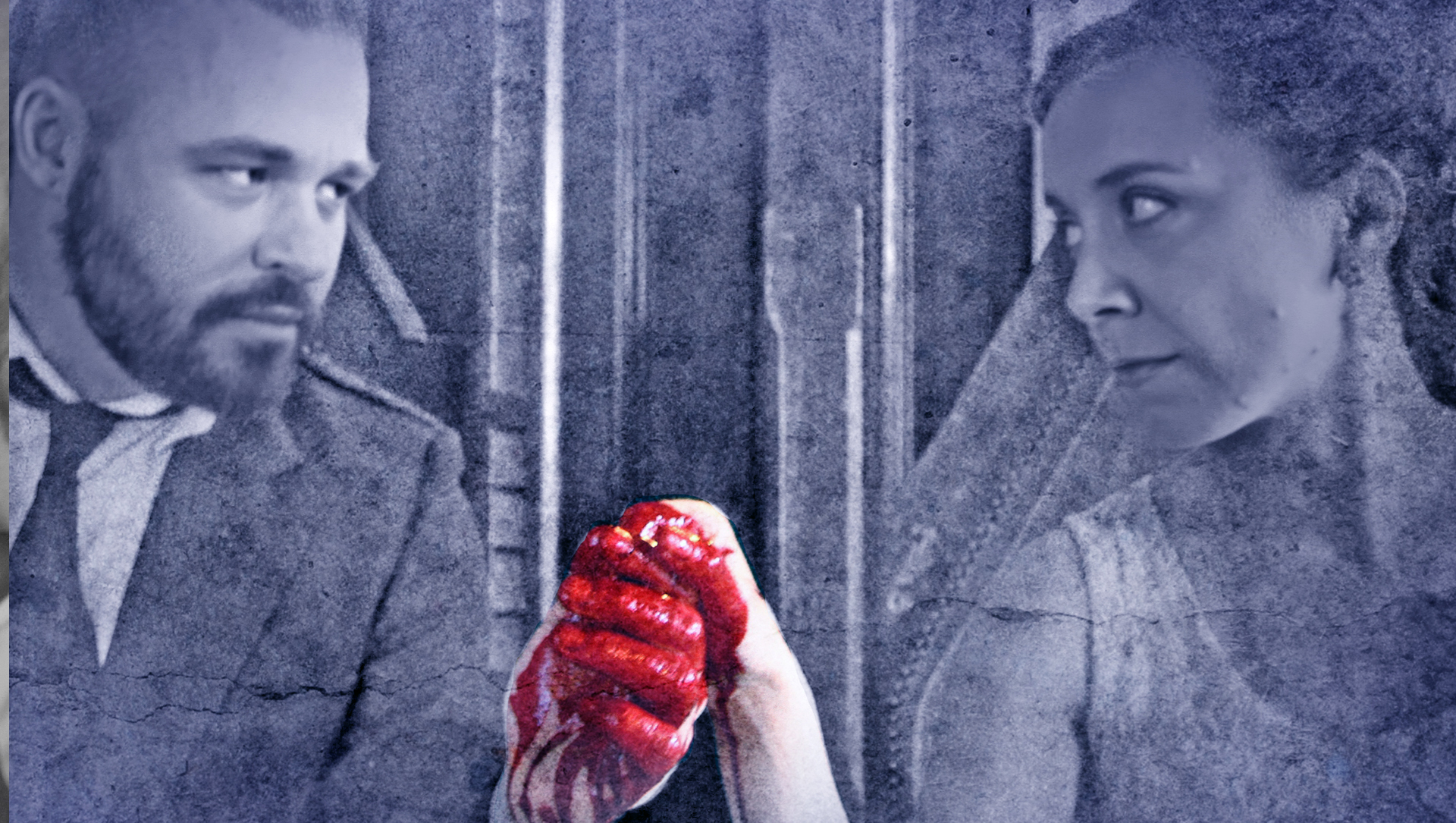
Following on from last year’s gender-reversed Taming of the Shrew, this version of Macbeth is a gender equal production – in fact, in an intriguing twist, McGregor’s cast includes more women than men. “Macbeth is normally a bit of a sausage fest in terms of casting, so it’s great to be able to offer so many roles to female actors. Both Duncan and Banquo have been made into female roles, and we’re loving the new opportunities and relationship impacts that these changes are making. For example, in our version, Banquo is a mother. Lady Macbeth has lost her child. How does that impact the relationship between the two women? Is there more of a connection between Banquo and Macbeth than just friends? Exactly who is jealous of whom?
“Duncan also has been opened up in so many interesting ways. She has that Margaret Thatcher feel to her: a bold, brave women in a cabinet of men who want her dead. Plus the thought of murdering Duncan is made even more harrowing if it’s an elderly woman in her bed. I was watching rehearsal a few days ago and was struck by the fact that the murder of Banquo is almost an entirely female staged spectacle of combat, and it’s a refreshing thing to be staging, even in an age when we’ve seen it all. I personally think it’s been a boys’ club for long enough. Give a girl a dagger.”
So what can audiences expect from this new version of a well known play? “Arrows & Traps has always been about making commercial entertainment that doesn’t lose its intelligence. I want to make shows that sell (name a theatre director that doesn’t), plays that people will have heard of, but that don’t lose their intellect or beauty for the sake of making it easier or shorter.
“I’m always struck by a common response I hear from people when asked if they go to the theatre. So many people say “I should. I should go more.” Like it’s the dentist. Like watching Hamlet is the theatrical equivalent of a root canal. Why is intelligent classic theatre seen as a dry duty for most people? It shouldn’t be. If Shakespeare had to compete with bear baiters and prostitutes and merchants all selling their wares in the theatre, his lines had to grab their attention. They had to fly. It’s our company goal to make commercial theatre that is as intelligent as it is entertaining. It’s got to be a live event. It’s got to be exciting. And if it’s Shakespeare and it’s done well, you’ve got to understand what they’re all saying. My hope is that Macbeth strikes this balance – both serving the beautiful text as well as being a rollercoaster ride.
Photo credit: Beth Gibbs
“I also wanted to make a genuinely frightening production of the play, because for me it’s all about fear. A standard GCSE answer is that Macbeth is all about ambition, and whilst that’s true, the word ‘fear’ is mentioned more times in Macbeth than any other play in the canon. It’s the story of a man who literally unleashes fear into the world. It’s a story where people believe in ghosts and witches and damnation and spirits. This is not our world, this isn’t reality, it’s a different playing space, a place where Freddy Krueger, Michael Myers and Norman Bates live. A place where things go bump in the night, and all our worst nightmares come and sit down beside us whilst we’re having dinner.
“Olivier said that if you don’t believe in witches then there’s no point in doing Macbeth – and I think he’s right. I think you have to create a world where witches can feasibly exist and take the audience on a journey into the belly of the beast. It feels like a horror film to me. Full of jumps and bumps and frights and somewhere in the midst of the darkness is a cautionary tale about the dangers of desire. But then again, and this is the genius of Shakespeare, Macbeth is also about a couple on the verge of breakdown, and the lengths that two people will go to in order to save their marriage. So there’s a lot to love about the text, and everyone is operating in a shade of grey. I didn’t want there to be villains or clear cut baddies. I think in many ways the Macbeths are more likeable than the ‘heroes’ of the story, Macduff and Malcolm, even though they do despicable things. It’s really the great-great-great grandfather of House Of Cards.”





 Theatre Things