Review: Twelfth Night at French Protestant Church, Soho

Twelfth Night: a story of love, disguise and trickery, where nothing and nobody is quite what they seem. It seems fitting that a play in which appearance versus reality is such a prominent theme should be visually stunning, and Scena Mundi’s adaptation doesn’t disappoint; the French Protestant Church in Soho Square provides a unique and beautiful setting for what proves to be a classy production.

Shipwrecked in Illyria, Viola (Harriet Hare) disguises herself as a boy and gets a job working for the Duke Orsino (Pip Brignall). He sends her with messages of love to Olivia (Emma Hall), who falls instead for Viola – who unfortunately happens to be in love with Orsino. Then Viola’s twin brother Sebastian (Clare Brice) turns up, and everything gets even more confusing, before finally resolving itself in typically neat Shakespearean fashion. Meanwhile, Olivia’s drunken cousin Sir Toby Belch (Jack Christie) is hatching a plot with his friends Maria (Clare Brice again), Sir Andrew Aguecheek (Thomas Winsor) and Fabian (David Keogh) to make a fool of the pompous Malvolio (Martin Prest) by convincing him Olivia’s in love with him. And all this is quietly observed by the Fool, Feste (Edward Fisher) – who, ironically, may just be the wisest man on the stage.

Cecilia Dorland’s production takes as its starting point the vanity and self-obsession of Shakespeare’s characters, and transforms the aisle into a shiny blue catwalk for the play’s fashion show-inspired opening. Though the fashion theme doesn’t explicitly come up again after this scene, it’s present in Georgia Green’s costumes, which are somewhere between contemporary and modern, giving the play – and each character – a unique and timeless style that fits well in the unusual setting.

Photo credit: Jessy Boon Cowler

The cast do a great job of teasing out the complexities and less attractive aspects of their characters, and at the same time revealing the play to be more than a straightforward comedy that’s just out for laughs. Though there are a good number of laughs to be had – Martin Prest in particular gives an outstanding comic performance as Malvolio, with an array of disapproving facial expressions (and a surprising flexibility during the infamous yellow stockings scene), and the scene in which Orsino starts to feel an attraction to Viola in her boy’s disguise is both funny and sweetly touching. On the other hand, the later confusion between Viola and Sebastian falls a little bit flat, possibly because the two actors playing the twins look nothing alike.

While Malvolio is easy to laugh at because he’s so consistently unpleasant, there are other characters who turn unexpectedly to the dark side, and it’s these performances that prove most memorable. Sir Toby, played by Jack Christie, seems at first to be a loveable drunk, but ultimately reveals himself to be nothing more than a bully. Tricking Malvolio is one thing, but when he turns on his friend Sir Andrew (played with a child-like vulnerability by Thomas Winsor), it feels a step too far, and is actually a bit uncomfortable to watch. Edward Fisher’s Feste is also a mildly discomfiting presence; as the Fool, he provides entertainment through his wit and music, but at the same time has the feeling of a conductor, seeing and knowing all, with the power to make or break his fellow characters as he wishes.

Scena Mundi’s adaptation of Twelfth Night has plenty to recommend it: visually striking, with strong performances and several laugh out loud moments, the play also offers up a warning about the dangers of putting style over substance – particularly in matters of the heart. Great fun and well worth a look, especially if you enjoy your theatre in unusual locations.


Can’t see the map on iPhone? Try turning your phone to landscape and that should sort it. I don’t know why but I’m working on it… 😉

Review: Anna Karenina at Jack Studio Theatre

If, like me, you’ve often thought about reading Tolstoy but been put off just by looking at the list of characters, let alone the number of pages, help is at hand. In their first non-Shakespeare production, Arrows & Traps have pulled off the astonishing achievement of compressing a 1,000-page novel into a little under three hours, with a cast of just eight, whilst still remaining faithful to the plot.

Anna, the respected wife of provincial governor Karenin (Adam Elliott), abandons her duty and reputation when she’s swept into a passionate affair with the dashing Count Vronsky (Will Mytum). Meanwhile landowner Levin has money and power, and the freedom to do anything he likes, but is desperately in love with Kitty (Pippa Caddick), the woman he believes will give his life purpose. Anna and Levin’s lives fit together to make a whole, with each possessing what the other longs for, and Helen Edmundson’s adaptation, directed by Ross McGregor, highlights this synergy beautifully. The stories unfold in parallel, and though Anna and Levin have never met, from the outset each becomes the voice of reason for the other, the one they confide in and from whom they seek help and comfort. Their dialogue also serves a second, more practical purpose, filling in the gaps with regard to setting and context, so that each time one asks the other, ‘Where are you now?’ it’s as much for our benefit as theirs.

Anna Karenina

As a result, the production needs little in the way of set or props, and the story is carried almost wholly by the fantastic cast. Most of them take on multiple roles, but keep them perfectly distinct, so we always know who we’re looking at, and even the comparatively minor roles are memorable (I particularly enjoyed Hannah Wilder’s giggling, superficial Princess Betsy). The two leads, Ellie Jacob and David Paisley, each capture to perfection the essence of their character: Anna’s charm and quick wit, which enchant everyone she meets, have a similar effect on the audience, while Levin wins our sympathy as a good, honest man radiating quiet desperation at the lack of direction in his life.

A third plot thread involves Anna’s adulterous brother Stiva (Spencer Lee Osborne) and his long-suffering wife Dolly, who’s played by Cornelia Baumann in a truly heartbreaking performance. Of all the stories, Dolly’s is perhaps the most devastating, as she lets Anna convince her to remain in her unfaithful marriage, and consequently ends up feeling she’s never really lived at all.

What’s particularly impressive about Arrows & Traps’ production is the way it somehow manages to be both intimate and epic, getting right to the heart of the characters but also capturing the scale of the novel. There are a few moments – the ballroom, the races, and in particular Anna and Vronsky in the snow – that feel almost cinematic, which is quite an achievement on such a tiny little stage.

Anna Karenina

Anna Karenina has a bit of everything – romance, tragedy (by the way, the death scenes are brilliantly done, and in one case almost a bit too convincing), drama, social commentary, and even a few moments of comedy to lighten the mood. With 1,000 pages of text to condense down, it’s no surprise that this is an intense and gripping production – but one that I’d happily go and see again tomorrow.

It’s even made me consider reading the novel. Well, maybe…


Can’t see the map on iPhone? Try turning your phone to landscape and that should sort it. I don’t know why but I’m working on it… 😉

Review: Merit at Finborough Theatre

Merit, a two-hander by Alexandra Wood, begins with a bombshell. Against all the odds, recent graduate Sofia’s landed a job as PA to one of Spain’s richest bankers, but is appalled when her polite, middle-class mother, Patricia, questions what she had to give in order to get it.

And so begins the story of a complex mother-daughter relationship, against a backdrop of economic instability. It turns out the argument that opens the play is just one of many; these are two women with fundamentally different ideas on just about everything, not least money and social responsibility. Each scene moves us on a little in time and features a new disagreement, as Sofia’s fortunes improve, while those of her parents decline, and her mother’s driven to increasingly drastic action. Ultimately, the play ends on another bombshell, albeit one that’s somehow a bit predictable and yet still seems hard to believe.

Merit at the Finborough
Photo credit: Robert Workman
Merit tackles some interesting themes, though, and skilfully introduces a cast of unseen characters, each with their own attitudes towards the economic situation. Most prominent of all is Antonio, Sofia’s boss, who gives away much of what he earns but still manages to live comfortably, and in doing so gains Sofia’s unswerving devotion and Patricia’s equally resolute disdain. As the trigger for most of their arguments, Antonio becomes almost a third main character in the story, a representative of his class whose actions – for better or worse – have an impact on so many.

Karen Ascoe and Ellie Turner both give compelling performances as Patricia and Sofia; the tension between them is palpable throughout as the advantage swings one way and then the other. Neither is perfect, and yet both at different times earn the audience’s sympathy, though we naturally side with Sofia pretty much from the start. Some of the dialogue feels a little unnatural – I can’t imagine too many young women use the word ‘rapacious’ in everyday conversation – but flows well between the two.

Tom Littler’s direction sees each scene change punctuated by flashing lights and loud music, and the two women mirror each other’s movements as they dress – perhaps the one and only time they’re in sync with each other. It’s almost like this is their time to prepare for the next battle, but who will emerge the victor each time remains in doubt. Meanwhile Phil Lindley’s set features a door at either side – one for home, one for work – with an open space in between providing an arena for Sofia and Patricia’s clashes.

Merit is an intriguing play, drawing on themes we’re all familiar with, but setting the story in a country where the economic crisis was much deeper, which enables the plot to go to greater extremes; the only problem is it’s so extreme it becomes hard to believe or relate to. Perhaps with a little more personal background, we could better understand how the mild-mannered Patricia ends up taking the path she does. Nevertheless, this is a thought-provoking piece, skilfully staged and performed, with plenty to think about after you leave the theatre.


Can’t see the map on iPhone? Try turning your phone to landscape and that should sort it. I don’t know why but I’m working on it… 😉

Review: Into The Hoods: Remixed at the Orchard Theatre

Think you don’t like hip hop? Think again…

When one of my friends told me I had to go and see ZooNation, I was a bit sceptical, to say the least – it’s really not my sort of thing. But I’m always happy to be proved wrong (where theatre’s concerned, anyway), so when I heard the company were coming back to the Orchard, I figured I’d give them a try. And I’m really glad I did.

Into The Hoods was ZooNation’s first full-length show back in 2006. Since then it’s become the West End’s first hip hop dance show, won What’s On Stage and Olivier Awards, and formed part of Nelson Mandela’s 90th birthday celebrations. Into The Hoods: Remixed is, as you might expect, a new, revamped version of the hit show; it follows two children on an adventure in the Ruff Endz Estate, where they must collect various items from a host of familiar characters… with a twist. Spinderella longs to be a DJ, if she can only get away from her ugly sisters. Singer Lil Red gets tricked into signing with Wolf, who runs Big Teef Records. Rap-on-Zel is kept locked up by her father, the landlord of Beanstalk Towers. And then there’s Jaxx, who lives in the basement (get it?).

Into The Hoods: Remixed, ZooNation

As a company, ZooNation, led by director Kate Prince, aims to make hip hop accessible to a wider audience, and there’s no doubt from the enthusiastic crowd response that Into The Hoods does exactly that. Musical director DJ Walde’s soundtrack has something for everyone, covering decades and countless different styles; there’s even a Charleston segment at one point. Rewriting fairy tales for a new generation – the items the children are looking for include ‘an iPhone as white as milk and a hoodie as red as blood’ – the show skilfully intertwines them into a story that has romance, drama and plenty of humour (the retirement home routine is particularly brilliant) yet always remains completely family friendly. And the cast, who range in age from just 16 to 37, are not only incredibly talented, but have an irresistible energy that seems to have no limits. You get the feeling they could cheerfully go on all night – as could the audience.

There’s a fantastic family atmosphere up on stage; everyone gets their moment in the spotlight, and no one performer outshines anyone else. The ensemble numbers too are genuinely a joy to watch – there’s nothing better than sitting back and watching a company who work together so well. In the same way, the lighting, set and video backdrop all combine perfectly with the choreography to create a seamless, polished production that’s easy to follow and really great to look at.

I officially stand corrected; Into The Hoods is a fantastic show, whether or not you think of yourself as a hip hop fan. And ZooNation’s company ethos is also to be admired – they believe passionately in investing in young people, and run various projects specifically aimed at nurturing young talent. If the brilliant performers on stage tonight are anything to go by, they’re definitely doing something right.

Into The Hoods: Remixed is at the Orchard Theatre until 9th March.

Review: All Your Wants and Needs Fulfilled Forever at Vault Festival

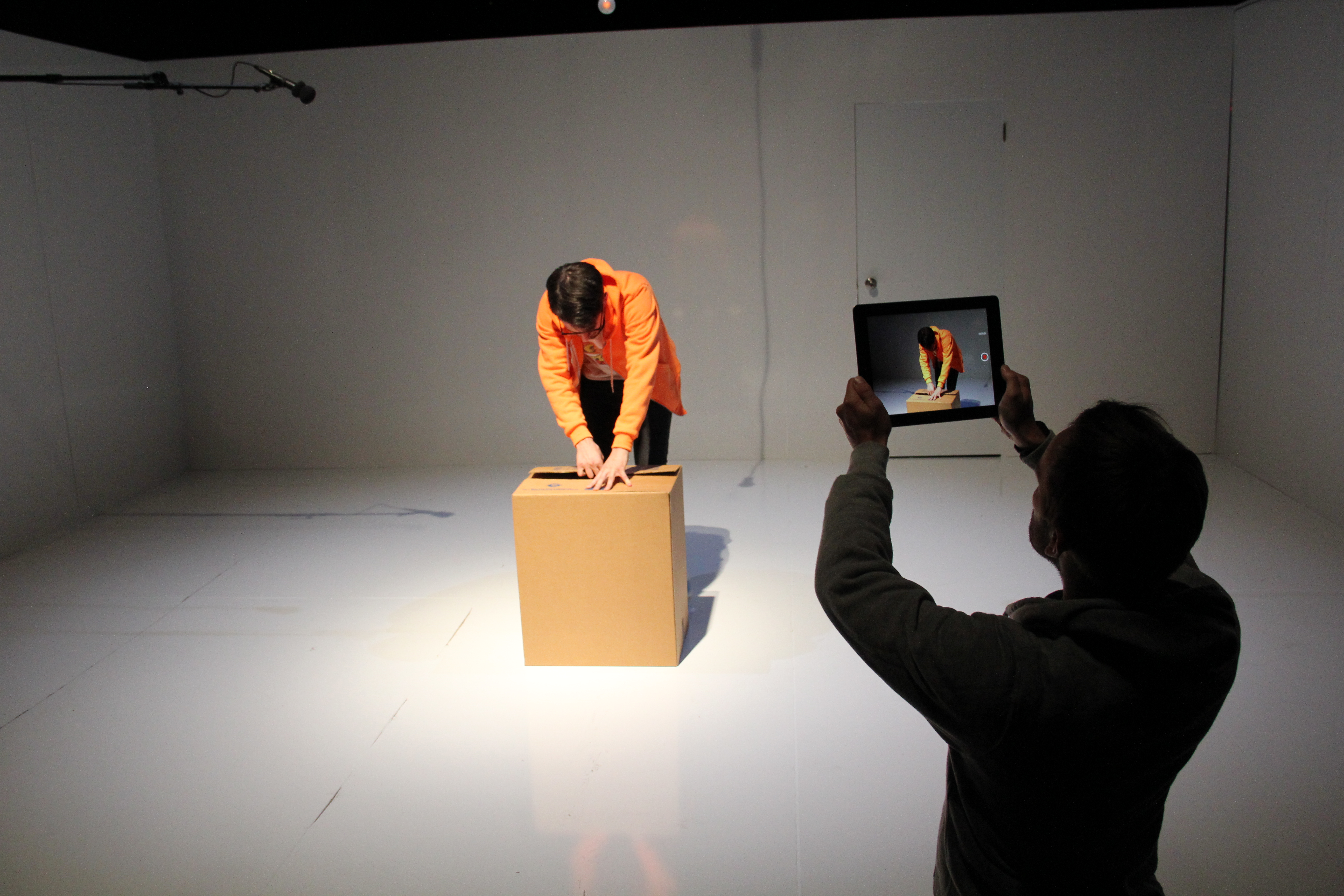
Meet Simon. Simon’s dad recently died, but he’s distracting himself from thinking about that too much by going jogging, playing video games, caring for his pet rats and worrying about both his mum and his on-off relationship with his girlfriend. But someone – a talking lightbulb, to be precise – has decided that’s not a satisfactory ending to Simon’s story, and with the help of three assistants assumes control of his life, manipulating his every action to ensure he follows the path set out for him. And the goal of all this, it seems, is not to give Simon what he wants or needs, but to entertain and satisfy us, the audience.

Photo credit: Sarah Burrell

All Your Wants and Needs Fulfilled Forever is an award-winning show from New Zealand-based company The Playground Collective, and it’s the kind of play I think needs to be seen more than once, because there’s so much going on it’s almost impossible to catch it all first time around. There’s laughter, action, emotion, countless cultural references, original music, a brief exploration of Pavlovian conditioning – and a few moments which, even if it’s not totally clear what’s actually going on, still evoke an almost physical reaction. It’s also something of a sensory explosion; flashing lights, bright colours and chirpy video game theme tunes all contribute to the sensation of being in an artificial environment.

Photo credit: Sarah Burrell

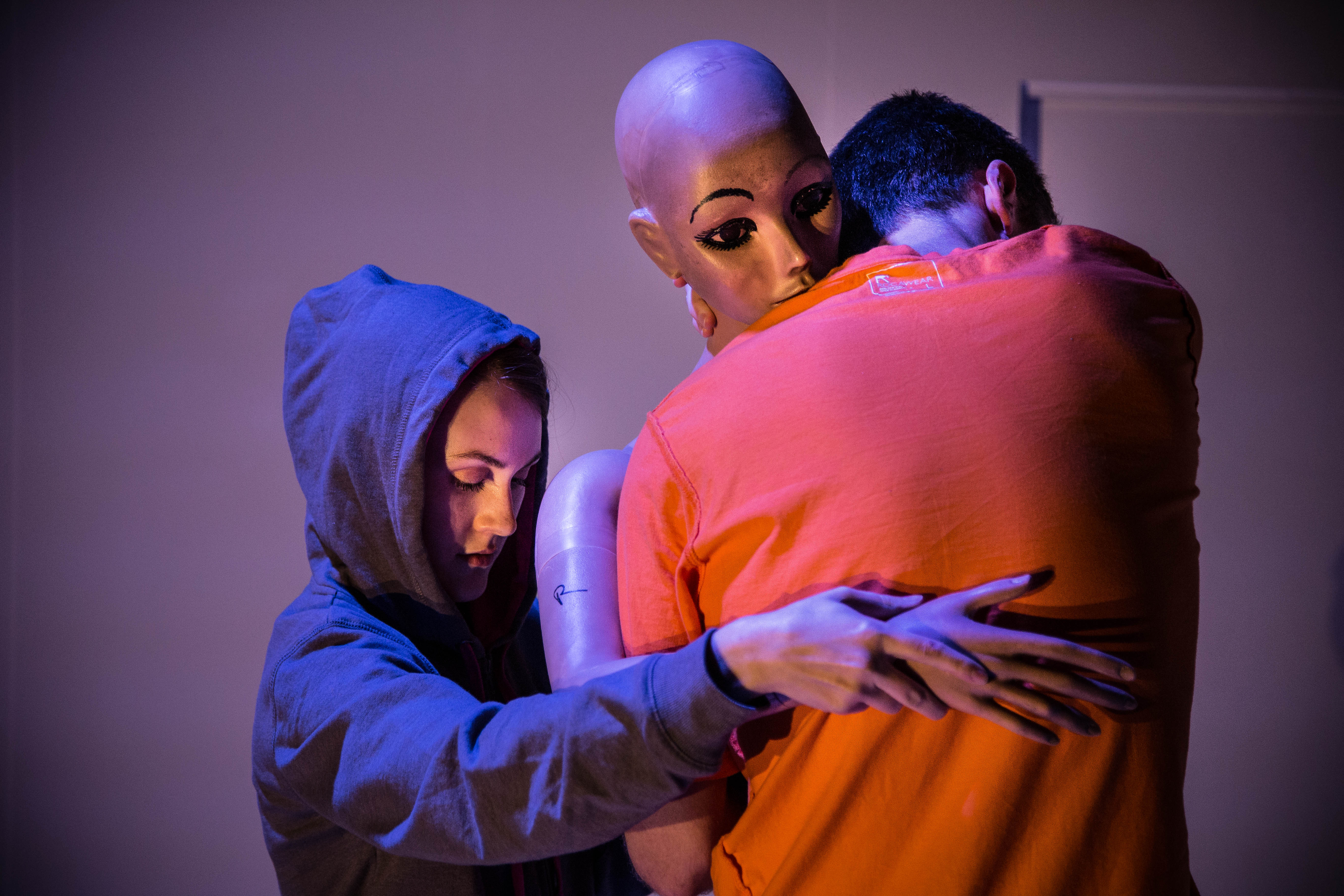
Writer Eli Kent, who plays Simon, spends most of his time alone in the stark, empty box that is his world. But even though he has nothing to work with, we nonetheless always know exactly what he’s doing, whether he’s making a smoothie, feeding his rats or getting caught up in a dramatic car chase. The other people in his life are represented by inanimate objects – his girlfriend is a mannequin, his best friend a cuddly toy and his mum a disembodied pair of washing up gloves. These characters are brought to life through the brilliant voice work of the three ‘players’ – Victoria Abbott, Hamish Parkinson and Joel Baxendale (whose backstage squabbling becomes just as much a part of the story as what’s happening up on stage) and Simon’s interactions with them are no less real; the break-up scene in particular is still devastating, even if one of the characters is a dummy.

Photo credit: Sarah Burrell

The play explores the idea of a ‘perfect story’, one that follows a traditional path and reaches a neat conclusion – just as in a video game we’re required to complete certain stages in order to proceed towards a showdown with the ultimate boss. But it turns out life isn’t always like that. It can be unpredictable, funny, sad, shocking or sometimes just mundane; despite what Die Hard (a perfect movie, according to Simon) would have us believe, car chases are not something that happens to everyone. Each of us is the central character in our own story, and we should take the opportunity to write it in our own way, for our own benefit, rather than for the unseen audience behind the fourth wall expecting a perfectly circular plot with a tidy ending.

All Your Wants and Needs Fulfilled Forever is an ingenious and totally unique piece of theatre, unlike anything I’ve ever seen before. It’s not so much a play as an experience, really, and one that doesn’t necessarily end when you walk out the door. And it’s also a show that, I suspect, everyone will interpret slightly differently – so in that sense, it’s the very best kind of theatre.


Can’t see the map on iPhone? Try turning your phone to landscape and that should sort it. I don’t know why but I’m working on it… 😉