Review: Transports at the Pleasance

Pipeline Theatre’s Transports, first performed in 2013, has been revived for a national tour, and the timing couldn’t be more appropriate. Though the play never makes any explicit reference to the current refugee crisis, it nonetheless offers a fascinating and intensely powerful insight into the emotional impact of being forced from one’s home and into a strange, and sometimes hostile, environment.

Transports is the story of two teenage girls. Lotte, the quiet, polite daughter of a rich Jewish family in Germany, gets on a train for England in 1939, not realising that she’s saying goodbye to her loving parents for the final time. Years later, Lotte waits anxiously for the arrival of her first foster child, a sullen fifteen-year-old named Dinah, who never knew her parents and likes to boast about the time a doctor said she had psychopathic tendencies. The two girls couldn’t be more different – and yet their lives end up on parallel tracks, as both struggle to adapt to the new home they never asked to be sent to, and to cope with the traumas of their past.
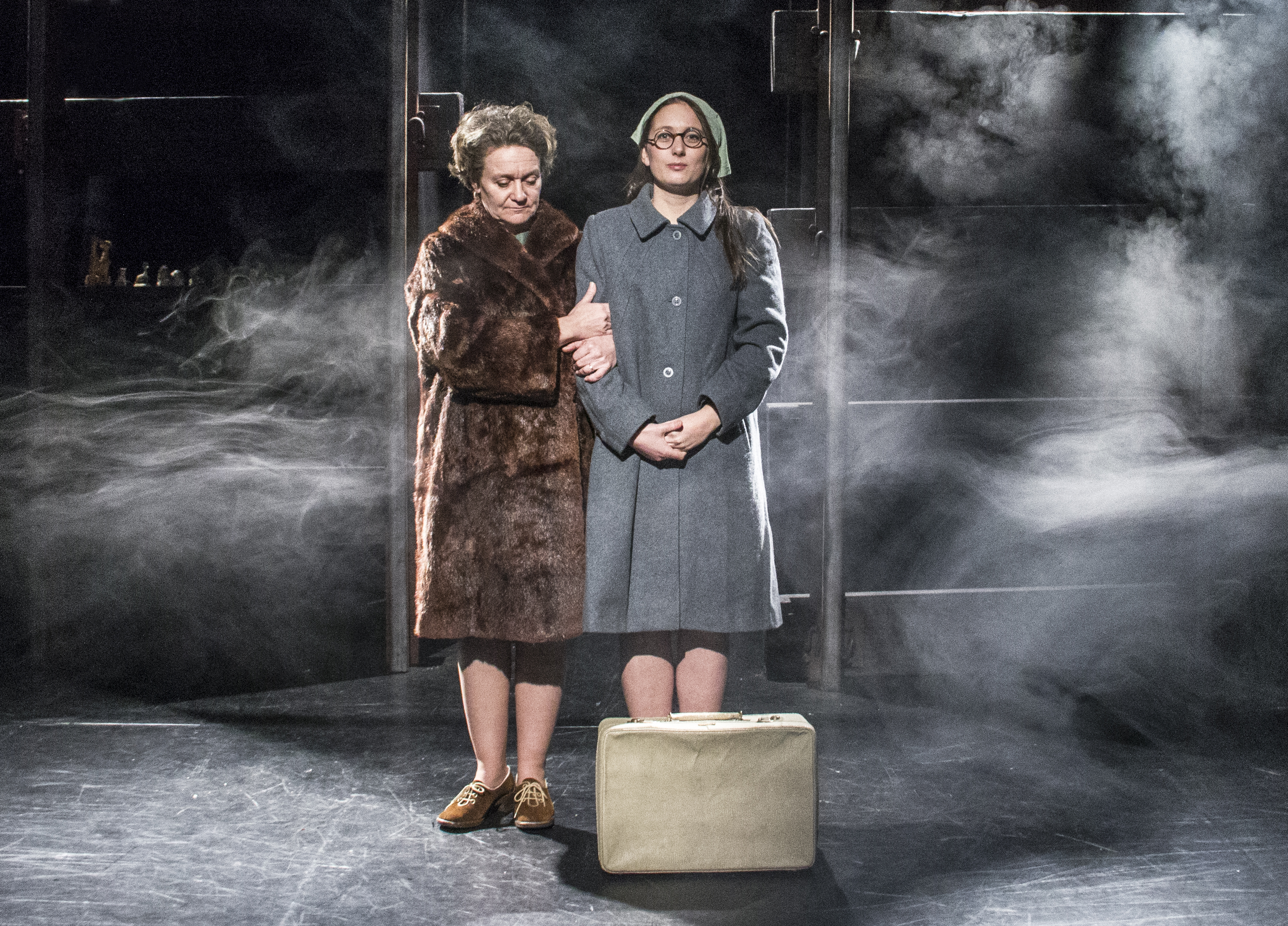
Transports at Pleasance Theatre

The girls’ interlocking stories are seamlessly presented in flawless performances from its cast of two. Juliet Welch plays the older Lotte – kind-hearted, anxious, who swears by her weekly routine and talks too much when she’s nervous – and Mrs Weston, who takes in the teenaged Lotte on her arrival in England and soon grows to love her. (She also, briefly, plays Lotte’s mother.) Hannah Stephens, meanwhile, takes on the challenge of playing the hugely contrasting roles of the two teenagers. It’s incredible to watch the chemistry between the two actors, and how they’re transformed in every way – clothes, voice, body language – as they switch from one character to the other and back again.

Alan Munden’s set is simple and effective, dominated by two huge train tracks that run from floor to ceiling and frame the action. Everything we don’t see is brought to life by sound effects: passing traffic, the sounds of the school playground, and even Lotte’s cat, Oskar, feel as real as if they were right in front of us. During the opening scene, as Lotte and Dinah stood by the side of the road, I swear I could smell petrol fumes, and have no idea if this was an extraordinary attention to detail or just my imagination.

Transports, Pleasance Theatre

Unsurprisingly for a story that deals with the Holocaust and childhood trauma, Transports packs quite a punch, particularly in the second act (one scene drew an audible gasp from the audience; another had us all in floods of tears). The addition of poetry, in a surprising twist that makes us view Dinah’s character in a whole new way, only increases the emotional intensity – not to mention the revelation that Lotte’s story is based on that of a real person – designer Alan Munden’s mother, Liesl.

On the way out, someone asked me if I’d enjoyed the play, and I wasn’t sure how to respond, because I’m not sure this is the kind of story that you can enjoy. It’s intense, and shocking, and it made me feel very, very sad – not just for Lotte, Dinah and Liesl, but because now, all these years later, there are still people going through this kind of trauma every single day.

But was it brilliant? Absolutely. Transports is probably one of the most original and interesting pieces of theatre I’ve seen this year. Beautifully performed and lovingly produced, it’s a hugely important play that deserves to be seen.


Can’t see the map on iPhone? Try turning your phone to landscape and that should sort it. I don’t know why but I’m working on it… 😉

Review: Chicago at the Orchard Theatre

Yesterday evening, as my train ground to a halt somewhere outside Lewisham, I sent a little prayer to the train gods (a.k.a. Southeastern) to please sort it out and get me to the theatre on time. Quite apart from the fact that I hate being late for anything – especially the theatre – I was on my way to see Chicago, and I think most people would agree that if you miss the opening number of Chicago, you’ve missed one of the best bits.

Chicago on Tour

Fortunately, the train gods were in a good mood for a change, so I made it to the Orchard in time to sit back, relax and enjoy Kander and Ebb’s classic musical about “murder, greed, corruption, exploitation, adultery and treachery… all those things we hold near and dear to our hearts”. Set in the 1920s, Chicago is a darkly satirical story based on a play by Maurine Watkins (which in turn was inspired by real events). Wannabe star Roxie Hart murders her lover and ends up in prison alongside singer Velma Kelly, accused of killing her husband and sister. But when they both hire slick lawyer Billy Flynn, the women soon realise that innocence and guilt mean very little in the courts of Chicago, and that it’s the media, not the jury, that they need to win over.

With a minimalist set – the only props are a few chairs and a couple of ladders – and no need for any significant costume changes, all our attention is focused on the cast and their performances, and they don’t disappoint. This particular revival, the latest of many, features a star turn from Hayley Tamaddon as Roxie, while Sophie Carmen-Jones – who doesn’t get her name on the posters, but really should – razzle dazzles as queen bee Velma. Sam Bailey also stands out as Mama Morton; she’s a convincing figure of authority, but with a note of genuine affection for the women in her charge – and . And John Partridge is all charm and fancy footwork as Billy Flynn – though his vocals are noticeably less strong than those of his co-stars, this didn’t seem to dent the audience’s enthusiasm at the end of each number.

This could be because what makes Chicago such a fantastic show is the music – provided by Ben Atkinson’s enthusiastic orchestra, who are on stage throughout – and the Fosse-inspired choreography from Anne Reinking. These are the kinds of spectacular numbers that would glaringly expose any mistakes, but the cast don’t put a foot wrong; they’re perfectly in sync and working as one throughout – never more so than in the Press Conference Rag, which, along with All That Jazz, is one of the highlights of the show. That said, I really can’t pick a favourite song; they’re all so infectious and it’s no wonder the entire cast look like they’re having the time of their lives.

There’s a reason Chicago’s been a hit with audiences since its premiere in 1975: it’s slick, sexy (did I mention the ridiculously attractive cast?) and oh so stylish, with a satirical humour that makes for some great one-liners, but also makes a serious – and still relevant – point about the damaging and seemingly limitless power of the media to influence public opinion. Add to that the timeless score and slick choreography, and I’ve no doubt this show will be entertaining us for many years to come.

Chicago is at the Orchard Theatre until Saturday 5th March.

Review: Mrs Henderson Presents

The Windmill Theatre in Soho is a little piece of London’s history, for two main reasons: its proud slogan, ‘We Never Closed’, and – probably even more famously – its naked ladies. Mrs Henderson Presents, originally a movie starring Judi Dench and Bob Hoskins, tells the story of the Windmill, its girls and its eccentric owner in a feel-good, high-energy spectacular that makes you feel proud to be British.

It’s hard to top Dame Judi in pretty much anything, obviously, but Tracie Bennett’s Mrs Henderson is a delight: her prim exterior hides a dry wit and occasional coarseness that’s all the more brilliant for its unexpected appearances. And she can belt out a tune as well, but then we knew that already. The relationship between Mrs Henderson and her manager, Vivian Van Damm (Ian Bartholomew), is lovely to watch – though they drive each other crazy, they also develop a strong and loyal friendship, and it’s not surprising to learn that she left the theatre to him when she died in 1944.

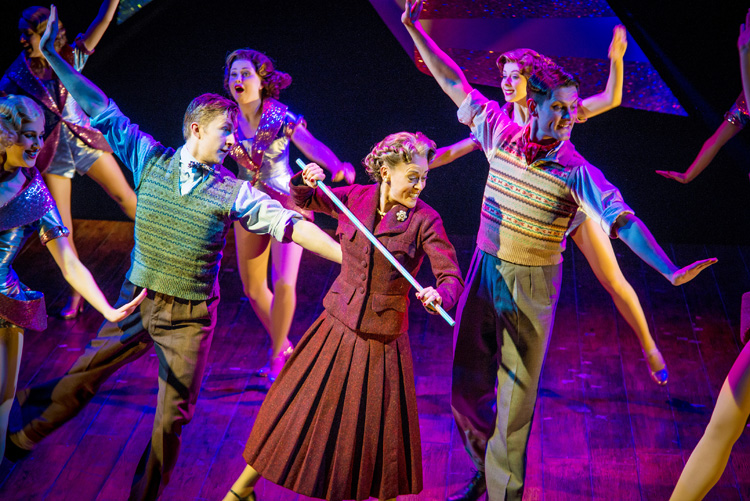
Mrs Henderson Presents
Photo credit: Paul Coltas

Now, let’s talk naked ladies. The Windmill Girls were known for their nude tableaux vivants, which had to be motionless to get around the Lord Chamberlain and his aversion to wobbly bits (I suspect it may have been a little more complex than that in reality, but let’s move on). Even so, the brave ladies in Terry Johnson’s production are on full display – albeit very tastefully presented – and you have to admire their nerve, particularly since in the one scene where the men get their kit off, they all have music stands or pianos to hide behind. Laura Williams gives a particularly classy performance as Maureen, whose rapid transition from shy, clumsy tea girl to glamorous star of the show is a forgivable stretch of the imagination. Despite the title of the show, this is really Maureen’s story (after the opening scenes, Mrs Henderson’s appearances are few and far between), and Williams steps into the role of leading lady with great dignity.

Though the show certainly leaves you smiling, with infectious tunes by George Fenton and Simon Chamberlain and dazzling choreography from Andrew Wright, it’s not all ‘Keep Calm and Carry On’. Though we see little of the war itself (and a few of the characters have a worryingly relaxed attitude about sitting on the roof at the height of the Blitz), there’s no getting away from the fact that it’s a horrible thing, and fortunately the show doesn’t try to. There’s a particularly moving moment when Dutchman Vivian Van Damm, after hearing that his country’s been invaded, sings Living in a Dream World, a song that could just as easily be about our attitude to events happening in the world right now. But through it all, our spirits are bolstered by comedian Jamie Foreman’s terrible (and terribly un-PC) jokes and the general air of defiance; it’s only when this dips briefly in act 2 that the energy of the show does likewise.

Mrs Henderson Presents
Photo credit: Paul Coltas

Mrs Henderson Presents has a lot more to recommend it than just naked ladies, as attractive as those ladies undoubtedly are. It sums up the Blitz spirit in one glorious image – Maureen, completely naked, giving Hitler the finger and telling him to go back where he came from. It’s a touching love story (featuring possibly the world’s greatest chat-up line) – but not quite the one we might expect. And, most importantly, it’s a lot of fun, and leaves you feeling uplifted and patriotic. You can’t ask for more than that.

Big thanks to LondonTheatre1.com for the opportunity to review the show!

Review: The Memory Show at Drayton Arms Theatre

The Memory Show began life in 2008 as a thesis project for Sara Cooper and Zach Redler, both of whom had their own memories of seeing a loved one go through Alzheimer’s. And that may well be why watching this heartbreaking musical feels uncomfortably like intruding on a very private and intimate moment, between a mother diagnosed with early onset Alzheimer’s and her daughter who reluctantly returns home to care for her. As their already tense relationship is put under ever greater strain, we’re presented with an unflinchingly honest view of the emotional and practical repercussions of caring for someone with this devastating condition, along with an exploration of the unpredictable nature of memory itself.

The Memory Show
Photo credit: Claire Bilyard (www.scarabpictures.co.uk)
And so there’s a song about cleaning the toilet, and another listing all the things that need to be done before the mother passes away. The daughter, forced to be endlessly patient with a parent who’s more like a child, doesn’t hold back about her complicated mix of emotions; she loves her mother, and despises her at the same time for all she’s had to give up. She wants it all to be over, but wishes that it could be possible afterwards to call her mother for a chat. Often speaking directly out to the audience as her only other human contact in an increasingly claustrophobic situation, she explains about difficulties with doctors, and confesses her fears about whether she’s doing the right thing.

But as hard as this blunt honesty is to watch, there are also some lovely, tender moments – as they sit together on the sofa looking at potential matches on a dating website, they could be any mother and daughter, rather than a patient and her carer. And the final scene is bittersweet, because we know that whether or not the two can mend their relationship, it’s still going to be too late.

The Memory Show
Photo credit: Claire Bilyard (www.scarabpictures.co.uk)
The relationship between Ruth Redman and Carolyn Maitland as the nameless mother and daughter is utterly convincing – the ups and downs, the bickering, the reminiscing – and both show flashes of the same feistiness. As they reflect on their difficult history together, one topic keeps recurring: Ira, late husband and father, who seems to be remembered very differently by the two women. One of them is remembering him wrong… but not necessarily the one we might expect – and the continued references to a ‘secret’ hold us in suspense until the truth is finally revealed.

The simply staged production, directed by Alex Howarth, finds the characters and audience confined within the pair’s living room, with a string of lights above their heads that illuminate during the mother’s brief, and increasingly rare, moments of clarity. Behind them, meanwhile, a white sheet provides a backdrop for flickering images from home movies, a haunting reminder of the life and happiness that’s slowly fading away.

The Memory Show paints a brutal picture of the horror that is Alzheimer’s, but it also leaves a powerful impression for those without direct experience of the disease. It’s a story of two people who learn how to love each other only when it’s too late, and encourages us to reflect on our own relationships, and the power of memory to make or break them. A heartbreaking show to watch, true, but still one that should be seen.


Can’t see the map on iPhone? Try turning your phone to landscape and that should sort it. I don’t know why but I’m working on it… 😉
Review: Dress Rehearsal at OSO Arts Centre

It’s an intriguing premise – a ‘play with opera’, following a group of performers both on and offstage, and giving us a glimpse at what goes on behind the scenes. And for the Overtones, it’s not a pretty sight; the air in their dressing room is heavy with bitterness, resentment and sadness over opportunities lost. As diva Bella (Amanda Wagg) and young newcomer Kit (Luke Farrugia) vie for the limelight, Steph (Alexandra Cowell) and Lionel (Tony Baker) are left to reflect on what might have been, and the group’s enthusiastic and talented pianist Phyllis (Karen Newby) – who’s secretly a bit of a rockstar – is completely overlooked by everyone.

Photo credit: Scott Rylander

Meanwhile, in the foreground, another story is unfolding – the story of a younger Steph (Chiara Vinci) and her romance with Micky (James Richards), a stand-up comedian on the verge of fame and fortune. As the truth about her past is gradually revealed, we begin to understand how Steph’s ended up as Bella’s backing singer, when she could have been so much more.

There’s a lot to like about the play, which is directed by Paola Cuffolo – not least the idea itself, which is original and full of comic potential. There are some lovely moments when, just like in an opera, the actors express a world of emotion without saying (or singing) a word, and it’s a nice touch to have AJ MacGillivray, who plays agent Zeno (agent as in talent, not secret, just to be clear), sitting in the audience to enjoy the show before suddenly making himself known to the performers.

Though the story is touching, and the characters are entertaining to watch, there are some frustrating plot holes which meant I found myself on the train home repeatedly thinking, ‘But what about…?’ There’s an allusion to a scandalous secret involving Kit’s mother, but we never get any further details; the same goes for Bella’s broken marriage, and Lionel’s story is summed up in just a couple of lines. Likewise we never really know what made young Steph decide to run out on her wedding, or how Micky declined in the intervening years to the shambling, broken figure we see in the second act (or even how many years it’s supposed to be). And then the play ends, with every character deep in thought but very little resolved.

Of course it’s not always necessary to wrap everything up, and the writer herself freely admits that it’s her goal to leave the audience with questions, but personally I would have enjoyed a little bit more background to help me really get invested in the characters, so I could share their triumphs and disappointments.

Photo credit: Scott Rylander

The cast are talented and enthusiastic, especially in the musical numbers; Luke Farrugia is particularly memorable as the young, arrogant Kit, who likes to show off by spontaneously updating the lyrics to some of the most popular opera classics, and Chiara Vinci balances her primarily speaking role with two show-stopping performances of songs by Gilbert and Sullivan. When it comes to silent acting, though, it’s Alexandra Cowell who stands out as Steph; in one scene, she watches her younger self performing with an expression of such longing that it’s genuinely quite heartbreaking.

Dress Rehearsal is a clever and original concept, with some strong vocal performances and an enjoyable repertoire of opera favourites. With a bit more character and plot development, it has the potential to be something special.


Can’t see the map on iPhone? Try turning your phone to landscape and that should sort it. I don’t know why but I’m working on it… 😉