Review: Every Seven Years at New Wimbledon Studio

Apparently, it takes seven years to completely regenerate every cell in your body. So technically, you could say that seven years from now you’d be a completely different person. Theatre Bench’s Every Seven Years puts that theory to the test, following the relationship between Pam and Ralph over 63 years, from the ages of 21 to 84, stopping in with them at seven-year intervals. During that time, we see them fall in love, get married, have children, laugh, dance, argue, get drunk and grow old, experiencing together all the ups and downs that life brings with it.

Photo credit: Ashley Carter

I had high hopes for this play, part of Wimbledon’s Illuminate Festival, because the summary put me in mind of Patch of Blue’s Beans on Toast (part of last year’s Illuminate, coincidentally), which I loved; the two have a similar focus on memory and how it’s often the little moments that make a life what it is. And last night I left the New Wimbledon Studio – rapidly becoming one of my favourite fringe theatres – with the same warm fuzzy feeling I got from Beans.

Charlotte Baker and Ben Fensome, who wrote the show, play Pam and Ralph throughout their lives, subtly altering their appearance and body language with each new scene so that it becomes easy to forget these are two young actors playing octogenarians. They ride the emotional rollercoaster along with the audience, one minute laughing at each other’s accents (she doesn’t understand his Wiltshire slang any more than he gets her Geordie), the next coping with a crisis that threatens to end their marriage.

Director Scott Le Crass places the two inside a ring of cardboard boxes, from which they produce shopping bags, party hats and countless cups of tea (because, as we all know, there is no situation in life – good or bad – that can’t be improved by a nice cuppa). This simple design gives the play an unsettled feeling, as if Pam and Ralph’s lives are always on the verge of momentous change – which of course, in this play, they are.

The ingenious seven-year format was inspired in part by Granada Television’s Up series of documentaries, which has been following the lives of fourteen children since 1964 by returning to interview them every seven years. By just dropping in every once in a while, the play allows the audience to join the dots and decide for ourselves how its characters got from there to here.

The moments we share aren’t necessarily the big ones – we see Pam discover Ralph’s about to propose, for instance, but not the actual proposal, and there’s a lovely moment before her 50th birthday party when the two are alone, and she describes from memory every detail of his hands. Then again, life isn’t just about the big events; sometimes it’s about two 84-year-olds sitting in their kitchen in the middle of the night, drinking tea and reflecting on the years they’ve had together.
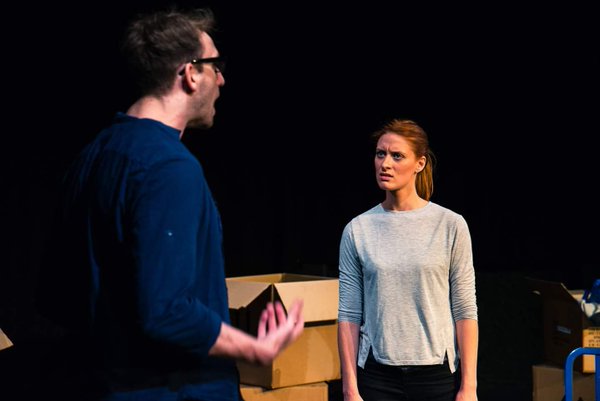
Photo credit: Ashley Carter

Every Seven Years invites us in to a love story that’s as messy as it is beautiful; neither Pam nor Ralph is perfect, but they’re perfect together. And the play is a heartwarming reminder that while a lot may change in seven years – events, circumstances, even our physical bodies – some things last forever.


Can’t see the map on iPhone? Try turning your phone to landscape and that should sort it. I don’t know why but I’m working on it… 😉

Review: Data at New Wimbledon Studio

Direct marketing is an industry we all know exists, and which we probably all realise is not a Good Thing – and yet it continues to thrive. Andrew Maddock’s new play Data, part of the Illuminate Festival at New Wimbledon Studio, aims to expose a little about how the system works, and maybe make us think twice about the many ways we willingly offer up our personal details every day.

DATA

We all know the direct marketing industry is a bit shady, but it’s also easy to dismiss as a minor irritation that doesn’t really hurt anyone. And, let’s face it, it’s not the most glamorous subject in the world. So, like all the most successful marketing campaigns, Data appeals to our emotional side in order to get the message across.

Directed by Phil Croft, three characters reveal different aspects of the industry – each beginning within their own carefully defined space before spilling out as their stories begin to interconnect. At the business end, where data is bought and sold, are professionals like Gaz and Rachel, whose job is first to get us to part with our data, and then to use it against us. The play, presented in a poetic style, manages to explain this in relatively simple terms and in a way that keeps the subject interesting, whilst simultaneously acknowledging that it’s a hugely complex system with a multitude of loopholes. 

At the other end of the story are those most at risk from Gaz and Rachel’s underhand tactics – like Bev, a lonely, confused old lady who doesn’t even remember what happened yesterday, let alone understand what TPS stands for.

Not entirely surprisingly, this is very much a story of good versus evil – and just to make sure we’re in no doubt, there’s a parallel drawn more than once between dealing in data and dealing in drugs. (“I just want leads… I think them about them all the time,” is a repeated refrain.) Gaz (Sam Ducane) is an utterly despicable character, motivated solely by money and ambition, who clearly sold his soul to the devil a long time ago, while Bev (Jean Apps) is a victim in every possible way: she’s a widow, her granddaughter wants little to do with her, her son’s moved to Australia in unpleasant circumstances; even her dog’s dead. If this were a Comic Relief video, Jean Apps’ performance would have us all reaching for our phones.

Between these two extremes – and saving the play from becoming too clean-cut – lies Rachel (Helena Doughty), with an intriguing storyline, and, it seems, at least traces of a conscience. Even as she plans her marketing campaigns for maximum emotional impact on strangers, she’s concerned for her nan’s wellbeing at the hands of other marketers, and fails to see that she herself has been manipulated by Gaz into handing over information of a different but no less powerful kind. As the one character who we don’t totally love or loathe, it would be great to see Rachel’s story developed further, particularly the relationship between what happened in her past and her attitude towards her work. Which is not to say Gaz and Bev’s stories aren’t interesting; it’s just that Rachel feels like the seesaw that could tip the balance, for better or worse.

Data certainly succeeds in provoking an emotional response, although it perhaps lacks a clearly defined call to action. The play makes us think about where our own data goes, and explains how we can protect ourselves through services like TPS (though even these, we’re told, are possible to get around). But there’s a wider problem here, which the play does a great job of educating us about – and then leaves us wondering, what can be done?


Can’t see the map on iPhone? Try turning your phone to landscape and that should sort it. I don’t know why but I’m working on it… 😉
What qualifies someone to write about theatre?

Earlier today, an article was published by The Stage in which producer Danielle Tarento was quoted as saying of theatre bloggers, “This is a massive generalisation, but a lot of people are not ‘proper writers’. They do not have the intellectual background or historical background or time to know what they are writing about.”

And then Twitter exploded.

My natural instinct is always to give people the benefit of the doubt in cases like this, ever since I was 18 and the local paper quoted me as saying my A-Levels had been easy (definitely not what I said) – so I naturally assumed the quote had been taken out of context. And there’s a good chance it was, particularly since in the same breath Danielle Tarento acknowledges the massive role bloggers play in spreading the word to a wider audience.

But that hasn’t stopped people getting upset about it, and the fact that the article was published at all seems like as good a reason as any to pause and ask: what qualifies someone to write about theatre?

I don’t come from a writing background, as evidenced by the noticeable absence of the novel I’ve been trying to write for years. I don’t come from a performance background either, unless you count a few appearances in school nativity plays and a brief spell in a drama group which I’m pretty sure only ever managed one production (I can’t remember what it was; all I know is we all said, “He’s not there!” a lot, and I was supposed to have a German accent). This worries me, because in addition to all the professional critics out there, it often feels like most other theatre bloggers are either students or practitioners of theatre. This, in my head, means they must know a lot more about the subject than I do, so I’m at a double disadvantage before I’ve even started.

I fell into theatre blogging totally by accident – it began as an occasional topic on a blog about stuff that makes me happy, and grew from there. Next thing I knew, I was reviewing regularly for three other sites, and eventually decided it was about time I started a specialist theatre blog of my own. And here we are.

IMG_1107 copy

150(ish) reviews later, here are a few things I know:

– Like most theatre bloggers, I’ve been going to the theatre my whole life, which means I have 30 years of experience as an audience member. True, I’ve only been reviewing for just over a year, and I’m too scared to look back at some of my early reviews because I’m sure they were very, very bad. But the only way to improve is to keep trying, and I like to think I’ve got at least a bit better over the past 12 months.

– Like most theatre bloggers, I have a full-time job to pay the bills. So I don’t have a lot of free time to work on reviews… but I make time. I stay up late, I use my lunch break and my commute, and the other day I sat in a restaurant with my family and ignored them all for a good five or ten minutes while I finished up a review – which I later rewrote because I hated the thought that I’d rushed it and not done a good job.

– Like most theatre bloggers, I don’t review because someone’s paying me. I do it because I want to; because I want to support theatre and share something I love with others. (Although if anyone wants to pay me, that’s totally okay. Just putting it out there.)

– Like most theatre bloggers, I sometimes worry my reviews aren’t intellectual enough, or that I’m somehow “doing it wrong”. But then I remember I’m not writing an academic essay; I’m writing for people like me, who enjoy a good show and might want to go and see something they may otherwise not have heard about. And it’s my blog, so as long as the review is honest and accurate, I can’t really mess it up.

So, what qualifies someone to write about theatre? Personally, I think passion, dedication and having an opinion are worth a lot more than using big words or having every comma in the right place (which is saying something, because I really care about correct punctuation). And if today is anything to go by, the theatre blogging community is overflowing with all these things.

The battle between bloggers and critics is, apparently, an endless one. It raises its head regularly, usually on Twitter, and everyone gets outraged every time. It is unfair to make the sweeping statement that bloggers aren’t proper writers, especially since some of us only plucked up the courage to start applying that label to ourselves very recently. But actions speak louder than words (or should that be words speak louder than tweets…? I don’t know), so let’s put our energy into proving our worth, by blogging on with pride, improving and learning as we go, and giving it 100% like we always do.

Review: The Local Stigmatic at the Old Red Lion Theatre

This year sees the 50th anniversary of Heathcote Williams’ The Local Stigmatic, which follows two sociopaths obsessed with celebrity culture. First performed in Edinburgh in 1966, the play was later made into a film starring Al Pacino. Michael Toumey’s new production remains faithful to the 1960s setting in which the play was written, and yet the story still feels chillingly relevant in our modern world of social media and reality TV.

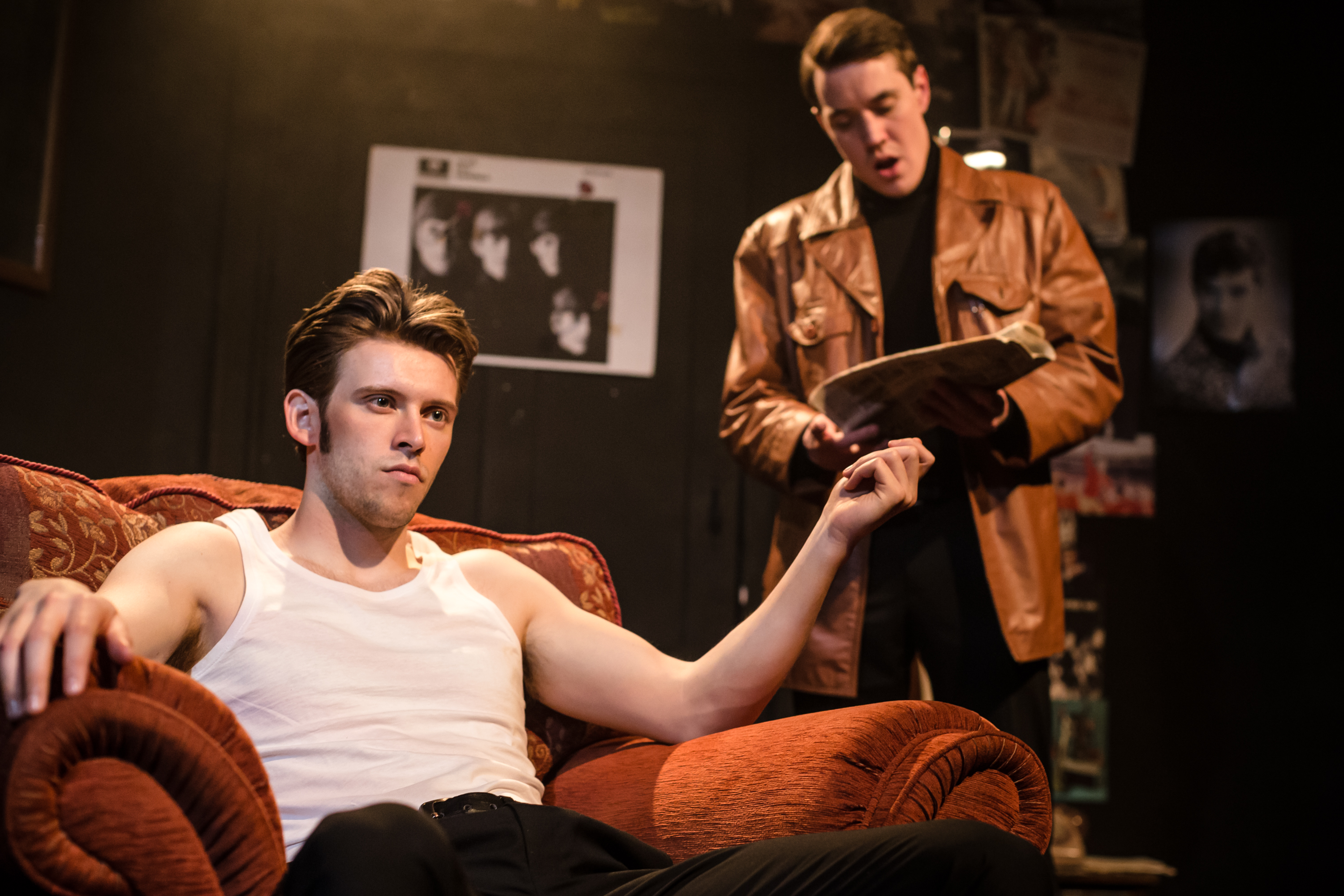
Graham (Wilson James) and Ray (William Frazer) are two friends who spend their time gambling, getting thrown out of pubs and reading newspaper gossip columns. When they bump into David (Tom Sawyer), a slightly famous actor, the two befriend him – but their twisted game takes a sudden, shocking turn, revealing their deep resentment of the celebrities they follow so religiously, and the depths to which they’re willing to go to prove their own superiority.

Photo credit: Scott Rylander

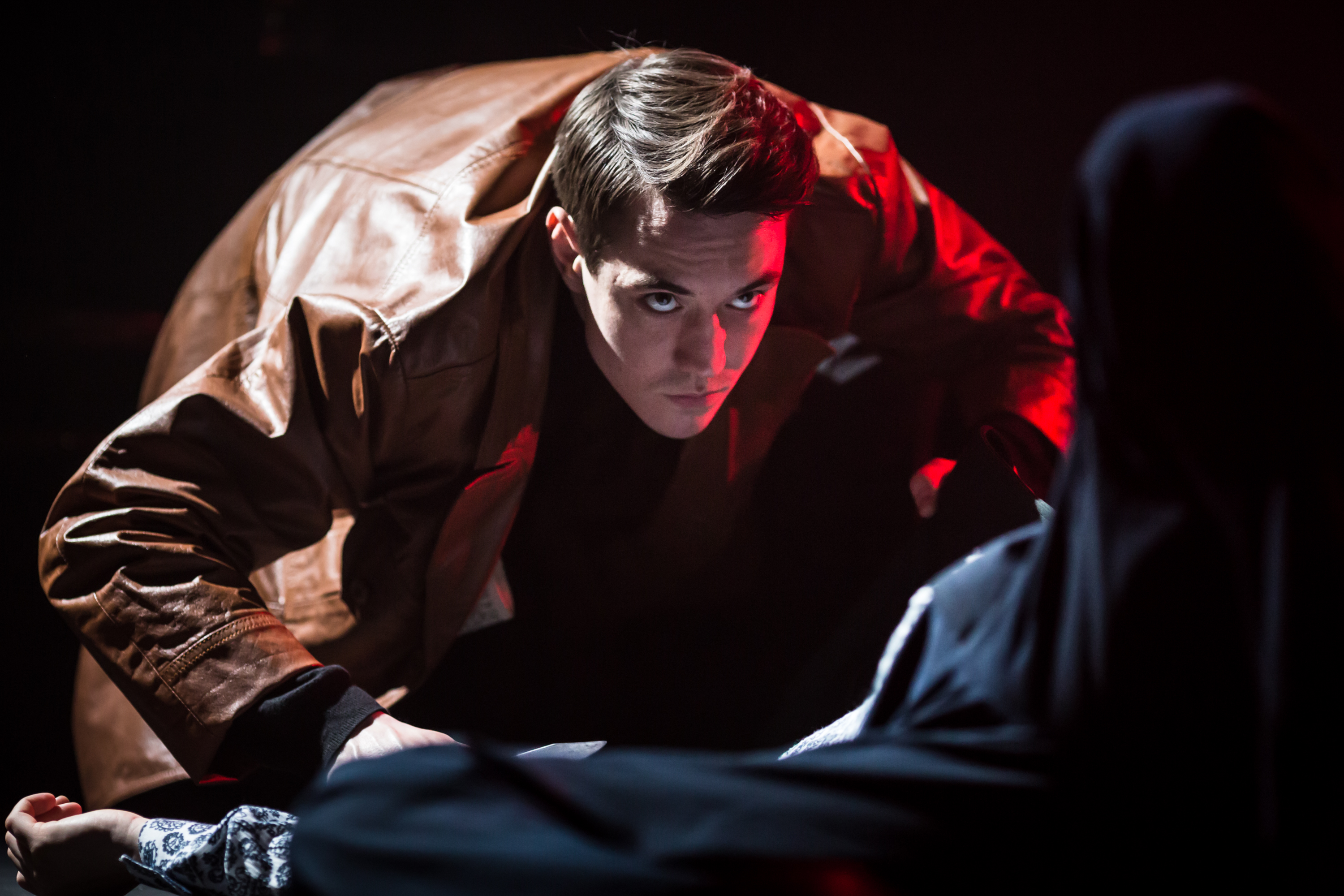
Wilson James and William Frazer give two unforgettable performances as Graham and Ray, subtly highlighting the differences in their personalities. Graham is the undoubted leader; his wide-eyed, unblinking stare (which he occasionally fixes on terrified audience members) gives the impression of a man on the brink of madness, and yet we soon discover beneath it all he’s always in control, choosing and pronouncing his words carefully to manipulate those around him.

Ray, on the other hand, is arguably the scarier of the two – though physically much more relaxed, and even occasionally quite funny, he too carries a pent-up rage that occasionally explodes in violence, and his blank-faced subservience to Graham, particularly in the closing minutes of the play, is truly chilling. Tom Sawyer’s David never stands a chance against this pair as, clearly flattered by their attention, he’s led neatly into the trap.

The dialogue is fast-moving and laden with meaning; it’s the sort of script that needs to be heard more than once to catch all the references (it also helps, I think, if you have a little knowledge of dog racing). What is clear is the way phrases are repeated throughout but with shifting significance, as the piece builds towards its shocking conclusion. And it is truly shocking, though not in the way I expected. When you’re braced for blood and gore, the violence initially seems a bit tame… but its power lies in the ability to send our imaginations into overdrive to fill in the gaps.

Photo credit: Scott Rylander

A simple set allows the actors to move easily between home, where celebrity posters adorn the walls, and the outside world, whilst keeping the two distinct. Tom Kitney’s lighting helps create an increasingly tense atmosphere, and sound designer Neil McKeown uses 60s hits to great effect both between and during scenes, to ensure some of the most powerful moments are those where no words are spoken.

The Local Stigmatic is an extreme example, but we only have to look at the increasingly common occurrences of internet trolling, or read the comments on any article in the Daily Mail sidebar, to realise the resentment felt by Graham and Ray towards the rich and famous is still shared by many. And now that we live in a world where we don’t even need to be stalkers to know all about the lives of celebrities we follow – a word used with startling prescience in Williams’ script, written long before Facebook or Twitter had even been dreamed of – this 50-year-old play feels more relevant than ever.


Can’t see the map on iPhone? Try turning your phone to landscape and that should sort it. I don’t know why but I’m working on it… 😉
Review: Blind Man’s Song at the Pleasance

I’ll be honest – I had mixed feelings going in to Theatre Re’s Blind Man’s Song last night. On the one hand, I was looking forward to something a bit different. On the other, as a general rule I like my theatre with words – the more the better.

There are no words in Blind Man’s Song. But as it turns out, none are needed. The show uses a combination of mime, dance, sound, illusion and original music to tell a moving and surprisingly powerful tale of love and loss, which is accessible enough to follow what’s going on but still leaves room for each individual to interpret it in their own way. The main character, a blind musician (Alex Judd), leads us on a journey into the dream-like world of his own memory (or is it imagination…?), in which a chance encounter between two strangers is just the start of the story.

Photo Credit: Richard Davenport

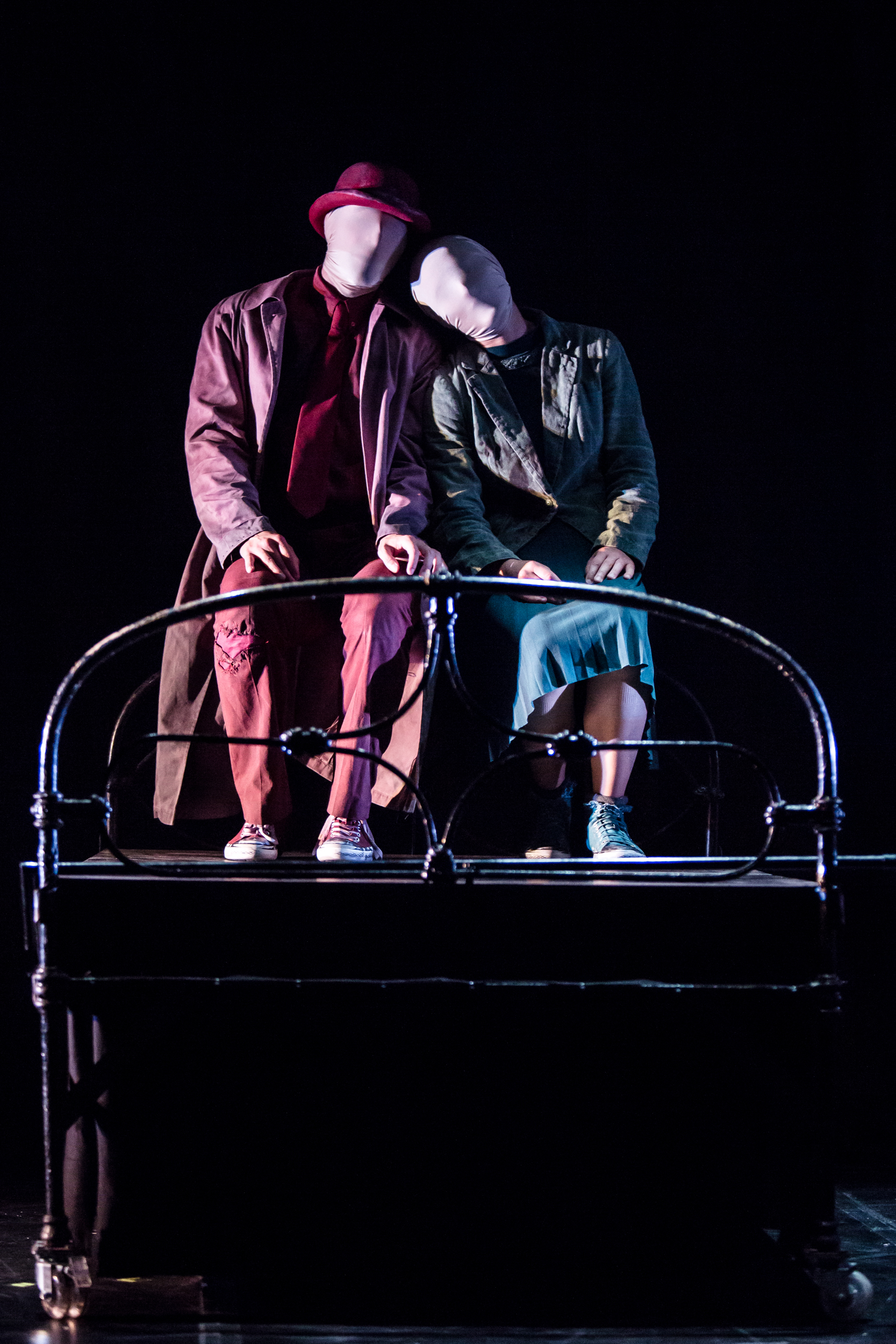
Two mannequin-like figures (Guillaume Pigé and Selma Roth), their faces covered, bring this world to life while the musician plays. In the absence of facial expressions, it’s the music and movement that convey the emotion of the piece – and in doing so reveal how much it’s possible to share without words. The combination is so evocative that we can feel the joy, passion, rage and grief of all three characters, as the music skips, swells and storms around them.

Said music is all original composition for violin and piano by Alex Judd, making effective use of the loop pedal to create layers and waves of sound. A simple theme, picked out with one finger on the piano, is repeated throughout the show, finally taking its place at the heart of the blind man’s song for the spine-tingling finale. Meanwhile, in harsh contrast, discordant sound effects – a rattle of metal against metal, a loud feedback tone – interrupt to break the spell and go on just long enough to make us uncomfortable, in a reflection of the musician’s own internal struggle.

Photo Credit: Richard Davenport

The show was conceived and directed by Guillaume Pigé, one of the faceless figures who cover the stage with a fluid grace, at times in slow motion and at others with surprising speed. There’s creative use of the sparsely furnished set; I particularly enjoyed the conversion of the bed into a train. Like the performers, the bed and the piano are rarely still for long, giving the piece a feeling of perpetual motion and urgency.

Blind Man’s Song is proof, for me at least, that sometimes it’s good to step out of your comfort zone; I left the Pleasance feeling genuinely moved by the beauty of the story, music and performance. Who needs words?


Can’t see the map on iPhone? Try turning your phone to landscape and that should sort it. I don’t know why but I’m working on it… 😉