Next month, Battersea’s Theatre503 plays host to Homecomings, a festival of new plays by prisoners and ex-prisoners about getting out and going home. Produced in partnership with the Synergy Theatre Project, the festival runs from 21st February to 18th March and will feature two of the winners of Synergy’s third national prison scriptwriting competition – Glory Whispers by Sonya Hale and The Monkey by John Stanley.
John, a lifelong Londoner, describes The Monkey as “a dark, comic contemporary drama of criminality, addiction and money owed”. The four characters he’s created, he explains, offer “a brief glimpse of the many diverse and varied people I met during my life’s erratic and unusual journey”.
Until he joined the Synergy project, John never imagined a future as a playwright: “The short answer is no, although I’ve always dabbled in poetry. Recently I completed a book about my life, but the truth is that until I completed the Synergy playwriting course I never had an interest in theatre.”
The Synergy Project, founded in 2000, seeks to build a bridge from prison to social reintegration, prevent young people from entering the criminal justice system, and inspire change by capturing the imagination of participants and public. After learning about the project from a friend who worked at the Young Vic, John joined the Synergy playwriting course and went on to write The Monkey. He’s thrilled to have his first ever play selected as a winner, out of a record 134 entries.
“I was over the moon when I found out, truly elated. Synergy has had such an enormously positive impact on my life that it’s impossible to quantify in a few sentences.” His advice to others thinking about getting involved in Synergy is simple: “Don’t hesitate and don’t delay, take the opportunity and go for it immediately.”
John’s now looking forward to seeing his work come to life on stage: “It’s exciting and nerve-wracking to see it come to life. I wrote The Monkey in 2012 and when I finally got to hear it in its entirety at the rehearsed reading recently, it was somewhat unreal but it was really gratifying. I am a touch nervous as to whether people will like it or not, though my feeling is you either do or you don’t and that’s how it is. Some people will find it hilarious and some won’t, but I hope they at least find it funny. If they do that would be wonderful.
“I’m sure I portray a world that most people are unaware of, so I hope they go away educated in some degree to an underbelly that exists in their midst – but most of all I hope they find it funny and have a good laugh.”
Proud Haddock’s production of The Trackers of Oxyrhynchus opens in Egypt in 1907, where two archaeologists and a team of local men are sifting through scraps of ancient papyrus. It’s an appropriate introduction to Tony Harrison’s 1988 play, which has itself been unearthed and given new life nearly 30 years after its last London performance.
Grenfell and Hunt (Tom Purbeck and Richard Glaves) are academics searching for a lost satyr play by Sophocles. Dismayed at their lack of success – all they seem to find is endless petitions for help from the dispossessed – Grenfell grows increasingly obsessive, and Hunt starts to worry about him… with good reason, as it turns out. Before we quite know what’s happening, Grenfell’s been possessed by the god Apollo, while Hunt’s transformed into Silenus, and (with a bit of audience participation) dramatically released his band of dancing satyrs.
Photo credit: Samuel Taylor
From here, the story takes us to ancient Greece and into the lost play, Ichneutae, where Apollo charges the satyrs with tracking down his lost cattle, only for them to discover instead something far more valuable to him. And finally, we’re whisked off to London’s South Bank in 2016, where the effects of that discovery are still being felt – but not necessarily in a good way.
Believe it or not, all of this happens in 75 minutes. The Trackers of Oxyrhynchus is a whirlwind of a production that’s barely contained by the Finborough’s tiny stage, and allows very little time to process what’s going on – yet still somehow manages to remain accessible to those of us without a degree in ancient Greek literature. Don’t get me wrong, the story is completely bonkers, and there are certainly a good few moments where we’re left wondering what on earth just happened (the sudden appearance of Hermes the man-baby would be a good example). But it all comes together in the end, with a powerful message not only about the dichotomy between high and low art, but more broadly about the divide between rich and poor, and a direct appeal to the audience which challenges us to examine our own attitudes. (That said, the perfectionist in me would have welcomed a chance to circle back to the beginning of the story, if only to find out what happened to Grenfell and Hunt.)
Photo credit: Samuel Taylor
Tom Purbeck and Richard Glaves lead the cast with strong performances, handling with ease Harrison’s rhyming verse. Purbeck particularly excels during a wild-eyed transformation from Grenfell to Apollo, his head snapping back and forth as the two personas war against each other. Glaves’ key moment comes late in the play, but is worth waiting for; as Silenus, he recounts movingly the flaying of his brother satyr Marsyas, who was punished by Apollo for having the temerity to become an accomplished flute player. But perhaps most memorable – for reasons that become obvious (costume designer Vari Gardner, take a bow) – are the satyrs, played by Dylan Mason, James Rigby, Nik Drake, Sacha Mandel, Dannie Pye and Adam Small. Energetic and irreverent, they stomp, dance and joke their way through the middle section of the play… yet this story is not destined to end happily, and their 21st century incarnations channel their energy in much darker ways.
The Trackers of Oxyrhynchus is a decidedly odd play, entertaining and tragic in equal measure. Jimmy Walters’ production could at times move a little more slowly, and could certainly benefit from a slightly bigger stage – but given the nature of the play and its message, a small theatre, in which audience and artists are within touching distance, feels like an appropriate setting for the rediscovery of this little-known work.
Can’t see the map on iPhone? Try turning your phone to landscape and that should sort it. I don’t know why but I’m working on it… 😉
The Brockley Jack annual Christmas show is the stuff of Fringe Legend. It sells out before it even opens, and the reasons for this incredible success are legion. The Brockley Jack is one of the most reputable and iconic venues in London, and it’s run by people who know what they’re doing and care passionately about the space. They pick good scripts, cast talented actors and produce the Christmas show themselves so audiences know it’s a sure thing. Added to this, the Jack does something other than panto – so it’s great marketing for those who are Cinderella-ed out.
This year’s offering is a comedic pastiche of Sir Arthur Conan Doyle’s The Hound of the Baskervilles. The plot is simple enough: Mr Baskerville has been murdered. People think it’s a huge hell-hound. Holmes goes up there with Watson to solve the mystery. He does. The End. The show is sold out now, so go and read the book, it’s great.
Photo credit: Tim Stubbs Hughes
The script owes a lot to plays like The 39 Steps or The Play That Goes Wrong, yet even those examples aren’t original ideas themselves, so this can be forgiven. Hound is a tight-paced physical comedy that has its three actors multi-roling rapidly between scenes, moving scenery and donning different hats, jackets and accents. It breaks the fourth wall constantly as the very conceit of the play is perpetually on the verge of falling apart, and the actors are forced to break character and become “themselves” more than once. Now, whilst I do have an issue with shows that try to do both a crappy play and make that funny (cod-accents and dodgy props), whilst doing a play crappily (falling down sets and scene changes going wrong), I have to admit the grace and tenacity with which this production was helmed completely won me over and had me giggling with glee. The highlight of the show for me was just after the interval when one of the actors gets irate with the audience after reading an interval tweet and forces his co-stars (and us) to go through the first half at triple speed to prove he was capable of a quicker pace. This moment of building chaos really sums up the production for me; it’s self-aware and tongue-in-cheek, it’s modern and humble, but it’s done with such slickness and panache that the audience are happy to be whipped through the same scenes again, like reading a York Notes Study Guide whilst on amphetamines.
Joey Bartram plays the Great Detective Sherlock Holmes – a role made difficult to make your own after so many iconic performances on screen recently (perhaps the 21st century’s Hamlet?), and this production sees Bartram striding about the stage dripping with confidence (sometimes sweat) and a faraway look, whilst whipping his dark locks about him like he’s modelling shampoo. It’s a boho, gin-drenched, Oxbridge kind of a take on the role, and it’s in keeping with the show, but it’s really the character actor side role/suspects where Bartram shines, teeth-gnashing, winking and scowling his way through scenes.
Adam Elliott plays the Doctor Watson role, which really, due to the absence of Holmes for a large section of the production, is promoted to leading man status. Watson is normally a dog of a part, if you pardon the pun, and yet Elliott does it, thankfully, with charisma and charm. Having seen Elliott perform on the Fringe multiple times now, I’m starting to think that there aren’t many things the actor cannot do. He is a great talent, and one that has a bright future ahead of him. He’s eminently watchable, has an almost flawless grasp of comedic timing, and handles the numerous roles he’s awarded with versatility and a sense of child-like glee.
Photo credit: Tim Stubbs Hughes
Andrew Fitch completes the trinity with a wide-eyed and energised Sir Henry Baskerville – the next victim of the Hound that Holmes and Watson are trying to keep from becoming pedigree chum. Fitch has a mountain of roles to contend with (even some that have to be performed on the first floor of the building above the theatre), and he manages to distinguish each one clearly and without undue effort, and he more than gives the two heroes a run for their money in terms of acting chops.
Kate Bannister (director), Karl Swinyard (set design) and Michael Edwards (lighting design) deserve all the credit for turning the small acting space of the Jack Studio Theatre into dozens of different locations, flicking instantly between a foggy moor to a dining room to a train carriage to a horse and cart, all with simple props choices, movement direction, action set pieces, moveable scenery and some of the slickest and most inventive lighting operation I have EVER seen on the Fringe circuit, helmed by Stage Manager John Fricker who seriously deserves an Off West End Award by himself just for managing that many sound and lighting cues on a fringe theatre tech desk.
If not already clear, this play is hilariously funny. The idea is not a new one, nor does it particularly care to strive for anything above an entertaining night out, but it doesn’t have to. It’s an incredibly well-directed, well-performed and well-constructed comedy, that’s firing on all cylinders and never lets up for a second. It’s a work of true skill, made by professionals who know their craft.
Fringe Theatre, at its best, transcends its limitations and is palpably made with love, passion, creativity and care. Kate Bannister and her team have done exactly that. I would say this should transfer somewhere bigger, but then perhaps it might lose some of the charm that makes it so impressive a feat of the face of their restrictions of space and budget. So perhaps I will say that the Jack Studio Theatre deserve and need all the support, investment and love that their community and fanbase can give them, for they really are a jewel in the London Theatre Crown. Edinburgh Festival 2017 Venue Managers, you better get this show booked in whilst you can…
Can’t see the map on iPhone? Try turning your phone to landscape and that should sort it. I don’t know why but I’m working on it… 😉
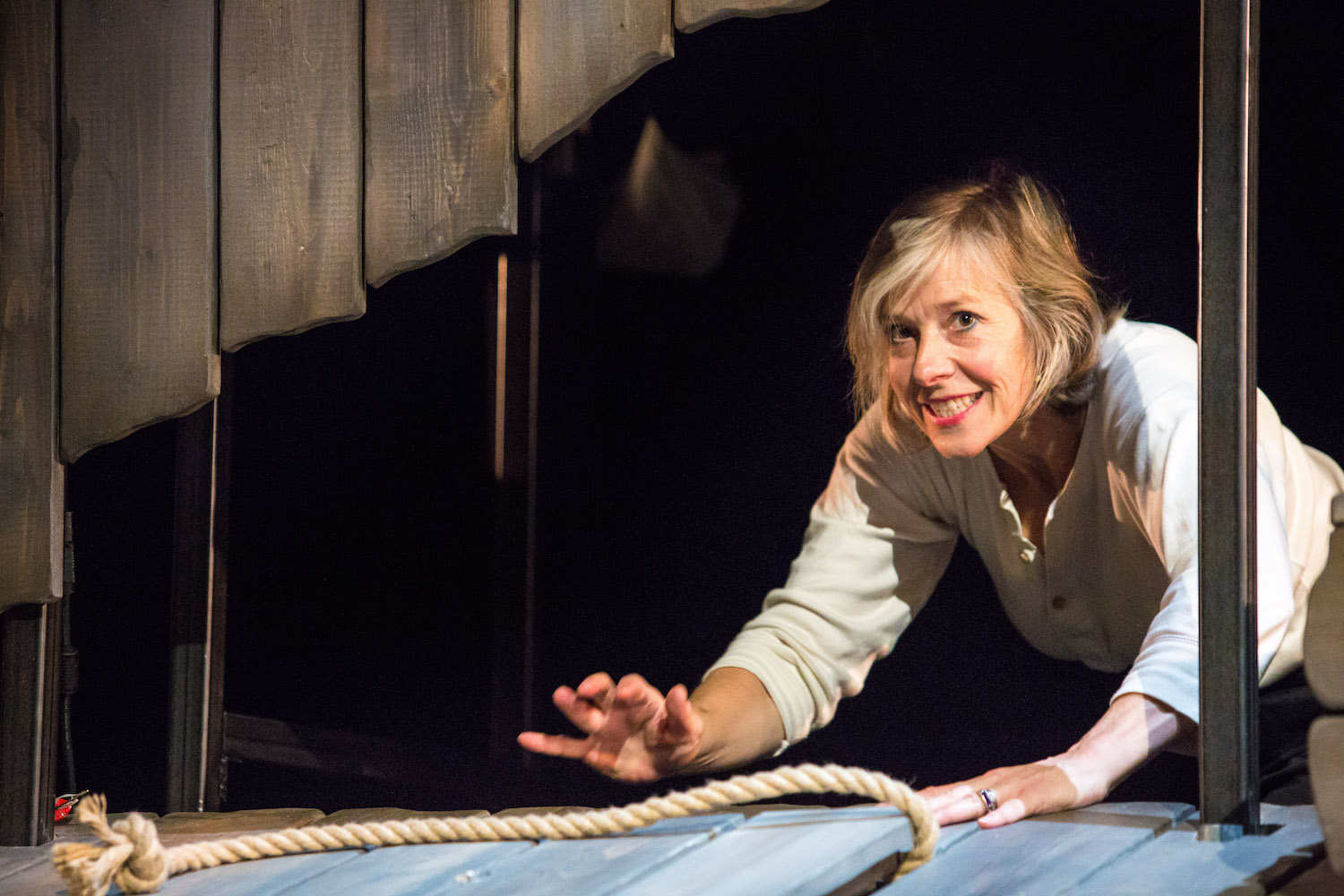
“I love how this story makes us think about others, about how we view difference and how sometimes we misjudge when we’re unsure or afraid,” says Danyah Miller, award-winning performer and storyteller, of Michael Morpurgo’s Why the Whales Came. “I would hope that the audience take away a sense of hope and joy and perhaps the feeling that one person can make a huge difference.”
Why the Whales Came sees Danyah again teaming up with director Dani Parr and designer Kate Bunce, following the success of their collaboration on I Believe in Unicorns – also by Michael Morpurgo. “I love working on Michael’s stories because they’re multi-layered and really gripping tales, based in truth,” she explains. “It is often said that he doesn’t patronise children in anyway and takes them, and us, to dark places and back again. I like that. I find his stories full of surprises, sadness, hope, joy. Above all, they’re about ordinary folk often doing extraordinary things during extraordinary times.”
Photo credit: Helen Murray
Their admiration is mutual; Michael Morpurgo describes Danyah as a “storytelling phenomenon”. What inspired her to take up performing as a career? “As long as I can remember I wanted to be a performer and I certainly ‘entertained’ my way through childhood! I have always been very chatty and there’s nothing I like more than spinning a good tale. How I became a storyteller is a long story…
“I suspect that the difference between being an actor and being a storyteller is a very fine line. As a storyteller we ‘hold’ a central point, as ourselves, and from there paint the world of the story, become characters, weave in and out of landscapes and people, but we always come back to the centre, as ourselves. As an actor we become another character and remain in that role (although of course sometimes actors are asked to multi-role too). Perhaps it’s possible to be both, I suspect that the best in our profession are both actor and storyteller. Stories are everywhere, aren’t they? We are storytelling beings and it’s what makes us human…”
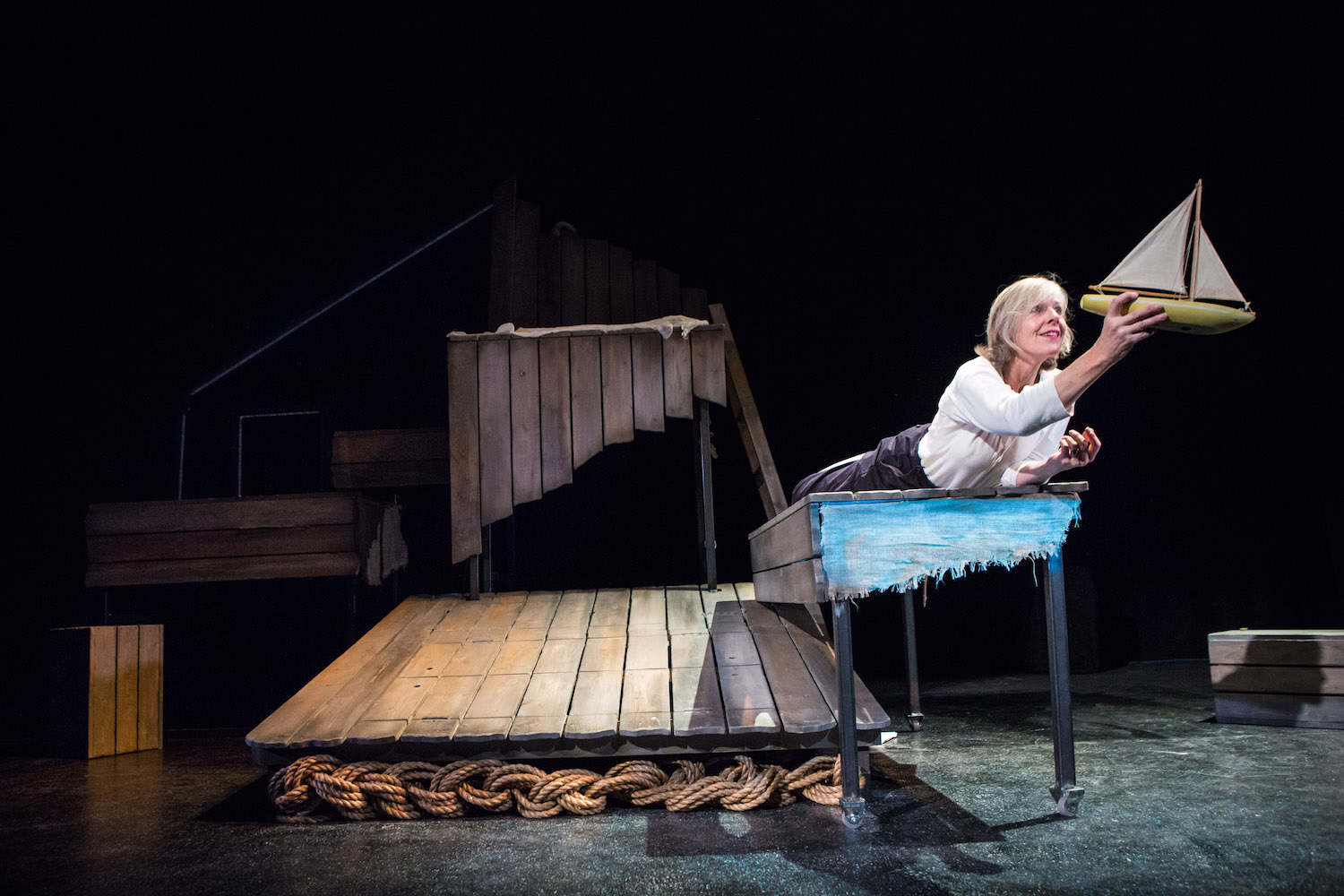
Why the Whales Came is the story of Gracie and Daniel, who’ve been forbidden to go near the mysterious and seemingly dangerous Birdman – but then they find a message in the sand that suggests all is not as it seems. When they get stranded on the Birdman’s tiny island, the two friends begin to unravel his secrets…
Although it’s based on a children’s book, Danyah believes the show has something for everyone: “This is definitely not a show just for children – it is a ‘family’ show in the widest possible sense. We have people of all ages from 7 to 107 enjoying the show whether or not they have children with them. Good stories, good theatre can appeal across the ages and we hope that our show does this.
“I enjoy sharing the show with children who’ve never been to a theatre before or experienced any kind of live show – as an audience they are really responsive and truthful and often give me insightful feedback. I also really enjoy it when families of children, parents and grandparents come to see the show and all of them have been moved by the show in different ways.”
Photo credit: Helen Murray
As a solo performer, Danyah may be the only person on stage, but she’s far from lonely. “I really like performing solo, although I feel as if I have a collaborator when I perform on the set, in the ‘world’ that the creative team have produced… the set, projection, lighting and sound,” she says. “I also like to be able to see the audience, we have the lights set so I can do this – so I’m not alone. I think of what I do as a delicious triangle between the story, myself and the audience – every show is different because of this, and I’m never lonely. I do have to make sure that I’m always fit and ready though, as it’s down to me being on top form for every show!”
Why the Whales Came is at Ovalhouse until 31st December, with other one-off performances scheduled for early 2017.
Someone told me yesterday that they find New Year a bit of a confusing time, because they never know whether they should be celebrating the last 12 months or looking forward to the next.
Well. This year more than ever, I’m all about looking forward and making the best of the opportunities 2017 has to offer. But while there’s a lot about 2016 that we might like to forget, it did bring us a lot of great theatre. So I’d like to pause for a moment and take a look back at a few of my highlights from the last 12 months. (As always, these are in no particular order – ranking them from 1 to 10 requires a level of decisiveness that’s far beyond me.)
It was inevitable that the Arrows would find their way into my top 10, but I’ve chosen Anna Karenina for this list, because it marked the moment I really fell in love with their work. Condensing Tolstoy’s epic novel into a drama as accessible as it was gripping, Anna Karenina bore all the hallmarks we’ve come to expect from an Arrows show: creatively staged, exquisitely performed and visually stunning.
A heartbreaking and incredibly timely play, Transports never explicitly mentioned current events, but nonetheless offered a powerful statement about the emotional trauma faced by refugees every day. Based on the life of designer Alan Munden’s mother, Liesl, the interlocking stories of two girls were simply and lovingly staged in a powerful and thought-provoking production.
It’s not really surprising that the experience of being a refugee has been a common theme in the theatre of 2016, but Tess Berry-Hart’s Cargo stands out as particularly powerful, because it turned the tables and forced us to not only imagine but actually experience what it might be like if we were the ones forced to flee our homes and seek refuge overseas. The result was a production that was disturbing, tense and unsettlingly authentic.
This one was a surprise to me, because going in I had no idea what to expect and really wasn’t sure if I’d enjoy this combination of mime, dance, sound, illusion and original music. But Theatre Re’s Blind Man’s Song was a revelation; I was soon swept away by the beauty of the love story unfolding on stage, and by the reminder of how much emotion can be expressed without saying a single word.
Patch of Blue struck gold again this year with We Live By The Sea, a beautiful and sensitive portrayal of a young girl with autism. While the carefully researched production made no attempt to conceal the difficulties experienced by Katy and her family, it also challenged us to look beyond her autism – and our own assumptions – to celebrate the person behind it and everything she had to offer.
Commissioned by the International Brigades Memorial Trust, Dare Devil Rides to Jarama – which continues touring into 2017 – tells the little-known but fascinating story of Clem Beckett, a young speedway rider from Manchester who gave his life fighting against fascism in the Spanish Civil War. Despite its sad ending, the story’s told with charm and humour by writer Neil Gore in a script that combines poetry, prose, music, and an enjoyable bit of audience participation.
As a fan of Jane Austen’s classic novel, I was either going to love or hate Two Bit Classics’ adaptation of Pride and Prejudice for two actors; it didn’t take long to decide it was the former. In an astonishing display of stamina, Joannah Tincey and Nick Underwood took on 21 characters between them, switching genders, costumes and accents at the drop of a hat in this funny and enjoyable show.
Cyprus Sunsets, the first in this double bill of monologues from up and coming talent Andrew Maddock, just missed out on my top 10 last year… but it’s time to put that right. The We Plays combined Cyprus Sunsets with Irn Pru – two very different stories that nonetheless shared an ability to wrongfoot and shock us. Powerful writing and captivating performances ensured the double bill definitely made the list this year.
Who would have thought a panto would make it into my top 10? Not me – but Sleeping Trees’ mash-up of Dickens and Disney is such a brilliant, hilarious and above all original take on the classic format that I’m currently trying to decide if I can squeeze in a repeat visit before it closes next week. And I shall also be demanding that every panto I see from now on features a giant lobster…
The Hope Theatre has had a great year, and it came to a triumphant, five-star end with Her Aching Heart, a lesbian gothic romance musical two-hander written by Bryony Lavery. A laugh out loud comedy, this unexpected delight of a show affectionately mocked the Mills and Boon genre on which it was based, while a modern day love story unfolding simultaneously introduced a more contemplative note.




 Theatre Things