Review: He(art) at Theatre N16

Andrew Maddock has already established himself as a writer to watch with his previous work, including In/Out (A Feeling) and more recently, The We Plays. In particular, he really knows how to create characters that we care about, so that when the story suddenly takes a darker turn, we’re caught totally off guard. He(art), Maddock’s latest play, follows a similar trajectory, setting up two separate but equally compelling stories before smashing them together in an explosive final scene.

Alice is looking for a painting to buy with her boyfriend Rhys. But he’s reluctant to commit – to a piece of art or anything else, including seeing a doctor about his congenital heart condition. Meanwhile Kev’s just got out of prison and is hatching a plan with his sister Sam to get the money they need for their dying Mum’s medical treatment – by stealing the very painting Alice and Rhys have their eye on…

Photo credit: Jesse Night

At first glance, there’s a lot in this story that doesn’t quite make sense. How did posh gallery curator Alice get together with “Wembley Warrior” window cleaner Rhys? Why do Kev and Sam have to steal that particular painting (and why any painting, come to that)? What happened to their dad? And what does die Maus Head Man have to do with anything?

We don’t get all the answers, but that’s sort of the whole point – Maddock gives us a sketchy snapshot of events, and how we fill in the blanks is up to us. If a few of those events are slightly random, well it just makes the overall impression more interesting – like a mouse head that triples a painting’s value. The opening scene, in which Alice tries unsuccessfully to teach Rhys about art, is actually as much for the audience as it is for him, letting us know that just because we don’t have all the info it doesn’t mean we can’t flesh out the story in our own way. The stage in director Niall Phillips’ production is a roped-off gallery space; the props are exhibits hanging from the ceiling, as is the painting at the heart of it all. This play is a piece of art in itself, to be examined, discussed and interpreted, not simply accepted at face value.

But as the title suggests, there’s more than just art here – there’s also a huge amount of heart. This manifests itself in small ways, like Rhys’ pride in the fact his are the only streak-free windows on the high street, or in Sam’s eclectic music collection and the affection for Johnny Cash that she shares with her brother. But it’s also built into the relationships of the characters; this is a story that’s absolutely driven by the heart instead of the head. On paper, Rhys and Alice’s relationship should never work. Sam and Kev’s planned heist is doomed to failure. And yet we find ourselves willing both to succeed, because both are motivated by that most fundamental of human emotions: love.

Photo credit: Jesse Night

This love comes through powerfully in the four actors’ performances. Jack Gogarty and Alex Reynolds are very natural together as Rhys and Alice, revelling in their light-hearted banter about the value (or not) of Banksy and a recent scandal in the porn industry. But their relationship is just as convincing in its more intense moments; her anxiety about his health and his longing for a normal life both feel entirely genuine. Similarly, the close sibling relationship between Kev and Sam, played beautifully by Shane Noone and Flora Dawson, feels completely authentic, precisely because it isn’t picture perfect – his concern for her welfare is frequently tinged with impatience and even violence, while her childlike emotional vulnerability and desperate desire to please him put everything at risk more than once.

In He(art), Andrew Maddock has another hit on his hands; it’s a poignant and at times very funny story of two halves – and if this time the twist in the tale isn’t entirely unexpected, that doesn’t make it any less compelling to watch. (One of the great things about theatre in the round is you can see how other audience members are reacting, and it’s safe to say I wasn’t the only one on the edge of my seat there at the end.) Most importantly, it reminds us that whether we’re talking about painting, music or even window cleaning, there’s no such thing as “just art”.


Can’t see the map on iPhone? Try turning your phone to landscape and that should sort it. I don’t know why but I’m working on it… 😉

Review: BU21 at Trafalgar Studio Two

Human beings tend to have a strange fascination with tragedy. Everyone has a “where I was on 9/11” story, for instance, even though in 99% of cases it makes absolutely no difference to anyone but us where we were when the Twin Towers were hit. And we often find ourselves morbidly gripped by all the details – whether that means slowing down to peer at the car crash on the other side of the road, or following minute-by-minute updates from the BBC on the latest terrorist attack.

I like to think this is not because we’re all awful people, but because we have no other way to process the unspeakable horror of what’s happening. There can’t be many of us who haven’t imagined at least once over the last few months and years the very real possibility of getting caught up in a major catastrophe – whether terrorist or accidental – but nobody ever really thinks it’ll happen to them, or knows how they’d react if it did.

Photo credit: David Monteith-Hodge

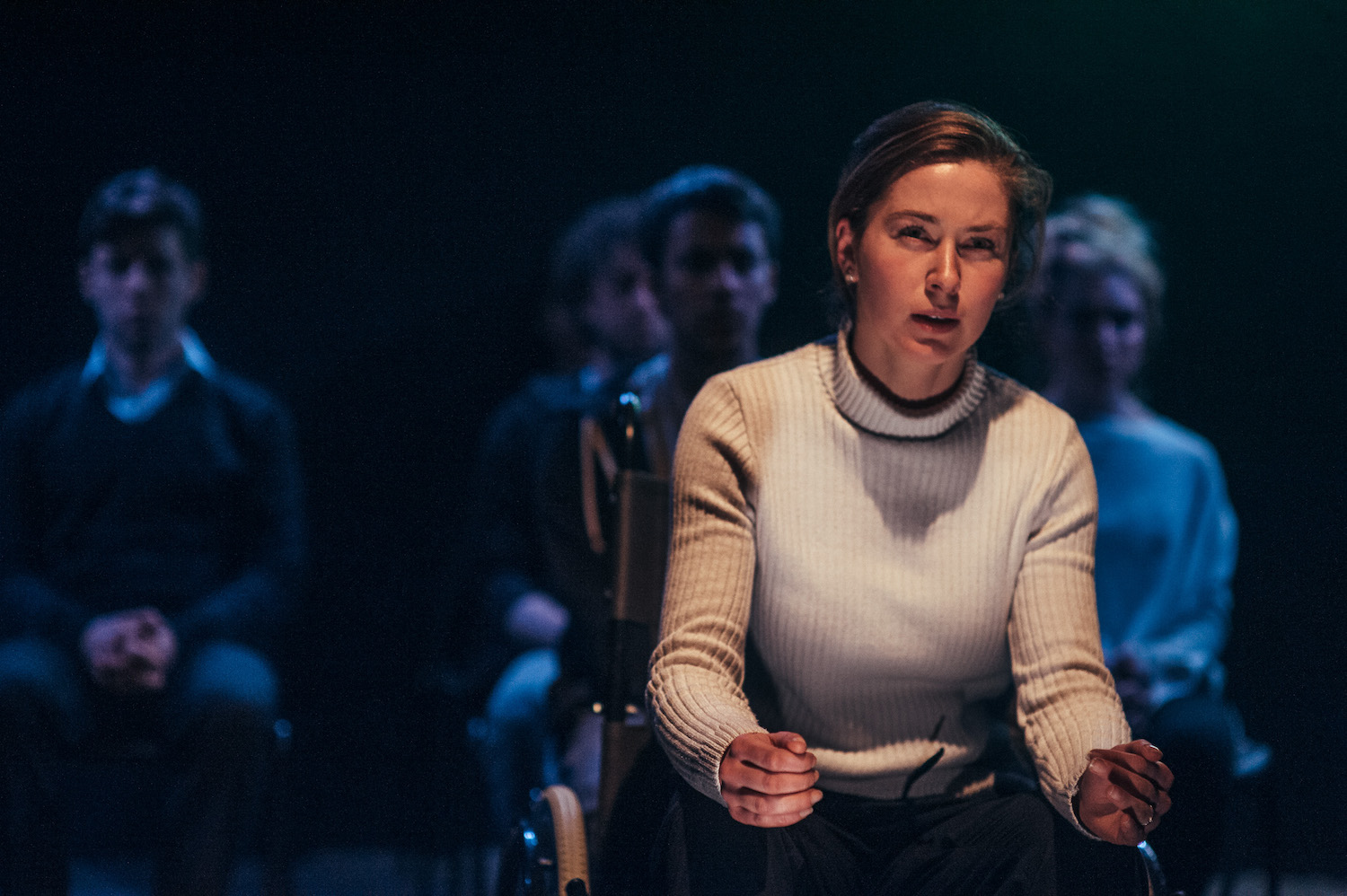
This is the inspiration for Stuart Slade’s excellent and thought-provoking BU21, which brings together six young Londoners affected in different ways when a fictional terrorist attack brings a plane crashing to the ground in Fulham, a few months from now. Each has their own story to tell: Ana (Roxana Lupu), horribly burnt and wheelchair-bound after the plane smashed into the park where she was sunbathing; Izzy (Isabella Laughland), who found out her mum was dead through a photo on Twitter; Alex (Alexander Forsyth), whose girlfriend and best friend were killed while in bed together; Graham (Graham O’Mara), an eyewitness who finds himself an accidental celebrity; Floss (Florence Roberts), traumatised by the sight of a man in a plane seat dying in her back garden; and Clive (Clive Keene), a young Muslim looking for answers in the wake of the crash. The fact that each of the actors is, in a way, playing an alternate version of themselves lends the play an unsettling authenticity, strengthened by the fact that the attack hasn’t yet taken place – but still could.

Dan Pick’s production is set in the soulless room where the six meet for their PTSD support group, illuminated by flickering strip lights, and furnished with a few plastic chairs and a metal trolley bearing the obligatory plate of biscuits that nobody ever eats. Yet despite a set-up that should suggest human connection, the majority of the play consists of monologues, with each character speaking into a void while the others deliberately look away.

Each account is horrifically detailed and brutally honest; there’s no glamour here, no tragic heroes, no political correctness or bold display of unity in the face of adversity – there’s just a bloody mess, and a bunch of people trying to pick up the pieces of their broken lives. The characters are not all nice people, they don’t all get a happy ending, and it’s difficult to tell how much support any of them are actually giving or getting as a result of talking things through. In the end, each of them copes in their own way, whether that means milking it or avoiding it, getting on with life or unable to move, seeking comfort or shutting people out.

Photo credit: David Monteith-Hodge

Slade doesn’t offer judgment or try and tell us who’s right or wrong – if anything, the spotlight is turned instead on our own attitudes. There’s the obvious one, of course, although I can’t imagine many people honestly believed Clive the Muslim would turn out to be a terrorist. But there are also moments that catch us off guard, like when Alex the charming but obnoxious banker suddenly breaks the fourth wall and challenges our decision to exploit his misery for our entertainment. Or every time we laugh – which happens a lot more than you’d expect – always with the uncomfortable sensation that we’re being disrespectful.

BU21 may deal with a terrorist attack, but it’s not a political play; we never really find out who the perpetrators were, and nor does it matter. Stuart Slade’s focus is on the psychology of human beings in a moment of crisis, and while we may not leave the theatre knowing how to survive a plane crash, we might just find we’ve learnt a little something about ourselves.


Can’t see the map on iPhone? Try turning your phone to landscape and that should sort it. I don’t know why but I’m working on it… 😉

Review: The Kite Runner at Wyndham’s Theatre

Khaled Hosseini’s first novel, published in 2003, is a modern classic. A story about friendship, betrayal and redemption, it’s sold millions of copies worldwide, and was made into an award-winning movie in 2007, before being adapted for the stage by Matthew Spangler two years later.

(It’s also one of my favourite novels, so I didn’t wait around until press night to see the play on its arrival at Wyndham’s Theatre just before Christmas. Consequently this review is based on one of the earliest previews, and it’s possible some aspects of the show may have changed since then.)

Photo credit: Robert Workman

The Kite Runner tells the story of Amir and Hassan – one the son of a rich businessman, the other the son of his Hazara servant – whose close friendship is shattered in one shocking moment of betrayal. More than 20 years later, after fleeing the Soviet invasion and starting a new life in America with his father, Amir receives a call that offers him a chance of redemption… but to take it he must return to Afghanistan and confront the demons of his past.

It’s a story that skilfully interweaves Amir’s personal journey with the historical and political story of his country, and Giles Croft’s production faithfully follows that same narrative. While Amir (Ben Turner, who plays both Afghan child and American adult) shares his account of events, there are frequent reminders of the home he left behind – but which, despite his efforts to move on, never left him. Tabla player Hanif Khan provides percussive accompaniment throughout, while Barney George’s set features a huge kite, on to which is projected beautiful backdrop imagery (designed by William Simpson), and which becomes a symbol of the culture and passion that united the two friends, but also the fateful day that tore them apart.

Said kite also mercifully shields our view of the traumatic pivotal moment, but Amir’s reaction to and description of it evoke all the horror I remember feeling the first time I read the novel. Because this is far from an easy story; there are a few laughs and one particularly joyful scene in Act 2 (though even this has a shadow of sadness to it), but the most powerful moments are undoubtedly those that shock us and break our hearts. Much like any tragedy – personal or national – the glimmer of hope in the play’s closing scene can’t undo the damage that’s been done.

Photo credit: Robert Workman

As both narrator and main character in a play lasting nearly three hours, Ben Turner has quite a task, but he performs it to perfection – at times you can almost see the guilt weighing on his shoulders. But while Amir is the voice and conscience of the story, its heart lies in the people around him: Hassan (Andrei Costin), who remains unfailingly loyal despite his betrayal; his wife Soraya (Lisa Zahra), who hears his story and forgives him; his father (Emilio Doorgasingh), with whom he finally develops a mutual respect; and Rahim Khan (Nicholas Khan), the family friend who offers him his chance of redemption. Through their eyes – and the excellent cast performances – we see a different Amir: a man not destroyed by guilt, but with the chance to be good again.

I know I say this every time, but seeing an adaptation of a beloved book is always a gamble. Fortunately, I have no complaints about The Kite Runner, which is as thought-provoking, powerful and emotionally scarring (I mean that in a good way… I think) as Hosseini’s novel. Yes, it’s a long evening – but it’s worth every second.


Can’t see the map on iPhone? Try turning your phone to landscape and that should sort it. I don’t know why but I’m working on it… 😉

Interview: Guillaume Pigé, The Nature of Forgetting

“The name of the company comes from the prefix ‘re’. It is the ‘re’ of re-discovering and re-imagining. For us it is not about inventing but about breathing new life into what is already there.”

Guillaume Pigé founded Theatre Re in 2009 while in training at the International School of Corporeal Mime in London. He was joined in 2011 by Katherine Graham, Malik Ibheis and Alex Judd and an international ensemble was formed, producing work that combines mime and theatre to examine fragile human conditions. Their last show, Blind Man’s Song, was a surprise (to me, anyway) entry in my top 10 of 2016, and they’re now looking ahead to the world premiere on 18th January of their latest project, The Nature of Forgetting.

Photo Credit: Richard Davenport for The Other Richard

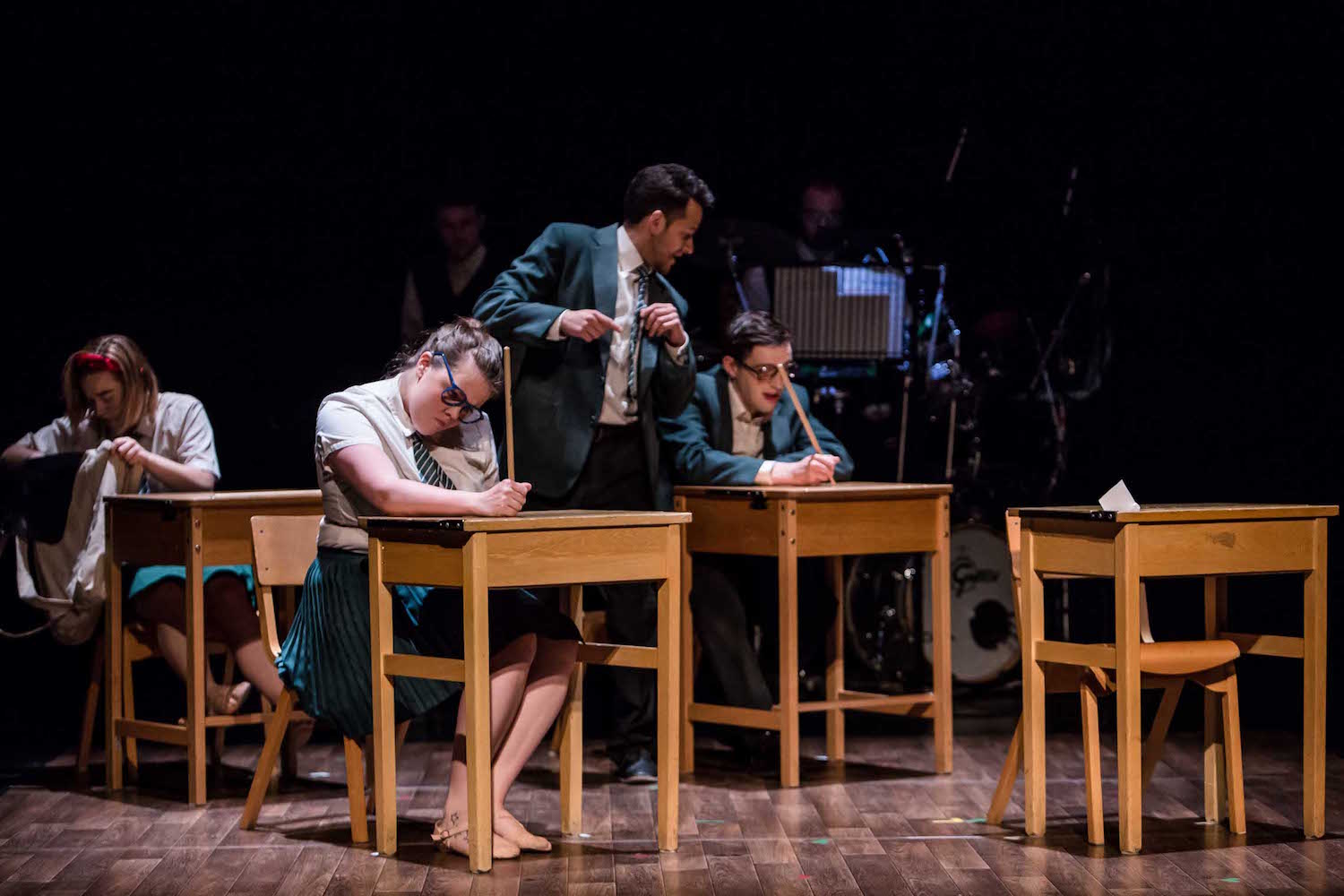
Inspired by recent neurobiological research and interviews with people living with dementia, the show tells the story of Tom, as he’s re-awakened on his 55th birthday by the tangled threads of his disappearing memories.

“As a company we work very collaboratively, and for this project we started by doing things, by moving, by playing,” says Guillaume. “A few objects very rapidly became central to the piece, like the wooden school desks for instance. We also collaborated with UCL Neuroscience Professor Kate Jeffery and interviewed older people and people living with dementia. The point was not to collect their stories or what they remembered, but to explore how they remembered. This was fascinating. The main question that guided our exploration was: what is left when memory is gone? We could not put the answer into words…so we made a show about it.”

The collaboration with Professor Jeffery proved invaluable to the creation of the piece: “She not only helped us to understand memory mechanisms, but she also helped us to gain a better understanding of the information we were getting through our interviews,” explains Guillaume. “She was also in rehearsal with us to support our physical and visual dramaturgy. In fact, this collaboration went so well that we will be organising a seminar with Professor Jeffery at UCL about the science behind the making of the show ahead of our premiere, where we will discuss how the concepts of the neurobiology of memory has shaped the making of the work.”

One of the unique features of Theatre Re’s work is composer and musician Alex Judd’s live music, which has been part of the company’s previous shows Blind Man’s Song, The Little Soldiers and The Gambler. “Alex’s music for this show is absolutely gorgeous and all created live from more than ten instruments on stage! It has all been composed in the rehearsal room as the piece was being developed. The music and the sounds are totally integral to the performance. Also, for the first time, Alex is joined on stage by a percussionist, Keiran Pearson, who adds different timbres, colours, and textures to the score.”

Photo Credit: Richard Davenport for The Other Richard

The show was also inspired by the work of theatre director Tadeusz Kantor: “I was originally drawn to the work of Tadeusz Kantor because the world of childhood memories (long term memory) became very rapidly central to the development of The Nature of Forgetting. I was especially inspired by pieces such as The Dead Class and Wielopole.

“While watching those pieces, I was fascinated by the mysterious raw visual and physical poetry that was developed on stage. Especially the use of ‘poor objects’ and the work of the actors; stylized and yet so real.”

The show premieres next week as part of the London International Mime Festival. For those not sure if mime is for them, Guillaume shares what first attracted him to the art form: “Everything. Absolutely everything. The disciplines, the imagination, the technique, the freedom, the vocabulary, the figures, the pieces and the whole world around it…

“I would like the audience to come out of the theatre with both a smile on their face and a tear in their eye.”

Book now for Theatre Re’s The Nature of Forgetting at Shoreditch Town Hall from 18th-20th January.

Interview: John Risebero, Henry V

John Risebero is co-director and designer of award-winning theatre company Antic Disposition, along with co-founder and director Ben Horslen. Next month they’ll be reviving their acclaimed production of Henry V; previously performed in France, with two London runs and a 2016 national tour, the show is taking to the road once more, giving audiences another chance to see what British Theatre called “one of the most impressive revivals of a Shakespeare play that I have seen in recent years”.

Photo credit: Scott Rylander

Founded in 2005, Antic Disposition have become known for their innovative interpretations of classic texts, particularly the works of Shakespeare – and the timing of this particular production was no accident. John explains: “We’d wanted to stage Henry V for several years but because we always tour our Shakespeare plays in France, we could never see a way to do it without being insensitive to our French hosts. But then we realised that not only was 2015 the 600th anniversary of the Battle of Agincourt, it was also the centenary of the Great War, which gave us the opportunity to create a production that reflected on the change in the relationship between England and France in those five centuries – from mortal enemies to loyal allies. So our production is set in a military hospital in France, where wounded British and French soldiers work together to stage their own production of Henry V. It’s really a play within a play – Henry V meets Oh, What a Lovely War.

In addition to Shakespeare’s text, the play also includes original songs and live music inspired by the poetry of A E Housman. “We knew we wanted to include music in the show but using period songs seemed too obvious and we weren’t comfortable writing new ones,” says John. “Then we discovered George Butterworth’s musical setting of ‘The Lads in Their Hundreds’ from A Shropshire Lad and found that Housman had acknowledged he was inspired by Shakespeare. Although Housman’s work predates the Great War, so much of it reads like he knew what was coming. Our brilliant composer, Christopher Peake, set six more poems to original music for our show but we still use Butterworth’s version of ‘The Lads in Their Hundreds’ – it’s our tribute to him, as he died on the Somme in 1916.

“The music is completely integral. Soldiers have always used song to lift spirits or celebrate victory. As well as poetry, the Great War gave us so much music that’s still with us, songs like ‘Pack Up Your Troubles in Your Old Kit-bag’. In our production, we use music at key moments to bring the two sides together and remind the audience that war is a shared experience. It’s emotional shorthand.”

Photo credit: Scott Rylander

Although the play may be set in the past, John believes it still has a powerful message to share with a modern day audience: “Absolutely. War is a huge gamble, often taken too lightly. The French massively outnumbered the English at Agincourt but still lost the battle. In 1914, everyone thought the Great War would be over by Christmas, but it turned into one of the most destructive conflicts in history. It’s easy to open Pandora’s box, but the consequences can never be fully foreseen.”

Antic Disposition have also developed a reputation for staging productions in historic buildings and unusual non-theatre spaces, and this tour is no exception; Henry V will visit eight cathedrals around the UK, including Ripon, Lincoln, Peterborough, Ely, Norwich and Southwark. “We started out working in theatres but haven’t staged a play on a conventional stage for six years now,” John explains. “We find working in unusual buildings more exciting. There’s a special kind of magic when you are performing Henry V with the tomb of King John in the front row of the audience, as we did at Worcester Cathedral. It can be challenging from an acoustic perspective – many of our venues weren’t designed for this kind of performance, but we feel that those challenges are more than made up for by an atmosphere you can’t get in a regular auditorium.”

The 2017 tour of Henry V opens at Southwark Cathedral on 2nd February – and it’s not only audiences who are looking forward to its return. “We had a wonderful experience touring cathedrals last spring and wanted to bring the show to new venues and new audiences,” concludes John. “We think it’s the best work we’ve done as a company, and we’re very proud of it.”

Antic Disposition’s Henry V visits eight cathedrals around the UK from 2nd to 22nd February.