The last production I saw of Richard III was at the Globe a few years ago, which happened to coincide with a huge thunderstorm that raged for most of the play; every dramatic moment was punctuated by a crash of thunder, and when the evil Richard met his end, the rain immediately stopped and the sun came out. (I’m not making this up, by the way; it was spooky.)
No such assistance from nature inside the Rosemary Branch, where Godot’s Watch’s production of Richard III runs until the 29th – but when it comes to creating atmosphere, no help is needed. This modern take on the murderous rise to power of Richard, Duke of Gloucester is a taut, gripping thriller that looks amazing and breathes new life (not to mention sex appeal) into a 500-year-old story.
Photo credit: Caroline Galea
On an empty stage illuminated by coloured strip lights, the throne of England awaits… but to claim it, Richard must first dispose of both his brothers. This he manages with worrying ease, before turning his attention to his two young nephews. With the help of Buckingham, who’s won over by the false promise of wealth and titles, Richard finally becomes King – but how long can he hold on to the throne?
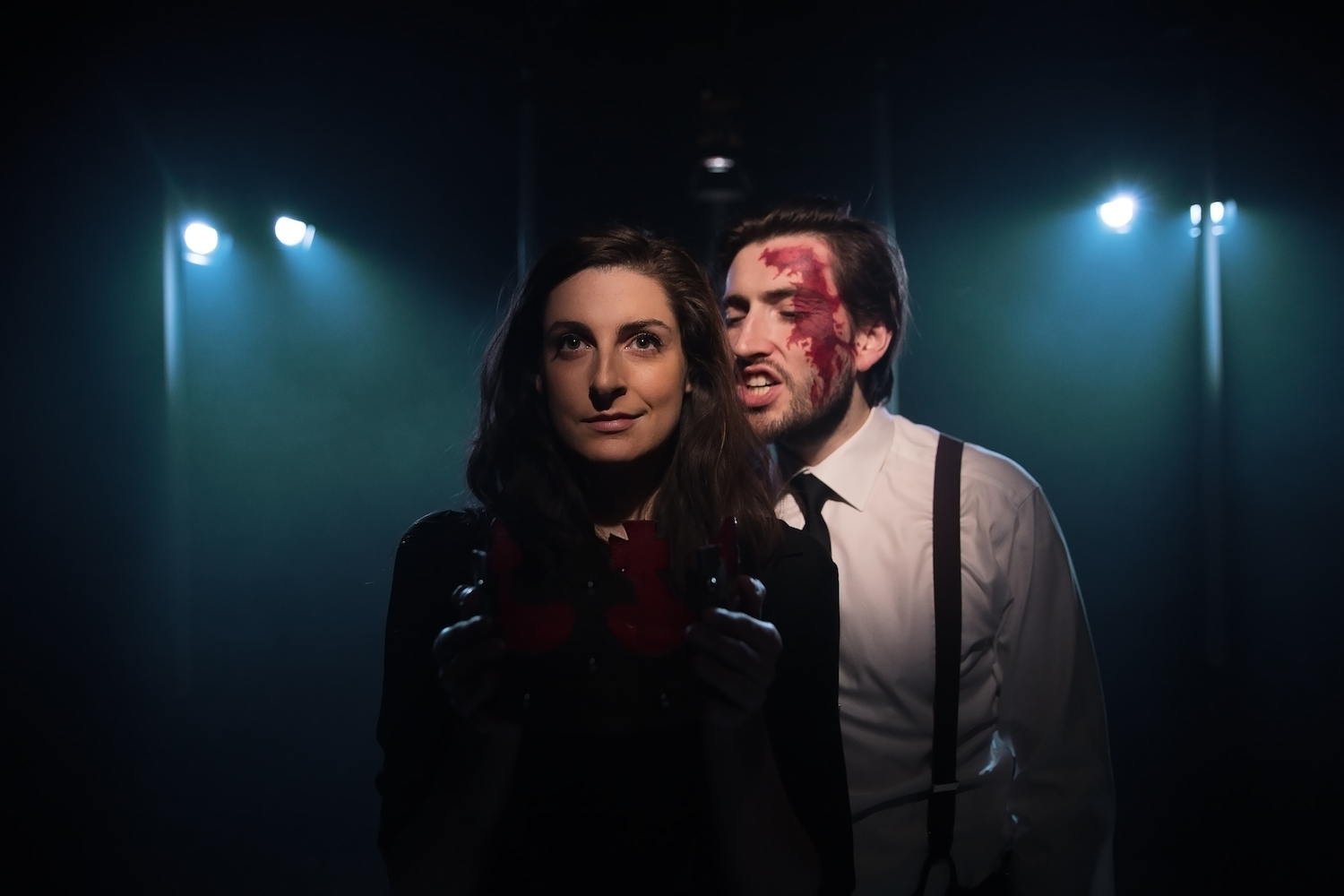
An excellent cast is led by Sam Coulson as the villainous Richard. No hunchbacks here – instead a blood-red birthmark stains one side of his face, foreshadowing the horrors ahead. This is a performance that walks the line between smoothly charming and violently unhinged; one minute he’s sweet-talking the grieving widow of one of his victims into marrying him, the next he’s roaring with crazed delight over the success of his evil schemes. And throughout, he takes the audience regularly into his confidence, making us complicit in his crimes as he bumps off victim after victim.
The inclusion of Elena Clements as Richard’s co-conspirator Buckingham brings a welcome shot of girl power to a play in which every other woman is forced into the role of victim, and I also really enjoyed the twist that turned Gloucester’s two killers into one conflicted soul; Michael Rivers brilliantly channels Gollum as he argues with himself over the rights and wrongs of proceeding with the murder.
Director Séan Aydon clearly isn’t afraid to take a few risks in modernising the story – the use of Siri to find a hitman willing to murder Richard’s nephews gets a lot of laughs, and there’s more than one reference to drug use in the royal court. Not historically accurate, maybe – but then as we’ve seen all too well in recent months, the storyline of a tyrant doing whatever it takes to claim power is one that works just as well in a modern context…
Another star of the show is the lighting design from Jack Channer, and sound from Daniel Harmer, which combine to create an atmosphere of drama and tension throughout. From Richard’s opening soliloquy, which plays out in semi-darkness like a scene from a black and white movie, to the harsh white flashes that accompany his victims’ deaths, it’s an ingeniously simple approach that shows you don’t always need fancy effects or a complicated set to make a powerful impact.
Godot’s Watch is a new company, and if this is what we get from their first production then it’s exciting news for theatre. Their Richard III is inventive, bold and utterly gripping (and don’t just take my word for it; my friend turned to me at the interval and said, “Why have I never seen this play before? It’s amazing!”) – I can’t wait to see more from them, and hopefully soon.
Can’t see the map on iPhone? Try turning your phone to landscape and that should sort it. I don’t know why but I’m working on it… 😉
The Doppel Gang by Dominic Hedges introduces us to four mediocre performers attempting to save their cash-strapped theatre. After stumbling rather inexplicably on a stash of unproduced Marx Brothers material, they decide to try and pull off the ultimate con, impersonating the rising American stars in front of a London audience desperate to escape the horrors of the Blitz. Can they pull it off and make their escape with the cash, or will they be caught out?
It’s a fun idea, and the cast certainly seem to be enjoying themselves from the outset. The play opens with a Fawlty Towers-esque sketch scene, in which frustrated theatre owner Lombard has to deal with an incompetent workman up a ladder. Though it has little if anything to do with the rest of the story, it’s a well-fashioned salute to British humour, and sets up a nice contrast with the all-American comedy that dominates Act 2.
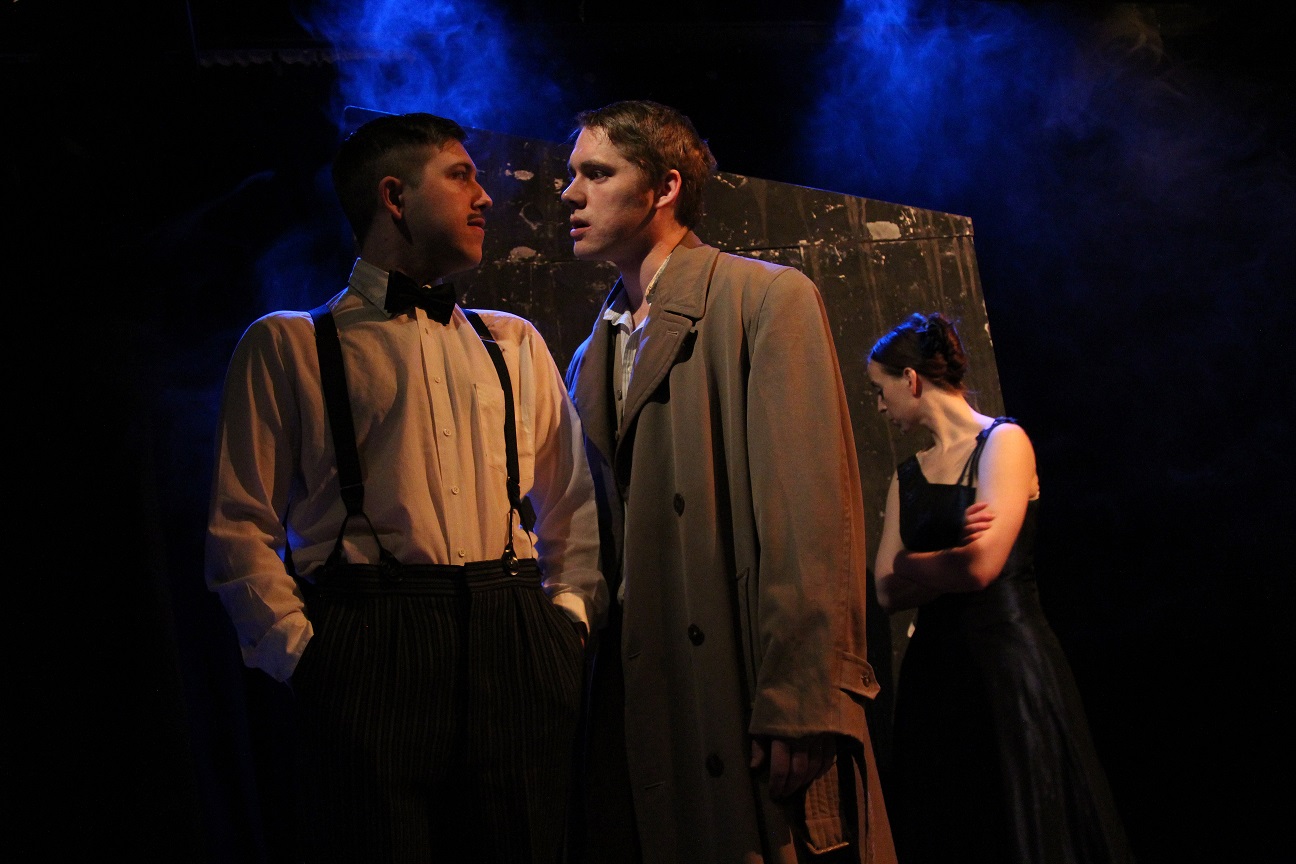
Photo credit: Mitchell Reeve
In fact, The Doppel Gang, directed by Terence Mann, takes great pleasure in lining up British and U.S. comedy alongside each other, and it makes the play very much one of two halves; Act 2 consists almost entirely of the group’s Marx Brothers act, whereas before the interval the focus is on establishing the characters and their often fractious relationships. Cyril (Jordan Moore) and Tommy (Peter Stone) can’t stand Lombard (Jake Urry), who they know full well is just using them for his own ends. And male impersonator Rachel (Rachel Hartley) is getting increasingly frustrated with the lack of respect she gets from the audience or her fellow performers – including her boyfriend Tommy.
The four characters’ constant sniping, and especially Rachel’s feisty disdain for the men she has to deal with, provided for me the funniest moments – although there are plenty of laughs to be found elsewhere too, especially for fans of the Marx Brothers. The cast’s enthusiasm for their subject is obvious, although not being an expert, I’ll leave it to those who know to judge the accuracy of their tribute act. And as the Brits, the four are just likeable and optimistic enough for us to overlook their conscription-dodging ways and wish them success.
There’s a subplot to all this, of course, in the threat of war that hangs over them all, and in the revelation of a secret that places one of the characters at even greater risk. The abrupt, subdued ending, coming so swiftly after half an hour of zany merriment, brings us back to earth with a bump, and out into the cold feeling slightly wrongfooted.
Photo credit: Mitchell Reeve
The set is really impressive for such a small space, with individual components – including a mobile proscenium arch – manoeuvred smoothly into position to take us on stage, off stage and on one occasion, underground. This gives the impression the stage is a lot bigger than it is, an idea backed up by Mitchell Reeve’s sound design, which recreates both the rumblings of war outside and the theatrical acoustics inside.
It’s a risky enterprise to make a comedy, because finding an approach everyone likes is practically impossible, but Just Some Theatre cover a couple of bases with The Doppel Gang, and do it well. I do feel that to fully appreciate this particular play you need to know and enjoy the Marx Brothers’ work (I was slightly in the dark at times during Act 2, if I’m totally honest), but nonetheless this is clearly a talented company with exciting times ahead.
Can’t see the map on iPhone? Try turning your phone to landscape and that should sort it. I don’t know why but I’m working on it… 😉
When thinking back on classic movies from my youth, Ghost is one that I always tend to forget about. I blame Dirty Dancing for this, mostly; for some unfathomable reason, that particular Patrick Swayze movie always takes first place in my mind.
Which is a shame, actually, because Ghost is a great story, with a bit of everything: tears, laughter, life after death and good old-fashioned murder. And now it also has songs, thanks to Dave Stewart and Glen Ballard, who along with the movie’s screenwriter Bruce Joel Rubin adapted it for the stage back in 2011. Tonight was my second visit, having previously seen Ghost during its West End run a few years back – so how did Bill Kenwright’s new touring production compare?
On the whole, the show is pretty faithful to the movie, though a couple of big events get slightly rewritten to make them work on stage. A quick recap for anyone who doesn’t know the plot: Sam and his girlfriend Molly are building the perfect life together, until they’re attacked one night and Sam is fatally shot. Unable to leave while Molly’s still in danger, Sam enlists the help of the only living person who can hear him, fraudulent psychic Oda Mae Brown, to bring his killer to justice and say a final farewell to the woman he loves.
Tonight’s show in Dartford saw the debut of Carolyn Maitland in the role of Molly – and it’s fair to say she smashed it, with spot on vocals and a genuinely heartbreaking performance as Sam’s bereaved girlfriend (and she also remembers not to look at him when he’s standing right in front of her, which I imagine must be a pretty difficult thing to adjust to). Andy Moss, continuing in his role as Sam, has a slight tendency to overact during his musical numbers, and his vocals don’t always live up to those of his co-star – but the chemistry between the pair is touchingly believable, especially for the first night of a new partnership.
Oda Mae Brown is an absolute gift of a part, and West End star Jacqui Dubois seizes it with both hands. Like Whoopi Goldberg before her, there’s no doubt she gets all the best lines, and they’re delivered with perfect comic timing and a fabulously sassy attitude; it’s a shame we have to wait till well into Act 1 for her first appearance.
The score is actually better than I remember, and includes some really quite beautiful numbers, with Molly’s spine-tingling solo, With You, the absolute highlight for me. And of course no production of Ghost would be complete without Unchained Melody, which makes several appearances (and yes, they brought the potter’s wheel with them).
Photo credit: Matt Martin
Where this production slightly falls down compared to its West End predecessor is in the special effects. Last time, I remember being left open-mouthed when Sam walked through closed doors, or someone who I just saw drop dead on one side of the stage suddenly appeared on the other, and I vowed to pay more attention next time to see how they did it. Apparently, in this production those mind-boggling effects have been stripped back so we can all focus more on the love story, and sadly what’s left is not as impressive. Don’t get me wrong, there’s still some pretty cool stuff going on – but let’s just say this time I could see the strings, and it slightly took the shine off.
That said, Ghost is still a great show and well worth a visit, especially if you love the movie. Get ready to laugh, cry, tap your foot and, best of all, join in with the cheesy dialogue (all together now: “Ditto…”) – then head home and curl up on the sofa for a Swayze double bill.
The Bunker’s first season concludes with Fiona Doyle’s two-hander, Abigail. Although why it’s called Abigail is an intriguing question, since the two characters in the play remain nameless throughout. It’s a dark tale about a dysfunctional, abusive relationship – but in a welcome challenge to convention, here it’s the man who’s the victim, struggling to find his way back to who he was before they met.
It all starts well: after meeting in the snow outside Berlin Airport, the couple embark on a whirlwind romance. He’s quite a bit older than her, but their attraction is instant and intense. By the time their one-year anniversary rolls around, though, it’s all fallen apart. He says he wants to leave; she has other ideas. Doyle’s script hops back and forth in time, filling in the story of their relationship as their final showdown unfolds in the present.
Photo credit: Anton Belmonté for 176 Flamingo Lane
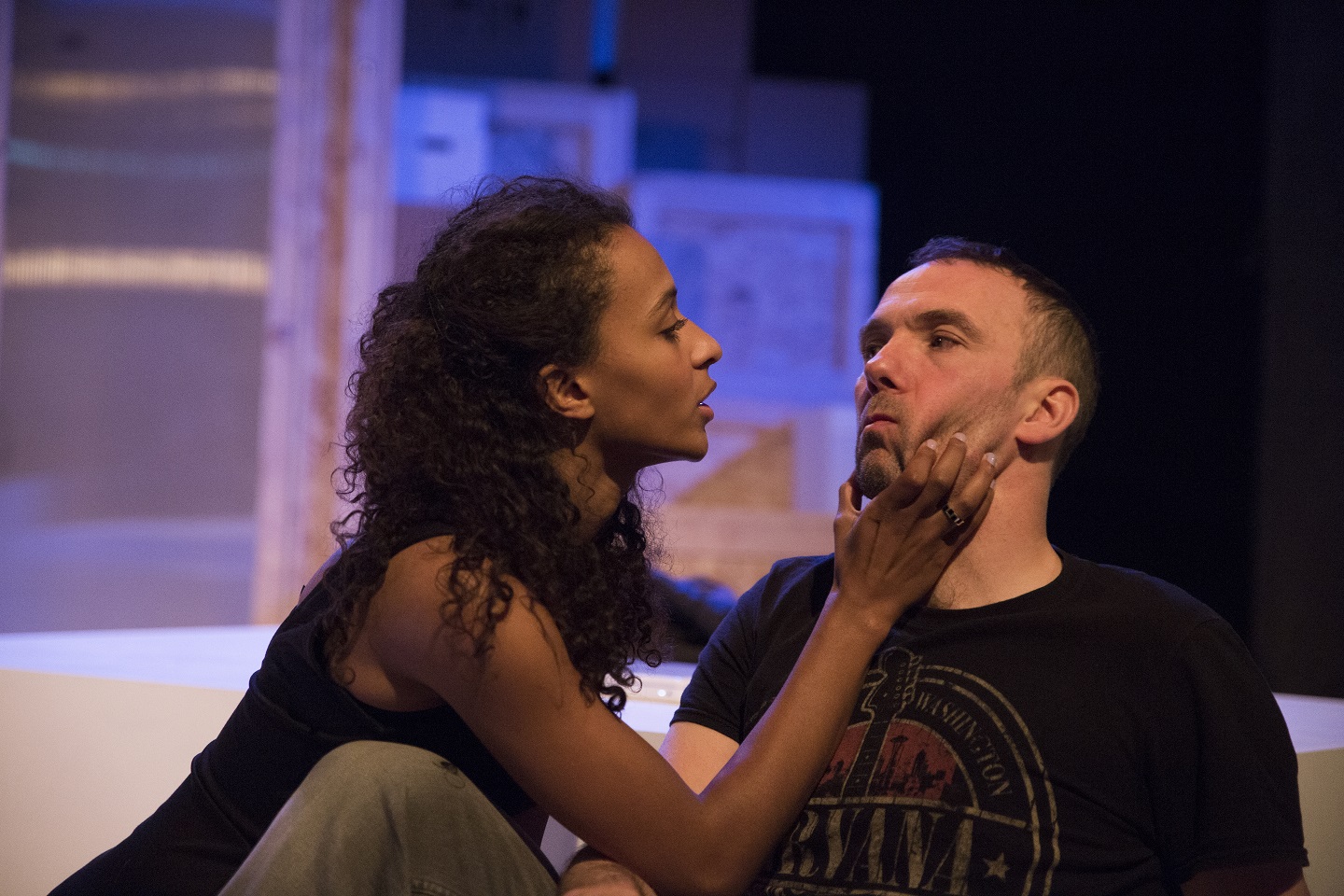
Tia Bannon and Mark Rose give compelling performances as the unhappy couple, dealing skilfully with the many changes in mood as time skips back and forth. Bannon has a bright smile that appears at inappropriate moments and which never quite reaches her eyes. And there’s an eerie, almost robotic calm about her throughout, which makes her violent outbursts all the more shocking. Rose, meanwhile, is the very image of a broken man, and handles the physical side of the role well; I’ll say no more for fear of spoilers, but suffice to say that at times his performance is uncomfortably convincing.
Max Dorey’s set, made up of boxes stacked in a huge pile, allows director Joshua McTaggart the chance to get creative with the staging; the two actors cover almost every inch of the space as they climb all over it, producing props and costumes that are concealed within the set, and which gradually end up scattered around the stage as the couple’s anniversary evening unravels.
So what’s there is good – but the problem is it feels like there’s quite a bit missing from the story. There’s nothing wrong with plot gaps in a play; having everything handed to you on a plate removes any need for interpretation or discussion afterwards. But at just 60 minutes, this play has more gaps than most – and leaves us with a lot of questions but not enough info to try and answer them.
Photo credit: Anton Belmonté for 176 Flamingo Lane
There’s an attempt in the script to explore the psychology of the abuser, but without sufficient detail for us to really understand her motivations. Some conversations seem like they’re about to reveal an important clue – but then the scene changes and we’re left (quite literally) in the dark.
As for the abused, we know next to nothing about him; he keeps insisting he’s not himself in this relationship, but apart from the scene in which the couple first meet, we get very few insights into who he really is outside it; she spends a lot of time reminiscing about her early life, but he never gets that opportunity. No attempt is made to explain why he’s stayed in a relationship that he says himself was only good for the first couple of months, nor what’s prompted him to finally take action now. It’s not often we get to see a depiction of abuse that’s this way around, so it feels like we’ve missed out on a rare opportunity to hear the point of view of a male victim.
I’ll say it again: what’s there is good. This is an excellent production, with strong performances, of a play that just feels a little bit too short. With a bit of work, this could be a really powerful piece of theatre, shedding light on an issue that currently doesn’t get enough attention. As it is now, it’s an enjoyably dark drama, but it doesn’t make the lasting impression that it probably should.
Can’t see the map on iPhone? Try turning your phone to landscape and that should sort it. I don’t know why but I’m working on it… 😉
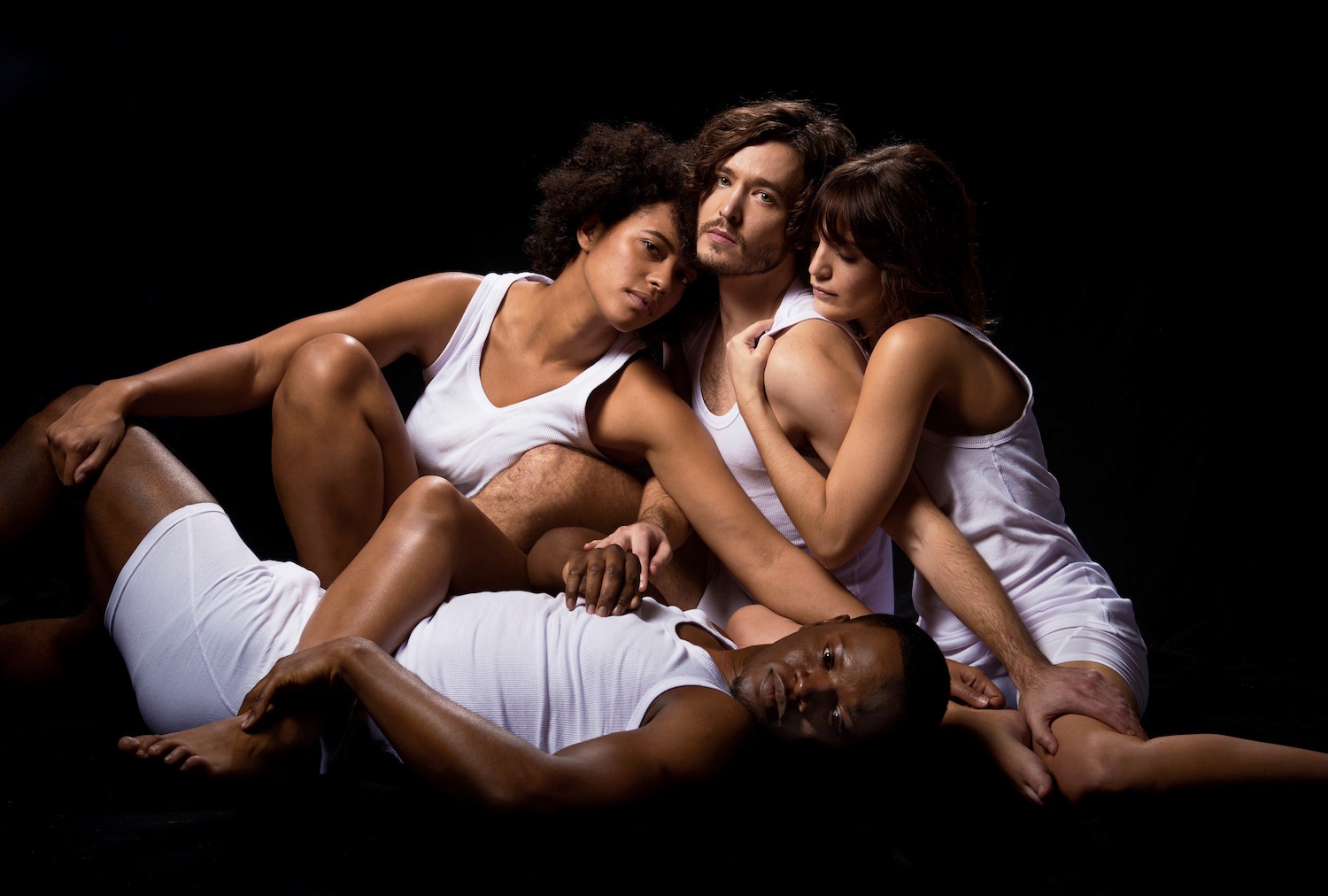
After a successful opening season, The Bunker opens its second in February with Collaborative Artists’ new production of La Ronde by Arthur Schnitzler. Adapted and directed by Max Gill, a cast of four actors – Lauren Samuels, Alex Vlahos, Leemore Marrett Jr and Amanda Wilkin – will take on the play’s ten roles, but with a twist: each night chance will decide the parts they play, ensuring that each performance is different.
“La Ronde is a helter-skelter through the mores and morals of society, via the sex lives of its inhabitants, thrown together by the blindness of fate and desire,” says Max. “What drew me to it initially was the whiff of controversy. Schnitzler’s original was banned for many years and subsequent incarnations and re-imaginings such as Max Ophüls’film and David Hare’s The Blue Room have certainly sizzled in the public’s imagination.
“Schnitzler’s world of turn-of-the century-Vienna is complex and detailed, but there is a seductive simplicity to the play: a man and a woman meet, they have sex, and we see the aftermath. There is a grammar to the world that is levelling. This allows one’s inventiveness to run quite free in terms of the interpretation of characters and their relationship dynamics.
“Furthermore, the sex act that takes place in every scene in Schnitzler’s original is marked only with asterisks. The text is an invitation to actors and theatre-makers to interpret and imagine; this is surely why it was considered so shocking. This act of imagination makes even the most puritanical of thinkers prurient, even if just for a moment! The play enforces an experience of fantasy, which I would posit is sexuality at its core.”
Max has taken Schnitzler’s 1897 play, set in Vienna, and adapted it for a 21st century London audience. “The play is all the more powerful for the fact it was written over 100 years ago. It presents human warmth and vulnerability, our need for another, and the insatiable beast of desire inside us all as if it were written yesterday. But the world of the original is, of course, of its time. For example, its women, with the exception of a prostitute, maid, and actress of ill-repute, do not work. It presents rigid portraits of gender, class, and sexuality that today are inevitably stale and that I didn’t feel compelled to regurgitate. Hence the desire to adapt it for the 21st century and a London audience.
“Modern London is the greatest social melting pot in the world; nowhere else has quite the same wealth of voices, cultures, and identities jostling together in bars, on the tube, and in the bedroom. To blow dust around in the past would be a shame when instead we could take Schnitzler’s ingenious structure and place it upon the beating heart of contemporary sexuality with its glorious opportunity and polyphony. In this way, I have refashioned each of the characters to suit contemporary social identities and have adapted the majority of situations. The dialogue, desires, and relations are therefore largely very different from the original.
“Integral to the play are verbatim testimonies from real life prostitutes, lovers, fetishists, people who have committed incest and so on, that we have collected over many months in London. It has been an adventure. They are a curation of sexual appetites today and I hope their voices give the play a vibrant relevance.”
Unlike the original, Max chose to make his version of La Ronde gender-neutral. “Fundamentally, I’ve stripped the text of any markers that point to a character’s gender, sexuality or age so that they can be embodied by each member of the cast, either male or female, depending on how the roulette falls,” he explains. “Whilst this in theory means the script is non-gender specific, it means that in performance an audience’s reaction to it is likely to be highly gendered. How do we digest a woman as opposed to a man visiting a female prostitute? And how might we react differently to a male stay-at-home parent philandering than to a female? How then might our appreciation of this relationship transform if both the parents aremen? What inadvertent expectations or prejudices does this throw up for you?Many of the characters appear gendered in that they may be ‘passive’or ‘active’, ‘dominant’or ‘submissive’, ‘masculine’or ‘feminine’; we want to explore how far these labels are attached to any physical reality at all.
“When Schnitzler wrote his play, there was a general fear of the open presentation of sexuality in a public domain. We are the opposite. We talk about sex all the time because we don’t want to be Victorian about our bodies. But this means that people now often have a fear instead of their own sexual repression and an anxiety around their own sexual identities; if sexuality is a spectrum, where am I on it? Do I have a fetish? If not, why not? Should I?! How do my sexual activities define me and do I want them to? A sex worker I interviewed for the play said that ‘people don’t do things not because they don’t want them, but because they don’t want to want them’.We have a freedom of choice today but we still haven’t worked out a freedom of self with regards to our sexual choices, indeed if this were ever possible.
“I hope our play delves into the kaleidoscopic nature of 21st century sexuality but also the freedoms and boundaries that lovers encounter today, be they societal or personal. I hope it goes some way to explore what lies at the heart of any relationship, amorous and/or lustful, no matter who it may be between.”
Photo credit: Ray Burmiston
Unsurprisingly, having different actors playing different roles every night throws up some huge challenges for director and cast alike: “But exciting ones,” adds Max. “We are so lucky to have such a talented cast and their dedication to the project is a testimony to their commitment as actors to keep demanding more and more of themselves.
“For one, it means that the actors have to know the whole play off by heart and it means that every night they have to be prepared to play any variation of roles, which is a very different discipline to acclimatising to one role over time mentally and physically. It means that rehearsals are a very collaborative process; everyone is always present and everyone feels a shared ownership of every beat in every scene, which provides a rare but hugely rewarding cohesion.
“Having said that, each actor is encouraged to have a very different understanding of a character and scene from the others, and so each scene is an exercise in truly engaging with the other actor; there can be no auto-pilot. After we have set down a framework for each scene, the different temperatures each actor and their interpretation brings will lead the moment. There is a ‘liveness’to the action that conventional theatre can lose through repetition.”
Max is honoured to be opening the second season at The Bunker: “It’s a seriously exciting new theatre for my generation, and it’s been welcomed ravenously! As a space, it aims to champion and develop adventurous work by younger artists; to take risks essentially, which sadly is all too rare in theatre today.I can’t wait to see how it continues to thrive.”
La Ronde is at The Bunker from 11th February to 11th March.





 Theatre Things