Review: A Christmas Carol, the Musical in Concert at the Lyceum Theatre

The next time someone tries to tell me Facebook is a bad thing (I have a colleague who tells me this with monotonous regularity, so it undoubtedly won’t be long), I plan to tell them the story of the London Musical Theatre Orchestra. In 2015, Freddie Tapner wrote a casual post looking for fellow musicians to play through a musical, just for fun. 24 hours later, he’d received over 250 replies – and two weeks after that, LMTO was born.

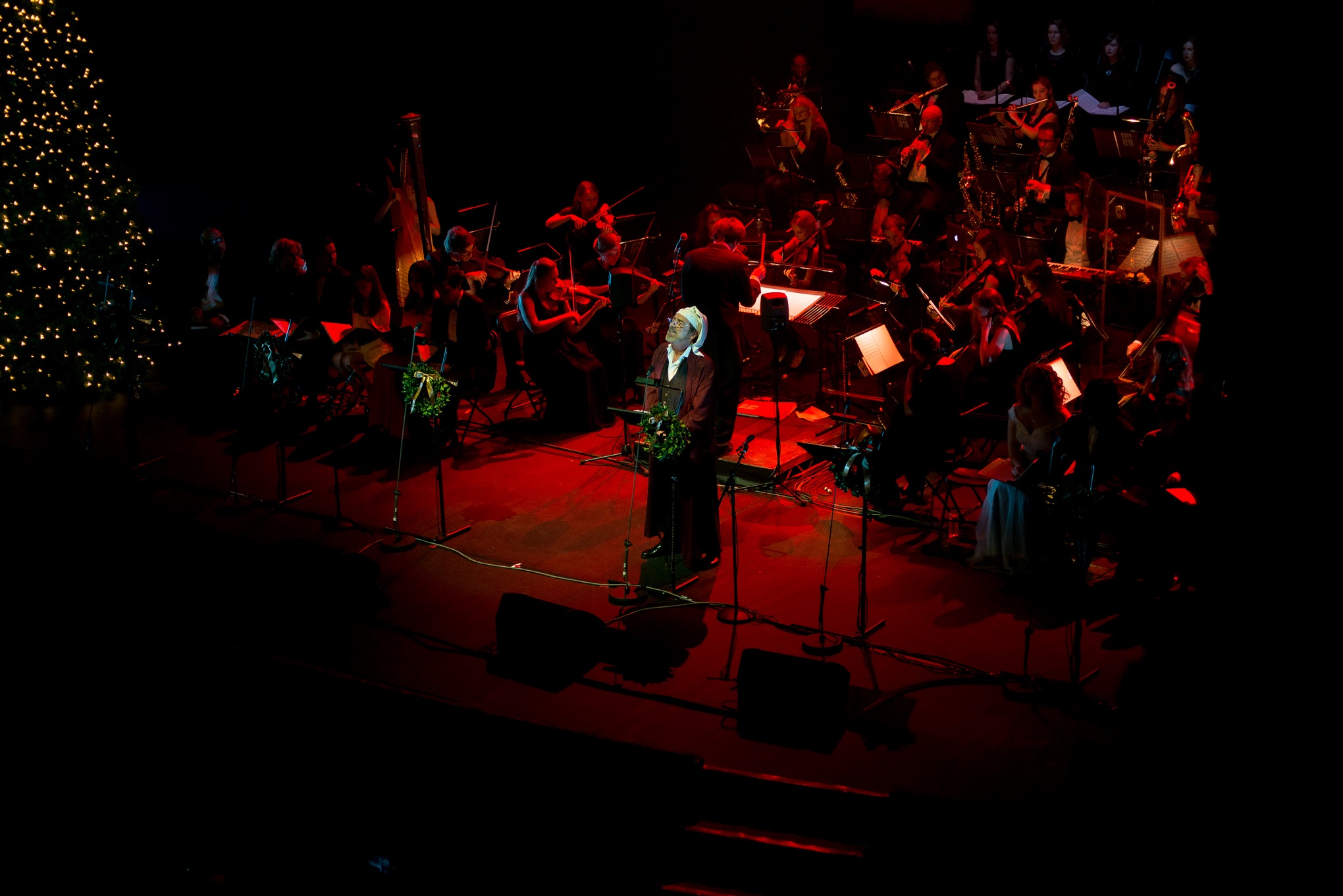
The shared passion that inspired the orchestra’s creation could be felt in abundance last night at the Lyceum Theatre, where an all-star cast joined LMTO for their one-night-only concert performance of A Christmas Carol – never more so than when founder and Principal Conductor Freddie Tapner bounded on to the stage to rapturous applause. His infectious joy was just the first highlight in an evening full of festivity, optimism and goodwill towards men.

christmas-carol-production-shot-5
Photo credit: Jamie Scott-Smith

Though the show, written by Alan Menken, Lynn Ahrens and Mike Ockrent, is better known on Broadway than in the West End, the story of A Christmas Carol by Charles Dickens is as British as they come. Grumpy old man Ebenezer Scrooge is not a fan of Christmas. Or charity. Or indeed people – and definitely not children. Not, that is, until he’s visited on Christmas Eve by the spirit of his former partner Jacob Marley, who’s now suffering for the sins he committed in life. Marley’s appearance is followed by visits from the Ghosts of Christmas Past, Present and Future, who help Scrooge to finally see the error of his ways, just in time.

The cast of singers brought together the cream of West End talent, including Robert Lindsay, Carrie Hope Fletcher, Peter Polycarpou, Hugh Maynard, Madalena Alberto and Norman Bowman, to name just a few. Alongside them were several young performers who proved more than a match for their more experienced co-stars; 9-year-old Tobias Ungleson particularly shone as Tiny Tim, with a performance that hit all the right notes both musically and emotionally.

But the biggest star of the evening, appropriately, was the orchestra. So often an afterthought for musical theatre audiences, here the musicians had the opportunity to take centre stage, and they didn’t waste a moment of it. It hardly mattered that the show was in a concert format; Alan Menken’s glorious score and the orchestra’s joyous performance of it told us everything we needed to know. Though not without its darker moments – the appearance of Jacob Marley (Norman Bowman) was suitably creepy, for instance – A Christmas Carol is, for the most part, a full-on celebration of all things festive, and if anyone left the Lyceum not feeling even a little uplifted – well, frankly they should probably change their name to Scrooge now and be done with it.
christmas-carol-production-shot-4
Photo credit: Jamie Scott-Smith

In fact the whole evening was so delightful that it almost feels wrong to find fault… so please don’t call me a Grinch for quietly pointing out that there were times when the orchestra’s enthusiasm became just a little overwhelming. Despite their best efforts, the singers were occasionally drowned out, and much of the spoken dialogue – particularly Robert Lindsay’s grouchy mutterings as Scrooge – was barely audible at all. (There was also one forgotten lines moment right at the end, but it was well covered, and by that point the entire theatre was so delirious with festive cheer that nobody gave a figgy pudding anyway.)

The main downside of the evening, though, is that it was only a one-off performance and we won’t get to see it again. However, it’s clear that the London Musical Theatre Orchestra are not going anywhere, and that is certainly news to which we can raise a festive glass or two.

So Merry Christmas – and God bless us, every one!


Can’t see the map on iPhone? Try turning your phone to landscape and that should sort it. I don’t know why but I’m working on it… 😉

Review: The Woman in Black at Fortune Theatre

Guest review by Ross McGregor

A haunted elderly man by the name of Arthur Kipps engages the services of a professional actor in the hopes of receiving tutelage in staging a private reading for his friends and family.

This is not just any performance though, as Kipps needs to exorcise himself of a particularly scarring event that happened to him in his youth. The problem is that Kipps simply does not possess the acting chops to take on the role of his younger self, and so quickly a second plan is hatched between Kipps and the Actor, whereby the Actor will play the role of Young Kipps and Kipps Senior will play all the peripheral characters in the story. It’s a play within a play kind of idea, and once the ball is finally rolling with it, the device is held together and conveyed in a spirited way, if you excuse the pun.

Photo credit: Tristram Kenton

Plot-within-the-plot-wise – the story is a standard fare rather similar to the opening of Dracula. Jonathan Harker – apologies – Arthur Kipps (the younger version of him that is) is sent to a remote and desolate mansion to conduct a menial administrative task. Kipps the Elder chimes in from time to time playing various people Kipps the Younger meets during his stay in the village of Crythin Gifford – the roles mainly yokel exposition. For the most part then, Kipps the Younger is left to his own devices. And what devices they are. For he is not alone in Eel Marsh House. There is a malevolent presence in there with him, and she’s very, very angry…

The star of The Woman in Black is not the two actors in it, nor the Woman herself, but the stage design and soundscape. The set begins as a dusty out-of-action theatre, with wicker hampers and backcloths draped everywhere, but eventually expands to reveal various outdoor elements of the mansion, as well as various internal rooms, most hauntingly – a particular one containing a rocking chair with a life of its own. The sound is immaculately done – one shudders to think how long tech days take this production to get it timed right with each cast change – and all the jumps are in the right places and suitably terrifying.

Because that’s what The Woman In Black relies on – a hefty number of jump scares. Added to this are the gaggles of school groups that flock to every performance, students of Susan Hill’s novel one assumes, who actually serve the production greatly as scream machines. Despite never being one for rustling sweet packets or chatterboxes in a theatre audience, this is one occasion where all the noise around me actually enhanced the production. Although, the actors really should learn to wait until the pubescent giggling and shrieking has stopped before continuing on with their lines, as not a soul can hear them.

Photo credit: Tristram Kenton

Joseph Chance plays the Actor, and he does it with aplomb, charm and panache. He has a beautifully deep and charismatic voice – perfectly cast as the classic young Olivier style of showman – and whilst his character’s mistake at the opening is one of hubris at his willingness to engage in what will be a harrowing experience for all concerned, he’s convivial and cheeky enough to stir empathy and willingness for the audience to follow him. As Kipps the Younger he’s able to realistically navigate the rusty and clunky plot – pantomime smoke and melodramatic script included – and convincingly convey the arc of a smirking sceptic turned wide-eyed, horror-stricken believer.

Stuart Fox as Kipps the Elder unfortunately suffers from volume issues. Had he been any quieter in his delivery only dogs would have heard him. And I was near the front. Of the stalls. Initially when Kipps is attempting to be an actor and failing, I assumed this was part of the schtick but unfortunately his issues continued for the rest of the production. Perhaps Fox is temporarily suffering from a winter cold. Unfortunately he also has issues with differentiating between the many characters he plays. Had it not been for the different jackets I would have struggled to tell them apart. I was most surprised to read in the programme that he had played the role before two years previously, because as it stands now Fox has substantially far to go before he fully inhabits the role as much as Chance does.

The Woman In Black has been running since 1987, and presumably will continue to do so long after this review has faded into obscurity. It’s akin to Madame Tussauds or the London Dungeon, it’s not so much a play anymore as a tourist attraction. The scares are legion, and the production is tight, but the plot is an old one, the dialogue is dusty as an Eel Marsh armoire and the direction could benefit from a new pair of eyes. But perhaps the producers are of the mind-set of “if it ain’t broke”, and it certainly isn’t. And so the Woman In Black awaits for those brave enough to step into her home…


Can’t see the map on iPhone? Try turning your phone to landscape and that should sort it. I don’t know why but I’m working on it… 😉

Review: The Mechanicals’ Twelfth Night at St Giles in the Fields

I last saw Scena Mundi Theatre Company performing Twelfth Night at the stunning French Protestant Church in Soho Square earlier this year. This week they were back, in an equally beautiful venue, with a one night only performance of the same play… but a very different adaptation.

Billed as ‘the new masters of concise classics’, the Scena Mundi Mechanicals specialise in short versions of Shakespeare’s plays, inspired by the memorable amateur actors of A Midsummer Night’s Dream. It’s an intriguing and clever concept, which makes Shakespeare’s work very accessible and adds an original twist to a play many of us will have seen a good few times before. As the four actors – Masters Phil, Jack, Ned and Martin – divide up the roles between them, the stage is set for chaos and comedy, featuring a bearded lady, a dodgy wig, floating hats, and of course yellow stockings.

Photo credit: Jim Templeton-Cross

Given the complex storyline of Twelfth Night, director Cecilia Dorland has done well to cut the script down to almost exactly an hour in a way that still makes sense, and leaves us with a whistle-stop tour of all the key points and characters (well, almost – we’re forced to lose Maria, with Sir Toby Belch taking her place as the architect of Malvolio’s downfall). The performance too, with all its swift costume and character changes, is very skilfully executed by the four-man cast of Pip Brignall, Jack Christie, Edward Fisher and Martin Prest, with nicely understated musical support from flautist Emma Hall.

In fact if anything it’s a bit too well executed – the Mechanicals concept is introduced at the beginning but then seems largely forgotten during the play itself, and though there’s the occasional missing prop or actor’s tantrum, the production on the whole is extremely polished. It feels odd to complain that the acting in a play is too good, but what makes the Midsummer Night’s Dream Mechanicals fun to watch is the fact that their performance is so shambolic, and there’s potential in Scena Mundi’s adaptation for even more well-intentioned mayhem. This band of Mechanicals never get their lines wrong, forget which part they’re playing, or stop the performance to explain to the audience what’s going on; the director never has to intervene, and aside from one brief exchange at the beginning of the show, nobody tries to play all the parts. None of which is a bad thing – it just feels like the framing concept could be further developed for maximum comedy value.

scena-mundi-mechanicals-twelfth-night-rehearsals-091
Photo credit: Jim Templeton-Cross

All that said, this is already a highly original and entertaining production of a classic play. As a bite-sized introduction to Twelfth Night, it’s perfect for newcomers to Shakespeare, who might find the usual two-and-a-half or even three-hour stretch a bit much to take. And let’s be honest, it’s always fun to watch good actors acting badly. This one-off performance was the first in a series of events at St Giles in the Fields to launch Scena Mundi’s 2017 season, and I look forward to seeing more of them in the coming months.


Can’t see the map on iPhone? Try turning your phone to landscape and that should sort it. I don’t know why but I’m working on it… 😉

Review: Sinbad the Sailor at Theatre Royal Stratford East

Guest review by Ross McGregor

The tried and tested conventions of the pantomime form are entrenched in our theatrical consciousness as deeply as Yorrick’s skull or Earnest’s mother’s handbag. The plucky principal boy (played by a girl), a 4th wall-breaking dame (played by a man), the slapstick comedy (borrowed from commedia dell-arte), the audience participation and the musical numbers all wrapped in a mythical fable. Panto season is old. But it is also, for theatre managers, big business. The pressure is on, then, with every theatre in the country performing the same set of fairy-tales, to make your pantomime a sure-fire success. 

At Theatre Royal Stratford East, director Kerry Michael and writer Paul Sirett have done exactly that. Sinbad The Sailor is a family-orientated festival of fun that honours the traditional archetypes of the pantomime form whilst allowing for refreshing modern twists. It is a fast and fluid, beautifully-realised pageant that champions community, acceptance and friendship.

The story is simple enough: Sinbad is in a competition for the love of a beautiful princess. It’s a race to find an artefact, the use of which ultimately sums up the production’s focus on the power of the human heart. It’s a quest across the sea, filled with monsters, pirates, giant monkeys, jungle fevers, rebellious genies, love, laughter and magic. 

Photo credit: Sharron Wallace

Sirret’s sharp-tongued and astute script, as well as Michael’s meticulous direction make the action sing, with scenes interlocking and careening the audience through the adventure plot. There was a tendency to rely too much on Donald Trump jokes, which I suppose is only to be expected this year, but I did feel their power and punch would have been strengthened had they been fewer. Wayne Nunes and Perry Melius’s music and lyrics serenades us into the exotic world of the story – the highlight being a phenomenal gospel revival church number for the Genies – whilst carefully dipping into modern pop culture.

Rina Fatania plays the Green Genie Uzz. Fatania is simply a force of nature; her neck-high pantaloons are bursting with an effervescent energy. She is the purest essence of a clown I’ve ever seen, and her mastery of her character arc is at once charming, gorgeous and irrepressibly endearing. At her side is Globe Theatre veteran Michael Bertenshaw as the villain Prince Naw-Ze Uzz. A veritable jedi of the medium, Bertenshaw fulfils the Dame/Buttons roles here as the primary link to the audience. This is an interesting inversion of the form on the writer’s part, and Bertenshaw flourishes majestically in his cutting social commentary. His gimlet-eyed, glee-filled confessional with the audience is flawless, and his scenes with Fatania become a masterclass in comic timing.

Alim Jayda also deserves mention for his star turn as Captain Greenbeard, a cross between Beetlejuice, Alan Carr, Jack Sparrow and The Hitcher from The Mighty Boosh.  Jayda commands the stage in every scene he’s in, and infuses the role with a verve and vitality that reveals the considerable depth of his talent, and his ease in the medium.  This young man has a bright future ahead of him.

Drama school graduate Julian Capolei plays the eponymous role of renowned adventurer Sinbad, another twist on the form being that it is actually his sister Sinbadda, played by Gabby Wong, who’s responsible for all the adventures, whilst Sinbad stays cosy and safe writing stories. The duo make a perfect pair, wide-eyed and happy-go-lucky, their onstage chemistry and affection for each other palpable. Along for the adventure is Marianna Neofitou as the Princess, who actually spends the majority of the play dressed as a young man, another clever inversion of the “principal boy” form, transforming her from the usual female prize/hostage to an active participant of the adventure. Capolei and Neofitou indulge in some wonderfully-realised gender-bending romance, revelling in the Twelfth Night-esque sexuality questions that plague Sinbad as his feelings for the feminine young man grow. It’s a beautiful thing to watch and perfectly rebrands the hetero-narrative of a panto romance with an arresting metrosexual and modern twist.

Photo credit: Sharron Wallace

Rounding off the band of heroes is Funky the Monkey, puppeteered and performed by Gemma Salter. Funky is clearly an inclusion for the younger viewers, and yet Salter fills the puppet with a cheeky irrepressible charm that reveals a performance of precision and an undeniable skill for the medium. After the first few minutes, Salter disappeared, and the puppet came to life, and that I think, is a truly magical achievement. Salter is blessed with an electric stage presence that delivers nuanced and poignant comedy. She convivially scampers across the stage with a delightful charm, imbuing Funky with all the qualities that a young person could want in their best friend. 

Ben Goffe plays the Sultan, father to the Princess, but it’s in his other character-based roles where he truly shines. Whether as an off-shore delivery man, a nine-headed monster, or a soul-singing genie, he emanates a versatile and capricious glee. Goffe and Josephine Melville (Clanker and Sultana) also provide one of the most beautiful and stylish tap routines, harkening back to the halcyon days of Fred Astaire and Ginger Rogers – a moment both tragic and uplifting.

Johnny Amobi is the Nurse, and whilst this role is presumably supposed to fill the “dame” requirement, Amobi has transcended the casting and delivered a multi-layered and deeply faceted performance that perhaps would be more suited to Ru Paul’s Drag Race. It offers a modern take on the role, and perhaps a much needed representation of trans-issues for the medium. He is not simply a man in a dress, he is a force of acceptance and discovery, and should be applauded for creating a loveable, twerking-winking-singing queen of the comebacks.

The set is simple in nature, and has a certain charm in the sense of its nod to kitsch and gaudiness, often drawing back to let the actors have full use of the space. Particular kudos must go to special effects consultant Scott Penrose, whose use of high-calibre magic stage effects were truly spell-binding at points and incredibly effective at selling the more supernatural elements of the production. There were slightly too many points where lights were shone directly in the audience’s faces to cover a trick – the creatives should have faith perhaps in their own illusory skills and not seek to hide so much of what is a fantastically designed production in terms of its business.

In its final moments, Sinbad the Sailor reminds us through its closing song that there is more that connects us than that which divides us, that we are all one people, and our strength is at its zenith when we are united. And, in the last days of 2016, this seems incredibly timely and well-judged.  Stratford East have a pantomime that is hilarious, warm and filled with heart – but most of all, its message for us right now is a vital one.


Can’t see the map on iPhone? Try turning your phone to landscape and that should sort it. I don’t know why but I’m working on it… 😉

Interview: Jimmy Walters, The Trackers of Oxyrynchus

Following his acclaimed production of John Osborne’s A Subject of Scandal and Concern, director Jimmy Walters returns to the Finborough Theatre in January with Tony The Trackers of Oxyrhynchus by Tony Harrison. Tom Purbeck and Richard Glaves star in the play’s first London staging for nearly 30 years as Bernard Grenfell and Arthur Hunt, two archaeologists sent to Egypt to dig up lost poetry and plays, who end up becoming part of a story they’ve discovered.

“It was a whole new challenge with this project,” explains Jimmy. “I thought, do I want to do the same thing again or do I want to make apples and oranges? I think if you constantly put yourself outside of your comfort zone then that’s a much more exciting place to be.”

Photo credit: Robert Boulton

Despite the weighty title, audiences won’t need an in-depth knowledge of Greek literature to appreciate the play: “It helps to know that the satyr play was staged deliberately after three tragedies in order to lighten the mood of the evening, and that satyrs are half man half goat creatures with large penises. Other than that you can just be entertained and learn a lot, which is great. I would say that this is not a dense academic play, despite the long title. It’s completely accessible with some laugh out loud moments put up against some real poignancy. This is our most entertaining play we’ve done yet but also the most powerful. Hands down.”

This is not the first play Jimmy’s directed that hasn’t been performed for many years; he co-founded his company, Proud Haddock, to celebrate unearthed stories from classical playwrights. What’s the appeal of unearthing these buried treasures? “I think it’s that great thing of taking a playwright who’s loved by many and unearthing a story of theirs people don’t know very well. If you just perform the classics then it becomes more about people wondering how you are going to approach each scene. ‘I wonder how they’ll do the balcony scene’, and everyone pre-empts ‘to be or not to be’. To tell a story people aren’t familiar with by someone they regard as a genius has a very strong effect.”

The Trackers of Oxyrhynchus was originally written for a one-off performance in the ancient stadium of Delphi, and was later seen at the National Theatre. Jimmy believes that the absence of any other recent adaptations makes his job as director easier: “It’s why if you talk to actors who play roles other actors have played before, they try and avoid watching their performances. It narrows your choices and you can run the risk of imitating. Also, if I had access to lots of adaptations I’d probably freak myself out and put so much pressure on myself. I think at the end of the day it must come from you. Those instincts you have from reading the script are yours and you should just go for it.”

the-trackers-of-oxyrynchus-3

Tony Harrison is an award-winning poet-playwright, who last year won the David Cohen Prize for Literature. What is it that makes his writing so special? “He loves contrast,” says Jimmy. “He’s a poet, so that gives the play a rhythm and the contrasts are everywhere. Contemporary v period, ancient Greek language against modern day slang, high art against low art, rich against poor etc. He doesn’t deal with any grey areas. He makes the familiar strange, and takes things you’re used to hearing in a certain way and turns them on their head. It’s punchy, unapologetic and deeply affecting. You have to be careful with this word because it gets thrown around too often – but he is a genius.”

Although The Trackers of Oxyrhynchus deals with ancient texts, and is set in the early 20th century, it still has plenty to say to modern audiences: “Oh, big time,” Jimmy confirms. “The last section of the play actually takes place in modern day London and with everything that’s happened recently with Brexit and the lack of unity in the country, this couldn’t be more relevant. It could have been written yesterday.”

The Trackers of Oxyrhynchus is at the Finborough Theatre from 3rd-28th January.