Joe Sellman-Leava seems the least likely person to appear in a show about anger and violence. Affable, chatty and funny, he keeps telling us throughout his hour-long solo show Monster that he’s “not that guy”, and because we like him, we believe him – but should we?
Photo credit: Ben Borley
In essence, the show is made up of two stories; in one, Joe’s increasingly fraught relationship with his girlfriend, and in the other Joe learning his lines for a role as a violent husband. Unable to connect to the character, he embarks on some intense internet research into the lives of Patrick Stewart, whose father was abusive, and Mike Tyson, for whom violence – in and out of the ring – was simply a way of life. Both men are voiced by Sellman-Leava, who switches rapidly between the two very different personas in an impressive display of imitation and versatility.
The two threads seem at first quite separate, but ultimately collide in a dramatic climax that may or may not have really happened (we’re told up front that some of the show’s content is true, and some isn’t). It’s not just about that one scene, though; the show is full of little moments that have the potential to explode – a male director’s condescending attitude towards Joe’s female co-star, for instance, or Joe’s own memories of childhood violence, which he insists don’t count because nobody actually got hurt.
The point of all this is to demonstrate that whether we like it or not, every one of us has the potential for violence. Anger is a natural human response, but it’s how we choose to act on that emotion that decides whether or not we become “that guy”. At a time when men’s treatment of women is very much under the microscope, it’s refreshing to hear a male voice that’s not just offering platitudes but actually stepping up and admitting his own (possible) contribution to the problem.
Photo credit: Ben Borley
As in Worklight Theatre’s previous show, Labels, which explores his own personal experience of racism, Monster demonstrates Joe Sellman-Leava’s ability to boldly tackle difficult and controversial issues with passion and honesty. The fast-moving performance, directed by Yaz Al-Shaater, uses few props and consequently relies almost solely on Sellman-Leava’s personality and considerable talent for bringing multiple different characters to life. The show has a complex structure, flitting back and forth between Joe’s room, the rehearsal room, the online interviews and excerpts from some of Shakespeare’s more troubling texts, yet somehow he keeps us with him every step of the way, guiding us slowly but surely towards the show’s thought-provoking message.
Monster has been in development since it began life as a short piece in 2009. Since then it’s been rewritten and reworked multiple times, and now comes to the stage at what feels like exactly the right time, as uncomfortable but essential viewing.
Can’t see the map on iPhone? Try turning your phone to landscape and that should sort it. I don’t know why but I’m working on it… 😉
GOLEM! is a Shakespeare theatre company with a difference. Last year their second production I Know You Of Old took the text of Much Ado About Nothing and rearranged it into a new story; the year before that, they brought us Macbeths, a unique take on Shakespeare’s famous tragedy from the sole perspective of the two central characters.
Now GOLEM! return with a new and even more ambitious project, Tomorrow Creeps. The play combines raw material from 16 Shakespeare plays and sonnets, and also takes inspiration from the music of Kate Bush, among a multitude of other influences.
“This is completely invented, new narrative, so it’s not going to reflect in any way a particular Shakespeare play like the previous two have,” explains director Anna Marsland. “It’s an exciting piece of work in terms of what adaptation can be; I think we’re doing something quite bold formally. Also if you want something that is hopefully a little bit chilling, a little bit exciting and immerses you in something that’s a bit dark and scary, this will be your cup of tea.”
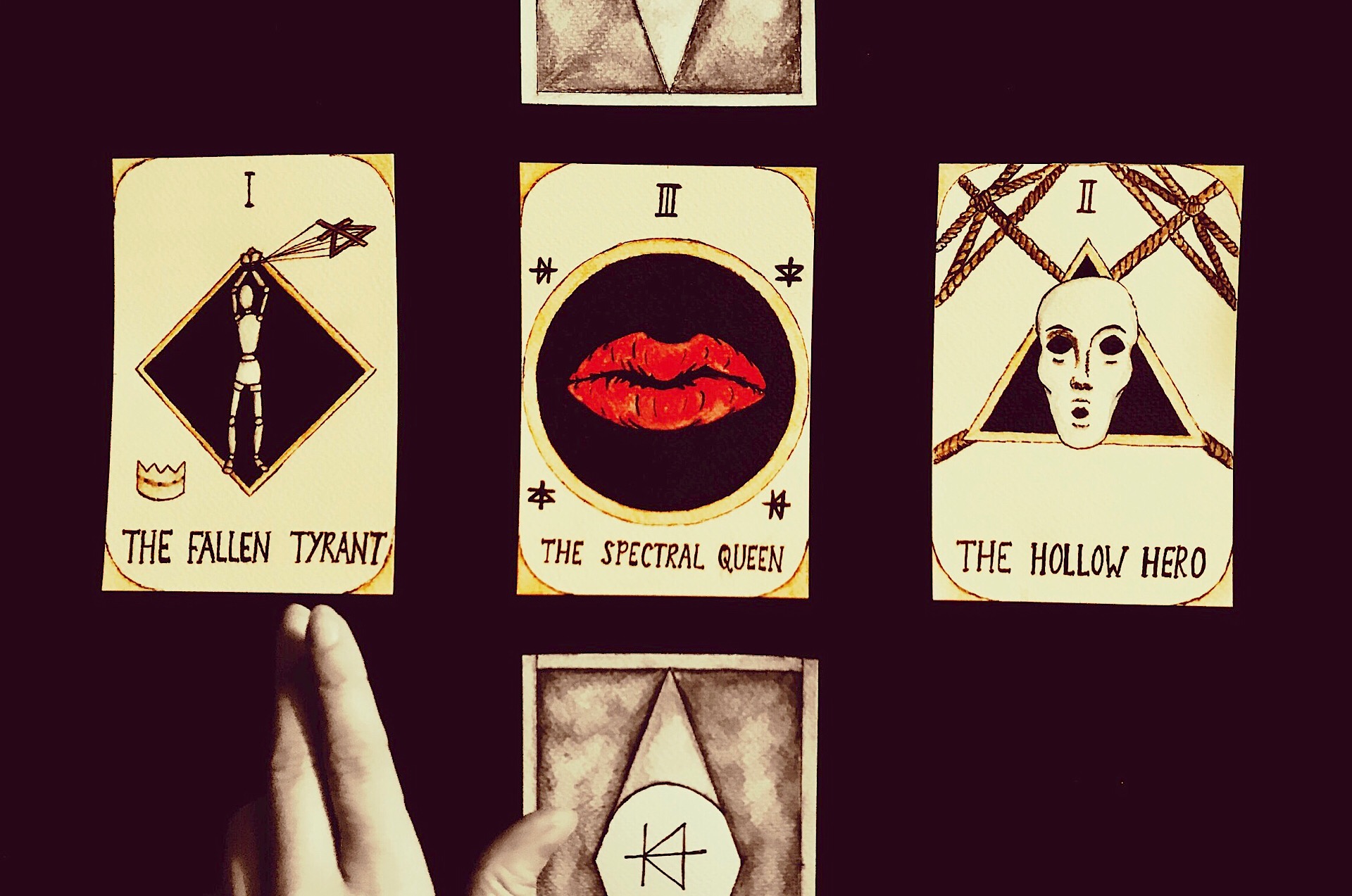
The play, which features three characters – the Fallen Tyrant, the Spectral Queen and the Hollow Hero – will be performed in the Cavern space at this year’s VAULT Festival from 24th to 28th January. “This is a new venture for us, being part of the VAULT festival,” says Anna. “It’s such a great environment because it feels like a mini Edinburgh underground, and we’re excited about making something that’s part of that artistic community. And also it’s a space for us to try something bolder and more experimental, and take this idea of re-orchestration even further.”
“And that was very exciting in terms of creating the script, knowing that that was the environment we’re working in,” adds writer David Fairs, who also plays the Fallen Tyrant. “There was that brilliant liberation knowing that the whole thing would be taking place in this really huge, cavernous long structure. It gave so much free rein in terms of how we were playing the physical journey of the character, and also it allows the audience to have a very experiential time while they’re following this narrative.”
The production features a soundscape designed by Odinn Hilmarsson, which draws on the aesthetic of the Vaults: “We’re going to use that creepy underground space to our advantage,” says Anna. “In fact David kind of formed the idea of the plot based on the idea that we could set this in an underground prison cell, so the Vaults were very much in mind.
“One thing about those Vaults spaces is that I think you have to embrace the sound quality in there – you’ve got the rumbling trains, a bit of water dripping from the roof, a slight echo. That’s part of the atmosphere and you can’t ignore it, so Odinn is creating something that’s pretty much durational for the whole piece, that adds to, enhances, and allows space for the sound of the Vaults itself, in order to create this world which is inhabited by supernatural forces and ultimately transformed in ways through sounds.”
David describes his writing process for this play as “similar but more expansive” than previously. “With I Know You Of Old, though it was based on the one play and the basic plot elements was taken from Much Ado, there was still that sense that what I wanted to do was create my own narrative within that, then work with the parts of the original play to do that. This one just took that and extended it to a new level – so I mapped out and knew what I wanted the plot, characters and journey to be. There was a lot of reading and delving back into the plays, re-familiarising myself with sections, then it was really just a very organic process, pulling things out of the texts and transferring that on to the page as a draft of the script.”
Though much of the writing is a solitary process, he points out that this time he wasn’t quite alone: “While I was writing I was listening to a huge amount of Kate Bush, who was both an influence and a really key part of the actual development of the script. I think she’s a brilliant lyrical and musical storyteller – so more than as a musician, I was looking at her as a writer, almost. Somebody like Shakespeare who creates brilliant expressions and stories, like Wuthering Heights, which is her creative response to this brilliant source novel. I was interested in how elements of that storytelling could form part of a narrative. The use of her as an idea, and her music and the way that she tells her stories, that very much weaves through this play along with the Shakespeare text.”
The production also draws on a wide range of other influences: “There’s the horror aspect, the supernatural elements including spirits and possession – so we’ve been looking at sources like American Horror Story, The Exorcist, Hammer Horror, Silence of the Lambs – which is a springboard for the relationship between the Hollow Hero and the Fallen Tyrant,” explains Anna. “And also beyond that, aliens have been an influence and as with other work that we’ve made, David Lynch, Twin Peaks, Mulholland Drive. So lots of filmic references that we’ve been drawing on.”
When asked to expand on their respect for David Lynch, both David and Anna are full of enthusiasm. “Some people watch David Lynch films and don’t understand what’s happening, so you either find that really intriguing and you go with how it makes you feel and respond, or some people find it distancing,” says Anna. “I feel like the thing that interests me about Lynch is the character; there’s a truth in that character but there’s also a heightened world, and just clever surreal details that he merges with realism, that feels very exciting to watch.”
“And all the details, characters and dialogue form something that does make absolute sense for you, but you get almost what you’re willing to give it,” continues David. “You have to be there and ready to experience each of these things, because his narratives often are very present, and you have to piece together the wider everything from those immediate experiences that are coloured with so much detail and so much imagination. It’s not about intellectually gathering it and understanding in that way; you just sit with it, experience it and it builds, and you feel that narrative.”
Although it’s inspired by Shakespeare, the play is “so far stretched” from the original texts on which it draws that it can be enjoyed equally by those who know Shakespeare and those who don’t. “This is very much a new play, you can come in and watch this, and you have no idea about any Shakespeare narratives or characters and it really doesn’t matter,” explains David. “If you do have it, you’ll enjoy different aspects perhaps, but that’s certainly not our intention by any means. These are three new characters, a new story, a new environment and you really need no prior knowledge at all to enjoy it.”
Where will I be a year from now? It’s a question most of us have asked ourselves at some point, particularly at the start of a new year – and the responses often reveal a lot about the person doing the speculating. It’s also impossible to predict; we can say what we’re hoping for, but in reality we never know when life’s going to throw a massive curveball at us – and even if we do get exactly what we think we want, it might turn out not to be quite as we thought it would be.
In RedBellyBlack’s A Year From Now, that question is the launch pad for a series of interviews with fourteen different people, which spin off in all kinds of unexpected directions and which are quite startling, and occasionally even slightly uncomfortable, in their honesty. We share the subjects’ hopes, fears, good news and heartbreak, all of which is interpreted on stage by five performers (Oscar Scott-White, Kate Goodfellow, Clementine Mills, Christopher Montague and Jessica Warshaw) who mouth the words along with audio recordings of the interviews. This is not as odd as it sounds – and I was surprised at how quickly I stopped remembering that the person on stage wasn’t actually the one speaking, even when there was a difference in age or gender. (I even found myself at one point marvelling at how many different accents they’d all mastered…)
Photo credit: Robert Boulton
Much of this is due to the quality of the performance; each of the five actors is absolutely spot-on with their lip-syncing, down to the tiniest hesitation, laugh, stutter or cough – I can only imagine the hours of rehearsal that have gone into getting every moment of the 60-minute show so totally in sync. In addition, each adopts the body language of the person speaking, from Kate Goodfellow’s bashful four-year-old to Oscar Scott-White’s elegant elderly lady, further enabling us to block out the physical appearance of the speaker and focus instead on their voice and movement, and ensuring that when the same people reappear later in the show, they’re instantly recognisable.
Though each scene takes the same format, there’s sufficient variety in the way they’re presented by director Vicki Baron to keep the show fresh and interesting (and some are separated by slightly surreal dance breaks – the meaning of which, I must admit, wasn’t totally clear to me). Some stories are told by just one person, others by a couple; one scene features four speakers whose stories share a common theme. And each is accompanied by choreographed movements that visually interpret the words we’re hearing, often performed by most or even all of the actors, again in perfect unison. These are striking without being distracting, and at times even quite moving – this is particularly true in the case of a comedian coming to terms with the loss of his mum, “voiced” by Christopher Montague and Jessica Warshaw, who both physically support and are supported by each other as they tell the story.
Photo credit: Robert Boulton
The original question, “Where will I be a year from now?” doesn’t actually feature heavily in the show, though we eventually circle back around to it at the end with an amusing twist. What it does do, though, is provide a starting point for stories covering everything from ill health to parenthood, perfect eyebrows to work pressures. Each of these accounts is unique, whether it’s a devastating look back at time past, a hopeful view of the year to come, or just an honest description of the way life is right now, and every member of the audience will be able to relate to particular voices more than others. There are a couple of moments when we – perhaps inevitably – veer into political territory, but we never stay there long; the power and heart of A Year From Now lie in its human stories, and it’s these that we take away with us.
Can’t see the map on iPhone? Try turning your phone to landscape and that should sort it. I don’t know why but I’m working on it… 😉
Heather Ralph is a London-based theatre producer from Northern Ireland. Currently she’s working with a number of companies on new and returning shows, but took a little time out of her busy schedule to chat about life as a producer, and tell me a bit about what we have to look forward to over the coming weeks.
“What does being a producer involve? I sum it up to friends as a constant chain of emails!Which isn’t actually that far from the truth,” she explains. “It entails a lot of organising of things – mostly my inbox! – and talking to venues. Once a project is off the ground, I usually head up the marketing campaign as well, which requires even more emails and a lot of time spent on HootSuite, Twitter, Facebook, you name it! I really like to try and connect theatre companies with each other, so am always on the lookout for other companies to cross promote with. This is so much easier when the shows are part of a wider festival, like the VAULT festival for instance.
“Before you get to this stage of a project, however, a lot of time goes into research. This is usually for funding and opportunities to develop new work. The tricky part of this is narrowing down what is most suitable for which project.If you just apply blindly for everything with every project, I personally would have no time for all those emails I have to send!
“To sum up it’s a lot of time spent at a computer, so I try and go into the rehearsal room as often as possible, even just to work on my laptop at the back. With all my current projects I’ve come on board at different stages. Shows like Rounds and purged, I’ve been on board since the start. With Rounds in particular it’s been great to be in the rehearsal room in the first few weeks, seeing how the actors come up with their ideas, and when we’ve had junior consultants come in tohelp us develop movement sequences by showing us how they perform things like a cranial nerve exam!
“My goal is to continue to work with people I like who produce work I love, while trying to survive the London rent prices at the same time! That would be my advice to anyone else: when you find people you like working with, stick together and make work; a great team can achieve anything. One of my favourite companies to work with is Haste Theatre, they make great work and are so driven – if you haven’t heard about them you should really check them out. As a company they’re very self sufficient and produce a lot of their own stuff – I’ll usually come on board and give them a helping hand with press and advise them with ACE forms and venue splits every now and again.”
So what’s on the horizon? “Dr. Zeiffal, Dr. Zeigal and The Hippo That Can Never Be Caught! is an award-winning kids’ show from Mouths of Lions with fantastic falling over, a lot of hippo chasing and loads of little hippo enthusiasts laughing at Dr. Zeiffal. It may be billed as a kids show, but we welcome old and young Hippo Catchers. I first came across this show as an audience member; it was just my boyfriend and me amongst a lot of little Hippo Catchers – this is how I refer to children now – but we loved it!
“Then there’s Blood & Bone, a colourful, kooky and downright dirty puppetry show from Cicada Studios. If you want an hour to forget your woes and have some real belly laughs, I’d advise catching Dr. Zeiffal, Dr. Zeigal and The Hippo That Can Never Be Caught! and Blood & Bone – thoughI will of course warn you that Blood & Bone is not a children’s puppet show. It’s for adults and gets very dirty very quickly. Those who are opposed to puppet nudity and puppet sex should probably not attend…”
That’s not all:“Oyster Boy is a multi-award-winning dark comedy about the struggles of a boy born with an oyster shaped head from Haste Theatre, and purged isan intimate, physical, visceral play by Catharsis about the impossibility of communicating to others the issues around mental health deterioration. Last but not least, Resuscitate Theatre are bringing back Rounds, a powerful and urgent tale of the first line of defence for the NHS.
“Rounds and purged are less zany shows, but equally as engaging. Both are based on true stories, dealing with mental health and issues that affect all of us daily, either directly or indirectly. Mental health awareness is a really important subject to me; both shows are a brave attempt to educate and move our audiences while offering some clarification into other people’s lives and their decisions we may not understand, which I think is an important thing for theatre performances to offer. Both shows focus on human relationships, and their physical style allows for a great sense of urgency to be portrayed.”
Heather’s particularly excited about the return of Rounds. “Genuinely I love this show. I shouldn’t say this but everyone knows it’s my favourite project I’ve worked on to date. And I’m even more excited it’s at Blue Elephant Theatre. Please check this venue out – it’s doing great things with new work and the team behind it are all superstars. I came across it last year when I worked with Les Femmes Ridicule on their show In The Gut and since then I’m never out of BET! I’m pretty sure Niamh (the Artistic Director) will eventually block my email address…
“What’s happening with the NHS is terrifying. Rounds focuses on the humans behind the junior doctors, and I think it demonstrates an important life lesson on our own vulnerabilities and how the government responds to them. Exeunt Magazinegave us a great quote for Rounds, but the sentiment stands true in anything: ‘Rounds is a lesson is vulnerability; without vulnerability we will never learn and we can never recover.’ The NHS and all its staff are very vulnerable right now, it’s how we go forward from here that will matter. The scary thing is the path so far doesn’t look that great.”
Rounds (Resuscitate Theatre): 16th-18th & 23rd-25th March, Blue Elephant Theatre
Juggling such diverse projects is a challenge – but an enjoyable one: “Kids’ shows is actually a new thing for me this year, and it’s been quite fun figuring out all the different rules that come with how to produce a kids show!” reveals Heather. “Mouths of Lions are no strangers to kids’ shows, so we’ve all really knuckled under as a team to make the most of the VAULT festival. But yes, it’s so much fun, it means my day is never boring. The challenge is to stay on top of everything and remember who you talked to about what show!”
Two of Heather’s shows can be seen at this year’s VAULT festival, which opens this week. “I’ve never done the VAULT festival before and I am so excited! There are so many great shows happening, but I have my eye on a few that I really want to get to: Cat Loud’s Wayward,Shrapnel Theatre’s Litterati, Cornwall vs China (shameless plug: you can grab a combo ticket for Cornwall vs China and Blood & Bone for just £18…), Redbellyblack Theatre Company’s A Year from Now. And one more high recommendation from me: Bric a Brac’s Ash, directed by Anna Marshall, who’s the director of Rounds.
“Why check out the VAULT festival? Because this is a month of great fringe theatre at affordable prices happening right here in London. No trains to Edinburgh or Brighton needed, just grab a tube to Waterloo and enjoy yourself!”
Check out the links below for more details and to book for Heather’s upcoming shows:
Meet Simon. Simon’s dad recently died, but he’s distracting himself from thinking about that too much by going jogging, playing video games, caring for his pet rats and worrying about both his mum and his on-off relationship with his girlfriend. But someone – a talking lightbulb, to be precise – has decided that’s not a satisfactory ending to Simon’s story, and with the help of three assistants assumes control of his life, manipulating his every action to ensure he follows the path set out for him. And the goal of all this, it seems, is not to give Simon what he wants or needs, but to entertain and satisfy us, the audience.
Photo credit: Sarah Burrell
All Your Wants and Needs Fulfilled Forever is an award-winning show from New Zealand-based company The Playground Collective, and it’s the kind of play I think needs to be seen more than once, because there’s so much going on it’s almost impossible to catch it all first time around. There’s laughter, action, emotion, countless cultural references, original music, a brief exploration of Pavlovian conditioning – and a few moments which, even if it’s not totally clear what’s actually going on, still evoke an almost physical reaction. It’s also something of a sensory explosion; flashing lights, bright colours and chirpy video game theme tunes all contribute to the sensation of being in an artificial environment.
Photo credit: Sarah Burrell
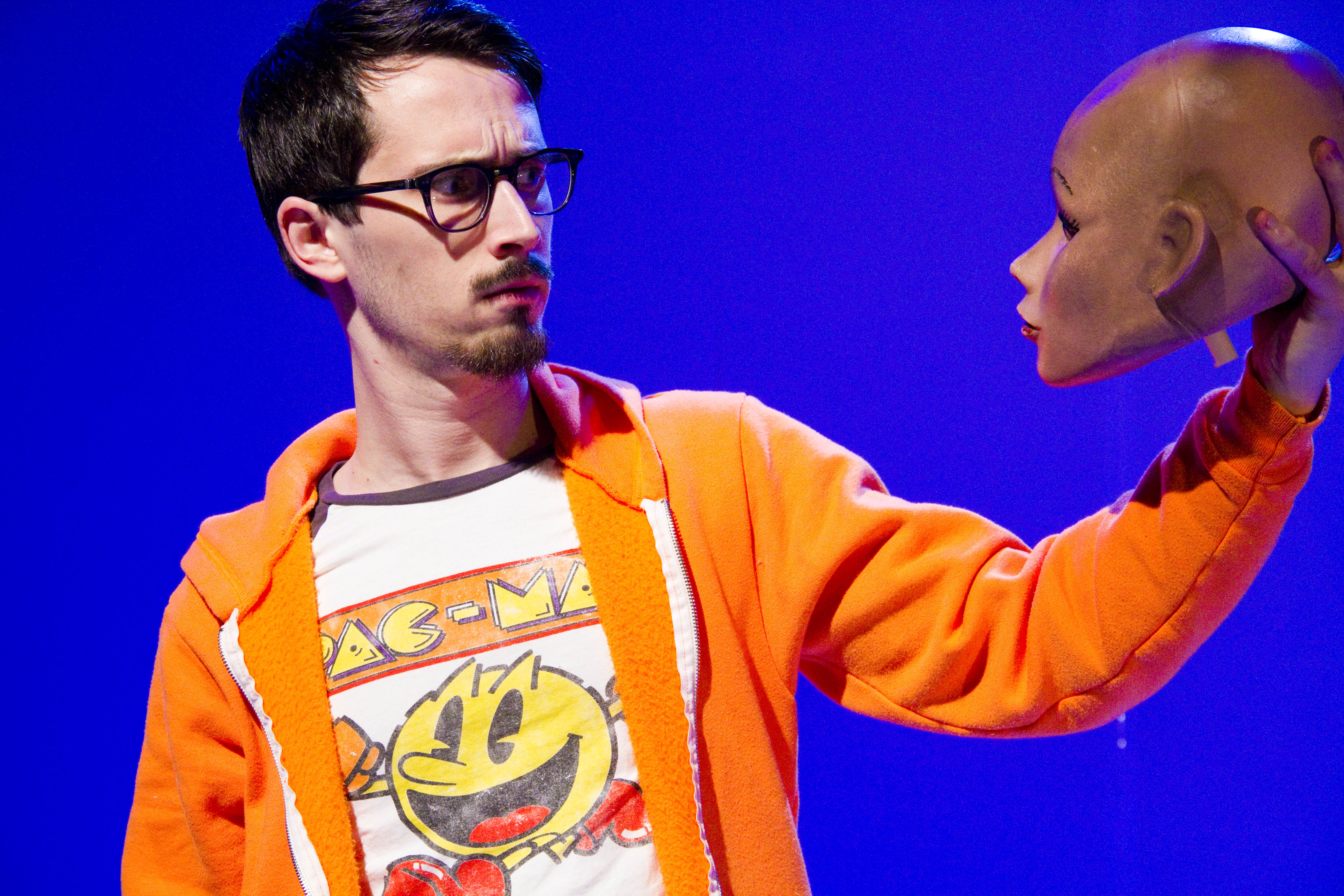
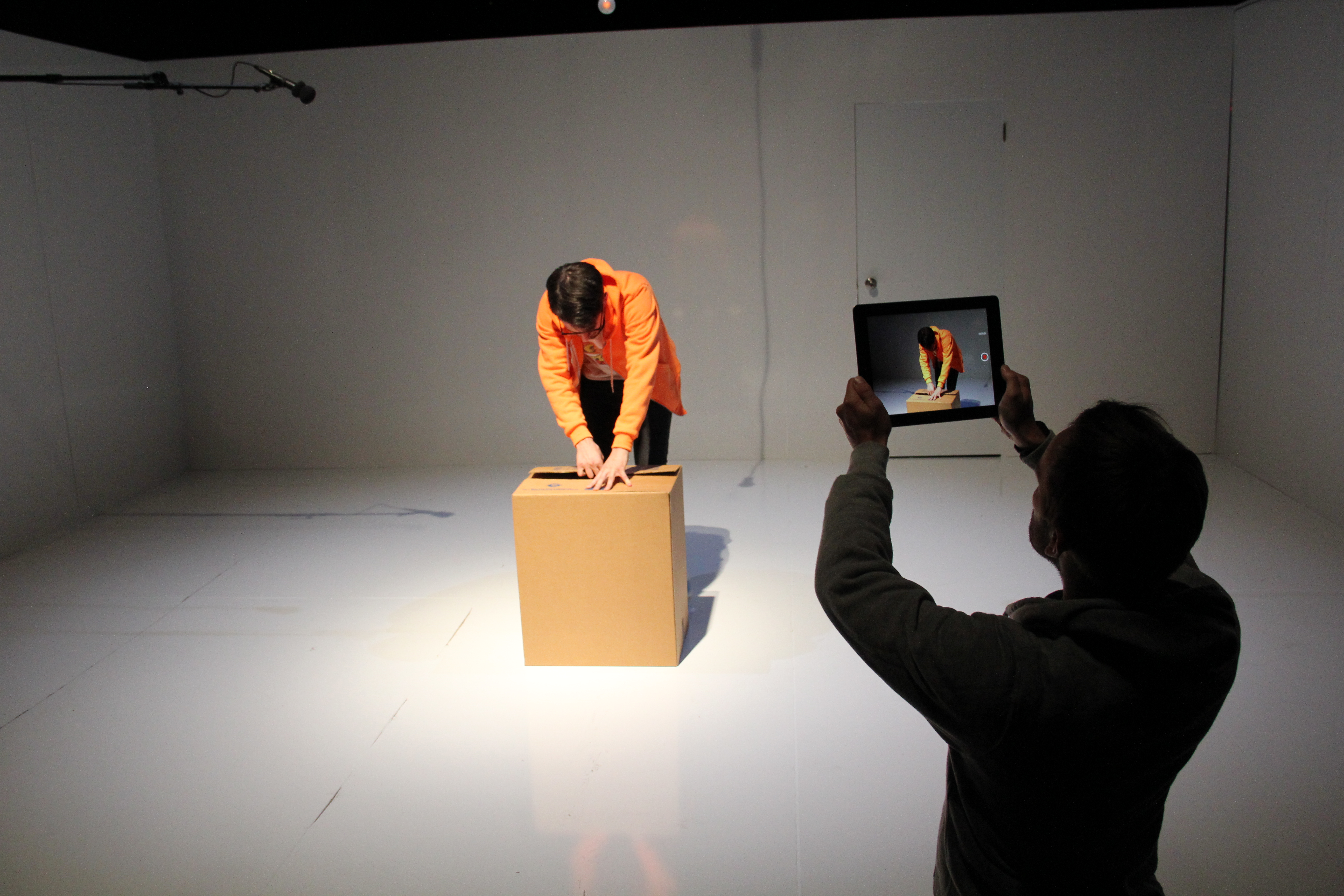
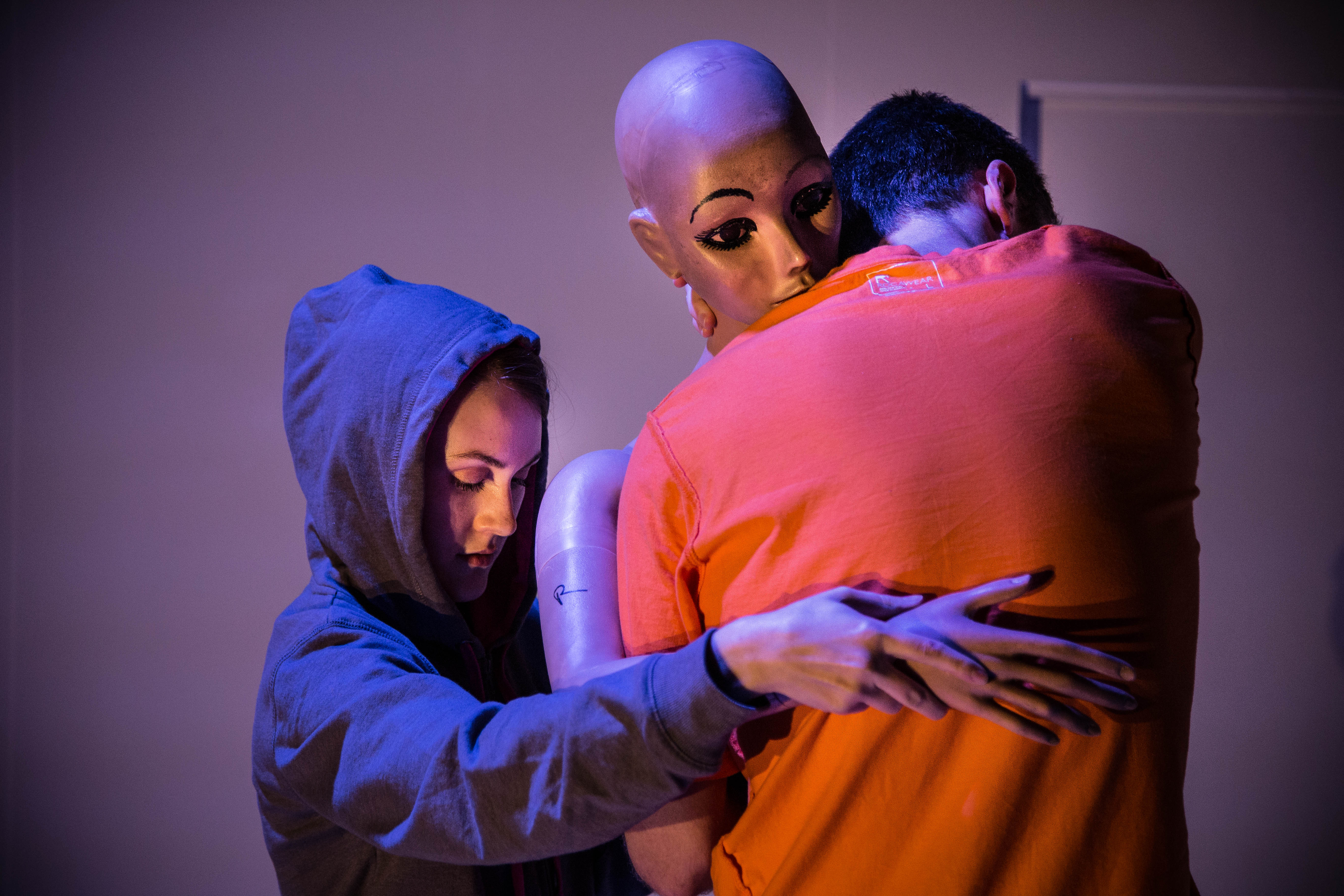
Writer Eli Kent, who plays Simon, spends most of his time alone in the stark, empty box that is his world. But even though he has nothing to work with, we nonetheless always know exactly what he’s doing, whether he’s making a smoothie, feeding his rats or getting caught up in a dramatic car chase. The other people in his life are represented by inanimate objects – his girlfriend is a mannequin, his best friend a cuddly toy and his mum a disembodied pair of washing up gloves. These characters are brought to life through the brilliant voice work of the three ‘players’ – Victoria Abbott, Hamish Parkinson and Joel Baxendale (whose backstage squabbling becomes just as much a part of the story as what’s happening up on stage) and Simon’s interactions with them are no less real; the break-up scene in particular is still devastating, even if one of the characters is a dummy.
Photo credit: Sarah Burrell
The play explores the idea of a ‘perfect story’, one that follows a traditional path and reaches a neat conclusion – just as in a video game we’re required to complete certain stages in order to proceed towards a showdown with the ultimate boss. But it turns out life isn’t always like that. It can be unpredictable, funny, sad, shocking or sometimes just mundane; despite what Die Hard (a perfect movie, according to Simon) would have us believe, car chases are not something that happens to everyone. Each of us is the central character in our own story, and we should take the opportunity to write it in our own way, for our own benefit, rather than for the unseen audience behind the fourth wall expecting a perfectly circular plot with a tidy ending.
All Your Wants and Needs Fulfilled Forever is an ingenious and totally unique piece of theatre, unlike anything I’ve ever seen before. It’s not so much a play as an experience, really, and one that doesn’t necessarily end when you walk out the door. And it’s also a show that, I suspect, everyone will interpret slightly differently – so in that sense, it’s the very best kind of theatre.
Can’t see the map on iPhone? Try turning your phone to landscape and that should sort it. I don’t know why but I’m working on it… 😉





 Theatre Things