Review: The Kite Runner at Wyndham’s Theatre

Khaled Hosseini’s first novel, published in 2003, is a modern classic. A story about friendship, betrayal and redemption, it’s sold millions of copies worldwide, and was made into an award-winning movie in 2007, before being adapted for the stage by Matthew Spangler two years later.

(It’s also one of my favourite novels, so I didn’t wait around until press night to see the play on its arrival at Wyndham’s Theatre just before Christmas. Consequently this review is based on one of the earliest previews, and it’s possible some aspects of the show may have changed since then.)

Photo credit: Robert Workman

The Kite Runner tells the story of Amir and Hassan – one the son of a rich businessman, the other the son of his Hazara servant – whose close friendship is shattered in one shocking moment of betrayal. More than 20 years later, after fleeing the Soviet invasion and starting a new life in America with his father, Amir receives a call that offers him a chance of redemption… but to take it he must return to Afghanistan and confront the demons of his past.

It’s a story that skilfully interweaves Amir’s personal journey with the historical and political story of his country, and Giles Croft’s production faithfully follows that same narrative. While Amir (Ben Turner, who plays both Afghan child and American adult) shares his account of events, there are frequent reminders of the home he left behind – but which, despite his efforts to move on, never left him. Tabla player Hanif Khan provides percussive accompaniment throughout, while Barney George’s set features a huge kite, on to which is projected beautiful backdrop imagery (designed by William Simpson), and which becomes a symbol of the culture and passion that united the two friends, but also the fateful day that tore them apart.

Said kite also mercifully shields our view of the traumatic pivotal moment, but Amir’s reaction to and description of it evoke all the horror I remember feeling the first time I read the novel. Because this is far from an easy story; there are a few laughs and one particularly joyful scene in Act 2 (though even this has a shadow of sadness to it), but the most powerful moments are undoubtedly those that shock us and break our hearts. Much like any tragedy – personal or national – the glimmer of hope in the play’s closing scene can’t undo the damage that’s been done.

Photo credit: Robert Workman

As both narrator and main character in a play lasting nearly three hours, Ben Turner has quite a task, but he performs it to perfection – at times you can almost see the guilt weighing on his shoulders. But while Amir is the voice and conscience of the story, its heart lies in the people around him: Hassan (Andrei Costin), who remains unfailingly loyal despite his betrayal; his wife Soraya (Lisa Zahra), who hears his story and forgives him; his father (Emilio Doorgasingh), with whom he finally develops a mutual respect; and Rahim Khan (Nicholas Khan), the family friend who offers him his chance of redemption. Through their eyes – and the excellent cast performances – we see a different Amir: a man not destroyed by guilt, but with the chance to be good again.

I know I say this every time, but seeing an adaptation of a beloved book is always a gamble. Fortunately, I have no complaints about The Kite Runner, which is as thought-provoking, powerful and emotionally scarring (I mean that in a good way… I think) as Hosseini’s novel. Yes, it’s a long evening – but it’s worth every second.


Can’t see the map on iPhone? Try turning your phone to landscape and that should sort it. I don’t know why but I’m working on it… 😉

Interview: Guillaume Pigé, The Nature of Forgetting

“The name of the company comes from the prefix ‘re’. It is the ‘re’ of re-discovering and re-imagining. For us it is not about inventing but about breathing new life into what is already there.”

Guillaume Pigé founded Theatre Re in 2009 while in training at the International School of Corporeal Mime in London. He was joined in 2011 by Katherine Graham, Malik Ibheis and Alex Judd and an international ensemble was formed, producing work that combines mime and theatre to examine fragile human conditions. Their last show, Blind Man’s Song, was a surprise (to me, anyway) entry in my top 10 of 2016, and they’re now looking ahead to the world premiere on 18th January of their latest project, The Nature of Forgetting.

Photo Credit: Richard Davenport for The Other Richard

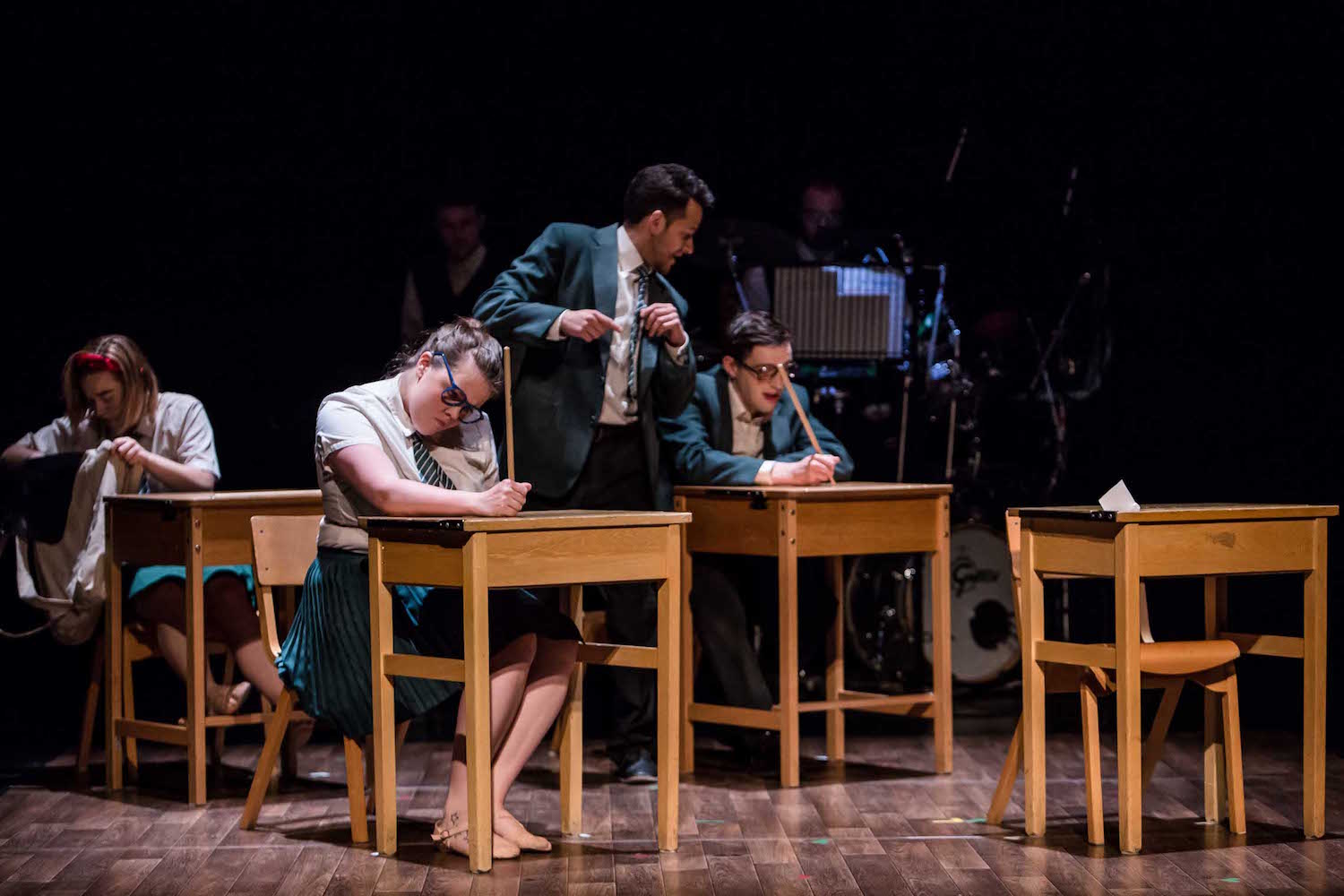
Inspired by recent neurobiological research and interviews with people living with dementia, the show tells the story of Tom, as he’s re-awakened on his 55th birthday by the tangled threads of his disappearing memories.

“As a company we work very collaboratively, and for this project we started by doing things, by moving, by playing,” says Guillaume. “A few objects very rapidly became central to the piece, like the wooden school desks for instance. We also collaborated with UCL Neuroscience Professor Kate Jeffery and interviewed older people and people living with dementia. The point was not to collect their stories or what they remembered, but to explore how they remembered. This was fascinating. The main question that guided our exploration was: what is left when memory is gone? We could not put the answer into words…so we made a show about it.”

The collaboration with Professor Jeffery proved invaluable to the creation of the piece: “She not only helped us to understand memory mechanisms, but she also helped us to gain a better understanding of the information we were getting through our interviews,” explains Guillaume. “She was also in rehearsal with us to support our physical and visual dramaturgy. In fact, this collaboration went so well that we will be organising a seminar with Professor Jeffery at UCL about the science behind the making of the show ahead of our premiere, where we will discuss how the concepts of the neurobiology of memory has shaped the making of the work.”

One of the unique features of Theatre Re’s work is composer and musician Alex Judd’s live music, which has been part of the company’s previous shows Blind Man’s Song, The Little Soldiers and The Gambler. “Alex’s music for this show is absolutely gorgeous and all created live from more than ten instruments on stage! It has all been composed in the rehearsal room as the piece was being developed. The music and the sounds are totally integral to the performance. Also, for the first time, Alex is joined on stage by a percussionist, Keiran Pearson, who adds different timbres, colours, and textures to the score.”

Photo Credit: Richard Davenport for The Other Richard

The show was also inspired by the work of theatre director Tadeusz Kantor: “I was originally drawn to the work of Tadeusz Kantor because the world of childhood memories (long term memory) became very rapidly central to the development of The Nature of Forgetting. I was especially inspired by pieces such as The Dead Class and Wielopole.

“While watching those pieces, I was fascinated by the mysterious raw visual and physical poetry that was developed on stage. Especially the use of ‘poor objects’ and the work of the actors; stylized and yet so real.”

The show premieres next week as part of the London International Mime Festival. For those not sure if mime is for them, Guillaume shares what first attracted him to the art form: “Everything. Absolutely everything. The disciplines, the imagination, the technique, the freedom, the vocabulary, the figures, the pieces and the whole world around it…

“I would like the audience to come out of the theatre with both a smile on their face and a tear in their eye.”

Book now for Theatre Re’s The Nature of Forgetting at Shoreditch Town Hall from 18th-20th January.

Interview: John Risebero, Henry V

John Risebero is co-director and designer of award-winning theatre company Antic Disposition, along with co-founder and director Ben Horslen. Next month they’ll be reviving their acclaimed production of Henry V; previously performed in France, with two London runs and a 2016 national tour, the show is taking to the road once more, giving audiences another chance to see what British Theatre called “one of the most impressive revivals of a Shakespeare play that I have seen in recent years”.

Photo credit: Scott Rylander

Founded in 2005, Antic Disposition have become known for their innovative interpretations of classic texts, particularly the works of Shakespeare – and the timing of this particular production was no accident. John explains: “We’d wanted to stage Henry V for several years but because we always tour our Shakespeare plays in France, we could never see a way to do it without being insensitive to our French hosts. But then we realised that not only was 2015 the 600th anniversary of the Battle of Agincourt, it was also the centenary of the Great War, which gave us the opportunity to create a production that reflected on the change in the relationship between England and France in those five centuries – from mortal enemies to loyal allies. So our production is set in a military hospital in France, where wounded British and French soldiers work together to stage their own production of Henry V. It’s really a play within a play – Henry V meets Oh, What a Lovely War.

In addition to Shakespeare’s text, the play also includes original songs and live music inspired by the poetry of A E Housman. “We knew we wanted to include music in the show but using period songs seemed too obvious and we weren’t comfortable writing new ones,” says John. “Then we discovered George Butterworth’s musical setting of ‘The Lads in Their Hundreds’ from A Shropshire Lad and found that Housman had acknowledged he was inspired by Shakespeare. Although Housman’s work predates the Great War, so much of it reads like he knew what was coming. Our brilliant composer, Christopher Peake, set six more poems to original music for our show but we still use Butterworth’s version of ‘The Lads in Their Hundreds’ – it’s our tribute to him, as he died on the Somme in 1916.

“The music is completely integral. Soldiers have always used song to lift spirits or celebrate victory. As well as poetry, the Great War gave us so much music that’s still with us, songs like ‘Pack Up Your Troubles in Your Old Kit-bag’. In our production, we use music at key moments to bring the two sides together and remind the audience that war is a shared experience. It’s emotional shorthand.”

Photo credit: Scott Rylander

Although the play may be set in the past, John believes it still has a powerful message to share with a modern day audience: “Absolutely. War is a huge gamble, often taken too lightly. The French massively outnumbered the English at Agincourt but still lost the battle. In 1914, everyone thought the Great War would be over by Christmas, but it turned into one of the most destructive conflicts in history. It’s easy to open Pandora’s box, but the consequences can never be fully foreseen.”

Antic Disposition have also developed a reputation for staging productions in historic buildings and unusual non-theatre spaces, and this tour is no exception; Henry V will visit eight cathedrals around the UK, including Ripon, Lincoln, Peterborough, Ely, Norwich and Southwark. “We started out working in theatres but haven’t staged a play on a conventional stage for six years now,” John explains. “We find working in unusual buildings more exciting. There’s a special kind of magic when you are performing Henry V with the tomb of King John in the front row of the audience, as we did at Worcester Cathedral. It can be challenging from an acoustic perspective – many of our venues weren’t designed for this kind of performance, but we feel that those challenges are more than made up for by an atmosphere you can’t get in a regular auditorium.”

The 2017 tour of Henry V opens at Southwark Cathedral on 2nd February – and it’s not only audiences who are looking forward to its return. “We had a wonderful experience touring cathedrals last spring and wanted to bring the show to new venues and new audiences,” concludes John. “We think it’s the best work we’ve done as a company, and we’re very proud of it.”

Antic Disposition’s Henry V visits eight cathedrals around the UK from 2nd to 22nd February.

Interview: John Stanley, The Monkey

Next month, Battersea’s Theatre503 plays host to Homecomings, a festival of new plays by prisoners and ex-prisoners about getting out and going home. Produced in partnership with the Synergy Theatre Project, the festival runs from 21st February to 18th March and will feature two of the winners of Synergy’s third national prison scriptwriting competition – Glory Whispers by Sonya Hale and The Monkey by John Stanley.

John, a lifelong Londoner, describes The Monkey as “a dark, comic contemporary drama of criminality, addiction and money owed”. The four characters he’s created, he explains, offer “a brief glimpse of the many diverse and varied people I met during my life’s erratic and unusual journey”.

the-monkey-by-jon-stanley

Until he joined the Synergy project, John never imagined a future as a playwright: “The short answer is no, although I’ve always dabbled in poetry. Recently I completed a book about my life, but the truth is that until I completed the Synergy playwriting course I never had an interest in theatre.”

The Synergy Project, founded in 2000, seeks to build a bridge from prison to social reintegration, prevent young people from entering the criminal justice system, and inspire change by capturing the imagination of participants and public. After learning about the project from a friend who worked at the Young Vic, John joined the Synergy playwriting course and went on to write The Monkey. He’s thrilled to have his first ever play selected as a winner, out of a record 134 entries.

“I was over the moon when I found out, truly elated. Synergy has had such an enormously positive impact on my life that it’s impossible to quantify in a few sentences.” His advice to others thinking about getting involved in Synergy is simple: “Don’t hesitate and don’t delay, take the opportunity and go for it immediately.”

John’s now looking forward to seeing his work come to life on stage: “It’s exciting and nerve-wracking to see it come to life. I wrote The Monkey in 2012 and when I finally got to hear it in its entirety at the rehearsed reading recently, it was somewhat unreal but it was really gratifying. I am a touch nervous as to whether people will like it or not, though my feeling is you either do or you don’t and that’s how it is. Some people will find it hilarious and some won’t, but I hope they at least find it funny. If they do that would be wonderful.

“I’m sure I portray a world that most people are unaware of, so I hope they go away educated in some degree to an underbelly that exists in their midst – but most of all I hope they find it funny and have a good laugh.”

Catch The Monkey and Glory Whispers at Theatre503 from 21st February to 18th March.

Review: The Trackers of Oxyrhynchus at the Finborough Theatre

Proud Haddock’s production of The Trackers of Oxyrhynchus opens in Egypt in 1907, where two archaeologists and a team of local men are sifting through scraps of ancient papyrus. It’s an appropriate introduction to Tony Harrison’s 1988 play, which has itself been unearthed and given new life nearly 30 years after its last London performance.

Grenfell and Hunt (Tom Purbeck and Richard Glaves) are academics searching for a lost satyr play by Sophocles. Dismayed at their lack of success – all they seem to find is endless petitions for help from the dispossessed – Grenfell grows increasingly obsessive, and Hunt starts to worry about him… with good reason, as it turns out. Before we quite know what’s happening, Grenfell’s been possessed by the god Apollo, while Hunt’s transformed into Silenus, and (with a bit of audience participation) dramatically released his band of dancing satyrs.

Photo credit: Samuel Taylor

From here, the story takes us to ancient Greece and into the lost play, Ichneutae, where Apollo charges the satyrs with tracking down his lost cattle, only for them to discover instead something far more valuable to him. And finally, we’re whisked off to London’s South Bank in 2016, where the effects of that discovery are still being felt – but not necessarily in a good way.

Believe it or not, all of this happens in 75 minutes. The Trackers of Oxyrhynchus is a whirlwind of a production that’s barely contained by the Finborough’s tiny stage, and allows very little time to process what’s going on – yet still somehow manages to remain accessible to those of us without a degree in ancient Greek literature. Don’t get me wrong, the story is completely bonkers, and there are certainly a good few moments where we’re left wondering what on earth just happened (the sudden appearance of Hermes the man-baby would be a good example). But it all comes together in the end, with a powerful message not only about the dichotomy between high and low art, but more broadly about the divide between rich and poor, and a direct appeal to the audience which challenges us to examine our own attitudes. (That said, the perfectionist in me would have welcomed a chance to circle back to the beginning of the story, if only to find out what happened to Grenfell and Hunt.)

Photo credit: Samuel Taylor

Tom Purbeck and Richard Glaves lead the cast with strong performances, handling with ease Harrison’s rhyming verse. Purbeck particularly excels during a wild-eyed transformation from Grenfell to Apollo, his head snapping back and forth as the two personas war against each other. Glaves’ key moment comes late in the play, but is worth waiting for; as Silenus, he recounts movingly the flaying of his brother satyr Marsyas, who was punished by Apollo for having the temerity to become an accomplished flute player. But perhaps most memorable – for reasons that become obvious (costume designer Vari Gardner, take a bow) – are the satyrs, played by Dylan Mason, James Rigby, Nik Drake, Sacha Mandel, Dannie Pye and Adam Small. Energetic and irreverent, they stomp, dance and joke their way through the middle section of the play… yet this story is not destined to end happily, and their 21st century incarnations channel their energy in much darker ways.

The Trackers of Oxyrhynchus is a decidedly odd play, entertaining and tragic in equal measure. Jimmy Walters’ production could at times move a little more slowly, and could certainly benefit from a slightly bigger stage – but given the nature of the play and its message, a small theatre, in which audience and artists are within touching distance, feels like an appropriate setting for the rediscovery of this little-known work.


Can’t see the map on iPhone? Try turning your phone to landscape and that should sort it. I don’t know why but I’m working on it… 😉