Review: Seussical the Musical at Southwark Playhouse

Colourful, feel-good and more than a little bit mad: Seussical is pretty much everything you’d expect from a musical based on the stories and characters created by Dr Seuss. Whether you grew up with the books or, like me, only know the basics (The Cat in the Hat, essentially), there’s plenty to enjoy and just as much to bemuse in this utterly bonkers but ultimately heartwarming show.

Photo credit: Adam Trigg

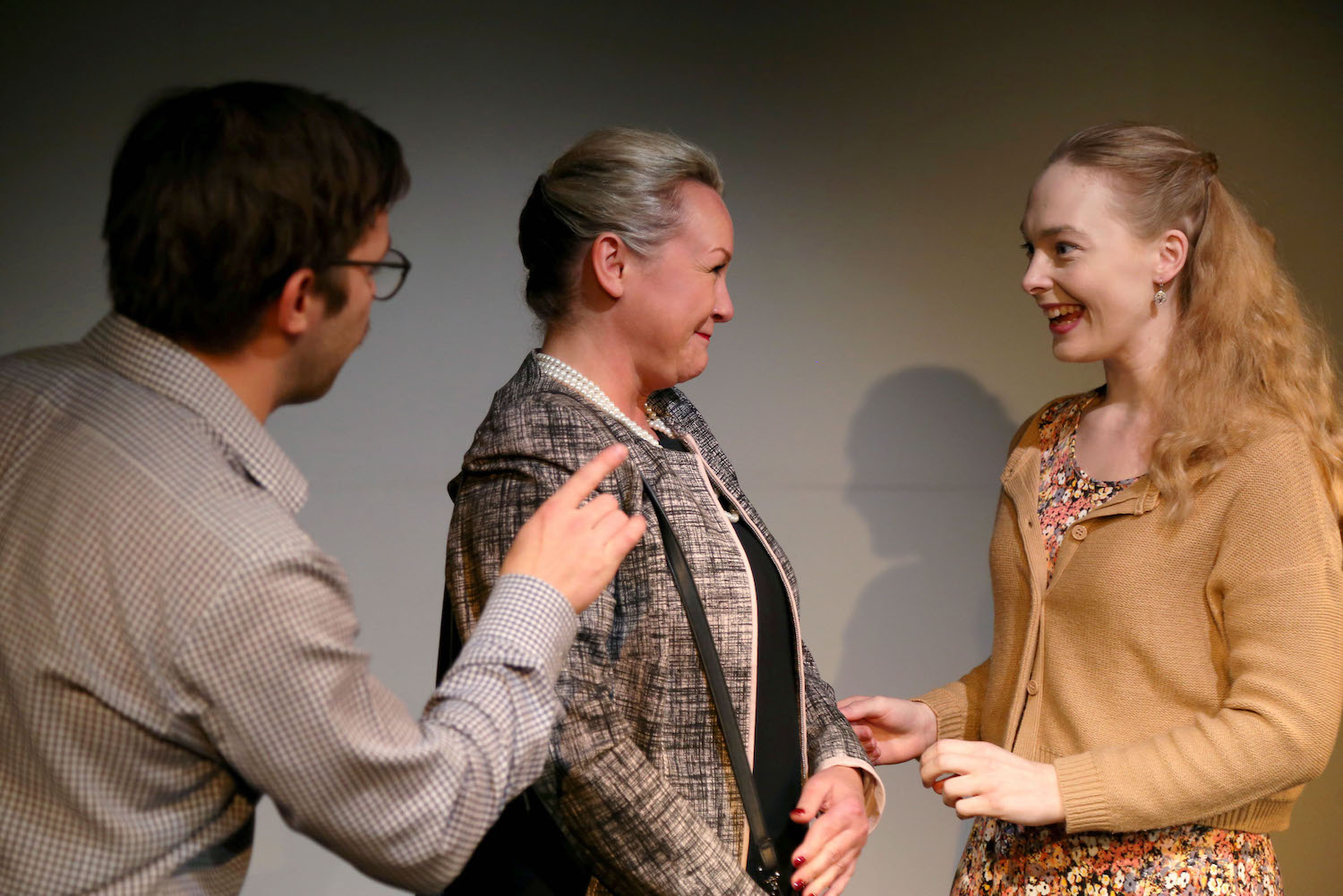
Written by Lynn Ahrens and Stephen Flaherty, and co-conceived by Eric Idle, Seussical brings together various Dr Seuss creations, but its central plot is based around Horton the Elephant (Scott Paige), a kind-hearted soul who rescues a tiny planet after he hears its inhabitants, the Whos, calling for help. Despite being bullied by the other animals – particularly the Sour Kangaroo (Ngozi Ugoh) and monkeys the Wickershams (Adam Dawson, Robbie Fell and Rhys Benjamin) – he refuses to give up on his new friends. Among these is young Who Jojo (Anna Barnes), who’s constantly getting into trouble because of her wild imagination, but is encouraged to keep thinking Thinks by her guide, the mischievous Cat in the Hat (Marc Pickering).

The original show – first performed on Broadway in 2000 – was split across two acts, but this production directed by Immersion Theatre’s James Tobias condenses the story into a single act of 75 minutes. In doing so it sets a pretty frantic pace, with musical number rapidly following musical number, and very little in the way of spoken dialogue (although what little we do get is, of course, in rhyming verse). This means the whole show is something of a whirlwind – but that doesn’t really matter, because it’s not so much the plot that’s important as the messages we take away from it. The importance of imagination, kindness, loyalty and being true to yourself all come through loud and clear, whether you’re eight or eighty, and are guaranteed to send you home feeling all warm and fuzzy.

The musical numbers, though not all that memorable (with the conveniently catchy exception of the finale), are enjoyable enough and well performed by the cast. Scott Paige is a sincere and instantly likeable Horton, and there are strong vocal performances from Amy Perry, Ngozi Ugoh and Katie Paine as Gertrude (a bird who’s in love with an unsuspecting Horton), the Sour Kangaroo and Mayzie La Bird respectively. But it’s Marc Pickering who steals the show, with an impeccable comedy performance as the Cat in the Hat. He has the audience in the palm of his hand from the start, and whenever he’s on stage – which is most of the time – there’s never a dull (or in some cases, dry) moment.

Photo credit: Adam Trigg

Visually the show is, without doubt, a spectacle; Justin Williams and Jonny Rust’s set design is bright, colourful and very recognisably from the world of Seuss. In keeping with one of the show’s core messages, Rachel Cartlidge’s clever and vibrant costumes leave a little bit to the imagination; Horton, for instance, is simply dressed in a grey shirt and tie, so it’s up to the audience to take that final mental leap and picture him as an elephant – at which point it becomes entirely obvious that that’s what he is.

An ideal antidote to the dreary winter evenings, Seussical is feel-good fun for the whole family, with plenty of wise words (and a few very silly ones) to take home. You can steer yourself in any direction you choose… and you could do far worse than heading down to Southwark Playhouse for 75 minutes of joyous silliness. And a cat. In a hat. Because what in the world could be better than that?

Review: Renaissance Men at the Old Red Lion Theatre

The complexities of male friendship go under the magnifying glass – literally – in Renaissance Men, a new show written by James Patrick and Bag of Beard. The play made its debut this week with a two-date first sharing, which proved more than enough to whet the appetite for a planned tour in 2019.

A riotous comedy with an unexpectedly dark twist, the play centres around three friends – Irvine (Sam Heron), Quentin (Alexander Knott) and Winston (James Demaine) – who think they’ve discovered a priceless original painting in a charity shop in Streatham. Excited by the prospect of striking it rich, the three call in slightly shady local art dealer Mr Sutcliffe (Jack Gogarty) to confirm the painting’s authenticity – but his visit ends up bringing answers of a very different kind when a shocking secret is revealed.

Photo credit: Zöe Grain

You might be tempted to assume, given their artistic background and love of a good philosophical debate (the company have deliberately steered away from the stereotypical image of the millennial generation), that these three friends would be more than capable of expressing how they feel about things. You might think that – but you’d be wrong. Behind the laugh-a-minute banter and quick-fire insults that characterise their friendship, and which are delivered with delightful authenticity by the cast, there are a whole heap of deep and unspoken emotions. This is particularly true for Sam Heron’s painfully vulnerable Irvine, whose recent interest in writing erotic poetry increasingly seems to be an attempt to get something very serious off his chest – if only his mates weren’t too distracted by their own dramas to pay attention.

It might be early days for the play, but Ryan Hutton’s production is already highly polished. All four characters are expertly drawn and totally convincing both in writing and performance; the four actors work very naturally together, and even in the play’s relatively short running time of 70 minutes, there’s a complexity and detail to each character that leaves us wanting to know more. Dysfunctional and eccentric they may be, but a few moments of genuine affection do manage to slip through the barriers the characters have constructed around themselves, making it obvious their problem isn’t that they don’t care about each other, but that they just don’t know how to say so.

The pace of the drama also feels just right, with the very funny first half of the play carefully laying clues to what’s coming, so that while it comes as a surprise, on reflection what happens next actually makes perfect sense. And there’s a growing suspense – heightened by the fact that we never get to see the painting ourselves – as we wait to find out if the three friends really are on to a winner.

Photo credit: Zöe Grain

Topical, original and very funny, Renaissance Men is off to a great start, with two sell-out performances already under its belt and no doubt many more to come. What begins as a simple story about three friends who like to wind each other up is quickly revealed to have hidden depths, and touches on some important issues – but while the play certainly enters some pretty dark territory, it never fails to be great entertainment. This is a really promising new production; let’s hope we don’t have to wait too long for the next chance to see it.

Renaissance Men was performed at the Old Red Lion Theatre on 25th and 26th November. For details of future shows, visit bagofbeard.co.uk or follow @BagOfBeard.

Review: Radiant Vermin at the Brockley Jack Studio Theatre

Philip Ridley’s Radiant Vermin, which sees a young couple resort to murder to secure their dream home, is a disturbing supernatural fantasy based on an equally depressing reality. With house prices still prohibitively high for so many, the play asks us to question not only what we would be willing to do to get on the property ladder – but also where we’d be prepared to stop.

Photo credit: Robert Piwko

Jill (Laura Janes) and Ollie (Matthew John Wright) are a young couple, recently married and looking forward to the birth of their first baby. As they despair of ever escaping their rented flat on a grotty estate, they’re invited by the mysterious Miss Dee (Emma Sweeney) to join a government scheme that will give them a free house, on the condition they take care of all the renovations. The couple jump at the chance, knowing it’s the only way they’ll be able to afford their dream home. When Ollie accidentally kills a homeless man on their first night, only to discover their kitchen has been magically transformed into the one they saw in Selfridges, he and Jill realise what they need to do, and set out on a murderous mission to complete the rest of the house. But then their baby is born, and new neighbours move in – and pretty soon Jill and Ollie find they can’t stop “renovating”, despite the terrible cost.

The play takes the form of a “confession” to the audience; Jill and Ollie hope if they can make us understand then it’ll justify what they’ve been doing and, more importantly, allow them to continue. Ridley’s play is a damning comment not only on the housing crisis but more broadly on the ease with which human beings adjust our moral compass to suit our own needs, implicating not only its characters but also the audience. Jill and Ollie seem like nice, normal people; the way they tell their story is very funny and engaging, and in spite of ourselves we find ourselves both liking and relating to them.

This is due largely to winning performances from Laura Janes and Matthew John Wright, who quickly build a rapport with the audience and bring the story vividly to life with the aid of absolutely no set or props. The action in Dan Armour’s production takes place against a stark white backdrop, and almost everything that happens is not seen but described by Jane and Ollie, inviting us to imagine, perhaps, our own dream home taking shape around them. Although excellent throughout, the pair’s stand-out moment comes towards the end of the play, at a birthday party for Jill and Ollie’s baby son, when the two actors play between them around twelve different characters – a high-speed tour de force that leaves both actors and audience breathless.

Photo credit: Robert Piwko

Though the majority of the stage time belongs to Jill and Ollie, it’s clear from the start that they’re not at all in command of the situation. Despite appearing only twice, all the power is in the hands of Emma Sweeney’s Miss Dee, who calmly manipulates and seduces the couple into taking her deal. There are enough clues scattered throughout the play to help us figure out Miss Dee’s true identity, but even without them it doesn’t take a genius to understand who – or what – we’re looking at.

Deeply disturbing but undeniably funny, Radiant Vermin is a cleverly written play that turns the spotlight ultimately on its audience. We all like to think we wouldn’t take the deal – but in a world where materialism reigns and enough is never enough, can we ever really know for sure?


Can’t see the map on iPhone? Try turning your phone to landscape and that should sort it. I don’t know why but I’m working on it… 😉

Review: Boujie at Drayton Arms Theatre

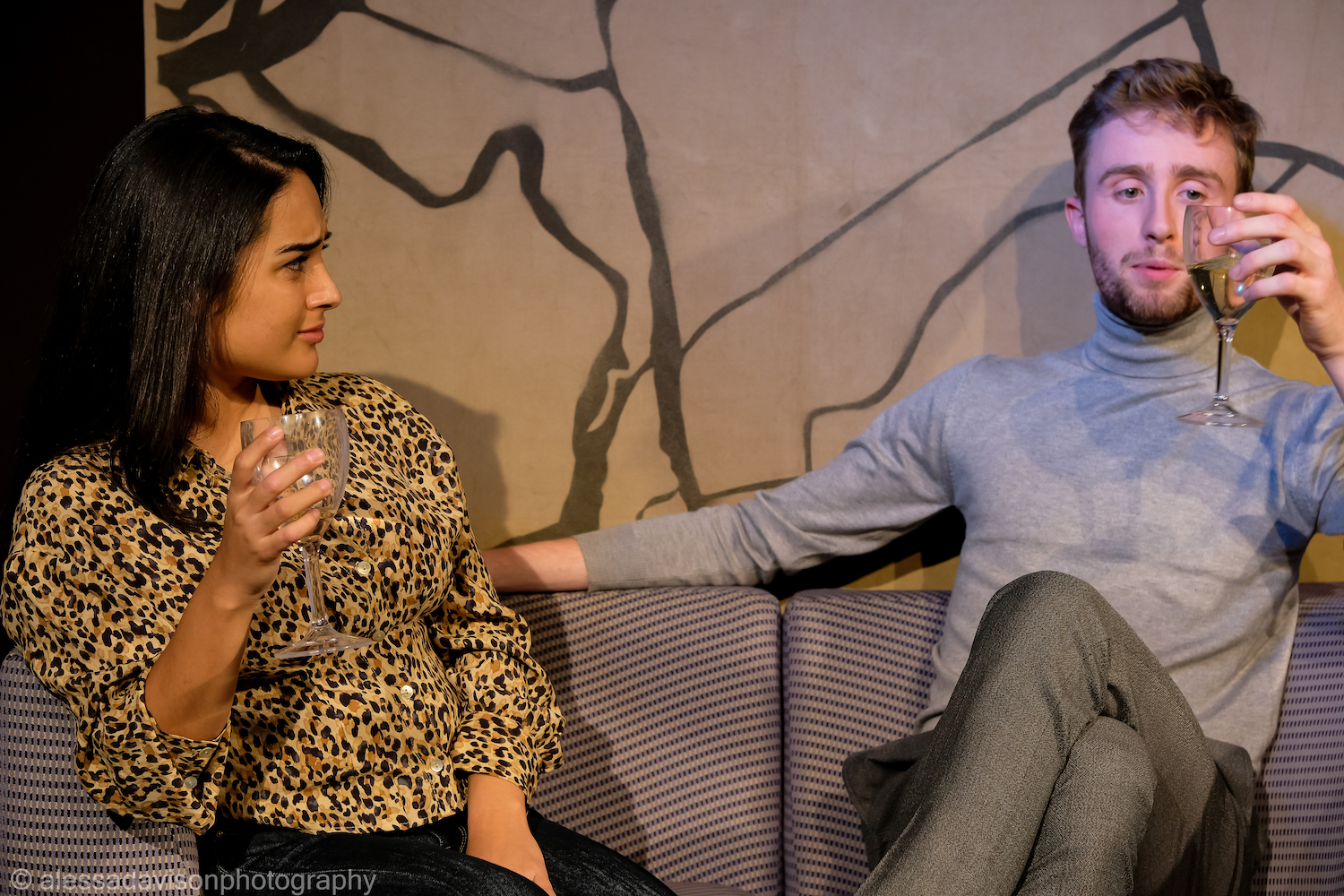
We all like to believe that wealth and success wouldn’t change us, or our relationships with the people closest to us – but how realistic is that when it actually happens? This is the question asked and rather gloomily answered by Hassan Govia’s Boujie, in which entertainment blogger Devin (played by Govia) invites his friends round for Friday night drinks. They’re suitably impressed by his posh new flat, but the evening turns sour thanks to a combination of Devin’s annoying neighbour Giles (Freddy Gaffney), a surprise visit from his sister Giselle (Cristal Cole), and a shock revelation about the true extent of his financial success.

Photo credit: Alessa Davidson

The issues raised by the play are interesting, relevant and well presented, enabling us to see the argument from both sides and exploring the complex psychology behind human beings’ relationship with money and class. Devin feels compelled to keep acting a role that he no longer feels comfortable with just to keep his friends happy, and to conceal his true feelings about the working class background and family he’s left behind. His friends (Natali Servat, Peter Silva and Maria Yarjah) are quite content for him to live in a nice flat all the while they think he can’t really afford it, but take offence when they realise he’s actually done pretty well for himself. But Devin’s not afraid of passing judgment either; having elevated himself, he now feels he has the right to look down on anyone who doesn’t do the same, assuming rather blindly that we must all be motivated by the same ambitions.

As a script, Boujie keeps on giving; the play gives us plenty to think about both in the moment and afterwards as it explores race, class, personal relationships, and how each of us chooses to define our own success. There are, however, moments and details that feel a little contrived, and in trying to cover so much material, the dialogue doesn’t always flow as naturally as you might expect between good friends. The format of the play also includes a number of soliloquies, and while there’s nothing wrong with that – and all are very well performed by a talented cast – as the play goes on it begins to feel a bit more like watching a debate than a social occasion.

The characters are, for the most part, well drawn and we get to know each of them pretty well as the play goes on; in particular, we gain a good understanding of what drives them from a career and financial point of view. The one exception is next door neighbour Giles – despite an enjoyable comedy performance from Freddy Gaffney, his absolute lack of social or cultural awareness (particularly given what we later learn about his relationship status) feels oddly one-dimensional and unrealistic, jarring against the other, far more complex and believable characters.

Photo credit: Alessa Davidson

A rather depressing outlook – despite his success, Devin doesn’t fit in with either his old friends or his new neighbours, and seems doomed to remain alone and miserable like a modern-day Scrooge – is saved by a touching final scene between Devin and his sister Giselle. Of anyone, she has the most reason to be mad at him, and although it feels like her refusal to give up on him may not be entirely selfless, it does at least bring the play to a rather more upbeat conclusion.

Though billed as a comedy, Boujie actually has some quite serious comments to make about how we let money and status dominate our lives, and prompts fewer laughs and more self-reflection than you might expect. It’s not perfect (yet), but this is a promising debut from Hassan Govia and Unshaded Arts, and with a bit of tightening in places it has the potential to make an even more powerful statement.


Can’t see the map on iPhone? Try turning your phone to landscape and that should sort it. I don’t know why but I’m working on it… 😉

Review: Rock of Ages at the Orchard Theatre

Chris D’Arienzo’s 2005 jukebox musical Rock of Ages has a lot going for it: a soundtrack of epic 80s rock classics, a feel-good LA love story, and perhaps most importantly, an absolute refusal to take itself seriously at any point. Add in the universally fantastic cast of Nick Winston’s touring production, and – a little bit of questionable humour aside – you’ve got the recipe for a great show (but maybe leave the kids at home).

Photo credit: The Other Richard

The year is 1987, and wannabe actress Sherrie (Danielle Hope) has just arrived on the Sunset Strip, where she meets wannabe rockstar Drew (Luke Walsh), but their budding romance is endangered when actual rockstar Stacee Jaxx (Sam Ferriday) turns up. One thing leads to another, and as Drew’s getting discovered by a record producer, Sherrie ends up working as a stripper for Justice (Zoe Birkett) at the Venus Club. Meanwhile local legend Dennis Dupree (Kevin Kennedy) must defend his beloved bar from two Germans (Andrew Carthy and Vas Constanti), who want to tear down the Strip and replace it with a Foot Locker – a plan also opposed vehemently by former City Planner Regina (Rhiannon Chesterman). It’s a long and bumpy road, but in the end everyone gets what they want – even if they didn’t know it was what they wanted in the first place.

The story is nothing we haven’t seen plenty of times before, but Rock of Ages realises that and leans into it, understanding that nobody in the audience has bought a ticket for the plot anyway, so why not have some fun with it? Narrator Lonny – in a hilarious, show-stealing performance from Lucas Rush – does exactly that, repeatedly breaking the fourth wall, openly acknowledging the formulaic nature of the story and turning it into a running joke that the audience is more than happy to go along with while we wait for the next rock classic.

And fortunately, we never have long to wait. We Built This City, We’re Not Gonna Take It, I Want to Know What Love Is, Here I Go Again, The Final Countdown, I Can’t Fight This Feeling, Don’t Stop Believing… and so many more hits make it almost impossible to sit still for more than a few minutes at a time. They’re also an excuse for the cast to showcase some sensational vocals; the show has an unusually large quantity of lead characters and without question, every single one of them delivers. Even the numbers that are clearly aiming more for comedy – like Lonny and Dennis’ duet in Act 2, or anything involving the Germans – don’t compromise on vocal quality. Barney Ashworth’s band are similarly excellent, and from a musical point of view, there’s absolutely no doubt that Rock of Ages is a resounding triumph.

Photo credit: The Other Richard

The one area where the show falters a little is in some of the humour, which is not so much offensive as just a bit tired. For instance, it’s never really clear why the two property developers have to be German, except as an excuse to make cheap gags at their expense – and in a script that has so much good stuff going for it in terms of comedy, this doesn’t add anything and feels unnecessary. And yes, I know the show is set in the 80s, but the less said about its portrayal of women, the better. (To quote my friend at the interval, “It’s good, but you can tell it was written by a man.”)

All the same, Rock of Ages does what it sets out to do: it well and truly rocks, and does so in an engagingly self-aware way that some other jukebox musicals could definitely learn a thing or two from. Great fun for a cheesy – and slightly cheeky – night out.