Review: Original Death Rabbit at Jermyn Street Theatre

This week, a teenage girl in the States crashed her car whilst attempting the Bird Box Challenge, prompting the local police to issue a statement begging people not to drive whilst blindfolded. The seventeen-year-old probably thought she would post the video online and bask in the admiration of her followers. Instead, her (unquestionably foolish) actions have made her the target of ridicule and vitriol from total strangers across the globe, the vast majority questioning her right to drive, to reproduce, and even to exist.
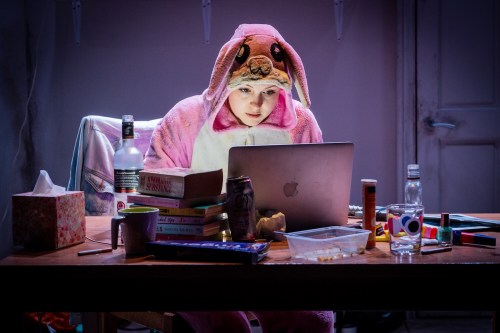
Photo credit: Robert Workman

I was reminded of this story whilst watching Rose Heiney’s Original Death Rabbit, directed by Hannah Joss, in which a young woman (Kimberley Nixon) inadvertently becomes an Internet meme – the Death Rabbit – after being photographed in the background of a child’s funeral procession wearing a pink bunny onesie. Seeking an escape from her own insecurities and the trauma of her father’s recently diagnosed schizophrenia, she throws herself headlong into the world of the Original Death Rabbit, eventually becoming so consumed by her online persona that she begins to lose any sense of her real identity. Now, on the eve of her 32nd birthday, she looks back over her decade of Internet “fame” and reflects on how it’s affected her life, relationships and mental health. More importantly, she sets out to do what the Internet so often fails to do – provide context to explain how she’s ended up where she is.

Kimberley Nixon gives an outstanding performance, commanding our attention and sympathy throughout as she engagingly delivers Rose Heiney’s insightful and witty script. For someone like the Original Death Rabbit, who’s always judged herself on how others perceive her (she was once wracked with guilt after being told by a friend that her favourite poet Philip Larkin was a racist and misogynist, and that by liking him she was aligning herself with his views) the Internet was always going to be a dangerous place, and her obsessive reaction to it is inevitable but also very relatable – whether or not we like to admit it. Anyone who’s ever been active on social media knows the little thrill of seeing a post liked or shared, and the sense of rejection – or worse – when something we’ve said or done online fails to land as we intended. The Original Death Rabbit’s need to be validated by the approval of strangers might be extreme, but it’s also very understandable.

But that’s not all we can relate to. The minute I walked in and saw Louie Whitemore’s set – a cluttered, neglected living room in which the only pristine items are the Richard Curtis movie posters adorning the walls – I had a feeling the play was going to be right up my street, and I wasn’t wrong. The Original Death Rabbit might be flawed but she’s not unlikeable, and our 90 minutes with her are easily as entertaining as they are disturbing. She has a passionate – bordering on aggressive – love for Richard Curtis movies, which gets some of the biggest laughs of the night, along with her sardonic impressions of her whiney younger sister and patronising leftie friend. And her story, though dark, is also enjoyably quirky (let’s be honest, anything involving a pink bunny suit would struggle to be too deadly serious).
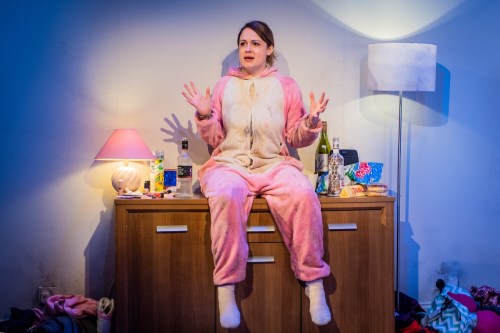
Photo credit: Robert Workman

Funny, sad, brilliantly performed and with a cautionary message that feels more necessary by the day, Original Death Rabbit kicks off Jermyn Street Theatre’s 25th anniversary year in triumphant style. Highly recommended.

Can’t see the map on iPhone? Try turning your phone to landscape and that should sort it. I don’t know why but I’m working on it… 😉

Review: Anomaly at the Old Red Lion Theatre

Liv Warden’s Anomaly begins with an image that’s all too familiar: world-famous movie producer, Phillip Preston, has been arrested for assaulting his wife. With the man himself in custody, as the news breaks across the globe all eyes turn instead on his three daughters. Piper (Natasha Cowley), the clever one, has been destined from a young age to inherit the family business; Penny (Katherine Samuelson), the pretty one, has grown up to become a successful movie actress. And then there’s Polly (Alice Handoll), the problematic one, who’s just discharged herself from the Priory after another stint in rehab.

Photo credit: Headshot Toby

What follows over the next 70 minutes is a gripping and troubling family drama that takes a scenario we know and invites us to see it from a perspective that’s often overlooked. Phillip Preston never appears; nor does his wife Fiona. The only people we see on stage are the three sisters, as each deals in her own way with the fallout from their father’s actions.

What’s interesting about Anomaly is that there’s never a moment of doubt from anyone that Phillip Preston did assault his wife. In fact the sisters have always known what kind of man he is: a violent, unfaithful bully, and perhaps guilty of something even worse. And herein lies the question at the heart of the play: are they victims of his behaviour, or has their silence made them complicit? Even after the scandal breaks, instead of seeing a chance to break free, as Polly does, Penny and Piper’s chief concern is protecting the family brand – but can we really blame them, when their own fortunes are so closely entwined with that of their father that defending themselves inevitably means defending him too?

Adam Small’s production sees all the sisters on stage throughout, despite the three of them never actually being in the same place. At a time when you’d expect any other family to be pulling together, Penny and Piper communicate with each other only in rushed phone calls; Polly, estranged from her sisters, is alone throughout and so the audience become her confidantes. There are also a number of peripheral characters in the play – reporters, partners, friends, board members – but they’re present only as disembodied voices, a clever way to ensure that like the rest of the world, all our attention stays focused relentlessly on the three women.

Fortunately the performances from Natasha Cowley, Katherine Samuelson and Alice Handoll more than stand up to such intense scrutiny. All are totally convincing in their roles, pasting on bright, media-friendly smiles while their eyes and body language tell a very different story. Their interaction with the ongoing barrage of recorded voices is also very natural, to the point that it’s sometimes easy to forget they’re talking to thin air. In fact they’re so compelling to watch that when the play reaches its shock twist ending – a clever and brilliantly staged piece of misdirection – it catches everyone completely off guard.

Photo credit: Headshot Toby

Though generally well written and certainly packing a punch, the play is not without some flaws. The fragmented structure, which jumps from one sister and location to another and back again, can make the timeline of events on occasion a bit hard to follow. There are also a couple of big revelations that, though serious enough to have a devastating impact on the family’s financial fortunes, never seem to get followed up by any of the characters on or off stage.

It’s so easy to assume that when someone like Harvey Weinstein, Kevin Spacey or the fictional Phillip Preston is finally accused and held to account, that it’s the end of the story; the truth is out, justice has been served at last. But men of such wealth and power never fall alone. Anomaly speaks for those caught up in the wreckage, in a topical and important story that needs to be told and deserves to be heard.

Can’t see the map on iPhone? Try turning your phone to landscape and that should sort it. I don’t know why but I’m working on it… 😉

Review: Saturday Night Fever at the Orchard Theatre

There can be few movies more iconic than Saturday Night Fever. Its place in popular culture is so established that even if you’ve never seen the film, you almost certainly still know the music and the dance moves, and you’ve probably performed some version of the latter to the former, most likely at a school disco or cheesy student club night. You also, I’d guess, know that John Travolta is Tony Manero, and like most people, you can’t quite imagine anyone else filling his shiny shoes and sharp white suit.

Photo credit: Pamela Raith

Tony is a young man in 1970s Brooklyn with little to look forward to in life; he still lives at home with his disappointed and unhappily married parents, and works during the week in a local paint store, with no obvious prospect of moving up in the world despite being very good at his job. The one bright spot on the horizon is Saturday nights at local disco 2001 Odyssey, where Tony can do what he loves: dance. When the club announces an upcoming dance contest, he teams up with new love interest Stephanie Mangano (Kate Parr) – funnily enough, the one woman in town who doesn’t want to sleep with him – to claim the prize, and with it her heart.

So given the tough act he has to follow, how does Richard Winsor fare in Bill Kenwright’s stage version? Actually, not bad. He’s got the classic moves and Manero swagger down, and leads the ensemble dance numbers under the 2001 Odyssey mirrorball with the cool confidence of a man who knows all eyes – particularly the female ones – are on him. For Act 1, that’s pretty much all the plot requires, but as events take a darker turn in Act 2 Winsor also shows us glimpses of the vulnerability behind the arrogance, and finally gives us a reason to root for Tony despite his many flaws.

This change in tone is reflected in the show’s other big star attraction: the soundtrack. While Act 1 packs in the legendary disco hits, from Stayin’ Alive to You Should Be Dancing, after the interval the pace slows, with numbers including Too Much Heaven and How Deep Is Your Love (and also Tragedy, during which everyone of a certain age could be seen physically restraining themselves from launching into the Steps dance routine). Almost all the musical numbers are performed by the show’s very own – and very convincing – Bee Gees, Edward Handoll, Alastair Hill and Matt Faull, but every now and again a key character breaks into their own solo, some of which fit what’s happening in the story better than others. Though all the songs are well performed, this lack of consistency in the show’s format jars somewhat, and feels like an unnecessarily confusing distraction.

Photo credit: Pamela Raith

There’s no doubt, however, that the production succeeds 100% in capturing the spirit of disco – from Bill Deamer’s irresistible choreography to Nick Richings’ lighting design and Gary McCann’s set and costumes, which between them bring Odyssey 2001 vividly to life both on stage and off. Because the songs stand alone as hits in their own right, they take centre stage throughout; it’s impossible not to get caught up in the excitement and energy of the group numbers, or to feel a sudden urge to get out on the dance floor yourself. The show does have its flaws, and it might not be the most memorable start to the theatre-going year, but that doesn’t mean you won’t head home with a skip in your step, all the same.

Review: Rumpelstiltskin at Queen Elizabeth Hall, Southbank Centre

Think you know the story of Rumpelstiltskin? Think again. This Christmas, the classic fairy tale gets a distinctly bizarre new look courtesy of Windmill Theatre Company’s Rosemary Myers and Julianne O’Brien. And while there’s a lot to enjoy – plenty of humour, a rocking soundtrack and a strong message, not to mention it looks amazing – the show feels at times like it’s trying too hard to be different, and it loses something in the process.

Photo credit: The Other Richard

In this adaptation, Rumpelstiltskin (Paul Capsis) is a reclusive but brilliant fashion designer, who’s so ugly his staff – a Rat (Alirio Zavarce) and a Crow (Elena Carapetis) – have had to hire a model (Mitchell Butel) to play him in public. When Harriet (Sheridan Harbridge) arrives in the city looking for a job and determined to prove her childhood bullies wrong, Rumpel helps her out – for a price. But then she wants more, and more… and with nothing left to offer, she promises to give up her most precious future possession if she can live happily ever after with the man she thinks is Rumpelstiltskin, despite the fact that means stealing him from her best friend Tootie (Michaela Burger). Soon Harriet has everything she ever wanted – until she gives birth to her first child, and the real Rumpel returns to call in the debt…

There are recognisable elements of the original plot, and the moral of the story (be careful what you wish for) is still there, but otherwise the show veers a little too far from both the source material and format, and as a result it ends up feeling at times unnecessarily complicated, particularly in Act 1. Australian cabaret star Paul Capsis makes an enjoyably eccentric Rumpelstiltskin but he’s not at all villainous, and if anything is actually quite likeable. In contrast, it’s hard to feel much sympathy for selfish, greedy Harriet when her baby’s stolen, given everything she’s done to get to where she is; unlike in the original, she’s almost entirely responsible for her own misery. All this makes it difficult to know who exactly we’re meant to be rooting for throughout the story, and the show’s abrupt, sugar-coated finale – though brilliantly performed by the undisputed star of Act 2, Ezra Juanta – feels both unlikely and a bit unsatisfying for an audience used to seeing a bad guy get their comeuppance.

Photo credit: The Other Richard

Problematic though the content of the show is, there’s no denying that from a design perspective, it’s a triumph. Together, Jonathan Oxlade’s set and Chris Edser’s animations make for some truly magical and slightly mind-bending effects, and everything on stage is so colourful and over the top that it feels like we’ve stepped right into the middle of a cartoon. (The 1960s look does seem a bit out of step with the show’s very modern dialogue and messaging – hashtags, Instagram and the like – but that seems a small price to pay for a production that looks as good as this.)

Rumpelstiltskin only partially succeeds in its ambition to reinvent a classic fairy tale for the 21st century, but though it’s let down by a lack of clarity in the writing, it’s still undeniably good entertainment. A high-energy family show with strong performances and plenty of silliness to appeal to both kids and grown-ups, it makes for a flawed but fun festive outing.

Review: Cinderella: A Fairytale at Brockley Jack Studio Theatre

If you enjoy a good festive fairytale but you’re not a fan of panto, Cinderella: A Fairytale, this year’s Christmas production at the Brockley Jack, offers an excellent alternative. Fairy godmothers and glass slippers are nowhere to be seen in this darkly humorous take on the well-known story – but despite a few grisly moments, there’s still a happy ending and more than enough fun and adventure to send the audience home full of glad tidings and cheer.

Photo credit: Tim Stubbs Hughes

Devised by Sally Cookson, Adam Peck and the original company back in 2011, this Cinderella borrows from the Brothers Grimm version, Aschenputtel, but with a few details tweaked. For starters independent, no-nonsense Ella (Molly Byrne) needs no rescuing; she’s more than able to take care of herself, first encountering the birdwatching prince (Charlie Bateman) in the woods after tricking her stepsiblings into doing her cleaning for her. Instead of stepsisters, this story has a stepsister (Aimee Louise Bevan) and a stepbrother (Joel Black), who may not be ugly but are definitely mean, though still portrayed in a more forgiving light than in most adaptations. The undisputed villain here is Ella’s awful stepmother (Bryan Pilkington), who’s more than prepared to mistreat her own children as well as Ella in order to get what she wants.

In a nod to the panto spirit, the show includes live musical numbers composed by Elliot Clay, and a little bit of harmless audience participation, led by Charlie Bateman as a prince whose social awkwardness actually makes him all the more charming. You won’t be called on to shout “oh no it isn’t” or “he’s behind you”, but it is tempting on more than one occasion to boo Bryan Pilkington’s wicked stepmother. The part of the baddie is very much played for laughs – and very successfully so – but that in no way detracts from the character’s viciousness, particularly in contrast to Pilkington’s other role as Ella’s kindly, mild-mannered father.

The Brockley Jack’s final show of the year is always a festive treat, and the latest offering from Kate Bannister and the team is no exception. While other productions of Cinderella may attempt a lavish Disney-style affair, this one uses the power of imagination to bring the story and its settings to life. The opening sequence charts Ella’s childhood years through some delightfully creative puppetry from Will Pinchin, and the all-important birds, who appear throughout the story as Ella’s friends and helpers, are portrayed using pages from books. Meanwhile Karl Swinyard’s deceptively simple set has a few magical surprises up its sleeve, and sound designer Phil Matejtschuk has rather too much fun with grisly sound effects; we may not see what happens when the meat cleaver comes out, but that doesn’t stop the audience flinching as one each time it finds its target.

Photo credit: Tim Stubbs Hughes

Meat cleavers (and vengeful birds) aside, Cinderella: A Fairytale is feel-good family fun, which discards the predictable cheesiness, chaos and risqué humour traditionally associated with festive shows, while retaining all the humour and entertainment value for audiences of any age. A charming, polished and hugely enjoyable Christmas production, this show is well worth venturing out in the cold to see. Oh yes it is…