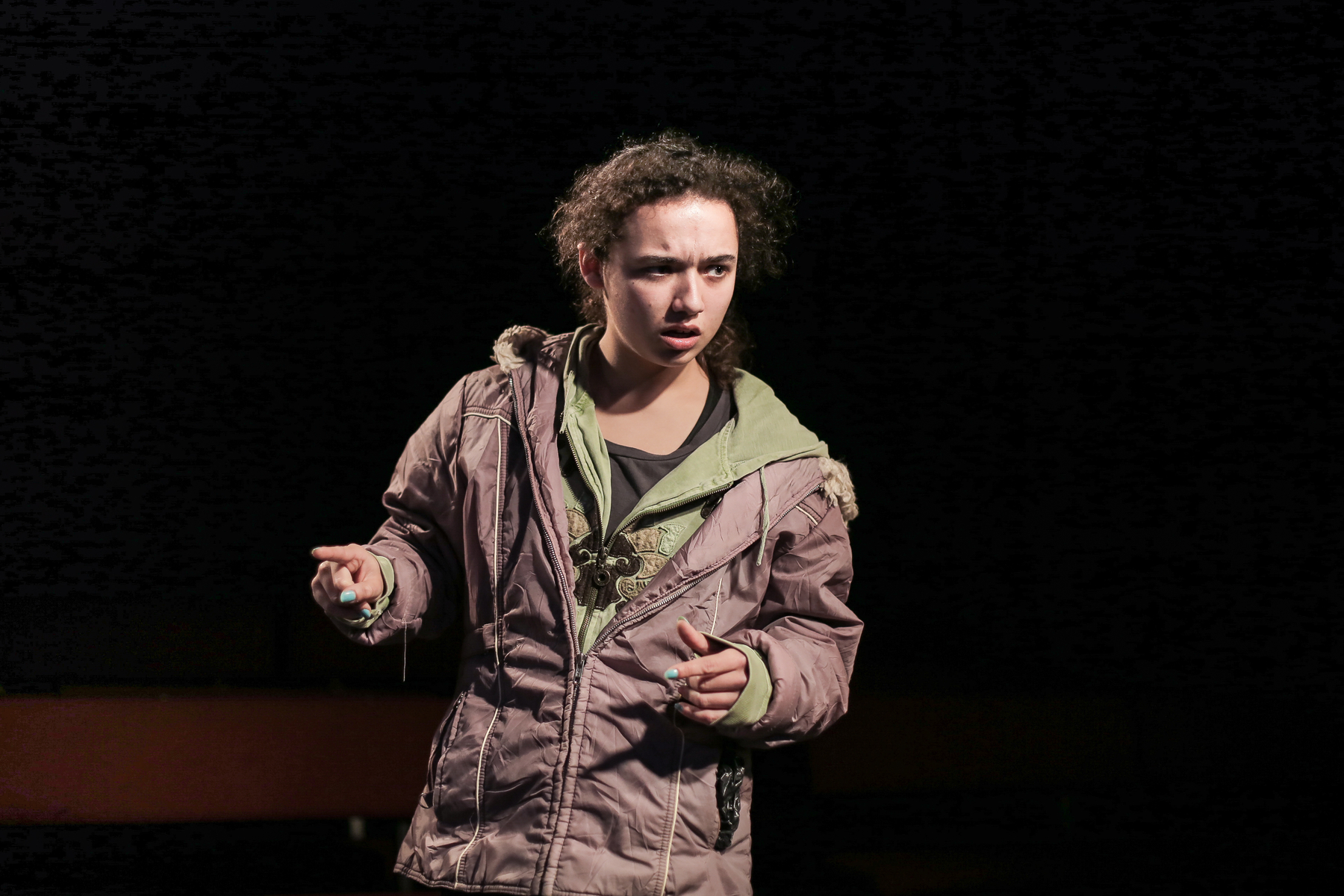
Review: Russian Dolls at King’s Head Theatre

Kate Lock’s Russian Dolls, winner of the 2015 Adrian Pagan award for new writing, brings together two unlikely companions – Hilda, blind, elderly and struggling to maintain her independence, and Camelia, who’s just got out of a young offenders’ institution and wants nothing more than to go back there. When she robs Hilda, a surprising connection is forged, and the two discover that their lives are actually not all that different.

Exploring as it does some difficult themes – abuse, loneliness, gang violence and addiction, among others – it would be easy for the play to become a bleak picture of two isolated souls just trying to survive. And while there’s certainly plenty in Hamish MacDougall’s production to shock and dismay, this brilliant two-hander is far from one-dimensional. Both Hilda and Camelia are strong-willed and proud, and they quite literally speak different languages, so the resulting clash of personalities allows for a good deal of humour alongside some genuinely heart-warming moments.

Russian Dolls at King's Head Theatre
Photo credit: Andreas Grieger
Playing these complex characters are two perfectly cast actresses, who each begin alone on stage with a soliloquy direct to the audience. Stephanie Fayerman’s Hilda is determined and stubborn, refusing to stop living her life or to give up the things she loves, and discussing the sudden total loss of her sight with a levity that only thinly masks her devastation. Meanwhile, Mollie Lambert takes Camelia, a character many would be all too ready to write off as a lost cause, and reveals her to be an affectionate, warm and funny girl, who loves her family and dreams of a better future. Like Hilda, her bravado hides an intense vulnerability, and her ambitions become all the more poignant as she’s inevitably drawn back into the repeating patterns of the world she’s left behind.

Becky-Dee Trevenen’s set takes in the whole width of the intimate space, encompassing Hilda’s front door, living room and kitchen. We never see outside the flat, only hearing second-hand about characters and events, and this heightens the sense of isolation for the two women. In fact the only time the story doesn’t feel completely natural is on the one occasion the outside world briefly enters their safe space, when Camelia arrives home with a gun she’s stolen from her brother and his gang. This results in a mildly chaotic scene in which she runs around the flat behind Hilda’s back, hiding the weapon somewhere new, only to pick it up again moments later and move it somewhere else – and finally putting it back where it was in the first place. When the gun then disappears in the following scene, it feels like a bit of an anticlimax, and we only learn its true significance much later.

Russian Dolls at King's Head Theatre
Photo credit: Andreas Grieger
This thoughtful and moving play ends rather abruptly, with no clear resolution, but still manages to leave us feeling uplifted, despite some of the horrors that take place within it. Camelia and Hilda’s relationship begins as a practical arrangement – Camelia acts as Hilda’s eyes, while Hilda provides the authority and discipline Camelia’s never had from her own mother – but grows into one of genuine affection. This, along with the open-ended final scene, encourages us to go away considering how society needs to change before such stories can possibly have a happy ending.


Can’t see the map on iPhone? Try turning your phone to landscape and that should sort it. I don’t know why but I’m working on it… 😉

Review: Chicago at the Orchard Theatre

Yesterday evening, as my train ground to a halt somewhere outside Lewisham, I sent a little prayer to the train gods (a.k.a. Southeastern) to please sort it out and get me to the theatre on time. Quite apart from the fact that I hate being late for anything – especially the theatre – I was on my way to see Chicago, and I think most people would agree that if you miss the opening number of Chicago, you’ve missed one of the best bits.

Chicago on Tour

Fortunately, the train gods were in a good mood for a change, so I made it to the Orchard in time to sit back, relax and enjoy Kander and Ebb’s classic musical about “murder, greed, corruption, exploitation, adultery and treachery… all those things we hold near and dear to our hearts”. Set in the 1920s, Chicago is a darkly satirical story based on a play by Maurine Watkins (which in turn was inspired by real events). Wannabe star Roxie Hart murders her lover and ends up in prison alongside singer Velma Kelly, accused of killing her husband and sister. But when they both hire slick lawyer Billy Flynn, the women soon realise that innocence and guilt mean very little in the courts of Chicago, and that it’s the media, not the jury, that they need to win over.

With a minimalist set – the only props are a few chairs and a couple of ladders – and no need for any significant costume changes, all our attention is focused on the cast and their performances, and they don’t disappoint. This particular revival, the latest of many, features a star turn from Hayley Tamaddon as Roxie, while Sophie Carmen-Jones – who doesn’t get her name on the posters, but really should – razzle dazzles as queen bee Velma. Sam Bailey also stands out as Mama Morton; she’s a convincing figure of authority, but with a note of genuine affection for the women in her charge – and . And John Partridge is all charm and fancy footwork as Billy Flynn – though his vocals are noticeably less strong than those of his co-stars, this didn’t seem to dent the audience’s enthusiasm at the end of each number.

This could be because what makes Chicago such a fantastic show is the music – provided by Ben Atkinson’s enthusiastic orchestra, who are on stage throughout – and the Fosse-inspired choreography from Anne Reinking. These are the kinds of spectacular numbers that would glaringly expose any mistakes, but the cast don’t put a foot wrong; they’re perfectly in sync and working as one throughout – never more so than in the Press Conference Rag, which, along with All That Jazz, is one of the highlights of the show. That said, I really can’t pick a favourite song; they’re all so infectious and it’s no wonder the entire cast look like they’re having the time of their lives.

There’s a reason Chicago’s been a hit with audiences since its premiere in 1975: it’s slick, sexy (did I mention the ridiculously attractive cast?) and oh so stylish, with a satirical humour that makes for some great one-liners, but also makes a serious – and still relevant – point about the damaging and seemingly limitless power of the media to influence public opinion. Add to that the timeless score and slick choreography, and I’ve no doubt this show will be entertaining us for many years to come.

Chicago is at the Orchard Theatre until Saturday 5th March.

Review: Dress Rehearsal at OSO Arts Centre

It’s an intriguing premise – a ‘play with opera’, following a group of performers both on and offstage, and giving us a glimpse at what goes on behind the scenes. And for the Overtones, it’s not a pretty sight; the air in their dressing room is heavy with bitterness, resentment and sadness over opportunities lost. As diva Bella (Amanda Wagg) and young newcomer Kit (Luke Farrugia) vie for the limelight, Steph (Alexandra Cowell) and Lionel (Tony Baker) are left to reflect on what might have been, and the group’s enthusiastic and talented pianist Phyllis (Karen Newby) – who’s secretly a bit of a rockstar – is completely overlooked by everyone.

Photo credit: Scott Rylander

Meanwhile, in the foreground, another story is unfolding – the story of a younger Steph (Chiara Vinci) and her romance with Micky (James Richards), a stand-up comedian on the verge of fame and fortune. As the truth about her past is gradually revealed, we begin to understand how Steph’s ended up as Bella’s backing singer, when she could have been so much more.

There’s a lot to like about the play, which is directed by Paola Cuffolo – not least the idea itself, which is original and full of comic potential. There are some lovely moments when, just like in an opera, the actors express a world of emotion without saying (or singing) a word, and it’s a nice touch to have AJ MacGillivray, who plays agent Zeno (agent as in talent, not secret, just to be clear), sitting in the audience to enjoy the show before suddenly making himself known to the performers.

Though the story is touching, and the characters are entertaining to watch, there are some frustrating plot holes which meant I found myself on the train home repeatedly thinking, ‘But what about…?’ There’s an allusion to a scandalous secret involving Kit’s mother, but we never get any further details; the same goes for Bella’s broken marriage, and Lionel’s story is summed up in just a couple of lines. Likewise we never really know what made young Steph decide to run out on her wedding, or how Micky declined in the intervening years to the shambling, broken figure we see in the second act (or even how many years it’s supposed to be). And then the play ends, with every character deep in thought but very little resolved.

Of course it’s not always necessary to wrap everything up, and the writer herself freely admits that it’s her goal to leave the audience with questions, but personally I would have enjoyed a little bit more background to help me really get invested in the characters, so I could share their triumphs and disappointments.

Photo credit: Scott Rylander

The cast are talented and enthusiastic, especially in the musical numbers; Luke Farrugia is particularly memorable as the young, arrogant Kit, who likes to show off by spontaneously updating the lyrics to some of the most popular opera classics, and Chiara Vinci balances her primarily speaking role with two show-stopping performances of songs by Gilbert and Sullivan. When it comes to silent acting, though, it’s Alexandra Cowell who stands out as Steph; in one scene, she watches her younger self performing with an expression of such longing that it’s genuinely quite heartbreaking.

Dress Rehearsal is a clever and original concept, with some strong vocal performances and an enjoyable repertoire of opera favourites. With a bit more character and plot development, it has the potential to be something special.


Can’t see the map on iPhone? Try turning your phone to landscape and that should sort it. I don’t know why but I’m working on it… 😉

Review: To She Or Not To She at Lyric Hammersmith

About ten months ago, I was at a scratch night at Morley College, where I watched the first fifteen minutes of a very funny one-woman show about a teenage girl who wants to be Hamlet in her school play, but is devastated to see the role going to an inferior actor – who just happens to be a boy.

Five months later, I was back at Morley to review the full show before it went up to Edinburgh, and was surprised by the direction it had taken. Instead of a riotous comedy about a woman playing Shakespeare’s men, the piece had developed into an honest and brave (but still funny) account of the difficulties faced by female actors in the theatre industry through one woman’s personal experience.

Last night, Joue le Genre‘s To She Or Not To She was back in London, playing to a sell-out crowd as part of Evolution at the Lyric Hammersmith, and I was keen to see how it had developed both during the Edinburgh run and since, under its new director Katharina Reinthaller.

To She Or Not To She, Joue le Genre

To She Or Not To She is the story of actor Emma Bentley, who plays various versions of herself at ages 14, 19, 23 and 24, as well as a host of other colourful characters from her past. Emma’s a natural comedian, and has no problem with joining the audience in laughing at herself – although even she seemed taken aback last night at how popular some of her one-liners were. Much of these are in-jokes for either the theatre crowd or the women in the audience, but none are so specialist that they can’t be appreciated by anyone who doesn’t fall into one of those categories.

Emma’s confident, natural performance and openness about her own shortcomings and disappointments – as an actor and a woman – mean that by the time we arrive at the serious heart of the show, the audience is fully invested and willing to listen, not just to Emma’s story but also to the other female actors who’ve supplied verbatim accounts of their experiences in the industry, for a scene that marks the show’s turning point from pure comedy to something much darker.

Under its new director, To She Or Not To She has been reworked – so gone is the record player that used to open the show, and instead we see Emma indulging in a bit of secret Shakespeare fangirling whilst mopping floors at the coffee shop where she works to pay the bills. This, it turns out, is the present day, and acts as a sobering backdrop to the younger Emma’s optimism as she chats excitedly to the audience about her future prospects.

It’s a privilege to have seen To She Or Not To She develop from its very early days into the show it is now – one that’s really fun to watch, but also has a clear and powerful political message. At a time when equality in acting is a hotly debated issue, it’s also very timely, and while Emma herself recognises that her own disappointments may not be the most shocking or serious, they nonetheless pave the way for an important discussion that needs to take place.


Can’t see the map on iPhone? Try turning your phone to landscape and that should sort it. I don’t know why but I’m working on it… 😉

Interview: Emma Bentley, To She Or Not To She

One of the first shows I reviewed for LondonTheatre1 was a scratch night at Morley College. The five companies performing were all preparing their work for Edinburgh, and competing for rehearsal space and the opportunity to return to Morley for a full-length performance before heading to Scotland.

My personal favourite – and the ultimate winner – was a one-woman show by Emma Bentley of Joue le Genre, called To She Or Not To She, about the challenges faced by women in the acting industry.

After a successful run in Edinburgh, Joue le Genre are now preparing to bring To She Or Not To She to Evolution at the Lyric Hammersmith on 23rd January. I was really excited to see it’s coming back down south, and got in touch with Emma, who was lovely enough to talk to me about the show. Thanks Emma! 🙂

What inspired you to write To She Or Not To She?

Both me and Holly Robinson, who co-wrote the show and directed the Edinburgh version, wanted to stick the finger up to casting directors/writers/directors putting women in shit roles. And in doing so write something ourselves where we could reclaim this exciting idea of getting to do whatever you want and not being judged for it.

Shakespeare at drama school had been a really wonderful experience because I had got to play a load of men: Feste in Twelfth Night and Angelo in Comedy of Errors. Not the big dogs like Macbeth or Richard III or anything but it was good fun. And with Feste in particular, it was refreshing to play a character whose relationship with the other characters in the play was not focused on romance and/or sex. I wanted to continue playing roles like this and exploring Shakepeare’s men. Luckily I started doing some work with Smooth Faced Gentlemen, the all female Shakespeare company based at the Greenwich Theatre, so I did get to play a murderer in Macbeth. Working with SFG made me want to write it even more.

Sophie Wu is Minging She Looks like She’s Dead and La Merda, both at Soho Theatre, were two shows that inspired the style of the show for me.

And then one of my teachers from LIPA, Gillian Lemon would always say, ‘What are you gonna do Emma? Just sit around on your arse waiting for the phone to ring? You’ve got to make your own work!’ So I had her very stern Northern Irish voice egging me on too.

Can you sum up the show in one sentence?

Shakespeare’s biggest fangirl falls in and out of love with the Bard and the acting industry, whilst growing into a young woman of no fame or fortune (yet) but some comedy potential.
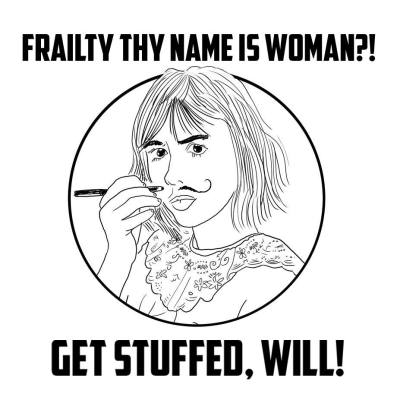
To She Or Not To She, Joue le Genre

You’re playing yourself – how close is show Emma to real Emma?

I’ve been working quite a bit on distinguishing the different Emmas within the show with Katharina Reinthaller, who is directing the show for its Lyric reincarnation. There are four different Emmas in total, you meet her (me) at 14,19, 23 and then there is also ‘Show Emma’, which is me on stage right now talking to the audience, trying to be as honest as possible.

The other Emmas are a bit of twist on the truth. I like to think 14-year-old Emma is a little more embarrassing than me actually as a teenager but I’m sure my friends would beg to differ.

Emma at drama school is probably a little more hopeful and bouncy than I really was at LIPA, I feel like I took everything quite seriously.

How has the show developed since you first wrote it?

The show has gone through 10,289 drafts. Or something like that. It’s changed a lot. Even in the last few days there are things where we say, do we really need this? And that’s just script wise, then there are lots of physical and spacial changes that we decide on with every rehearsal. The cynical voice of ‘Show Emma’ has definitely manifested herself a little more for this run of the show. And because we’re in a bigger space than Edinburgh at the Lyric there is more physicality to it. I’m going to push over a chair whilst standing on it at one point which I’m very excited about – I get to have my Frantic Assembly moment.

Has it taken any unexpected directions?

Originally I thought the show was going to be me playing a variety of Shakespeare’s men. Then, one day when I was showing Holly a scene for a scratch night I had written, where I played Hamlet on a tinder date (which sounded hilarious to me), she said to me why don’t we just write a play about you? Why don’t we write your story so far of wanting to play Shakespeare’s men? Then you can play a load of men, but also a load of women and yourself. With some made up bits of course to make it more Shakespearean. I’m not a very private person anyway, so I didn’t find it shocking or anything writing my story to share, but I guess I just never thought of it being dramatic. It turns out stick a few gags in and a bit of lighting and you’ve got a show.

What’s been the highlight so far?

In Edinburgh there was a girl who came to see the show, who sat on the front row and who had come up to do a production of Comedy of Errors. In the preshow I played Shakespeare Top Trumps with someone from the audience, so I spotted her and asked, ‘do you wanna play Shakespeare Top Trumps with me?’ She looked at me and was just like ‘YEAH’. That was a good show.

Aaaand getting to be a part of Evolution at the Lyric. I used to work in the café. Now I’m getting to perform my play there. I like the old-fashionedness of it – a feeling of working your way up by getting to know people. Makes you feel part of a theatre family somewhere.

And finally… if you could play any Shakespeare role, which one would it be?

Hammmm ….

Catch To She Or Not To She at the Lyric Hammersmith on Saturday 23rd January at 8.45pm.

@tosheornottoshe
facebook/jouelegenre