Interview: Owen Calvert-Lyons, Ovalhouse

Owen Calvert-Lyons was recently appointed as the new Head of Theatre and Artists’ Development at Ovalhouse Theatre in South London. The former artistic director of The Point and The Berry theatres in Hampshire joins the Ovalhouse team as they prepare to move to a new home in Brixton in 2019.

Owen Calvert-Lyons

So what does a Head of Theatre and Artists’ Development actually do? “My role is to ensure that art and artists are at the centre of everything that we do,” explains Owen. “I want to give a voice to a new generation of artists, particularly those from South East London. I will programme the mainhouse (Downstairs) and studio (Upstairs) theatres, commission artists to create new works and I’ll build an artist development programme which supports, nurtures and champions artists.

“My first season of programming will be Spring 2017, which will see a really exciting mix of new and familiar artists presenting bold and innovative productions. Before that, in July we have Seiriol Davies’ How to Win Against History, which is a hilarious, anarchic new musical.”

The new Head of Theatre is full of plans for audiences and artists alike: “I want to grow our audiences. I want people from across London to see Ovalhouse as a place that they can come to enjoy performances by the most exciting artists around.

“And I want us to be an artist’s first port of call when they have a great idea. A place where they can make their vision a reality. Ultimately, artists want to create great work and audiences want to see great work. We are creating an environment in which artists and audiences can come together to explore new ideas.

“Ovalhouse is a special venue, with a long history of radicalism. This has meant something different for every decade: feminist theatre, LGBT theatre, political theatre, performance as protest etc. This has meant that Ovalhouse has been a space for new ideas and new voices, which is always where the most exciting work comes from. We are in the process of defining what we think radicalism means for 21st century artists and audiences.”

Owen joins fellow new recruits Stella Kanu (Executive Producer) and Gary Johnson (General Manager) at a huge moment in the theatre’s history, as plans get underway for the move to Brixton: “Stella and Gary are great. They are bringing new ideas and new ways of working. This has engendered a feeling of energy and optimism amongst the whole team, so that we are all working together to ensure that Ovalhouse has a really exciting future.

“The whole team is bubbling with excitement about the move. The new venue will be right in the heart of Brixton. One of the things that makes it distinctive is that it will have seven rehearsal rooms, so it will be a creation centre full of artists making extraordinary things.

“Many of the spaces will be rigged for aerial work, so we will be able to support the development of contemporary circus as well as theatre and dance. The two new performance spaces will be bigger than the existing Ovalhouse studios and better equipped, so we can make even more exciting work for even bigger audiences.” 

Find out more about How To Win Against History, and see what else is coming up in the Ovalhouse Spring/Summer 2016 season at www.ovalhouse.com.

Interview: Teresa Burns, How It Ended

“The little gardener worked very hard but he was just too little to make a difference. One night, he makes a wish ‘for a little bit of help’ and as he sleeps the local children, inspired by his beautiful flower, help bring his garden to life.”

Photo credit: Eva Sampson

So begins the story of Emily Hughes’ The Little Gardener, adapted by How It Ended, in association with Scamp Theatre. Dramaturg and co-artistic director Teresa Burns explains what drew the company to the story:

“We’re big fans of Emily Hughes so we were very excited about the book’s release last year. The Little Gardener felt like perfect subject material for adaptation, particularly outdoor theatre – not only because of its setting but because of its message about community. The story beautifully illustrates the impact an act of kindness can make on a person’s life and how it can inspire them to carry on.

We’d love our audiences to take away a sense of community; a feeling that by working together you can make something really special.”

The play, which is currently touring and free to attend, is set in a greenhouse, containing a real garden. “The greenhouse is interactive in the sense that it can be opened up to allow children inside. Inside the greenhouse sits a large tree (wherein the Little Gardener sleeps) and flower beds – ready for planting! The set is designed and built by James Lewis, who’s done a remarkable job. The set breaks down into 28 pieces and we tour with over 100 flowers.”

Photo credit: Rachel Ferriman

It’s not the company’s first collaboration with author Emily Hughes. “Last year, we worked with Emily on the stage adaptation of her debut book Wild and we conducted a really successful period of research and development.  We’re hoping to bring Wild to theatres in 2017.

“Emily is such a joy to work with. From day one she has been so warm and encouraging. She isn’t precious about her work and pushes us to delve deeper or go darker, which is really freeing.” 

The fact that The Little Gardener is an interactive show does bring with it an element of unpredictability: “Every audience is different, so we’ve tried our best to prepare for every perceivable eventuality. But of course audiences will always surprise you! Some children are very comfortable with handling plants and getting their hands dirty, whilst others are understandably more hesitant, so it’s about making those children feel at ease. For each performance we have a lovely team of Production Assistants/Gardeners who are there to make sure the audience are happy.”

How It Ended’s goal is to excite young audiences and inspire the next generation of theatre makers. The honesty and responsiveness of children is fantastic. They certainly let you know how they feel about the show whether it be positive or negative – you know where you stand! But making work for young children is boundlessly rewarding, they give back in ways older audiences don’t.

“When we opened the show last week at The Lyric we had lots of children linger around the greenhouse with their parents after the show. They wanted to make comments on the show and ask questions about the flowers and the greenhouse – which was wonderful. It’s great to see them discussing the show, as it hopefully challenges their expectations of what theatre can be.”

Photo credit: Eva Sampson

Catch The Little Gardener at Greenwich and Docklands International Festival (25th – 26th June), Watford Palace Theatre (2nd – 3rd July), Latitude Festival (17th July) and Stockwood Discovery Centre (29th – 30th July). All performances are free to attend and are non-ticketed. Ages 3+.

Review: A Subject of Scandal and Concern at Finborough Theatre

John Osborne’s A Subject of Scandal and Concern was written in 1960 as a TV drama starring Richard Burton. Now adapted by Jimmy Walters of Proud Haddock, the play gets its long-awaited London debut in the intimate setting of the Finborough Theatre.

Based on true events, A Subject of Scandal and Concern tells the story of George Jacob Holyoake, the last man to stand trial for blasphemy in England. On his way from Birmingham to Bristol in 1842, the young teacher stops in Cheltenham to give a lecture, where his determination to speak his mind will prove to be his downfall. Despite the efforts of a parade of lawyers, journalists and churchmen to break him, however, Holyoake maintains a steadfast resistance, even when it ends up costing him everything.

Photo credit: Samuel Taylor

Jamie Muscato gives a riveting performance as the unfortunate Holyoake, an unassuming figure who overcomes a severe stammer to make his case with passion and conviction. It’s a testament to Muscato’s presence and performance that even during his lengthy courtroom speech, we still hang on his every word. He’s joined by a versatile cast of five, who take on a multitude of roles; Edmund Digby-Jones impresses with an astonishingly fast and fluent delivery of the indictment against Holyoake, while Doron Davidson plays no less than five characters, each with a different accent and personality.

In addition to playing multiple roles within the story, the cast also constantly rearrange the simple wooden frames that make up Philip Lindley’s set, to become a jail cell, a courtroom, a kitchen and, most memorably, the ever-changing road from Birmingham to Bristol. There’s something almost mesmerising about the graceful movement of the actors as they move the pieces around, and it gives the play a dynamic feel, as if it’s taking place on a much larger stage.

Photo credit: Samuel Taylor
 Much like its title, A Subject of Scandal and Concern is a very wordy play; it’s worth getting hold of a copy of the play text to read through afterwards if you can. But what could have been a pretty heavy hour is broken up by moments of humour, and a vein of quiet sarcasm runs throughout the play. The authority figures ranged against Holyoake are all faintly ridiculous, but there’s a note of censure against the protagonist too, particularly towards the end of the play. As explained by the narrator in his closing lines, the play doesn’t seek to provide answers; this is not a story with a moral, and we must draw our own conclusions. Nonetheless, this is a fascinating tale, which still resonates today in its references to freedom of speech and the influence of religion in everyday life. This buried treasure has finally seen the light of day, and it was well worth the wait.


Can’t see the map on iPhone? Try turning your phone to landscape and that should sort it. I don’t know why but I’m working on it… 😉

What qualifies someone to write about theatre?

Earlier today, an article was published by The Stage in which producer Danielle Tarento was quoted as saying of theatre bloggers, “This is a massive generalisation, but a lot of people are not ‘proper writers’. They do not have the intellectual background or historical background or time to know what they are writing about.”

And then Twitter exploded.

My natural instinct is always to give people the benefit of the doubt in cases like this, ever since I was 18 and the local paper quoted me as saying my A-Levels had been easy (definitely not what I said) – so I naturally assumed the quote had been taken out of context. And there’s a good chance it was, particularly since in the same breath Danielle Tarento acknowledges the massive role bloggers play in spreading the word to a wider audience.

But that hasn’t stopped people getting upset about it, and the fact that the article was published at all seems like as good a reason as any to pause and ask: what qualifies someone to write about theatre?

I don’t come from a writing background, as evidenced by the noticeable absence of the novel I’ve been trying to write for years. I don’t come from a performance background either, unless you count a few appearances in school nativity plays and a brief spell in a drama group which I’m pretty sure only ever managed one production (I can’t remember what it was; all I know is we all said, “He’s not there!” a lot, and I was supposed to have a German accent). This worries me, because in addition to all the professional critics out there, it often feels like most other theatre bloggers are either students or practitioners of theatre. This, in my head, means they must know a lot more about the subject than I do, so I’m at a double disadvantage before I’ve even started.

I fell into theatre blogging totally by accident – it began as an occasional topic on a blog about stuff that makes me happy, and grew from there. Next thing I knew, I was reviewing regularly for three other sites, and eventually decided it was about time I started a specialist theatre blog of my own. And here we are.

IMG_1107 copy

150(ish) reviews later, here are a few things I know:

– Like most theatre bloggers, I’ve been going to the theatre my whole life, which means I have 30 years of experience as an audience member. True, I’ve only been reviewing for just over a year, and I’m too scared to look back at some of my early reviews because I’m sure they were very, very bad. But the only way to improve is to keep trying, and I like to think I’ve got at least a bit better over the past 12 months.

– Like most theatre bloggers, I have a full-time job to pay the bills. So I don’t have a lot of free time to work on reviews… but I make time. I stay up late, I use my lunch break and my commute, and the other day I sat in a restaurant with my family and ignored them all for a good five or ten minutes while I finished up a review – which I later rewrote because I hated the thought that I’d rushed it and not done a good job.

– Like most theatre bloggers, I don’t review because someone’s paying me. I do it because I want to; because I want to support theatre and share something I love with others. (Although if anyone wants to pay me, that’s totally okay. Just putting it out there.)

– Like most theatre bloggers, I sometimes worry my reviews aren’t intellectual enough, or that I’m somehow “doing it wrong”. But then I remember I’m not writing an academic essay; I’m writing for people like me, who enjoy a good show and might want to go and see something they may otherwise not have heard about. And it’s my blog, so as long as the review is honest and accurate, I can’t really mess it up.

So, what qualifies someone to write about theatre? Personally, I think passion, dedication and having an opinion are worth a lot more than using big words or having every comma in the right place (which is saying something, because I really care about correct punctuation). And if today is anything to go by, the theatre blogging community is overflowing with all these things.

The battle between bloggers and critics is, apparently, an endless one. It raises its head regularly, usually on Twitter, and everyone gets outraged every time. It is unfair to make the sweeping statement that bloggers aren’t proper writers, especially since some of us only plucked up the courage to start applying that label to ourselves very recently. But actions speak louder than words (or should that be words speak louder than tweets…? I don’t know), so let’s put our energy into proving our worth, by blogging on with pride, improving and learning as we go, and giving it 100% like we always do.

Review: The Local Stigmatic at the Old Red Lion Theatre

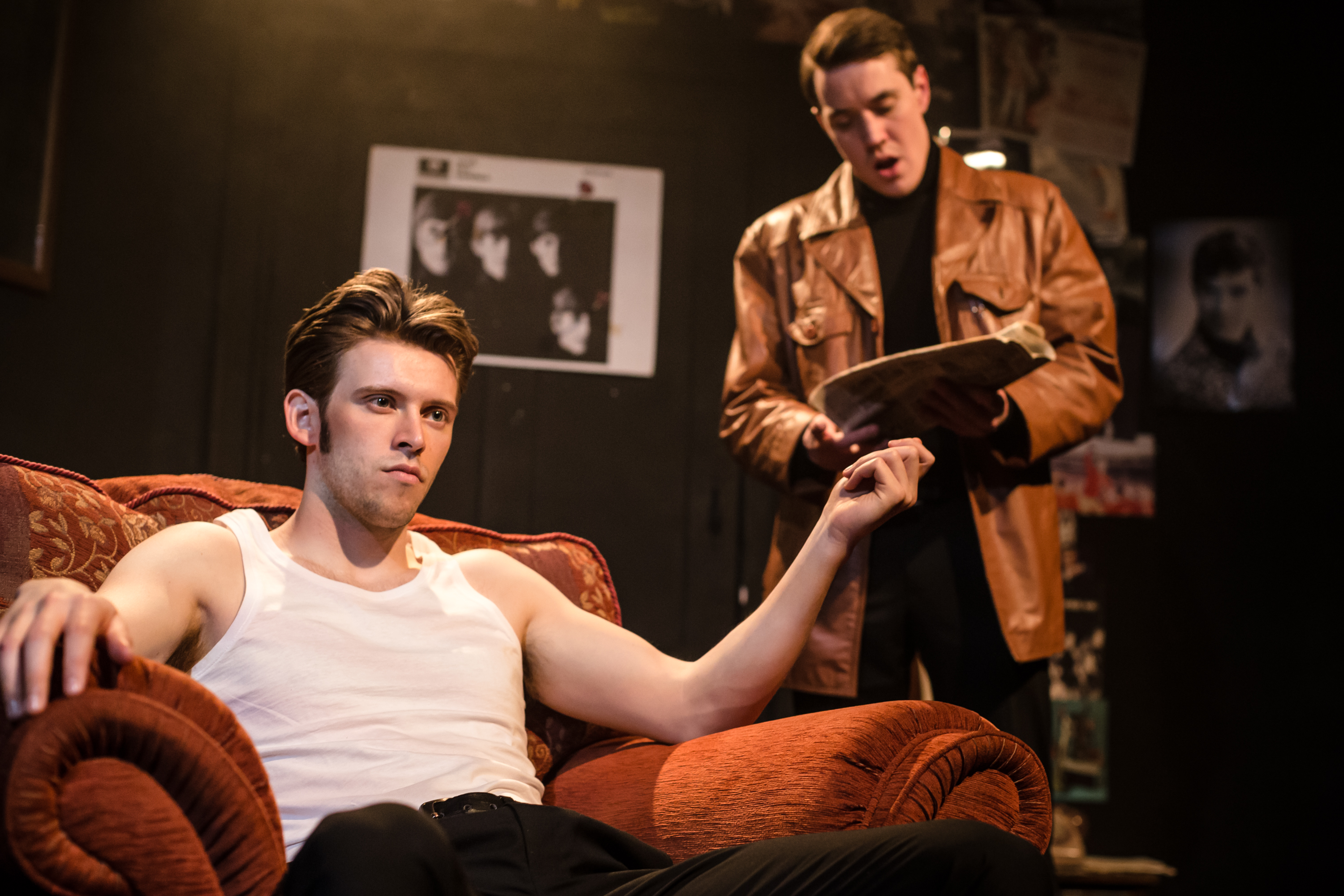
This year sees the 50th anniversary of Heathcote Williams’ The Local Stigmatic, which follows two sociopaths obsessed with celebrity culture. First performed in Edinburgh in 1966, the play was later made into a film starring Al Pacino. Michael Toumey’s new production remains faithful to the 1960s setting in which the play was written, and yet the story still feels chillingly relevant in our modern world of social media and reality TV.

Graham (Wilson James) and Ray (William Frazer) are two friends who spend their time gambling, getting thrown out of pubs and reading newspaper gossip columns. When they bump into David (Tom Sawyer), a slightly famous actor, the two befriend him – but their twisted game takes a sudden, shocking turn, revealing their deep resentment of the celebrities they follow so religiously, and the depths to which they’re willing to go to prove their own superiority.

Photo credit: Scott Rylander

Wilson James and William Frazer give two unforgettable performances as Graham and Ray, subtly highlighting the differences in their personalities. Graham is the undoubted leader; his wide-eyed, unblinking stare (which he occasionally fixes on terrified audience members) gives the impression of a man on the brink of madness, and yet we soon discover beneath it all he’s always in control, choosing and pronouncing his words carefully to manipulate those around him.

Ray, on the other hand, is arguably the scarier of the two – though physically much more relaxed, and even occasionally quite funny, he too carries a pent-up rage that occasionally explodes in violence, and his blank-faced subservience to Graham, particularly in the closing minutes of the play, is truly chilling. Tom Sawyer’s David never stands a chance against this pair as, clearly flattered by their attention, he’s led neatly into the trap.

The dialogue is fast-moving and laden with meaning; it’s the sort of script that needs to be heard more than once to catch all the references (it also helps, I think, if you have a little knowledge of dog racing). What is clear is the way phrases are repeated throughout but with shifting significance, as the piece builds towards its shocking conclusion. And it is truly shocking, though not in the way I expected. When you’re braced for blood and gore, the violence initially seems a bit tame… but its power lies in the ability to send our imaginations into overdrive to fill in the gaps.

Photo credit: Scott Rylander

A simple set allows the actors to move easily between home, where celebrity posters adorn the walls, and the outside world, whilst keeping the two distinct. Tom Kitney’s lighting helps create an increasingly tense atmosphere, and sound designer Neil McKeown uses 60s hits to great effect both between and during scenes, to ensure some of the most powerful moments are those where no words are spoken.

The Local Stigmatic is an extreme example, but we only have to look at the increasingly common occurrences of internet trolling, or read the comments on any article in the Daily Mail sidebar, to realise the resentment felt by Graham and Ray towards the rich and famous is still shared by many. And now that we live in a world where we don’t even need to be stalkers to know all about the lives of celebrities we follow – a word used with startling prescience in Williams’ script, written long before Facebook or Twitter had even been dreamed of – this 50-year-old play feels more relevant than ever.


Can’t see the map on iPhone? Try turning your phone to landscape and that should sort it. I don’t know why but I’m working on it… 😉