Review: Window at the Bread and Roses Theatre

In a world of reality TV and social media, it’s all too easy to fall into the habit of obsessively observing other people’s lives, and then comparing them to our own. In Ron Elisha’s Window, this voyeurism reaches new heights when married couple Grace and Jimmy spot their neighbours having sex, seemingly at all hours of the day and night.

It all begins as a bit of slightly naughty fun, even helping to rekindle the dormant sex life of the exhausted new parents. But when Grace falls pregnant with their second child, her interest in the young, beautiful couple across the way – in her mind, an earlier version of herself and Jimmy – starts to develop into an unhealthy obsession that affects her work, health and family life.
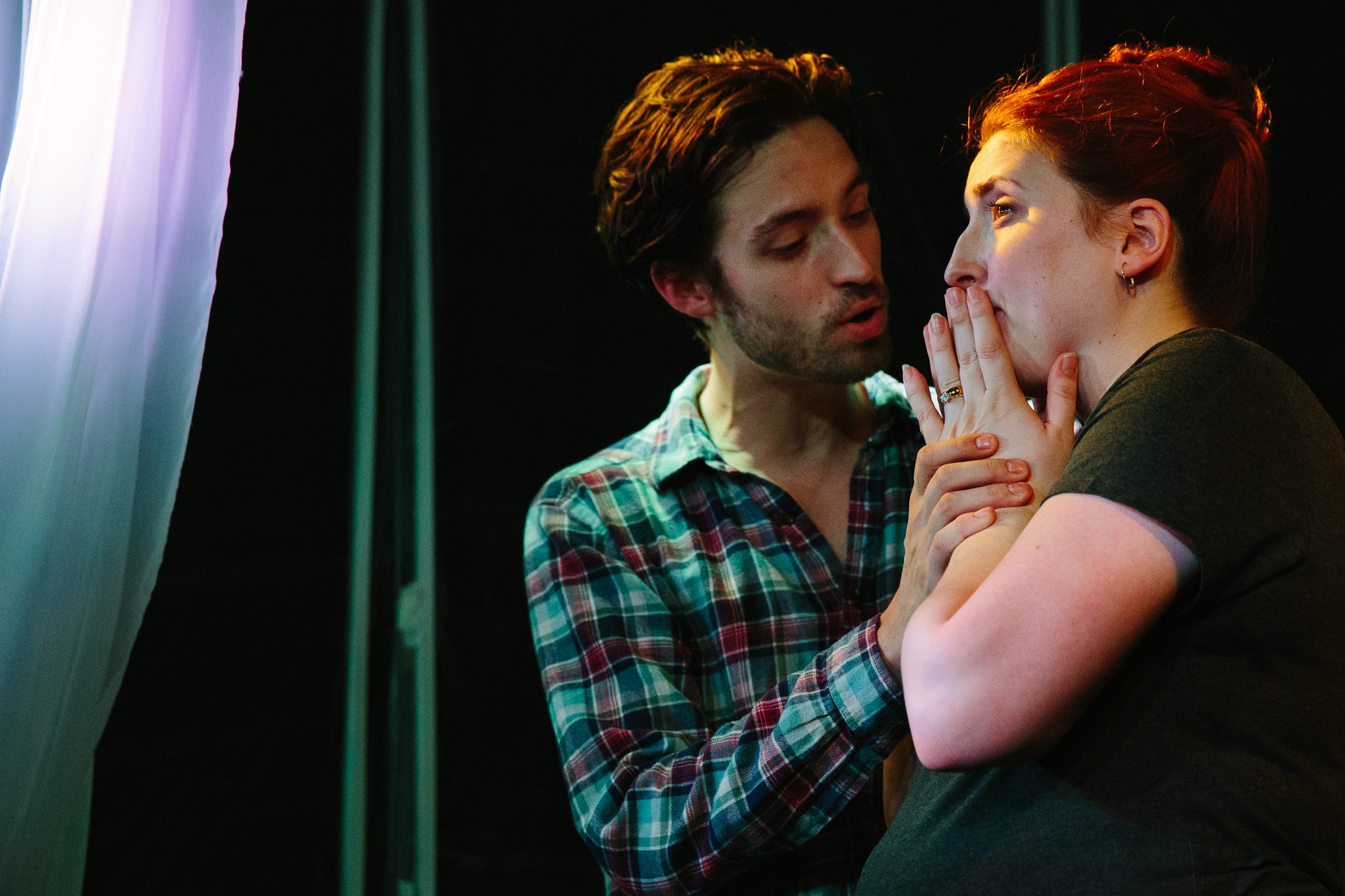
Photo credit: Greg Goodale

The two-hander play deals sensitively with issues of pre- and post-natal depression, with Idgie Beau giving a strong performance as an increasingly distressed Grace. Charles Warner is equally impressive as Jimmy, whose initial amusement soon gives way to concern for the wellbeing of his wife and baby, balanced against his frustration over her neglect of their family. Although there are moments in the story of their relationship that feel unlikely, the actors’ portrayal of it is entirely convincing.

Covering five years without ever leaving the couple’s bedroom, it would have been easy for scenes to run together, but director Dave Spencer breaks up the action with costume changes and brief musical interludes, while references in the script keep us up to speed on how much time has passed. Even so, things do start to slow ever so slightly towards the end, as the subjects of Grace’s obsession go through a personal crisis, and she dissolves again and again into panicked tears on their behalf while Jimmy tries to console her. It’s only when she finally takes action that the cycle is broken, and Grace’s recovery can begin – a moment that’s beautifully played by the actors but in terms of plot development feels a bit too neat, given all that’s gone before.

There are a few other moments where we’re required to suspend our disbelief in order to make the story work: the fact that the neighbours would never, in five years, consider closing the curtains or turning the light off, for instance; or that given the ever more blatant gawking from Grace and Jimmy, who can clearly see every detail, the other couple would never notice them. But that’s what makes the play such a perfect metaphor for social media – by putting our lives on display, we effectively open the curtains and allow anyone to see in. We know they’re there, and we kind of like it that way… but providing others with free access to our everyday lives means they inevitably see the bad as well as the good.

Photo credit: Greg Goodale

The situation in which Grace and Jimmy find themselves is one that the vast majority of us will never need to deal with (or let’s hope not, anyway) – but that doesn’t stop Window being highly relevant to a generation that’s as addicted to sharing as we are to observing. Although it could use a little more pace towards the end, this is an entertaining and unsettling new play that will definitely make you think twice about leaving the curtains open.


Can’t see the map on iPhone? Try turning your phone to landscape and that should sort it. I don’t know why but I’m working on it… 😉

Review: BLUSH at Soho Theatre

We’ve all felt that flush of shame when someone tags us in a terrible photo on Facebook, or we’ve tweeted something and instantly wished we could take it back. But what if it was far worse than an embarrassing selfie or misjudged comment? Sharing isn’t always caring, as we’re about to discover in Charlotte Josephine’s BLUSH, an intense, exhausting and impassioned two-hander.

Directed by Ed Stambollouian, BLUSH delves into the world of social media, with all its practical, social and psychological side effects. We now live in a world where anything we do at any time can be made public, whether by our choice or not. At the same time that world provides sufficient anonymity for people to behave in a way they almost certainly wouldn’t in real life: make vile comments on a video of a teenager that her boyfriend posted as a joke; make public naked selfies that a young woman sent privately through a dating app (and then use them to blackmail her into sending more); make rape threats against a girl on Twitter because she turned down the advances of a man they don’t even know.

Photo Credit: The Other Richard

These are some of the stories told by the three women and two men played by Charlotte Josephine and Daniel Foxsmith in BLUSH; at first in an orderly fashion, taking it in turns to step up and tell their story, the show becomes increasingly frantic and chaotic as it builds to a climax, leaving both actors out of breath and dripping with sweat, and the audience feeling we’ve gone through it all with them.

The script is descriptive and at times verging on poetic (opening with a particularly graphic picture involving 30,000 pairs of eyeballs) without ever feeling forced or inauthentic. And the set is literally that – a film set, surrounded by lights and cameras, with a circular red carpet at the centre that could be interpreted in several ways: the “stage” of a TED speaker trying to reach out to an audience; the record button on a camera; the embarrassed blush of the show’s title; or maybe just a big stop sign.

The presence of a male and female voice means we also get to explore the fascinating and distressing gender imbalance at play. A young male professional on a high-profile business trip gets drunk and tweets about a girl who turned him down, unleashing a torrent of hatred – against her. In response he gets a slap on the wrist and is whisked back home on the next flight. Simultaneously, a young woman whose boyfriend has ghosted her posts explicit images and videos of him on the Internet – but the instant backlash is against her, not him.

Photo Credit: The Other Richard

The play makes no attempt to justify this behaviour on either side, or to suggest answers (though there is a pointed comment at one stage about the ineffectiveness of the law on revenge porn); instead it focuses on making us aware of the dangers lurking and the countless ways both we and those around us can be affected by our widespread need for validation. Importantly, though, BLUSH doesn’t indulge in victim blaming; quite the opposite – it goes out of its way to be clear that the fault lies squarely with those who feel the need to take advantage of others’ vulnerability.

Hard-hitting, complex and hugely topical, at a little over an hour BLUSH feels both mercifully short and not long enough – and certainly makes you think twice about reaching for your phone the moment it’s over.


Can’t see the map on iPhone? Try turning your phone to landscape and that should sort it. I don’t know why but I’m working on it… 😉

Review: Shakespeare Tonight at Theatro Technis

Shakespeare Tonight imagines what would happen if the Bard lived in the era of social media and TV chat shows. And indeed, the man himself is about to appear on one of these shows for the very first time. In a coup for producer Rebekah, one of the most famous men on the planet will be talking live in the studio to bubbly host Martina Fleur about his latest play, Hamlet, which has just opened to mixed reviews.

In a twist, though, Shakespeare won’t be the only guest on the show; he’ll be joined by arch rival Sir Francis Bacon, who – unlike William – is no stranger to the TV cameras. As the flamboyant, smirking Bacon makes himself at home on Martina’s sofa, and Shakespeare does his best to look cool and collected, the stage is set for a spectacular showdown between two great literary minds.

Shakespeare Tonight

There’s lots to enjoy about Shakespeare Tonight; the script, by Paul Wilson and Tim Ferguson is witty, wordy and packed with so many references it almost warrants a return visit to try and catch them all. The only downside to this is that anyone not interested in Shakespeare may get a bit lost (but then again, it’s unlikely they’d go and see a play called Shakespeare Tonight, so moving on…).

The addition of modern culture into the mix is also good fun, tweets from the audience presented with cheeky and irreverent charm by Martina’s warm up and social media guy, the Duke, played by an extremely likeable Paul Obertelli. Francesca Mepham, in contrast, is decidedly unlikeable in her brief but memorable appearance as the sneering bully Rebekah, who’s happy to exploit both host and guests to bring in the viewers and secure a second series. And Kaara Benstead impresses in an even more fleeting yet highly significant role, bringing the show to an emotional end as Shakespeare’s estranged wife, Anne Hathaway.

The main bulk of the show is carried by Priscilla Fere as Martina, Garry Voss as Bacon and Peter Revel-Walsh as Shakespeare, and while there’s clearly no shortage of talent on stage, unfortunately their scenes also expose some flaws in the production. Issues with acoustics mean that much of the script gets lost as actors turn away from the audience, while a few fluffed lines lead to awkward silences that interrupt the flow of the conversation and leave everyone – on stage and off – feeling a bit tense and anxious.

Part of the problem is a lack of context; though I’m not usually an advocate of canned laughter, the studio setting could perhaps benefit from some sound effects to remind us where we are and how the spectators in the room are reacting. (It seems unlikely, for instance, that Jeremy Kyle’s audience would remain silent when one guest is threatening another with a dagger.) It is made clear from the outset that we’re supposed to be the studio audience – but aside from a few occasions when the Duke invites us to applaud, we’re given little indication of what’s expected of us or how involved we’re supposed to get.

This show clearly has a lot of potential, and will I’m sure deliver on its early promise as its week-long run at Theatro Technis continues, and later in the month when it travels to Edinburgh. With an experienced director in David Parry and an undoubtedly talented cast, the problems encountered last night are all very fixable, and shouldn’t detract from what is still an enjoyable evening.


Can’t see the map on iPhone? Try turning your phone to landscape and that should sort it. I don’t know why but I’m working on it… 😉