Review: A Midsummer Night’s Dream at the Marlowe Theatre

In case anyone’s missed it, this year is the 400th anniversary of Shakespeare’s death. To mark the life and achievements of one of our greatest Britons, the RSC has embarked on a massive and daunting task: a new production of A Midsummer Night’s Dream, bringing together an ethnically diverse cast made up of professionals and amateurs to celebrate the universal scope of not only Shakespeare, but theatre in general.

It’s a risky project, fraught with challenges and potential pitfalls, but there’s no sign of nerves from the cast at the Marlowe, which includes members of local group the Canterbury Players and children from King Ethelbert School in Birchington. It seems unfair to label the newcomers ‘amateurs’, though; all take to the stage with such aplomb – in particular Lisa Nightingale, who almost steals the whole show as the RSC’s first ever female Bottom – that you’d think they’ve been performing with the company all their lives.

Photo credit: Topher McGrillis (c) RSC
Director Erica Whyman has set the familiar tale in a crumbling, post-war Britain, a time of hardship but also of hope for a brighter future. As the nation prepares for a royal wedding, four lovers escape into the woods, and a band of amateur actors meet to rehearse a play. But little do they all know they’re entering a world of fairy magic and mischief, and that after this night, their lives will never be the same again. A Midsummer Night’s Dream is one of Shakespeare’s more accessible plays – there’s a reason we all studied it at school – and there’s plenty to enjoy for young and old audience members alike in this chaotic and colourful version.

In an excellent cast, Lucy Ellinson shines with her spiky-haired Puck. Clearly enjoying doing her master’s bidding and causing as much chaos as she can, she covers every inch of Tom Piper’s versatile set (and beyond) with seemingly limitless energy. There’s great physical comedy from the four lovers (Mercy Ojelade, Laura Riseborough, Chris Nayak and Jack Holden) as the men threaten violence and the women actually attempt it – and as Oberon and Titania, Chu Omambala and Ayesha Dharker bring a vibrant party atmosphere to their fairy realm.
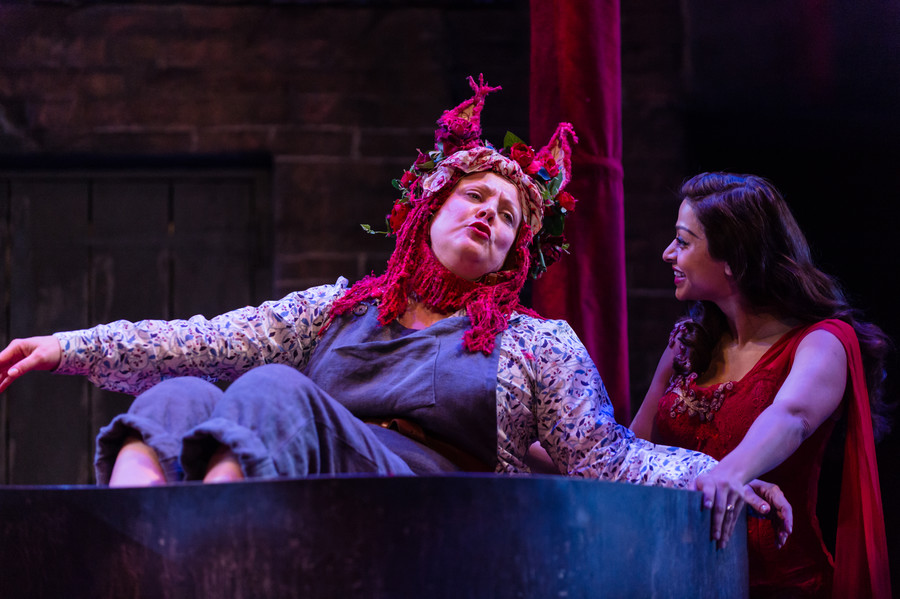
Photo credit: Topher McGrillis (c) RSC
A Midsummer Night’s Dream is a timeless and irresistible story about love, and the things we’re willing to do for it. Whether it’s romantic love, parental love or simply a love for our art, it can lead us into madness – but it can also inspire us to greatness. It’s fair to say there’s more than a hint of madness about the RSC’s epic scheme to create a Play for the Nation… but there’s plenty of greatness too – not just for those of us who already love Shakespeare but, more importantly, for the next generation of theatre lovers. Here’s to another 400 years!

A Midsummer Night’s Dream is at the Marlowe Theatre, Canterbury, until 23rd April.

Review: The Taming of the Shrew at Above the Arts

The Taming of the Shrew is a comedy with a dark heart – a twisted little love story that’s generally considered one of Shakespeare’s most problematic. And for that very reason, it’s also a great candidate for a gender swap experiment. Nowadays, to watch a man attempt to control his wife by a combination of mental and physical torment is called abuse. But do we react the same when it’s a woman in charge, or is that just considered girl power?

Custom/Practice have taken on this question with great enthusiasm in their gender-reversed production of The Taming of the Shrew, the centrepiece of the inaugural Verve Festival at the Arts, celebrating cultural, ethnic and gender diversity in theatre. In this version of the story, the women hold all the power and it’s the men – trussed up in corsets and tottering around in women’s shoes – who must do as they’re told.

5M6A6610

Doing away with the framing story of Christopher Sly, we’re thrown straight into the action. Famously bad-tempered Katherina (Kazeem Tosin Amore) is forced against his will into marrying Petruchio (Martina Laird), who’s more than willing to take on a challenge in exchange for her husband’s generous dowry. This frees his younger brother, the young, handsome Bianca (Tim Bowie), who has plenty of women after him but hasn’t been allowed to marry until Katherina does. As Bianca’s suitors, exchanging increasingly insincere air kisses, battle for his affections, Katherina’s new wife sets out to break his spirit and bring him to heel through a systematic programme of abuse and neglect.

Perhaps surprisingly given the subject matter, this spirited, high-energy production directed by Rae McKen delivers plenty of laughs – not least, dare I say, in the moments when the actors throw Shakespeare’s script out the window and start ad libbing. Brigid Lohrey and Eugenia Caruso make a brilliant comedy duo as Bianca’s bumbling suitors Gremio and Hortensio – think Cinderella’s ugly sisters fighting over Prince Charming – while Kayla Miekle’s Tranio is the ultimate fairy godmother with attitude, and Lorenzo Martelli gets some of the biggest laughs as Petruchio’s long-suffering servant, Grumio.

Meanwhile, Martina Laird gives a captivating performance as Petruchio, at once seductive and tyrannical. Swaggering about the stage, she has a way of directing her asides straight at individual members of the audience that makes us feel somehow complicit in her torture of her husband. And while it’s hard not to laugh at Katherina’s desperate expression as Petruchio launches herself at him, all the time we’re uncomfortably aware that if it were a man behaving this way, we’d probably be appalled instead of amused.

5M6A6849

This is theatre with a dual purpose – to make us laugh, and make us think – and on both fronts, it delivers. In a fast and frantically paced production, the cast never miss a beat, and genuinely seem to be having as much fun as the audience (occasionally more). And while the play’s central theme is always going to be challenging, gender swap or no gender swap, the awkward final scene is softened here by a Beyonce-inspired finale that, much like the rest of the show, is impossible to resist.


Can’t see the map on iPhone? Try turning your phone to landscape and that should sort it. I don’t know why but I’m working on it… 😉

Review: Twelfth Night at French Protestant Church, Soho

Twelfth Night: a story of love, disguise and trickery, where nothing and nobody is quite what they seem. It seems fitting that a play in which appearance versus reality is such a prominent theme should be visually stunning, and Scena Mundi’s adaptation doesn’t disappoint; the French Protestant Church in Soho Square provides a unique and beautiful setting for what proves to be a classy production.

Shipwrecked in Illyria, Viola (Harriet Hare) disguises herself as a boy and gets a job working for the Duke Orsino (Pip Brignall). He sends her with messages of love to Olivia (Emma Hall), who falls instead for Viola – who unfortunately happens to be in love with Orsino. Then Viola’s twin brother Sebastian (Clare Brice) turns up, and everything gets even more confusing, before finally resolving itself in typically neat Shakespearean fashion. Meanwhile, Olivia’s drunken cousin Sir Toby Belch (Jack Christie) is hatching a plot with his friends Maria (Clare Brice again), Sir Andrew Aguecheek (Thomas Winsor) and Fabian (David Keogh) to make a fool of the pompous Malvolio (Martin Prest) by convincing him Olivia’s in love with him. And all this is quietly observed by the Fool, Feste (Edward Fisher) – who, ironically, may just be the wisest man on the stage.

Cecilia Dorland’s production takes as its starting point the vanity and self-obsession of Shakespeare’s characters, and transforms the aisle into a shiny blue catwalk for the play’s fashion show-inspired opening. Though the fashion theme doesn’t explicitly come up again after this scene, it’s present in Georgia Green’s costumes, which are somewhere between contemporary and modern, giving the play – and each character – a unique and timeless style that fits well in the unusual setting.

Photo credit: Jessy Boon Cowler

The cast do a great job of teasing out the complexities and less attractive aspects of their characters, and at the same time revealing the play to be more than a straightforward comedy that’s just out for laughs. Though there are a good number of laughs to be had – Martin Prest in particular gives an outstanding comic performance as Malvolio, with an array of disapproving facial expressions (and a surprising flexibility during the infamous yellow stockings scene), and the scene in which Orsino starts to feel an attraction to Viola in her boy’s disguise is both funny and sweetly touching. On the other hand, the later confusion between Viola and Sebastian falls a little bit flat, possibly because the two actors playing the twins look nothing alike.

While Malvolio is easy to laugh at because he’s so consistently unpleasant, there are other characters who turn unexpectedly to the dark side, and it’s these performances that prove most memorable. Sir Toby, played by Jack Christie, seems at first to be a loveable drunk, but ultimately reveals himself to be nothing more than a bully. Tricking Malvolio is one thing, but when he turns on his friend Sir Andrew (played with a child-like vulnerability by Thomas Winsor), it feels a step too far, and is actually a bit uncomfortable to watch. Edward Fisher’s Feste is also a mildly discomfiting presence; as the Fool, he provides entertainment through his wit and music, but at the same time has the feeling of a conductor, seeing and knowing all, with the power to make or break his fellow characters as he wishes.

Scena Mundi’s adaptation of Twelfth Night has plenty to recommend it: visually striking, with strong performances and several laugh out loud moments, the play also offers up a warning about the dangers of putting style over substance – particularly in matters of the heart. Great fun and well worth a look, especially if you enjoy your theatre in unusual locations.


Can’t see the map on iPhone? Try turning your phone to landscape and that should sort it. I don’t know why but I’m working on it… 😉

Review: Shakespeare As You (Might) Like It at Rosemary Branch

Wait, what just happened?

Honestly, I have no idea how to sum up what I just saw. Shakespeare As You (Might) Like It is a mish mash of party, cabaret and game show, with bits of serious drama thrown in for good measure. After enjoying free stoops of wine and sweet treats, unsuspecting audience members are called on to read lines, ring bells and pass parcels, and are occasionally hauled on stage to join the mayhem – all whilst wearing paper hats, found inside the party bags that are handed out at the door.

The fact that every single person willingly put their hat on, though, is a testament to the infectious enthusiasm and joy of both the show and its performers. Shook Up Shakespeare’s Roseanna Morris and Helen Watkinson are a natural double act, bouncing off each other (sometimes literally) as they engage in witty banter, play energetic party games, sing Shakespeare-inspired songs (written by Shane Rutherfoord-Jones) and reenact a few of the Bard’s best loved scenes.

Shakespeare as you (might) like it, Shook Up Shakespeare

It does all get a bit manic, and even slightly alarming, from time to time, and it’s never completely clear what’s planned and what’s just ad libbed on the spot – although I suspect it’s a mixture of the two. The two actors throw absolutely everything into their performance, backed by their ‘one-man, one-wo-man’ band, who often look as bemused as the rest of us.

The show is described as a ‘Quad Centenary Wake’ and is a light-hearted tribute to the great playwright, poet and party planner that was William Shakespeare. I’m not sure what he would have made of it, but hopefully he would have been entertained – and perhaps only mildly outraged by the criticism of his poetry (which we established, through extensive research, ‘doesn’t even rhyme!’). Despite a scene that seems to suggest otherwise, these ladies clearly know their Shakespeare plays, and it’s fun to try and spot all the references to his works casually dropped in throughout the show.

If you’re a diehard fan of ‘straight Shakespeare’, these guys may not be for you; they’re unconventional, unpredictable and often very, very silly, mixing scenes from different plays with wild abandon. Equally, if you dislike audience participation, you may not feel entirely comfortable – although in reality nobody’s asked to do anything too terrifying.

But if you enjoy a bit of randomness, you fancy some light entertainment with a Shakespearean flavour, or you just like the occasional stoop of wine and ‘much ado about muffin’ (I did enjoy that one, I must admit), then they may be right up your street. This particular show ended its run at the Rosemary Branch Theatre this evening, but keep an eye on Shook Up Shakespeare to see what’s coming up next.


Can’t see the map on iPhone? Try turning your phone to landscape and that should sort it. I don’t know why but I’m working on it… 😉

Review: To She Or Not To She at Lyric Hammersmith

About ten months ago, I was at a scratch night at Morley College, where I watched the first fifteen minutes of a very funny one-woman show about a teenage girl who wants to be Hamlet in her school play, but is devastated to see the role going to an inferior actor – who just happens to be a boy.

Five months later, I was back at Morley to review the full show before it went up to Edinburgh, and was surprised by the direction it had taken. Instead of a riotous comedy about a woman playing Shakespeare’s men, the piece had developed into an honest and brave (but still funny) account of the difficulties faced by female actors in the theatre industry through one woman’s personal experience.

Last night, Joue le Genre‘s To She Or Not To She was back in London, playing to a sell-out crowd as part of Evolution at the Lyric Hammersmith, and I was keen to see how it had developed both during the Edinburgh run and since, under its new director Katharina Reinthaller.

To She Or Not To She, Joue le Genre

To She Or Not To She is the story of actor Emma Bentley, who plays various versions of herself at ages 14, 19, 23 and 24, as well as a host of other colourful characters from her past. Emma’s a natural comedian, and has no problem with joining the audience in laughing at herself – although even she seemed taken aback last night at how popular some of her one-liners were. Much of these are in-jokes for either the theatre crowd or the women in the audience, but none are so specialist that they can’t be appreciated by anyone who doesn’t fall into one of those categories.

Emma’s confident, natural performance and openness about her own shortcomings and disappointments – as an actor and a woman – mean that by the time we arrive at the serious heart of the show, the audience is fully invested and willing to listen, not just to Emma’s story but also to the other female actors who’ve supplied verbatim accounts of their experiences in the industry, for a scene that marks the show’s turning point from pure comedy to something much darker.

Under its new director, To She Or Not To She has been reworked – so gone is the record player that used to open the show, and instead we see Emma indulging in a bit of secret Shakespeare fangirling whilst mopping floors at the coffee shop where she works to pay the bills. This, it turns out, is the present day, and acts as a sobering backdrop to the younger Emma’s optimism as she chats excitedly to the audience about her future prospects.

It’s a privilege to have seen To She Or Not To She develop from its very early days into the show it is now – one that’s really fun to watch, but also has a clear and powerful political message. At a time when equality in acting is a hotly debated issue, it’s also very timely, and while Emma herself recognises that her own disappointments may not be the most shocking or serious, they nonetheless pave the way for an important discussion that needs to take place.


Can’t see the map on iPhone? Try turning your phone to landscape and that should sort it. I don’t know why but I’m working on it… 😉