Review: Richard III at the Rosemary Branch

The last production I saw of Richard III was at the Globe a few years ago, which happened to coincide with a huge thunderstorm that raged for most of the play; every dramatic moment was punctuated by a crash of thunder, and when the evil Richard met his end, the rain immediately stopped and the sun came out. (I’m not making this up, by the way; it was spooky.)

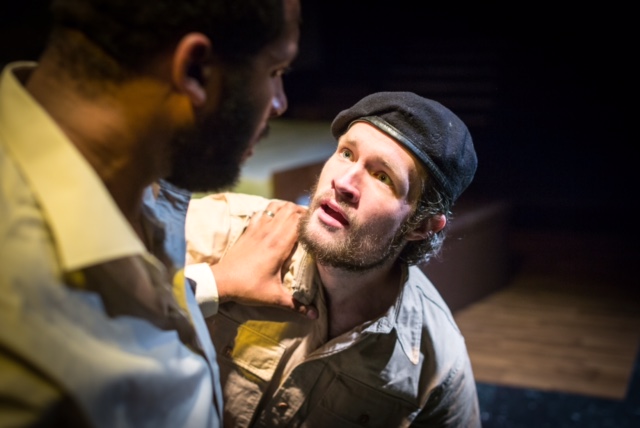
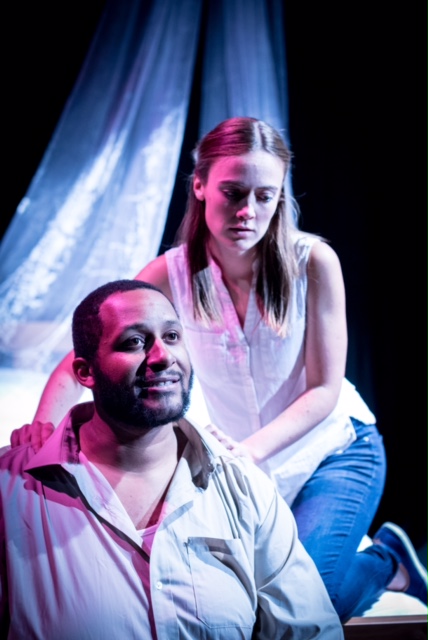
No such assistance from nature inside the Rosemary Branch, where Godot’s Watch’s production of Richard III runs until the 29th – but when it comes to creating atmosphere, no help is needed. This modern take on the murderous rise to power of Richard, Duke of Gloucester is a taut, gripping thriller that looks amazing and breathes new life (not to mention sex appeal) into a 500-year-old story.

Photo credit: Caroline Galea

On an empty stage illuminated by coloured strip lights, the throne of England awaits… but to claim it, Richard must first dispose of both his brothers. This he manages with worrying ease, before turning his attention to his two young nephews. With the help of Buckingham, who’s won over by the false promise of wealth and titles, Richard finally becomes King – but how long can he hold on to the throne?

An excellent cast is led by Sam Coulson as the villainous Richard. No hunchbacks here – instead a blood-red birthmark stains one side of his face, foreshadowing the horrors ahead. This is a performance that walks the line between smoothly charming and violently unhinged; one minute he’s sweet-talking the grieving widow of one of his victims into marrying him, the next he’s roaring with crazed delight over the success of his evil schemes. And throughout, he takes the audience regularly into his confidence, making us complicit in his crimes as he bumps off victim after victim.

The inclusion of Elena Clements as Richard’s co-conspirator Buckingham brings a welcome shot of girl power to a play in which every other woman is forced into the role of victim, and I also really enjoyed the twist that turned Gloucester’s two killers into one conflicted soul; Michael Rivers brilliantly channels Gollum as he argues with himself over the rights and wrongs of proceeding with the murder.

Director Séan Aydon clearly isn’t afraid to take a few risks in modernising the story – the use of Siri to find a hitman willing to murder Richard’s nephews gets a lot of laughs, and there’s more than one reference to drug use in the royal court. Not historically accurate, maybe – but then as we’ve seen all too well in recent months, the storyline of a tyrant doing whatever it takes to claim power is one that works just as well in a modern context…
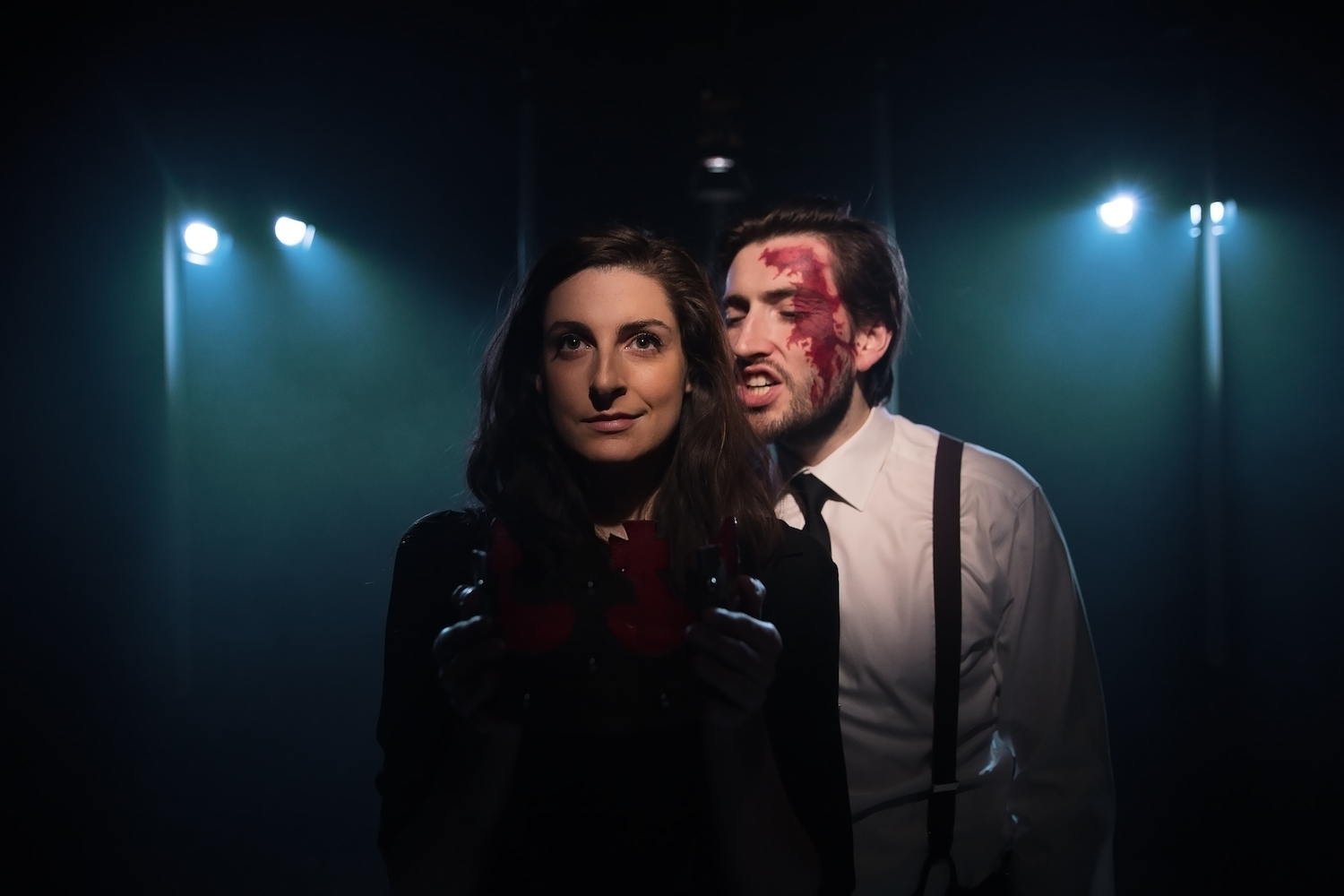
elena-clements-buckingham-sam-coulson-richard-caroline-galea

Another star of the show is the lighting design from Jack Channer, and sound from Daniel Harmer, which combine to create an atmosphere of drama and tension throughout. From Richard’s opening soliloquy, which plays out in semi-darkness like a scene from a black and white movie, to the harsh white flashes that accompany his victims’ deaths, it’s an ingeniously simple approach that shows you don’t always need fancy effects or a complicated set to make a powerful impact.

Godot’s Watch is a new company, and if this is what we get from their first production then it’s exciting news for theatre. Their Richard III is inventive, bold and utterly gripping (and don’t just take my word for it; my friend turned to me at the interval and said, “Why have I never seen this play before? It’s amazing!”) – I can’t wait to see more from them, and hopefully soon.


Can’t see the map on iPhone? Try turning your phone to landscape and that should sort it. I don’t know why but I’m working on it… 😉

Interview: John Risebero, Henry V

John Risebero is co-director and designer of award-winning theatre company Antic Disposition, along with co-founder and director Ben Horslen. Next month they’ll be reviving their acclaimed production of Henry V; previously performed in France, with two London runs and a 2016 national tour, the show is taking to the road once more, giving audiences another chance to see what British Theatre called “one of the most impressive revivals of a Shakespeare play that I have seen in recent years”.

Photo credit: Scott Rylander

Founded in 2005, Antic Disposition have become known for their innovative interpretations of classic texts, particularly the works of Shakespeare – and the timing of this particular production was no accident. John explains: “We’d wanted to stage Henry V for several years but because we always tour our Shakespeare plays in France, we could never see a way to do it without being insensitive to our French hosts. But then we realised that not only was 2015 the 600th anniversary of the Battle of Agincourt, it was also the centenary of the Great War, which gave us the opportunity to create a production that reflected on the change in the relationship between England and France in those five centuries – from mortal enemies to loyal allies. So our production is set in a military hospital in France, where wounded British and French soldiers work together to stage their own production of Henry V. It’s really a play within a play – Henry V meets Oh, What a Lovely War.

In addition to Shakespeare’s text, the play also includes original songs and live music inspired by the poetry of A E Housman. “We knew we wanted to include music in the show but using period songs seemed too obvious and we weren’t comfortable writing new ones,” says John. “Then we discovered George Butterworth’s musical setting of ‘The Lads in Their Hundreds’ from A Shropshire Lad and found that Housman had acknowledged he was inspired by Shakespeare. Although Housman’s work predates the Great War, so much of it reads like he knew what was coming. Our brilliant composer, Christopher Peake, set six more poems to original music for our show but we still use Butterworth’s version of ‘The Lads in Their Hundreds’ – it’s our tribute to him, as he died on the Somme in 1916.

“The music is completely integral. Soldiers have always used song to lift spirits or celebrate victory. As well as poetry, the Great War gave us so much music that’s still with us, songs like ‘Pack Up Your Troubles in Your Old Kit-bag’. In our production, we use music at key moments to bring the two sides together and remind the audience that war is a shared experience. It’s emotional shorthand.”

Photo credit: Scott Rylander

Although the play may be set in the past, John believes it still has a powerful message to share with a modern day audience: “Absolutely. War is a huge gamble, often taken too lightly. The French massively outnumbered the English at Agincourt but still lost the battle. In 1914, everyone thought the Great War would be over by Christmas, but it turned into one of the most destructive conflicts in history. It’s easy to open Pandora’s box, but the consequences can never be fully foreseen.”

Antic Disposition have also developed a reputation for staging productions in historic buildings and unusual non-theatre spaces, and this tour is no exception; Henry V will visit eight cathedrals around the UK, including Ripon, Lincoln, Peterborough, Ely, Norwich and Southwark. “We started out working in theatres but haven’t staged a play on a conventional stage for six years now,” John explains. “We find working in unusual buildings more exciting. There’s a special kind of magic when you are performing Henry V with the tomb of King John in the front row of the audience, as we did at Worcester Cathedral. It can be challenging from an acoustic perspective – many of our venues weren’t designed for this kind of performance, but we feel that those challenges are more than made up for by an atmosphere you can’t get in a regular auditorium.”

The 2017 tour of Henry V opens at Southwark Cathedral on 2nd February – and it’s not only audiences who are looking forward to its return. “We had a wonderful experience touring cathedrals last spring and wanted to bring the show to new venues and new audiences,” concludes John. “We think it’s the best work we’ve done as a company, and we’re very proud of it.”

Antic Disposition’s Henry V visits eight cathedrals around the UK from 2nd to 22nd February.

Review: The Mechanicals’ Twelfth Night at St Giles in the Fields

I last saw Scena Mundi Theatre Company performing Twelfth Night at the stunning French Protestant Church in Soho Square earlier this year. This week they were back, in an equally beautiful venue, with a one night only performance of the same play… but a very different adaptation.

Billed as ‘the new masters of concise classics’, the Scena Mundi Mechanicals specialise in short versions of Shakespeare’s plays, inspired by the memorable amateur actors of A Midsummer Night’s Dream. It’s an intriguing and clever concept, which makes Shakespeare’s work very accessible and adds an original twist to a play many of us will have seen a good few times before. As the four actors – Masters Phil, Jack, Ned and Martin – divide up the roles between them, the stage is set for chaos and comedy, featuring a bearded lady, a dodgy wig, floating hats, and of course yellow stockings.

Photo credit: Jim Templeton-Cross

Given the complex storyline of Twelfth Night, director Cecilia Dorland has done well to cut the script down to almost exactly an hour in a way that still makes sense, and leaves us with a whistle-stop tour of all the key points and characters (well, almost – we’re forced to lose Maria, with Sir Toby Belch taking her place as the architect of Malvolio’s downfall). The performance too, with all its swift costume and character changes, is very skilfully executed by the four-man cast of Pip Brignall, Jack Christie, Edward Fisher and Martin Prest, with nicely understated musical support from flautist Emma Hall.

In fact if anything it’s a bit too well executed – the Mechanicals concept is introduced at the beginning but then seems largely forgotten during the play itself, and though there’s the occasional missing prop or actor’s tantrum, the production on the whole is extremely polished. It feels odd to complain that the acting in a play is too good, but what makes the Midsummer Night’s Dream Mechanicals fun to watch is the fact that their performance is so shambolic, and there’s potential in Scena Mundi’s adaptation for even more well-intentioned mayhem. This band of Mechanicals never get their lines wrong, forget which part they’re playing, or stop the performance to explain to the audience what’s going on; the director never has to intervene, and aside from one brief exchange at the beginning of the show, nobody tries to play all the parts. None of which is a bad thing – it just feels like the framing concept could be further developed for maximum comedy value.

scena-mundi-mechanicals-twelfth-night-rehearsals-091
Photo credit: Jim Templeton-Cross

All that said, this is already a highly original and entertaining production of a classic play. As a bite-sized introduction to Twelfth Night, it’s perfect for newcomers to Shakespeare, who might find the usual two-and-a-half or even three-hour stretch a bit much to take. And let’s be honest, it’s always fun to watch good actors acting badly. This one-off performance was the first in a series of events at St Giles in the Fields to launch Scena Mundi’s 2017 season, and I look forward to seeing more of them in the coming months.


Can’t see the map on iPhone? Try turning your phone to landscape and that should sort it. I don’t know why but I’m working on it… 😉

Review: Hamlet Part II at the Hen and Chickens

If you’ve ever wondered what happened next after the tragic conclusion of Shakespeare’s Hamlet (and let’s face it, who hasn’t?) an answer can be found in the snappily titled Hamlet Part II from the Theatre of Heaven & Hell, returning to the Hen and Chickens after an acclaimed run at this year’s Camden Fringe. Whether it’s the answer Shakespeare had in mind I’m not totally sure, but one thing is certain: it’s a lot of fun.

Fun? I hear you ask, and not without good reason. After all, most of us know how Hamlet (Part I) ends – bodies all over the stage and Denmark’s entire royal family wiped out in one bloody encounter. Making a comedy out of that scenario would take some doing, you could suggest. And yet when you stop and think about it, there actually is something slightly comical about a play in which every character gets wiped out; it’s so extreme that it almost crosses the line from tragedy to comedy.

image1

Writer Perry Pontac seizes upon this blurring of genres and runs with it, picking up not only on the excessive quantity of corpses but also the many other slightly ridiculous elements of Shakespeare that we all put up with because – well, it’s Shakespeare. The flowery language; the drawn-out death bed speeches; the Fool who talks complete nonsense; the soliloquies that none of the other characters ever hear, even though they’re standing two feet away… all make an appearance. The story’s also packed with references to Shakespeare’s other plays – some subtle, some not so much; you don’t have to be a major literature buff to find the humour in this very accessible show.

Part of Pontac’s ‘Codpieces’ trilogy, the story sees Seltazar (Darren Ruston) return home to Denmark, met by court librarian Fornia (Elena Clements) who reluctantly unfolds the recent tragic events; her list of the dead is so extensive she has to check them all off on a clipboard. Together, with a bit of ‘help’ from a passing Fool (Nicholas Bright), the two attempt to figure out who’s left to take over the throne – but just as they hit upon a solution, the rightful king (Brian Eastty) appears… and it’s not who you might expect.

All four cast members give it their all, though it’s Darren Ruston and Elena Clements who take centre stage as Seltazar and Fornia; their evolving love-hate relationship really is a hilarious joy to watch from beginning to end. And director Michael Ward finds opportunities for humour even when nobody’s saying a word; the opening moments are particularly enjoyable, and so totally unexpected it’s almost impossible not to laugh.

A common complaint about Hamlet is that it’s too long; there’s a lot of talking and not a lot of doing, and – let’s be honest – it’s not exactly the cheeriest of tales. No such problems with the sequel; at just 45 minutes, any hanging around is very much part of the joke, and unlike its predecessor, Pontac’s parody is genuinely a laugh a minute, whether you’re a Shakespeare fan or not. Though I can’t promise nobody dies in this one – it is still Hamlet, after all.


Can’t see the map on iPhone? Try turning your phone to landscape and that should sort it. I don’t know why but I’m working on it… 😉

Review: Othello at Upstairs at the Gatehouse

Othello forms part of the Arrows and Traps repertory season, alongside Twelfth Night (read more about that show, and the double bill as a whole, in my review). The two shows are both directed by Ross McGregor and performed by the same cast on the same set, but there the similarities end. While Twelfth Night is a riotous comedy full of romantic mischief, Othello is a dark, dramatic and gripping thriller, with a stunning climactic scene that I’d willingly watch over and over again.

In a modern day setting, army general Othello (Spencer Lee Osborne), known by most as the Moor, has married Desdemona (Pippa Caddick) against her father’s wishes. The couple’s happiness is set to be shortlived, however, thanks to the machinations of Othello’s ensign Iago (Pearce Sampson), who was recently passed over for promotion in favour of Cassio (Adam Elliott). In revenge, and with the unwitting help of his wife Emilia (Cornelia Baumann), Iago convinces Othello that Desdemona has been unfaithful with Cassio, setting in motion a dramatic and ultimately tragic chain of events.

Photo credit: The Ocular Creative

While Arrows and Traps have proved they can turn their hand to pretty much anything, it seems tragedy is where they really excel. Othello, like their recent blood-soaked Macbeth, is intense, powerful and utterly compelling from start to breathless finish. And as in Macbeth, the production draws on the talents of movement director Will Pinchin, particularly in the murder scene, a dream-like montage of music and movement that’s quite spine-tinglingly beautiful to watch.

Unlike Twelfth Night, which draws on the cast’s talents as an ensemble, this play primarily focuses on three central characters: Othello, Iago and Desdemona. As the duped Othello, Spencer Lee Osborne shows us the insecurity of a man who’s always been an outsider, and can’t quite believe his luck that the woman he loves should return his feelings. My problem with Shakespeare’s play has always been in believing that a loving husband could be so quickly persuaded of his wife’s betrayal – but this Othello, though powerful in stature, has an emotional fragility that makes him easy to manipulate, and his willingness to believe Iago’s lies becomes therefore much more convincing for the audience.

Pearce Sampson, fresh from playing Jesus in the Arrows’ last production, here skilfully turns his hand to an altogether different role as the villainous Iago, his twinkly northern charm disguising his evil intentions. This is a bad guy who gets – and deserves – no sympathy from us. On the other hand, we feel nothing but sympathy for Pippa Caddick’s Desdemona, a devoted wife and kind-hearted, loyal friend, with an independence of mind and playful, ever so slightly flirtatious nature that unknowingly hasten her downfall at Iago’s hands.

Photo credit: The Ocular Creative

The Gatehouse has a much larger stage area than many fringe theatres, and the production takes full advantage of the space, with actors appearing from all directions and even on the balcony above the stage. The set’s divided into three parts, which removes the need to break up the action with scene changes, but more importantly allows scenes to unfold simultaneously, heightening the drama and creating the familiar cinematic effect seen in previous Arrows productions.

Othello is a deliciously dark flip side to the madcap comedy of Twelfth Night, but it also stands alone as an intense and thrilling drama about human weakness. In addition, it makes a powerful statement about the way we treat those we see as different to ourselves, a topic that could hardly be more relevant at this moment in history. And it’s confirmed my view that Arrows and Traps are one of the best companies producing Shakespeare in London right now. Check them out if you can; you won’t regret it.


Can’t see the map on iPhone? Try turning your phone to landscape and that should sort it. I don’t know why but I’m working on it… 😉