Review: Poker Face at King’s Head Theatre

Legal Aliens are an international company, dedicated to telling European stories at a time when others might be tempted to shy away. The result of this determination is their Translating Europe series, which opens with the English premiere of Petr Kolečko’s Poker Face.

Translated by Eva Daníčková, the play tells the story of Jana (Lara Parmiani), a hugely successful international poker player, who in her youth may or may not have got pregnant by the writer, revolutionary, and later first president of the Czech Republic, Václav Havel. The resulting child was Pavlína (Daiva Dominyka), now a young woman and in a relationship with the idealistic Viktor (Mark Ota), who wants to start a revolution of his own, if only he had the funds…

Photo credit: John Watts

Considering the play was written by a Czech playwright, in Czech, (presumably) for a Czech audience, the story and its context are surprisingly easy to understand for British viewers. Although, inevitably, we may not catch every reference in Becka McFadden’s production, even someone with no knowledge at all of Czech history or politics – or poker, come to that – can make sense of what’s going on, and the family drama that unfolds between the characters could almost be happening anywhere.

At the centre of the story is Lara Parmiani’s Jana, whose poker face remains in place even away from the card table, in her troubled, brittle relationship with her daughter. Yet we also meet a younger, more emotional Jana, who longs for news from her absent father (Arnošt Goldflam, on screen) and looks forward excitedly to a meeting with her adored Havel. Lara Parmiani skilfully embodies both versions of the character, so that even as we dislike the woman she’s become, we can’t help but feel – if not sympathy, then at least understanding of the events that have brought her here.

Photo credit: John Watts

Pavlína, played by Daiva Dominyka, is the polar opposite of her cold-hearted mother; sensitive and romantic, she’s struggling to understand who she is and where she fits within her family and her society. As her boyfriend Viktor, Mark Ota probably has the closest to a comedy role within the play; a skilled speaker, he knows how to turn on the charm and deliver a good soundbite, and even his darker scenes are shot through with a surreal humour that’s as entertaining as it is slightly bewildering.

The use of video is effective, if occasionally a bit frustrating – this is particularly the case in the opening scene, when Arnošt Goldflam, the man we later learn to be Jana’s father, speaks at length in Czech. There are subtitles, but positioned as they are at the bottom of the screen, reading them involves a fair bit of neck craning for anyone not sitting in the centre of the front row. The later footage of Havel’s funeral works really well though, playing silently in the background and looming over the family’s dysfunctional attempt at a Christmas celebration.

Poker Face may be set in a foreign country, and it may make reference to events we’re not all that familiar with, but that doesn’t make it any less relatable. At a time when it’s becoming all too common to regard anyone not from our own country as inherently different, this play offers a timely reminder that while we may not speak the same language or share the same politics, at the end of the day we’re all human beings. And while that might not be an especially new or surprising message, it’s nonetheless one that – increasingly, it seems – needs repeating.


Can’t see the map on iPhone? Try turning your phone to landscape and that should sort it. I don’t know why but I’m working on it… 😉
Review: Can You Hear Me Running? at the Pleasance

I’m not a runner. I can walk all day if I have to, but the last time I ran anywhere, it took me about half an hour to get my breath back. And that was just legging it to the train. The idea of running a marathon is so alien to me that I can’t even begin to imagine the sense of achievement that comes with crossing that finish line after 26 gruelling miles.

So it was with a degree of fascination that I took myself off to see Can You Hear Me Running?, a one-woman show about running the London Marathon. Except Louise Breckon-Richards’ story is really about a lot more than that, and in fact running plays a far smaller, though no less significant, part in the play than I’d expected.

Photo credit: Graham Saville

In 2008, Louise, an actress and singer preparing to audition for a West End show, lost her voice. That’s probably something that’s happened to us all at some point, but in Louise’s case, the situation was far more serious than your average cold. Can You Hear Me Running?, written by Jo Harper, directed by Steve Grihault and performed by Louise herself, documents her journey as she consults a string of doctors and tries a variety of techniques in an attempt to regain her voice and singing career. It’s a journey with many ups and downs, and at her lowest point, Louise decides to focus her energy on a new goal – training for and completing the London Marathon.

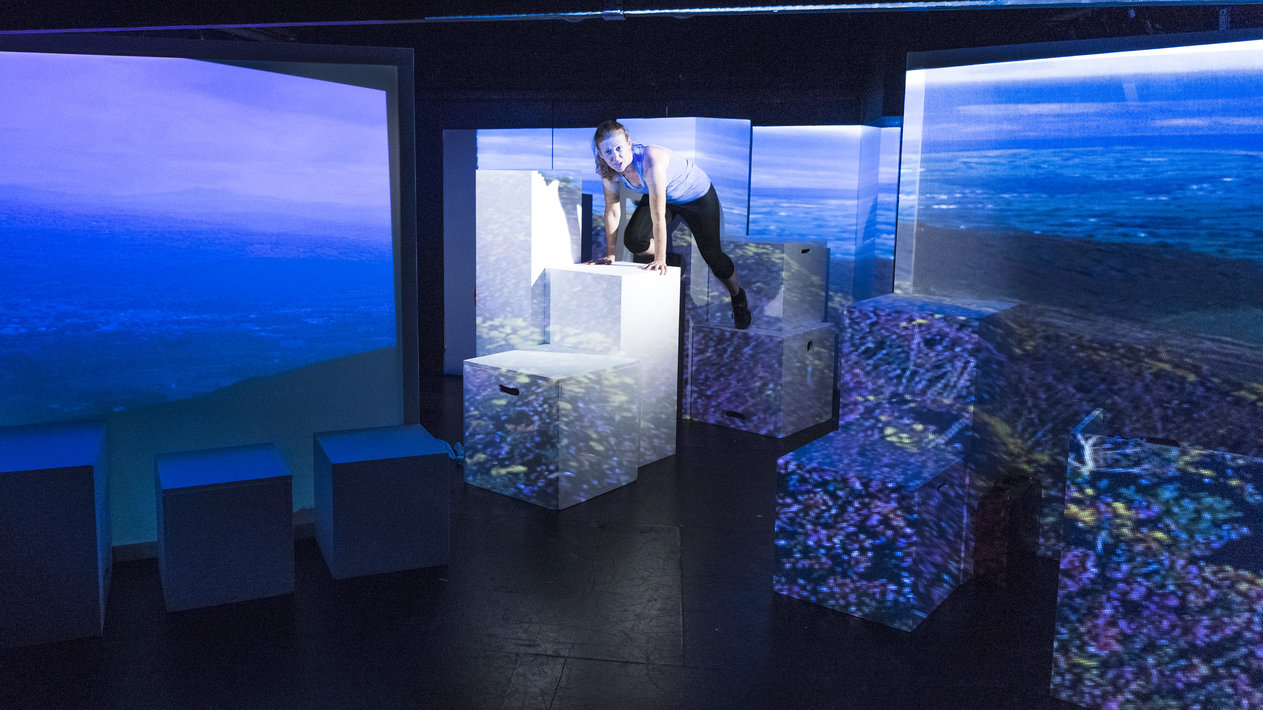
It’s a courageous, honest and very physical performance, with Louise clambering all over the boxy white set, while video screens show us footage of her out running in the open air, identify key figures in the story, and at one point give us a rather too graphic look down her throat. Her determined positivity in the face of devastating loss is inspiring, and the moments of unexpected humour lying in wait throughout Jo Harper’s script help to take the edge off what could have been a very dark tale.

Though she’s the only actor on stage, Louise’s story features a number of characters, from the specialist who operates on her vocal folds to the girl in Starbucks who’s flummoxed by her silence. Proving the point made by one of her doctors that a person’s voice is their unique signature, Louise adopts multiple different accents and tones, so that each new arrival in the story has a distinct sound all their own.

Photo credit: Graham Saville

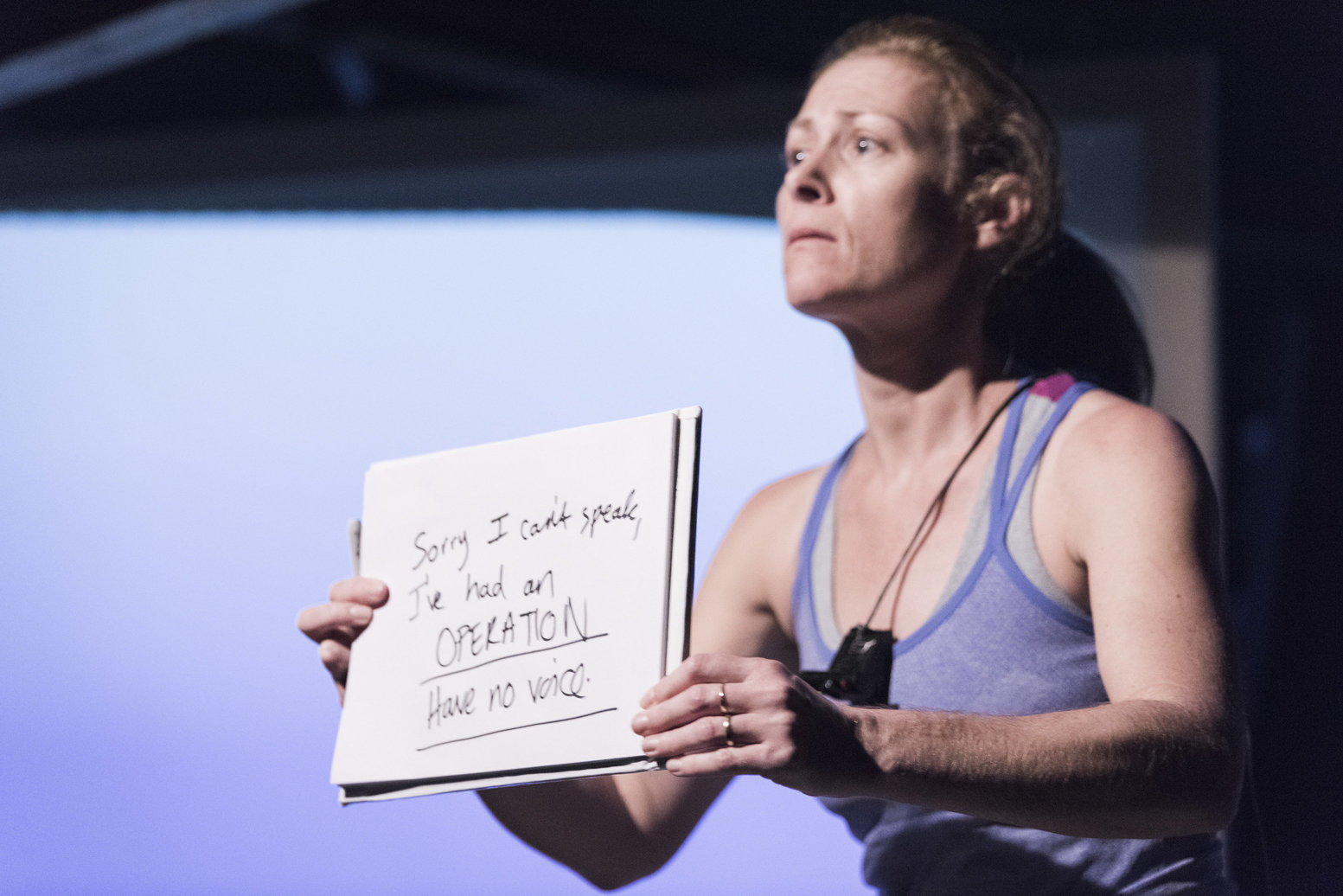
Pianist and musical supervisor Dan Glover provides recognisable snippets of hits from Louise’s upbeat running playlist – but he also has a greater role to play as a reminder of what she’s lost, and also the focus of her optimism. And just as music has an important part in the story, so too does silence. One of the most poignant scenes takes place during Louise’s recovery from surgery, when she has no choice but to communicate in writing with her bewildered young sons.

Can You Hear Me Running? is an uplifting story about one woman’s refusal to give up, no matter what. It gives us the opportunity to pause and think about how easily we take our own voices – and the ability to communicate with loved ones, friends and colleagues – for granted. And its conclusion lifts the heart and makes us believe, however briefly, that anything’s possible. I was almost persuaded to give running a go…


Can’t see the map on iPhone? Try turning your phone to landscape and that should sort it. I don’t know why but I’m working on it… 😉

Review: dreamplay at The Vaults

What did you dream about last night? I can’t be sure, although I have a feeling at one point I was teaching some American children how to do the can-can. This is pretty standard; my dreams hardly ever make any sense, if I remember them at all. But what does tend to stay with me is how they make me feel – sometimes happy and relaxed, occasionally relieved, other times tense and panicky. (I once had a dream I was on the run, and spent the entire following day feeling uneasy and looking over my shoulder, without really knowing why.)

Anyone seeking a linear or even logical narrative in BAZ Productions’ dreamplay, based on August Strindberg’s 1901 play, will inevitably leave feeling disappointed; each time we come close to understanding what’s going on, the play veers off in an unexpected direction and brings us back to square one. And yet there’s no denying that the scenes we witness – as disjointed and downright odd as they undoubtedly are – evoke some pretty powerful emotions. Some are funny, others sad, others a bit scary (nothing quite like being suddenly plunged into darkness to get the heart racing). And I’m willing to bet if you asked the audience on the way out which moment in particular spoke to them, there’d be a lot of different answers.

Photo credit: Cesare De Giglio
At this point in a review I’d usually include a plot summary, but as we’ve already established, that’s not really relevant in this case. That said, there is the hint of a story running through the scenes: a young woman, Agnes, comes to Earth to try and discover what makes human beings sad. It’s a quest that ends in disappointment, however, and Agnes finally leaves without the enlightenment she was hoping for.

The Vaults, beneath Waterloo Station, is an atmospheric and inspired choice of venue for director Sarah Bedi’s mysterious journey into the world of dreams. As we move from each space to the next, we’re plunged into a different world: a dimly lit auditorium; a modern bedroom; vast, echoing tunnels; even the open air. And while the promenade experience is an unusual and occasionally frustrating one – just as you’re getting comfortable, up you get and move on again – it also feels necessary to create that sensation of being in a dream, where your surroundings can and do change without warning. The only scene that didn’t really work for me was the last one; with the audience all on our feet and most of the action taking place on the floor, those of us in the back struggled to see what was happening.

The cast take on a variety of roles throughout the show. Colin Hurley is convincing as an audience member plucked from his seat; it’s simultaneously a disappointment and a relief when he’s revealed to be a plant. Jade Ogugua and Jack Wilkinson shine in perhaps the closest scene to “normality”, in which a recently married couple argue about their finances, while Michelle Luther is both entertaining and slightly terrifying as a performer controlled by the cello music to which she dances. That music is provided by alternative cellist, vocalist and singer-songwriter Laura Moody, in whose hands the cello becomes not just a musical instrument but almost human, capable of menace, joy, playfulness and despair.

Photo credit: Cesare De Giglio
From a traditional perspective, dreamplay doesn’t really make any sense. It’s a series of striking images and moments that, afterwards, we may struggle to connect. As someone who likes to leave the theatre understanding what I’ve just seen, I now find myself a little frustrated at my inability to pinpoint what this play was all about. Then again, I often feel that way about my dreams (I have no idea where teaching the can-can came from, for instance, and that bothers me) – so in that respect, dreamplay is right on the money.


Can’t see the map on iPhone? Try turning your phone to landscape and that should sort it. I don’t know why but I’m working on it… 😉

Review: Rehearsal for Murder at the Orchard Theatre

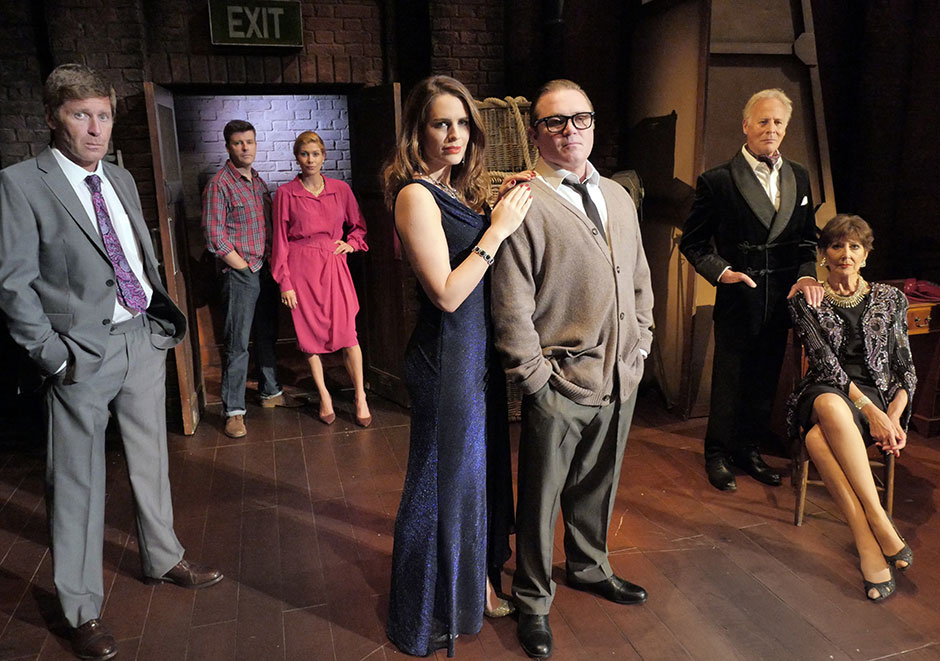
After ten years producing classic thrillers from the pen of Agatha Christie, Bill Kenwright has taken a (slightly) new direction. Rehearsal for Murder is the first production from The Classic Thriller Theatre Company; written by Murder She Wrote’s Richard Levinson and William Link, and adapted for the stage by David Rogers, there’s nonetheless a distinctly Christie-esque quality to this story of love, murder and revenge.

rehearsal-for-murder-grimsby-auditorium

Playwright Alex Dennison (Alex Ferns) has started work on a new script, and gathers together his old cast, director and producer for a rehearsal. Not by coincidence, this reunion happens to take place exactly one year after Alex’s fiancée, the beautiful movie star Monica Welles (Susie Amy), fell to her death in an apparent suicide. And it soon becomes clear to the assembled group that Alex has a very specific reason for bringing them all back together; despite all the evidence to the contrary, he believes Monica was murdered – but by who…?

There’s a defined formula to this kind of mystery: a cast of suspects, each with a clear – if not always entirely imaginative – motive for the crime; a suitably spooky location (this particular story takes place in an empty theatre) from which nobody’s easily able to escape; a few red herrings; and, of course, a twist in the tale before the murderer is finally revealed. It’s also not uncommon for the first act to involve a lot of talking and not much in the way of action, as motives are established and clues worked in so as to give the audience a fighting chance of figuring out the mystery. Rehearsal for Murder is no exception. After a relatively slow start, the action kicks off in dramatic fashion in Act 2, culminating in an unexpected turn of events which, like all good twists, is only predictable with the benefit of hindsight.

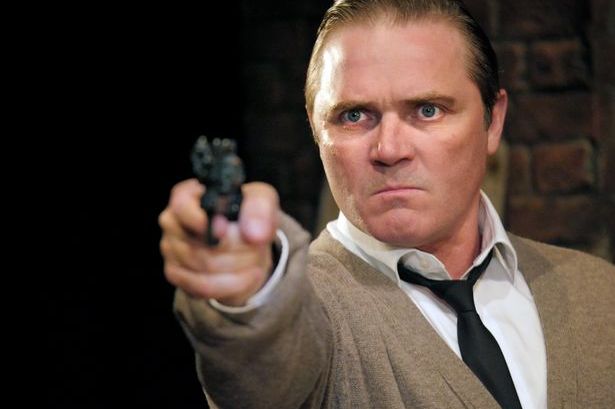
Ex-Eastenders villain Alex Ferns is the heartbroken playwright; although clearly slightly unhinged, his desperation to solve the mystery of his fiancée’s death is heartfelt and it’s hard not to cheer him on in his pursuit of justice, even when he starts waving a gun about (because of course, there had to be a gun). Ferns is joined by a cast of familiar faces from TV and film, including Peak Practice actor Gary Mavers, Carry On star Anita Harris, and veteran of the Agatha Christie Theatre Company, Ben Nealon, as a variety of theatrical ‘types’ – each of them with something to hide.

rehearsal-for-murder

Rehearsal for Murder is at once comfortingly familiar and yet still original enough to surprise, with a liberal sprinkling of theatre-related humour, thanks to the choice of setting. At times the pace is a little more gentle than it needs to be, and the story does sometimes feel a bit thin – but that comes with the territory, like the way everyone knows Hercule Poirot’s a famous detective, yet they always choose to commit murder when he happens to be visiting, then seem surprised when he solves the crime. Formulaic it may be, but fans of classic murder mystery won’t be disappointed in this enjoyable and cleverly staged thriller.

Rehearsal for Murder is at the Orchard Theatre until 24th September.

Review: Torn Apart (Dissolution) at Theatre N16

Torn Apart (Dissolution), written and directed by Bj McNeill, is an intense and compelling drama about three couples. Though their stories take place years and miles apart, there’s a common theme of love and loss – not only of partners but of family, home and history – as well as an actual connection between the three that’s revealed a little at a time, with the final piece falling into place just moments before the end.

In 1980s West Germany, young Polish student Alina (Nastazja Somers) falls for an American soldier (Simon Donohue), even though she knows that sooner or later he’ll have to follow his duty and leave her behind. In 1999, Elliott (Elliott Rogers), a chef from London, and Casey (Christina Baston), a backpacker from Melbourne, try to come to terms with the fact their relationship has an expiry date dictated by the Home Office. And in present day Britain, Holly (Sarah Hastings) finally plucks up the courage to leave her perfect husband for Erika (Monty Leigh), but their new-found happiness is threatened by devastating news.

dsc_9462
Photo credit: Yuebi Yang

Szymon Ruszczewski’s set is visually striking: the stage, at the centre of which is a double bed, is enclosed within a large cage made of string. This creates a space that is at once intimate and claustrophobic – inside it the lovers make plans, laugh, dance, argue, have sex, and share the complex family histories that ultimately bind them together. At times they play with and caress the strings that surround them, while at others they reach out through them in a desperate attempt to be free.

The play holds nothing back, in emotional or physical terms, and the audience is placed in the sometimes quite uncomfortable position of the voyeur, watching a series of deeply private encounters unfold. This effect is heightened by the absence of a curtain call; as we leave the theatre, two of the actors remain on stage in a final embrace, seemingly unaware that we’ve ever been there (similarly, the action is already underway as we enter, with the same two actors enjoying a night of passion that leaves little to the imagination).

The play is gripping throughout, with some powerful performances from its excellent cast. Elliott Rogers and Monty Leigh are particularly impressive as two of the most damaged characters, Elliott and Erika, who simultaneously can’t believe their luck and are terrified of losing the person they love to forces beyond their control. It’s only at the end that the play seems to suddenly run out of energy. A crucial closing scene is unnecessarily repetitive and takes rather too long to make its point, which means we lose momentum in the run-up to the big final revelation, and it doesn’t have quite the dramatic impact that it should.

dsc_97671
Photo credit: Yuebi Yang

Torn Apart (Dissolution) is a love story, but not in the traditional sense; nobody’s riding off into the sunset in this tale. It makes us pause and consider what love means to us – is it something to be desired, or feared? And yet, surprisingly, this is not as bleak a story as it might sound. Each of the characters gains something from their relationship, even if it’s just the memory of what it feels like to be loved, perhaps for the first time in their life. So while it’s not a happy ending, it’s not without an element of hope as well.

Full of drama, passion and emotion, Torn Apart is a heartfelt and ambitious play that speaks to us all in some way. If it could maintain its pace and energy right to the end, there’s a powerful piece of theatre here.

Torn Apart (Dissolution) is at Theatre N16 until 30th September.


Can’t see the map on iPhone? Try turning your phone to landscape and that should sort it. I don’t know why but I’m working on it… 😉