Review: Conquest at The Vaults

One of the interesting things about the #metoo movement that’s been sweeping social media since the Harvey Weinstein revelations is how it’s been just as much of a wake up call for women as it has for men. And not only in terms of realising the scale of the issue; many women will have spent time over the last few months re-evaluating incidents from our own lives that we might have previously played down, tried to justify to ourselves, or never even thought of as unwanted physical contact.

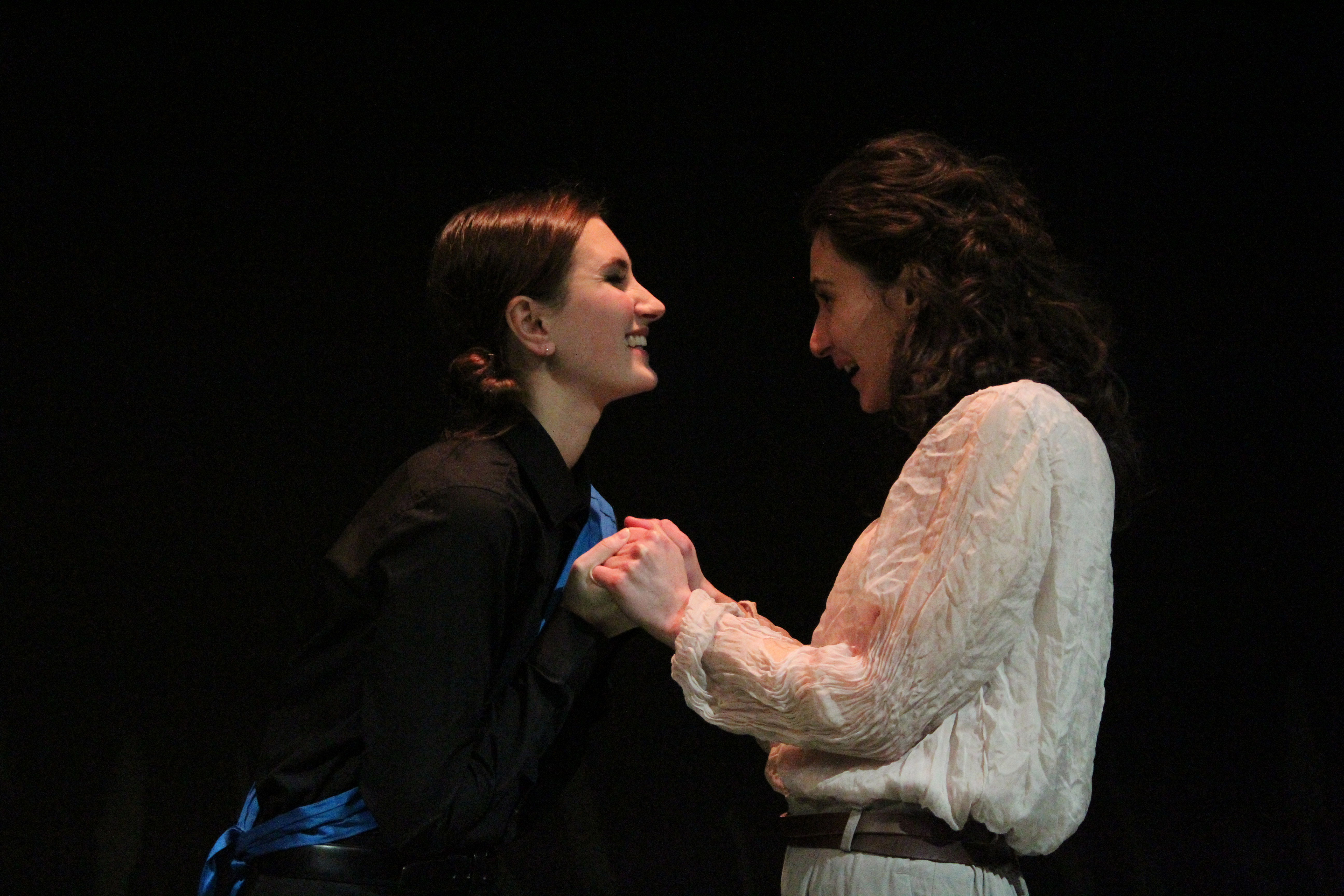
Alice’s #metoo moment happens in Boots, as she’s buying the morning after pill following a one night stand that on reflection, she’s not at all sure she wanted to happen but was basically too polite to put a stop to. As fate would have it, she bumps into Jo, a perfect stranger and committed feminist, who’s irritated by what she sees as Alice’s weakness (she cries a lot, apparently) but also spies an opportunity to recruit a new member for her feminist revenge group, Conquest.

Conquest’s mission is simple: to take revenge on men who’ve shown they don’t understand that no means no. They do this via the inventive medium of cupcakes – with one very unique ingredient. (I won’t go into detail, but let’s just say I went in half hoping we might get cupcakes as part of the show, and left very glad that we didn’t.) Whether this approach actually achieves anything is unclear, however, and when Alice freaks out on her first cupcake delivery run, it all begins to unravel.

Written by Katie Caden and directed by Jess Daniels, this funny and thought-provoking debut from PearShaped Theatre is brought to life by Lucy Walker-Evans and Colette Eaton, in a fast-paced performance that never flags in energy (their breaking and entering exploits are particularly fun to watch). Along the way, they take on a variety of characters, among them Jo’s chain-smoking mum Angela – also a feminist, but of the old-school variety – and Alice’s nonplussed, boxers-clad revenge target, Dave. This multi-roling approach is acknowledged early on in one of many direct addresses to the audience, but a warning that we might get confused proves unfounded; the characterisation of each is distinct, and smoothly handled by both performers as they scurry from chair to chair, adopting different postures and accents as they go.

In the end, though, this is Alice and Jo’s story; a story of two very different women drawn together by their need for solutions to a problem so massive that it’s impossible to even fully get your head around, let alone know where to start in fixing it. (Which raises the question: why should it be the responsibility of women to fix it anyway?) What makes the two unlikely friends so appealing to watch, besides their constant amicable bickering, is that there’s far more to both of them than their initial stereotyping would suggest. And while all their plans seem to end in disaster, at least they’re doing something.

At a time when sexual consent is high on many agendas, Conquest is a timely and important piece of work, which exposes the complexity of the issue in a way that speaks to both male and female audiences. And if it makes you think twice the next time someone offers you a cupcake – well, that’s probably a small price to pay.

Conquest‘s run at Vault Festival 2018 is now over – but keep an eye on @pearshapedplays for future news.

Can’t see the map on iPhone? Try turning your phone to landscape and that should sort it. I don’t know why but I’m working on it… 😉
Review: The Quantum Physics of My Heart at The Vaults

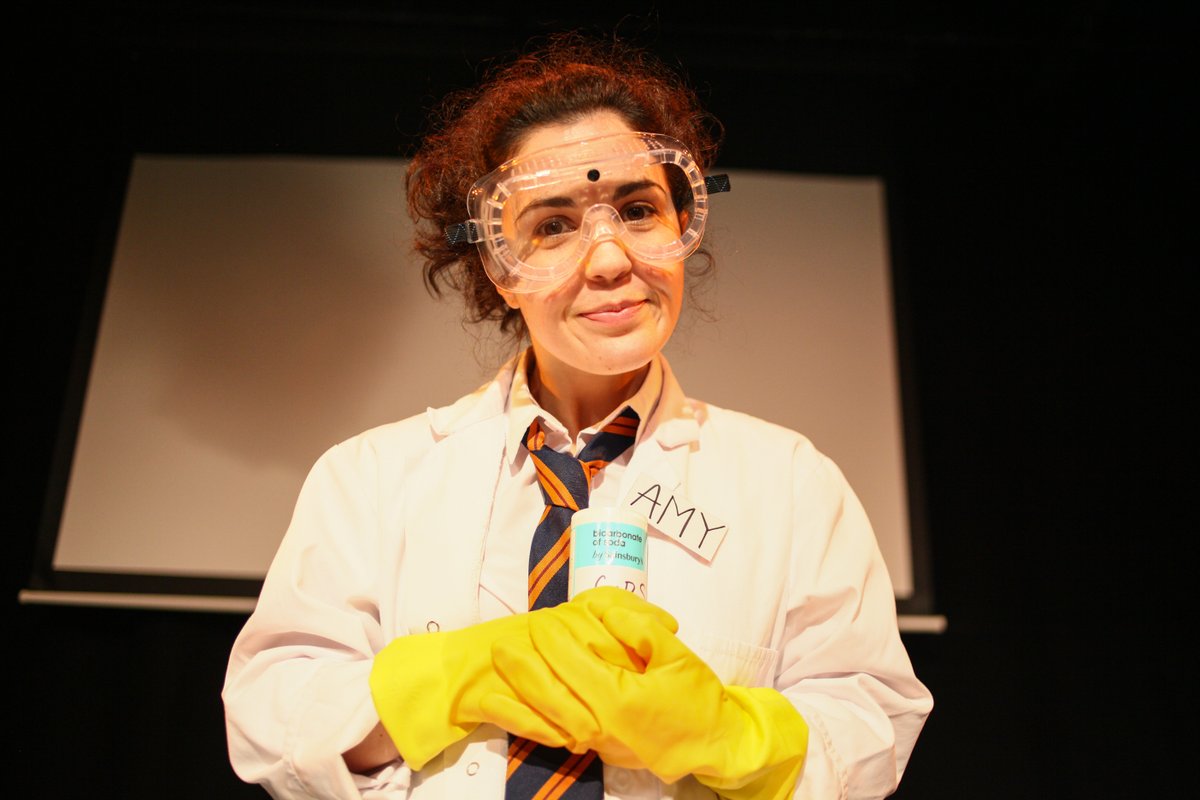
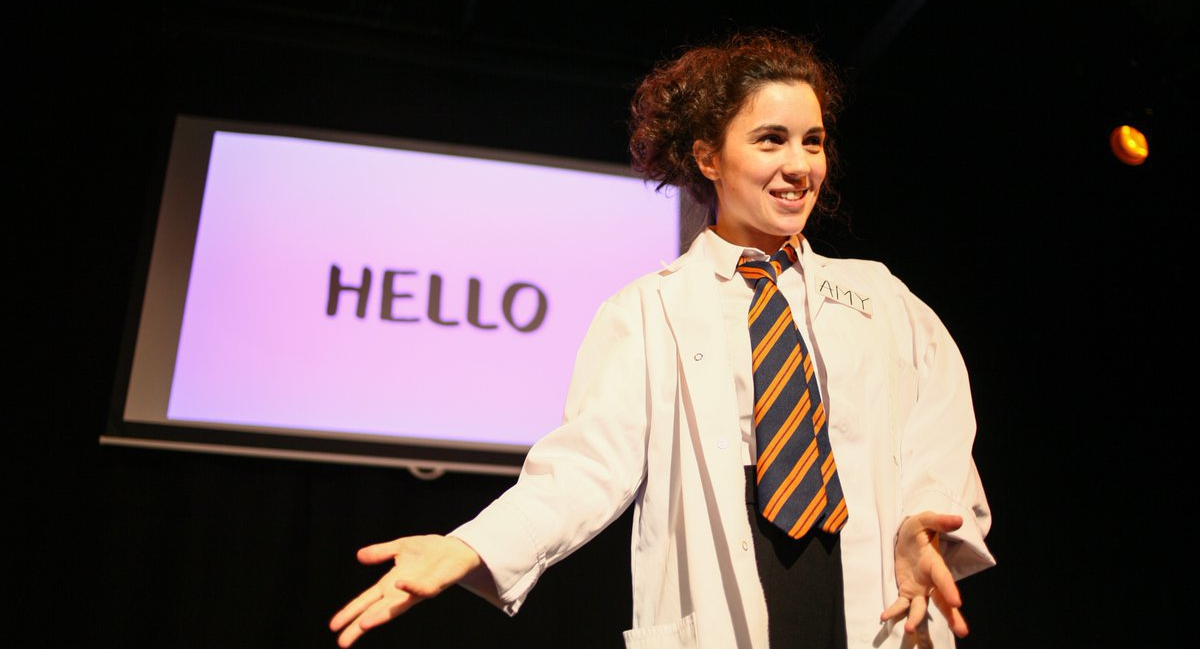
Writer and performer Amy Tobias introduces The Quantum Physics of My Heart as a lecture about science, which will combine anecdotes from her life, audience participation and experiments. I won’t lie – as someone who didn’t particularly love science at school, and who’s definitely not a fan of audience participation, this formula presented me with mild cause for concern – particularly having innocently taken a seat in the front row (seriously, when will I learn?). But then something unexpected happened: in a pleasantly surprising chemical reaction, everything came together to produce a show that’s funny, endearing and even a bit educational.

Photo credit: Mann Bros Media

The magic ingredient, I suspect, is Amy Tobias herself. Taking full advantage of the fact that – as she herself admits – a lot of people think she’s still a child (even though she’s not), she plays her teenage self with twinkly enthusiasm, unflinching honesty and a self-deprecating humour that proves very difficult to resist. Over the course of an hour, to a soundtrack of 90s hits and video clips from classics like Clueless and Jurassic Park, she reflects on her life between the ages of 13 and 16, including teenage crushes, her first house party, and an inappropriately placed hand on her 16-year-old knee.

The aim of all this is to try and prove the hypothesis that science can be used to explain everything. Following in her scientist dad’s footsteps, Amy loves the subject, and throughout the show manages to successfully bend various theories to make sense of life’s Big Questions – or at least what pass for Big Questions when you’re a teenager: things like why your BFF doesn’t want to be friends any more, or why last week you fancied your science teacher, and now you’re more interested in the ICT technician. But eventually she encounters a problem that can’t be explained away so easily – the aforementioned inappropriate hand – and is forced to look elsewhere for answers.

Photo credit: Mann Bros Media

Directed by Roxy Cook, the action is indeed framed very much as a (slightly unconventional) lecture, with audio and visual aids on a projector screen to help illustrate the show’s anecdotes and theories. Meanwhile down on the ground, Amy bounces around the stage in her school uniform and a lab coat, vividly recreating events so that we’re totally drawn into her story and come to really care about what happens to her.

As for the audience participation, it’s all very harmless, mostly consisting of us all delving frequently into our “experiment bags” and producing 90s-themed props (some of the edible kind). The role each of these plays in Amy’s experiments is tenuous at best, but their inclusion brings the show to life in a fun, nostalgic way. And for those of us who also grew up in the 90s or 00s, it’s a great opportunity to reflect on our own teenage years and the important moments – and music – that made us who we are today. I only wish all my science lessons at school had been this much fun.

Can’t see the map on iPhone? Try turning your phone to landscape and that should sort it. I don’t know why but I’m working on it… 😉
Review: Foul Pages at The Hope Theatre

To quote the timeless classic Shakespeare in Love (not sarcasm, I love that movie): “Love, and a bit with a dog – that’s what they want.” Robin Hooper clearly subscribes to the same belief; his play Foul Pages has both – and Shakespeare too, though in this case it’s not him who’s in love but pretty much everyone else. Will, meanwhile, is more interested in refining his latest work, As You Like It, whilst fending off interference from the Countess of Pembroke, a fellow writer full of helpful suggestions, and from King James I, who’s become infatuated with one of the actors and insists that he be given the lead role. The purpose of the production is to charm the monarch into pardoning Sir Walter Raleigh, who’s days from execution for treason – but pleasing the king comes at a cost for more than one member of the company.

Oh, and there’s also a talking dog.

Photo credit: LHPhotoshots

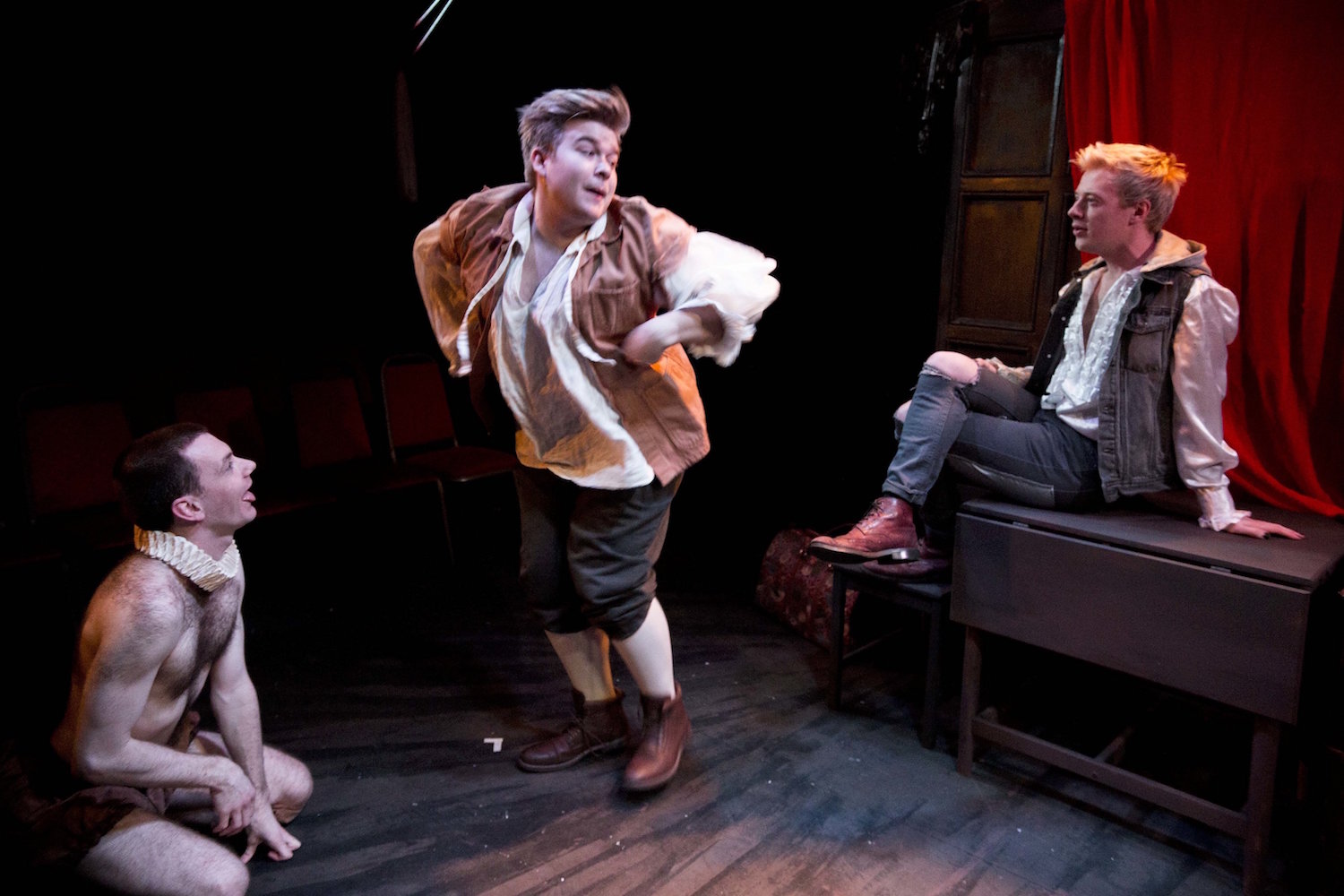
Ian Hallard appears as Shakespeare, but such are the scandalous goings on that for once the legendary playwright isn’t the centre of attention. As his all-male company is torn apart by jealousy, ambition and more than a little sexual tension, all Will can do is watch in bemusement and do his best to hold everything together, along with straight-talking maid Peg (Olivia Onyehara) and the king’s devoted Scottish bodyguard Mears (Jack Harding).

Meanwhile it’s the more flamboyant characters – Lewis Chandler’s shunned actor Alex, Clare Bloomer’s eccentric Mary, Countess of Pembroke, and Tom Vanson’s lovelorn King James – who take centre stage, each driven by their own desires to take potentially catastrophic actions. There’s poignant work from Thomas Bird and Greg Baxter as actors Rob and Ed (also Shakespeare’s brother), whose fledgling relationship is threatened by the king’s interference. And then there’s Chop the dog, played to scene-stealing perfection by James King, who’s not only got all the animal behaviours down but also gets the most laughs, with wry observations on the bizarre human behaviour going on around him.

Photo credit: LHPhotoshots

Though the action is set in 1603, director Matthew Parker gives the production a modern twist; the costumes are an intriguing mix of 17th and 21st century, and rapid scene changes are punctuated by loud music and flashing lights, creating a sense of urgency as the stakes become ever higher and events take an unexpectedly tragic turn. Rachael Ryan’s economical set allows us a glimpse of goings on both upstairs and downstairs at Wilton, while still somehow allowing enough room on the tiny Hope stage for nine people to come out and treat us to an energetic jig at the end of the show.

There’s a political detour in the plot that doesn’t quite fit – it arrives out of nowhere and is just as quickly dealt with and forgotten – but that aside, Foul Pages is a compelling and irresistibly entertaining tale of love, lust and theatrical ambition that may just make you see As You Like It, and Shakespeare himself, in a whole new light.

Can’t see the map on iPhone? Try turning your phone to landscape and that should sort it. I don’t know why but I’m working on it… 😉

Review: What Goes On In Front Of Closed Doors at the King’s Head Theatre

Ask pretty much anyone, and if we’re really honest we’ll probably admit to some preconceived ideas about the causes of homelessness. We might mention drugs, alcohol, mental illness, criminal records, domestic abuse… All problems we don’t – and assume never will – face ourselves.

It’s not entirely our fault; the media plays a significant role in shaping society’s view of homelessness, and the more horrors someone has been through on the way to losing their home, the more sympathetic – and therefore interesting – their story. But it also places the homeless at even more of a distance from those of us lucky enough to have a roof over our heads and a nice warm bed to go home to. We may shake our heads at the sadness of the story; we may even buy someone a coffee or make a donation to a homelessness charity – but then we go on our way, safe in the knowledge theirs isn’t a problem we’ll ever face ourselves.

Photo credit: Caz Dyer

The truth is, though, homelessness isn’t necessarily the result of a dramatic crisis; sometimes it’s simply the product of a wrong move here or there. Molly, the central character in What Goes On In Front Of Closed Doors, doesn’t quite know how she ended up homeless; she didn’t even fully register that she was for a good two weeks after being evicted. Maybe it’s because she was bullied at school. Or because she didn’t go out with that guy from her class. Maybe because her dad left, or her mum died, or she decided not to go to uni. Maybe it’s because of a combination of these, or something else entirely.

Molly’s played by Emma Bentley, who wrote the show along with Calum Finlay, and whose engaging performance quickly wins us over as she attempts to make sense of where she went wrong. Articulate, funny and resilient, Molly’s completely honest about her own lapses of judgment and the slow disintegration of her life – even before she ends up on the street in a thunderstorm, messaging a random guy on Tinder just to have somewhere to stay the night. While not solely a victim of circumstance, she also doesn’t do anything obviously wrong; she’s not a drug addict, or a criminal – she’s just like anyone else, and this relatability is both enjoyable and rather unsettling.

The Tinder scene is just one reference to technology in a show that makes frequent use of it. Images from Molly’s phone are projected on to a sheet at the back of Rasa Selemonavičiūtė’s set, and there’s inventive use made of a webcam to take us on a tour of the home that exists now only as a memory. Katharina Reinthaller’s production also introduces several other characters to the story through the use of audio clips, with which Molly interacts throughout the play. It’s an ambitious project, and not without an element of risk, but it pays off; the inclusion of these extra characters helps to build up a more complete picture of Molly’s life and relationships, and also emphasises her loneliness once all those voices fall silent.

Photo credit: Caz Dyer

Developed with the benefit of Emma Bentley’s volunteering experience at St Mungo’s, the play also has a feeling of authenticity, particularly when Molly starts sharing details about her current state of “purgatory”, as she waits to find out if she’ll get permanent housing or end up back on the street. In a series of short scenes, we also learn about the lengthy, repetitive bureaucratic process she had to go through just to get temporary accommodation. With her fate out of her hands, all she can do is wait and hope for the best.

What Goes On In Front Of Closed Doors clearly aims to make us think, but resists the temptation to preach or tell us what to do. Instead, by sharing one person’s story, the show invites us to process for ourselves the uncomfortable home truth at its heart: but for a different decision somewhere along the road, Molly could have been – and could still be – any one of us.

Review: The Tempest at Brockley Jack Theatre

Controlled Chaos Theatre Company aims to promote diversity in the theatre, “including giving women a chance to take centre stage in the male dominated classics”. And they don’t come much more male dominated than The Tempest, a play in which the sole female character does exactly what she’s told by her father, then falls instantly in love with the third man she’s ever seen. Controlled Chaos aren’t the first company to turn that gender imbalance on its head with an all-female production; the Donmar did it last year, setting the action in a women’s prison, and a gender-reversed production at the Brockley Jack in 2005 saw all the male roles not only played by women but actually converted to female characters.

Photo credit: Kevin Kamara

This production keeps things much simpler: the characters are still male, and there’s no framing device; the only difference is all the parts are played by women. As in any gender-blind production, it’s a welcome sight to see female actors getting a chance to take on the meatier roles that Shakespeare never thought to grant them. That said, without any context it’s not always exactly clear what purpose the all-female concept is serving, and somewhat tentative performances from some of the cast dilute the powerful statement that could have been made by placing women in these positions of authority.

However, there’s still plenty to smile about in this version of Shakespeare’s tale of revenge, romance and magic on a deserted island. After a fierce storm shipwrecks the King of Naples and his entourage, they discover the island where they’ve landed is home not only to mischievous spirits, but also to the ousted and vengeful Duke of Milan, Prospero, his daughter Miranda and his slave Caliban. As Caliban conspires with drunken newcomers Trinculo and Stephano to kill his master, Miranda meets and falls for the king’s son Ferdinand, who’s become separated from his father and the rest of their party. And while all this is going on, elsewhere on the island Prospero’s brother Antonio plots to murder the king and put his dim-witted brother Sebastian on the throne.

Photo credit: Kevin Kamara

Dylan Lincoln’s production includes live music played and sung by the cast, to produce an atmosphere of magic and mystery, and also engages particularly well with the humour in the story. Carmella Brown’s Ariel is a delight throughout, skipping around the stage doing Prospero’s bidding with a mischievous twinkle in her eye. Michelle Pittoni also stands out as Miranda, her comical wide-eyed wonder at meeting a handsome young man replaced later by horrified embarrassment as her father lectures Ferdinand about his intentions. Shereener Browne and Afsana Sayyed are good fun as Antonio and Sebastian, whispering childishly together behind the king’s back before making a hilariously clumsy attempt on his life, and Ceri Ashe and Kimberley Capero make quite the raucous double act as Stephano and Trinculo.

At just over two hours, this is an accessible and entertaining adaptation of The Tempest, a perfect introduction for those unfamiliar with the story. As to whether the show delivers on its promise of a “bold re-imagining”, I’m not sure – but there’s plenty to enjoy either way, and any production that promotes diversity on the stage deserves to be celebrated.


Can’t see the map on iPhone? Try turning your phone to landscape and that should sort it. I don’t know why but I’m working on it… 😉